Being served with a lawsuit can feel overwhelming. The papers may be long. The legal terms may be unfamiliar. The deadline may already be running.
Your first job is not to prove your whole case. Your first job is to understand what you received and act before the deadline. A safe plan to respond to a civil complaint begins with the summons and service date. In many ordinary California civil cases, a defendant must file a written response within 30 days after service. California’s summons statute requires that warning on the summons. Different rules can apply based on the case type and the way service happened.
This guide explains how to respond to a civil complaint in an ordinary California Superior Court case. It does not cover small claims, eviction, family, probate, bankruptcy, or federal court cases. Those proceedings use different forms and deadlines.
This article provides general legal information. It does not give legal advice about your facts. If the case involves a large claim, insurance coverage, a business entity, disputed service, or a possible cross-claim, speak with a California lawyer promptly.
Confirm What Kind of Case You Received
Before you respond to a civil complaint, identify the court and case type. Do not choose a form from the word “complaint” alone.
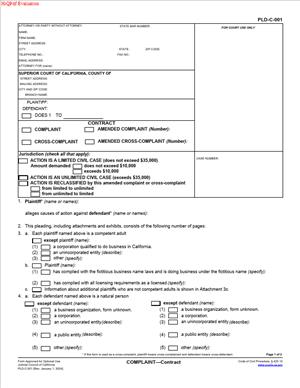
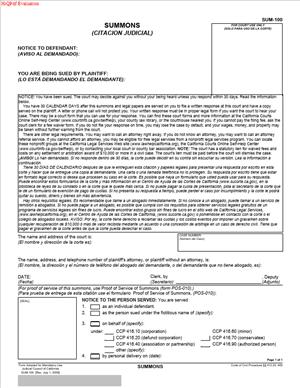
Look at the first page of each document. An ordinary California civil case often includes a summons, commonly SUM-100, and a complaint. The summons states the court, parties, case number, and response warning. The complaint explains what the plaintiff claims and what relief the plaintiff wants.
Cases that use different procedures
Stop and confirm the rules if the papers concern:
- an unlawful detainer, which is an eviction case;
- small claims court;
- divorce, custody, parentage, or another family matter;
- probate or guardianship;
- bankruptcy or federal court;
- a restraining order; or
- an appeal or administrative case.
These matters may have much shorter deadlines or special response forms. Before you respond to a civil complaint, make sure the ordinary civil rules apply. A general civil answer may be wrong even if the packet contains a document called a complaint.
Read the full packet
To respond to a civil complaint accurately, review every page and envelope. Note:
- the exact plaintiff and defendant names;
- the court county, branch, and address;
- the case number;
- the complaint type;
- whether the complaint is verified under oath;
- the date and method of service;
- the plaintiff’s lawyer and service address;
- every attachment, exhibit, and local notice; and
- any hearing or case management date already listed.
Save the envelope and make a complete copy or scan. Do not write notes on the only clean copy. If several defendants are named, each defendant may need a separate response.
Your Deadline to Respond to a Civil Complaint
California Code of Civil Procedure section 412.20 says the summons directs a defendant to file a written response within 30 days after service. It also warns that the plaintiff may seek entry of default if the defendant does not respond.
Treat the deadline to respond to a civil complaint as urgent. Do not wait until day 30 to decide what to file.
Start with the service record
When preparing to respond to a civil complaint, write down when and how you received the papers. Personal service usually means someone handed them directly to you. Substituted service may involve leaving copies with another adult at a home, office, or qualifying mailing address and then mailing another copy.
Under Code of Civil Procedure section 415.20, substituted service is generally complete on the tenth day after mailing. That can change the date from which the response period runs. Service by publication, service outside California, waiver of service, and service on a business can raise other issues.
If you are unsure when service became complete, do not guess. Take the papers, envelope, and any proof of service to the court self-help center or a lawyer.
Count carefully
California Code of Civil Procedure sections 12 and 12a explain the basic counting rule. Exclude the first day and include the last. If the last day falls on a Saturday, Sunday, or qualifying judicial holiday, the period generally extends to the next non-holiday.
This simple rule does not resolve every service problem. Your deadline to respond to a civil complaint may also be affected by local filing cutoffs and electronic filing rules. Confirm the court’s current filing methods and hours.
If the deadline is close or may have passed
Act the same day if your time to respond to a civil complaint may have expired. Check the online case docket or call the clerk to learn whether a default has been entered. The clerk can give procedural information but cannot tell you which legal response to choose.
Ask the plaintiff’s lawyer whether the plaintiff will agree in writing to more time. Do not rely on a phone conversation or an unanswered request. An agreement does not protect you unless it is valid, clear, and accepted under the applicable rules.
You may still have options if the deadline passed, especially if no default has been entered. Those options depend on the docket and facts. Get legal help before filing a late answer or a motion.
First-Week Checklist After Service
The safest way to respond to a civil complaint is to organize the work by date.
| Time | Action | Why it matters |
|---|---|---|
| Day received | Save every page and record who delivered it, where, and when. | Service details affect the deadline and possible objections. |
| Within 24 hours | Read the summons, complaint, exhibits, and local notices. | You need the case type, court, parties, claims, and requested relief. |
| Within 2 days | Check insurance, contracts, and indemnity rights. | An insurer or another party may have notice duties or a defense obligation. |
| Within 3 days | Contact a lawyer, self-help center, or legal-aid provider. | Early review protects more options than last-day review. |
| Before drafting | Select the response and check whether a cross-complaint is needed. | The wrong filing can waive rights or fail to prevent default. |
| Several days early | Arrange service and filing, including any fee-waiver request. | Rejected filings and service errors need time to correct. |
Do not send a casual letter to the plaintiff and assume that it counts as a way to respond to a civil complaint. A settlement email, phone call, or payment proposal normally does not replace a filed court response.
Choose the Correct Way to Respond
An answer is common, but it is not the only possible response. Before you respond to a civil complaint, decide whether an answer, motion, demurrer, or another pleading fits the case.
Filing an answer
An answer is the most common way to respond to a civil complaint. It tells the court which allegations you admit, deny, or cannot confirm. It can also state affirmative defenses. An affirmative defense is a legal reason the plaintiff should not recover, even if some alleged facts are true.
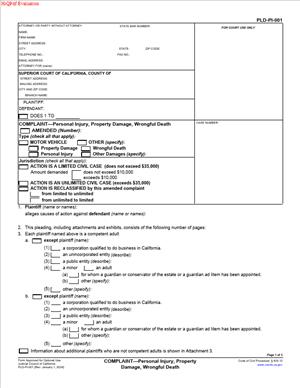
California provides different answer forms for different complaint types. The court’s self-help guide identifies PLD-C-010 for many contract complaints and PLD-PI-003 for personal injury, property damage, or wrongful death complaints. PLD-050 is a General Denial with specific limits printed on the form.
Do not use a general denial only because it is short. Check whether the complaint is verified and whether the form’s eligibility conditions apply.
Challenging the complaint before answering
Some defendants respond to a civil complaint with a demurrer, motion to strike, or motion to quash service. These filings are technical. They can involve notice, meet-and-confer duties, evidence, and separate deadlines. They may not address the facts in the same way as an answer.
A motion to quash may challenge the court’s power over the defendant based on service or jurisdiction. Taking other steps first can affect that objection. Get legal advice quickly if service or jurisdiction is disputed.
Negotiating without losing the deadline
You can discuss settlement while preparing to respond to a civil complaint. Do both tracks at once. Do not let informal talks consume the response period.
If the plaintiff offers an extension, get the exact terms in writing. Confirm the new date, the parties covered, and whether the plaintiff will refrain from seeking default. A lawyer should review the agreement when possible.
Which California Answer Form May Apply?
The complaint’s title and allegations guide which form you use to respond to a civil complaint. This table is a starting point, not a substitute for reviewing the current form and your case.
| Complaint or situation | Common Judicial Council form | Key caution |
|---|---|---|
| Contract claim | PLD-C-010, Answer—Contract | Read the verified-complaint instructions before using a general denial. |
| Personal injury, property damage, or wrongful death | PLD-PI-003, Answer—Personal Injury, Property Damage, Wrongful Death | Address the numbered allegations and applicable defenses carefully. |
| Eligible general denial | PLD-050, General Denial | Use only when the conditions printed on the current form are satisfied. |
| Eviction | UD-105 or another unlawful-detainer response | Eviction deadlines and procedures differ from ordinary civil cases. |
| Family case | Family-law response form | Do not use an ordinary civil answer. |
| Federal lawsuit | Federal pleading under federal and local rules | California Judicial Council answer forms generally do not control. |
The California Courts answer guide explains common form choices. Always download the current version from an official court source or confirm the form’s status before filing.
How to Prepare an Answer
If an answer is the correct way to respond to a civil complaint, use a clean copy of the proper form. Copy the case caption exactly. A small mismatch can place the filing in the wrong case or cause rejection.
Match the caption
Enter the court name, branch, plaintiff, defendant, and case number exactly as shown on the summons and complaint. Include your current contact information. If you want the court to use a safe mailing address, ask the clerk or a lawyer about available procedures before listing confidential information.
Address the allegations
Follow the answer form’s instructions. You may need to admit an allegation, deny it, or state that you lack enough information to admit or deny it. Do not write a long story where the form asks for a direct response.
Read every numbered paragraph in the complaint. Create a private checklist so none is missed. If an allegation contains several facts, it may need careful treatment.
Identify affirmative defenses
Affirmative defenses must have a good-faith basis. Possible defenses vary by claim. Examples may involve payment, release, expiration of a limitations period, lack of standing, failure to meet a condition, comparative fault, waiver, or other legal bars.
Do not copy a long list from the internet. Unsupported defenses can create confusion and may carry consequences. The California Courts list of civil defenses is an educational starting point, not a decision about which defenses fit your facts.
Decide whether you need a cross-complaint
A cross-complaint asks for relief against the plaintiff or another party. California’s compulsory cross-complaint rule can be important. Code of Civil Procedure section 426.30 says a defendant who answers may later be barred from asserting a related claim against the plaintiff if that claim was not included.
A related claim generally arises from the same transaction, event, or series of events. For example, a contractor sued over a project may believe the owner breached the same contract. A driver sued after a crash may believe another party caused part of the loss.
Cross-complaints involve strategic and service issues. Ask a lawyer to review possible claims before you respond to a civil complaint.
Review, sign, and copy
Check every page for:
- the correct case number and party names;
- a response to each required allegation;
- supported affirmative defenses;
- all attachments referenced in the answer;
- the requested relief;
- the date and signature; and
- enough copies for service, filing, and your records.
Do not attach evidence just because you have it. An answer is a pleading, not usually the place to submit the full trial record. Keep evidence organized for discovery, motions, settlement, and trial.
Serve the Answer Correctly
Preparing an answer is not the last step needed to respond to a civil complaint. You must also serve it as the rules require.
Use an eligible server
The defendant should not serve their own answer. For service by first-class mail, POS-030 states that the server must be over 18 and not a party to the action. The server mails the papers and completes the proof of service.
Serve the plaintiff’s lawyer if the plaintiff has one. If the plaintiff has no lawyer, serve the plaintiff at the proper address. Cases with several plaintiffs or parties may require service on more than one recipient.
Use the correct proof of service
POS-030 documents service by first-class mail in a civil case. POS-040 covers several civil service methods. The correct form depends on what was served and how.
Do not use POS-030 to prove service of the original summons and complaint. Its own information sheet says it is for later civil documents, such as an answer, when mail service is allowed.
How to Prepare and File a Personal Injury Complaint in California
Keep proof
Keep a copy of the signed proof of service and the exact answer that was sent. Save mailing records and electronic confirmation if applicable. A proof of service should state the real date, method, documents, recipient, and address.
File the Response With the Court
To respond to a civil complaint, file the response in the court listed on the summons. Serving the plaintiff without filing does not complete the response.
Check the county court’s website for accepted filing methods. Depending on the court and case, filing may occur in person, by mail, through a drop box, or electronically. Local rules and electronic filing requirements can differ.
Plan for the filing fee
The court may charge a first-appearance fee. Verify the current amount with the court; do not rely on an old article or form packet. If you cannot afford the fee, you may ask for a waiver using FW-001, Request to Waive Court Fees, with any required supporting information.
A fee-waiver request does not decide the lawsuit. It asks the court to waive eligible court costs based on financial information. Submit it with enough time to fix any incomplete section.
Obtain a filed copy
Keep a copy showing the court accepted the response. For electronic filing, save the acceptance notice and filed-endorsed document. For in-person filing, ask for a stamped copy. If filing by mail, follow the court’s instructions for return copies.
Do not treat an upload receipt as final acceptance. Check for a rejection notice. If the clerk rejects the filing, read the reason, correct it promptly, and consider the deadline.
What Happens If You Do Not Respond?
If you do not respond to a civil complaint on time, the plaintiff may ask the clerk to enter default. CIV-100, Request for Entry of Default, is one form used in that process.
Entry of default can stop you from filing an ordinary late answer without permission. The plaintiff may then seek a default judgment. A judgment can lead to collection steps allowed by law, including liens, levies, or wage garnishment, depending on the judgment and exemptions.
Default and default judgment are related but not identical. A docket may show one before the other. If either appears, get legal advice immediately. Setting aside a default or judgment usually requires a proper request, legal grounds, evidence, and timely action. It is not automatic.
Do not ignore the lawsuit because you think the plaintiff is wrong, the amount is unfair, or service was defective. Those issues usually must be raised through the correct procedure.
What Happens After You File an Answer?
Filing an answer to respond to a civil complaint keeps you in the case. It does not end the dispute.
Case management
The court may schedule a case management conference. The parties discuss service, issues, discovery, settlement, trial length, and scheduling. Read every court notice and calendar each date.
Discovery
Discovery is the formal exchange of information before trial. It can include interrogatories, document demands, requests for admission, and depositions. DISC-020, Requests for Admission, is one example.
Discovery requests carry separate deadlines. Missing them can cause serious harm. Preserve emails, contracts, photos, messages, receipts, business records, and other relevant information. Do not delete or alter evidence.
Settlement and motions
The parties may negotiate, mediate, or attend a settlement conference. A settlement should clearly state payment, release, dismissal, deadlines, and what happens if someone does not perform.
Either side may also file motions. Each motion has its own notice, service, evidence, and filing rules. Track them separately from the original answer deadline.
Trial preparation
Build a simple case file. Keep the pleadings, proofs of service, court notices, discovery, evidence, and settlement messages in separate folders. Maintain a deadline list. Bring filed copies to hearings.
Common Mistakes to Avoid
Many defendants know they must respond to a civil complaint but lose time on avoidable errors.
- Assuming every case has the same deadline. Case type and service method matter.
- Calling the plaintiff instead of filing. A conversation does not normally protect against default.
- Using the wrong answer form. Match the response to the complaint and proceeding.
- Ignoring a verified complaint. Verification can affect how allegations must be answered.
- Leaving out affirmative defenses. Review possible defenses before filing.
- Forgetting a related cross-claim. California’s compulsory cross-complaint rule may bar a later case.
- Serving the papers yourself. Use an eligible adult who is not a party when required.
- Serving the wrong person. Serve counsel of record when the plaintiff is represented.
- Missing the proof of service. Keep a complete, signed service record.
- Waiting until the last day. Filing rejection, payment problems, or technical failures may leave no repair time.
- Deleting evidence. Preserve relevant paper and electronic records.
- Using old forms. Confirm current Judicial Council and local forms before submission.

When Professional Help Is Especially Important
Try to get a legal review before you respond to a civil complaint when:
- the deadline is within a few days or has passed;
- default has been requested or entered;
- you dispute service or the court’s jurisdiction;
- the complaint is verified;
- the claim could affect a home, business, license, or major asset;
- an insurance policy may cover the claim;
- a contract requires notice, indemnity, or arbitration;
- you may have claims against the plaintiff or another person;
- several defendants have different interests;
- you are responding for a corporation or another entity; or
- the complaint requests an injunction or other non-money relief.
California courts provide self-help information, but self-help staff do not represent either side. The State Bar of California lists certified lawyer referral services. LawHelpCA helps people locate legal-aid resources.
Conclusion
To respond to a civil complaint in California, begin with the summons, complaint, and service details. Confirm that the case is an ordinary Superior Court civil action. Calculate the deadline carefully. Then choose the correct response, preserve valid defenses and related claims, arrange proper service, and file with proof before time runs out.
Do not let settlement talks replace a filed response. Do not select a form only because its title sounds close. When the deadline, service, jurisdiction, insurance, or cross-complaint issue is uncertain, get help early.
A calm, documented process gives you the best chance to avoid default and participate fully in the case.
Frequently Asked Questions
How long do I have to respond to a civil complaint in California?
The summons in an ordinary California civil case generally directs you to file a written response within 30 days after service. The service method and case type can affect when that period begins. Read the summons and confirm the date with the court self-help center or a lawyer if anything is unclear.
What is the difference between an answer and a general denial?
An answer responds to the complaint and may admit, deny, or state a lack of information about allegations. A general denial denies all allegations together, but California limits when Form PLD-050 may be used. Read the current form conditions before choosing it.
Can I respond by sending the plaintiff a letter?
Usually, no. A letter, email, phone call, or settlement offer normally does not replace a response filed with the court. To respond to a civil complaint, use a pleading or motion allowed by the applicable rules and complete service and filing.
Do I have to serve my answer before filing it?
California’s court self-help process directs defendants to have the answer served and to complete proof of service as part of filing. An adult who is not a party generally serves the answer. Check the applicable rule, form instructions, and local filing procedure.
What if I cannot afford the response filing fee?
You may ask the court to waive eligible fees using FW-001. The court reviews your financial information and decides the request. Use the current form and submit every required page or attachment.
What happens if the court rejects my answer?
A rejected answer may not protect you from default. Read the rejection notice immediately, correct the stated problem, and resubmit as quickly as possible. Get urgent help if the deadline has passed or the docket shows a default request.
Can I file a claim against the plaintiff in the same case?
Possibly. A cross-complaint can assert claims against the plaintiff or another party. Some related claims may be compulsory, meaning you risk losing the right to bring them later if you answer without including them. Ask a lawyer to review this before filing.
What should I do if I was not served correctly?
Do not ignore the papers. A service or jurisdiction challenge may require a prompt motion, and other actions in the case can affect the objection. Take the summons, complaint, envelope, and service details to a California lawyer as soon as possible.
Resources
- California Courts Self-Help Guide — What happens if you’re sued
https://selfhelp.courts.ca.gov/civil-lawsuit/defendant - California Courts Self-Help Guide — Fill out Answer form to respond
https://selfhelp.courts.ca.gov/civil-lawsuit/defendant/answer - California Courts Self-Help Guide — Serve your answer
https://selfhelp.courts.ca.gov/civil-lawsuit/defendant/serve-answer - California Courts Self-Help Guide — File your Answer with the court
https://selfhelp.courts.ca.gov/civil-lawsuit/defendant/file-answer - California Courts Self-Help Guide — What to expect if you default
https://selfhelp.courts.ca.gov/civil-lawsuit/defendant/default - California Courts Self-Help Guide — Civil defenses
https://selfhelp.courts.ca.gov/civil-lawsuit/defendant/defenses - California Code of Civil Procedure section 412.20
https://leginfo.legislature.ca.gov/faces/codes_displaySection.xhtml?lawCode=CCP§ionNum=412.20 - California Code of Civil Procedure sections 10–13b (time computation)
https://leginfo.legislature.ca.gov/faces/codes_displayText.xhtml?lawCode=CCP - California Code of Civil Procedure section 426.30 (related cross-claims)
https://leginfo.legislature.ca.gov/faces/codes_displaySection.xhtml?lawCode=CCP§ionNum=426.30 - State Bar of California — Certified Lawyer Referral Service Search
https://www.calbar.ca.gov/certified-lawyer-referral-service-search - LawHelpCA — Legal-aid directory
https://www.lawhelpca.org/
Disclaimer: The content provided on this blog is for informational purposes only and does not constitute legal, financial, or professional advice.
Contents