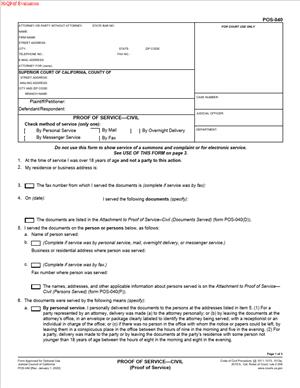
POS-040 – Proof of Service – Civil
Fill out nowJurisdiction: Country: United States | Province or State: California
POS-040 – Proof of Service – Civil is a court form used to show that legal documents were properly delivered to another party in a civil case. When you file papers with the Superior Court of California, the court usually requires proof that the other side received copies. This form provides that proof.
If you are representing yourself, this document becomes especially important. The court does not notify the other party for you in most civil matters. You are responsible for making sure service happens and that it is documented correctly.
POS-040 – Proof of Service – Civil is not about arguing your case. It does not explain your claims or defenses. It simply records when, how, and by whom certain papers were delivered.
If this form is incomplete or inaccurate, the court may reject your filing or delay your case. That is why it helps to understand exactly what this document does and how to complete it clearly.
What is POS-040 – Proof of Service – Civil?
Clear definition
POS-040 – Proof of Service – Civil is a written declaration filed with the Superior Court of California to confirm that legal documents were served in a civil case. “Service” means delivering copies of court papers to the other party or their attorney.
The form identifies the server, the documents served, the method of service, the date, the time, and the address where delivery occurred. It acts as an official record for the court.
This form is commonly used for service by mail, personal delivery, messenger service, fax, or electronic service in civil cases, depending on what method is allowed in the situation.
Who typically uses this form?
Self-represented litigants frequently use this form after mailing or personally delivering documents. If you are not represented by an attorney, you will often prepare this form after someone else serves your papers.
Attorneys and legal staff also use this form. In law offices, a staff member may complete and sign it after serving documents on opposing counsel.
The person who actually serves the papers fills out and signs the form. In many situations, that person cannot be a party to the case.
Why might you need this form?
Courts require proof that all parties receive notice of filings. Without notice, a case cannot move forward fairly. This form shows the court that notice was given.
You may need it when filing motions, responses, amended pleadings, or other court papers. Each time you serve new documents, a new proof of service may be required.
The court clerk may refuse to process your filing if there is no proper proof of service attached or filed separately. Judges also rely on this document when deciding whether deadlines were met.
Typical real-life scenarios
- You file a motion asking the court to change a hearing date. After filing, someone over 18 who is not involved in the case mails a copy to the other party. That person completes POS-040 – Proof of Service – Civil to confirm the mailing.
- You respond to a complaint and need to serve your answer on the plaintiff’s attorney. A friend personally delivers the papers to the attorney’s office. The friend fills out the form describing the date, time, and address of delivery.
- You submit additional documents before a scheduled hearing. You send them by mail to all parties listed in the case. The individual who handled the mailing signs the proof of service.
- You serve documents electronically because the parties have agreed to accept electronic service. The person who transmitted the documents completes the form and notes the method used.
- In each example, the court does not witness the delivery. The form provides the court with a sworn statement that service occurred.
When would you use POS-040 – Proof of Service – Civil?
You use this form after serving documents in a civil case pending in the Superior Court of California. It is generally used after the initial complaint has already been served.
For example, once the case is underway, most additional filings require service on the other party or their attorney. This includes motions, oppositions, replies, discovery documents filed with the court, and certain notices.
If you are the plaintiff or defendant and you file new paperwork, someone else must serve it. After the service is completed, the server prepares this proof of service.
In many civil cases, service by mail is common. In others, personal delivery may be required or preferred, especially when deadlines are short. The method used affects how the form is completed.
You may also use this form when serving multiple parties. The form allows space to list names and addresses of each person served. If there is not enough room, attachments may be used.
Timing matters. Service usually must occur before or on the same day you file certain documents. The proof of service reflects that timing. The date listed on the form becomes part of the official case record.
Legal characteristics of POS-040 – Proof of Service – Civil
This form functions as a declaration under penalty of perjury. The person signing it is stating that the information provided is true and correct. That sworn statement gives the document legal weight.
For the form to be effective, it must accurately describe the method of service used. The server must be eligible to serve documents. In many civil matters, the server must be at least 18 years old and not a party to the case.
Common problems include listing the wrong case number, failing to include all parties served, omitting the date or address, or having the wrong person sign. These errors can cause delays or require correction.
The form does not itself serve documents. It only records that the service has already happened. If the service was improper, filing this form does not fix the underlying problem.
In California civil procedure, different rules may apply depending on the type of case and the method of service. Some filings have strict deadlines tied to the date of service. The proof of service becomes the reference point for calculating those deadlines.
The form also does not prove that the other party actually read the documents. It only confirms that they were delivered using a legally recognized method.
Is it legally binding?
Yes, in the sense that it is a sworn declaration. When the server signs POS-040 – Proof of Service – Civil, they are declaring under penalty of perjury that the service details are accurate.
Because it is signed under penalty of perjury, false information can carry serious consequences. The court relies on the truthfulness of this statement when managing the case.
However, the form does not create or change legal rights by itself. It does not decide the outcome of your motion or claim. Its legal effect is limited to proving that notice was given according to procedural rules.
If challenged, the court may review whether service actually complied with applicable rules. The signed form is strong evidence, but it may be examined if there is a dispute.
How to fill out POS-040 – Proof of Service – Civil
Step 1 – Read the caption from your court document
Start by looking at the top portion of the document you served. Copy the court name, case title, and case number exactly as they appear. This information goes in the caption area of the form. Accuracy here ensures the proof of service is linked to the correct case.
Step 2 – Identify the server
Enter the name, address, and contact information of the person who served the documents. This must be the individual who actually performed the service. Confirm that the server meets any basic eligibility requirements, such as age and not being a party to the case.
Step 3 – State the server’s qualifications
The form includes statements about the server’s age and connection to the case. The server confirms they are over 18 and not a party. Read these statements carefully before proceeding. The server’s eligibility is part of what makes the service valid.
Step 4 – List the documents served
Write the full title of each document that was delivered. Use the exact names as shown on the filings, such as “Notice of Motion” or “Memorandum of Points and Authorities.” If multiple documents were served together, list each one clearly.
Step 5 – Choose the method of service
Select the method that matches what was actually done. Options may include personal delivery, mail, overnight delivery, messenger service, fax, or electronic transmission. Only mark the method that reflects the real event.
Each method section requires specific details. For example, service by mail asks for the mailing address and the city and state from which the documents were mailed. Personal service requires the address where delivery occurred.
Step 6 – Provide service details
Enter the date of service and, where required, the time of service. Include the full name and address of each person served. If serving an attorney, use the attorney’s name and office address as shown in the case records.
If there are multiple recipients, ensure each one is listed. If additional space is needed, attachments may be used and referenced in the form.
Step 7 – Review for completeness
Before signing, the server reads the entire form to confirm that all information is correct. Check spelling of names, accuracy of addresses, the case number, and the method selected. Small errors can create confusion or delay.
Step 8 – Sign under penalty of perjury
The server signs and dates the form where indicated. The signature confirms that the information provided is true. Once signed, the form becomes a sworn declaration.
After signing, the completed POS-040 – Proof of Service – Civil is filed with the court, either attached to the related filing or submitted according to the court’s usual filing process.
Legal terms you might encounter in POS-040 – Proof of Service – Civil
- Proof of Service: This is the written statement confirming that court papers were delivered to the required person or party. On this form, it shows who was served, what was served, how it was served, and when. The court relies on this document to verify that proper notice was given.
- Declarant: The declarant is the person who signs the proof of service. This is usually the server, not you. The declarant is stating, under penalty of perjury, that the information in the form is true.
- Penalty of Perjury: This means the person signing the form swears the information is true to the best of their knowledge. If they knowingly provide false information, they can face legal consequences. The declaration language appears near the signature line.
- Personal Service: This refers to physically handing the documents to the person being served. On the form, the server must provide the date, time, and address where the documents were delivered.
- Service by Mail: This method involves mailing the documents to the other party. The form requires the mailing date, the city and state where the mailing occurred, and the mailing address used.
- Business Address: This is the work address of the server. The form asks for this information so the court can identify and locate the person who completed service if needed.
- Party Served: This identifies the individual or entity who received the documents. The name must match the case records exactly. If serving an attorney, you must list the attorney’s name and the party they represent.
- Documents Served: This section lists each paper delivered. You must use the exact title of each document as it appears on the first page. If there are multiple documents, all must be clearly listed.
- Service Date: This is the exact date the documents were delivered or mailed. The court uses this date to calculate deadlines. Accuracy here is critical.
- Case Number: This is the unique identifier assigned by the court. It must match the number on your court filings exactly. An incorrect case number can delay or invalidate the filing.
FAQs
Does POS-040 – Proof of Service – Civil need to be filed with the court every time I serve documents?
In most civil cases, yes. The court needs written confirmation that service was completed. After the server signs this form, you typically file it with the clerk so it becomes part of the case record. If you do not file it, the judge may treat the other party as not properly served.
Who is allowed to sign this document?
Only the person who actually served the papers can sign it. That person must be at least 18 years old and not a party to the case. You cannot serve your own papers. The signature confirms they personally completed the service and that the details listed are accurate.
What if I served more than one document at the same time?
You must list every document served. Use the exact titles shown on the documents themselves. If you leave one out, the court may conclude it was never served. If there is not enough space, attach an additional page and clearly reference it in the form.
What happens if the name of the party served is slightly different from the court record?
The name should match the court record exactly. Even small differences can cause confusion about whether the correct person was served. Before filing, compare the name on this form to the complaint or other initiating document and correct any mismatch.
How do I confirm the court accepted my filed proof of service?
After you submit it, the clerk typically stamps it as “filed.” If you filed in person, ask for a stamped copy. If you filed electronically, check the filing confirmation notice and download the accepted version for your records. Keep this confirmation with your case documents.
What date controls deadlines: the mailing date or the filing date?
Deadlines usually run from the date service was completed, not the date the form was filed. That means the service date listed on this document matters. Make sure the server enters the correct date because it affects response timelines.
Do I need a separate proof of service for each person served?
Yes. Each person or party served generally requires their own completed form unless they were served in the exact same way at the same time and address. To avoid confusion, many people prepare a separate POS-040 – Proof of Service – Civil for each recipient.
What if I realize there is an error after the form has been filed?
If you notice a mistake, you cannot simply cross it out on the filed copy. The server should complete a new, corrected proof of service with accurate details. File the corrected version promptly so the court record reflects the true service information.
Checklist: Before, During, and After POS-040 – Proof of Service – Civil
Before
- Confirm the correct case name and case number from your court papers.
- Verify the full legal name of each person or attorney being served.
- Choose the proper method of service allowed for your document.
- Make sure the server is at least 18 and not a party to the case.
- Prepare complete copies of all documents to be served.
- Double-check addresses for accuracy and completeness.
- Review any court rules about timing for service.
- Print a blank copy of the form for each person being served.
During
- Have the server complete service exactly as planned.
- Record the exact date of service immediately.
- Write down the full address where the service occurred.
- List every document served using exact titles.
- Ensure the server fills in their business or residential address.
- Confirm the correct method of service box is selected.
- Review the form for missing fields before signing.
- Have the server sign and date under penalty of perjury.
After
- Make at least two copies of the signed form.
- File the original with the court clerk if required.
- Obtain a filed-stamped copy for your records.
- Confirm electronic filing acceptance if applicable.
- Calendar any response deadlines triggered by the service.
- Store the proof of service with your case documents.
- Provide a copy to your attorney if you have one.
- Monitor the case docket to ensure it appears in the record.
Common mistakes to avoid with POS-040 – Proof of Service – Civil
- Mistake: Letting a party to the case serve the documents, which happens when someone tries to save time or money, can invalidate service and delay your case, so do not forget that the server must be a neutral adult.
- Mistake: Listing the wrong case number because you copied it from memory can cause the form to be filed in the wrong case or rejected, so do not forget to match it exactly to the court document.
- Mistake: Forgetting to list all documents served, often because attachments were overlooked, can lead the court to treat some papers as unserved, so do not forget to review every page delivered.
- Mistake: Entering an incorrect service date due to delayed paperwork can disrupt deadline calculations, so do not forget to record the date immediately after service.
- Mistake: Failing to have the server sign under penalty of perjury, which happens when rushing, makes the form incomplete and unacceptable to the court, so do not forget the signature and date.
- Mistake: Using an outdated address for the party served because you relied on old records can result in ineffective service, so do not forget to verify the current address before serving.
- Mistake: Selecting the wrong method of service box by misunderstanding how delivery occurred can create inconsistencies in the record, so do not forget to match the box to the actual method used.
- Mistake: Not filing the completed form with the court, assuming service alone is enough, can stall hearings or rulings, so do not forget to submit the signed original when required.
What to do after filling out POS-040 – Proof of Service – Civil
Once the server signs the form, your job is to make sure it becomes part of the official court record and that you protect yourself with good documentation.
- Step 1: Review the completed form carefully. Check names, addresses, dates, document titles, and the case number. Make sure nothing is blank.
- Step 2: Make copies. Keep one copy for your personal file. If you are working with an attorney, provide them with a copy as well.
- Step 3: File the original with the court if filing is required for your situation. This may be done in person at the clerk’s office or through an approved electronic filing system.
- Step 4: Confirm acceptance. If you file in person, ask the clerk to stamp your copy. If you file electronically, wait for confirmation that the filing was accepted and not rejected for correction.
- Step 5: Check the case docket. After a few days, review the court’s case record to ensure the proof of service appears in the file.
- Step 6: Calculate deadlines. Look at the service date and determine when the other party’s response is due. Write that date in your calendar.
- Step 7: Organize your records. Keep the filed-stamped copy together with the documents that were served. Store them in chronological order.
- Step 8: Prepare for next steps. If the other party must respond, monitor for incoming filings. If a hearing is scheduled, confirm that proper service is reflected in the court file before the hearing date.
- Step 9: Update your internal case notes. Record the date of service, method used, and filing confirmation. Clear records help you stay organized and respond quickly if questions arise.
- Step 10: Address any issues promptly. If the court rejects the filing or identifies a defect, correct it immediately by preparing and filing a revised proof of service.
Careful follow-through protects your case. The form is more than paperwork. It is your evidence that proper notice was given.
Disclaimer: This guide is provided for informational purposes only and is not intended as legal advice. You should consult a legal professional.