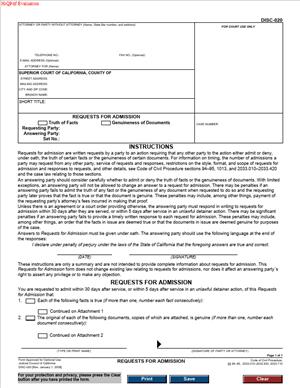
DISC-020 – Requests for Admission
Fill out nowJurisdiction: Country: United States | Province or State: California
If you are involved in a civil case in California, you may come across DISC-020 – Requests for Admission during the discovery stage. This document is used to ask the other side to admit or deny specific statements under oath. It is part of the formal information‑gathering process before trial.
DISC-020 – Requests for Admission help narrow down what facts are actually in dispute. Instead of arguing about everything, both sides identify what is agreed upon and what still needs to be proven. This can save time, reduce court hearings, and clarify the core issues in the case.
You may be filling out this form because you want the other party to confirm certain facts, or you may be responding to it because someone served it on you. Either way, understanding how it works is important. Your answers can affect what must be proven at trial.
This guide explains what the form does, when it is used, and how to complete it in a practical, step‑by‑step way. The focus is on helping you understand the structure and purpose of the document so you can approach it with confidence.
What is DISC-020 – Requests for Admission?
Clear definition
DISC-020 – Requests for Admission is a California Judicial Council form used in civil cases to ask another party to admit the truth of specific facts, the authenticity of documents, or the application of law to fact. Each request is a separate statement that the responding party must admit, deny, or explain why they cannot admit or deny it.
The form is part of written discovery. Discovery is the phase of a lawsuit where both sides exchange information. Unlike interrogatories, which ask open‑ended questions, requests for admission are framed as statements. The responding party answers by admitting, denying, or stating that they lack sufficient information after a reasonable inquiry.
The goal is not to gather new information. Instead, it is to eliminate issues that are not truly disputed. When a fact is admitted, it generally does not need to be proven later in court.
Who typically uses this form?
This form is commonly used by plaintiffs and defendants in civil lawsuits. Either side can prepare and serve it. Self‑represented litigants often use it when they want to simplify the issues or confirm basic facts.
Attorneys frequently rely on requests for admission in cases involving contracts, property disputes, personal injury, business disagreements, or other civil matters. It can be used in limited civil cases and unlimited civil cases, depending on the nature of the dispute.
If you are representing yourself, you may use this form to ask the other side to admit facts such as the existence of a contract, receipt of a payment, ownership of property, or the authenticity of a document. You may also receive this form and need to prepare responses within the required time frame.
Why might you need this form?
You might use this form to lock in certain facts so they cannot later be disputed. For example, if the other party has already acknowledged signing a contract, you can ask them to formally admit that fact. If they admit it, you do not have to prove signature authenticity at trial.
You may also use it to test the strength of the other side’s position. If they deny facts that are clearly true, it may affect how the case proceeds. In some situations, unreasonable denials can have cost consequences later in the case.
If you are responding to the form, you need to answer carefully. Admissions can significantly limit your arguments later. A denied request may signal that the issue remains contested and must be proven with evidence.
Typical real-life scenarios
- In a contract dispute, one party may send requests asking the other to admit that a written agreement exists, that certain payments were made, and that specific deadlines passed without performance. This helps narrow the dispute to whether there was a breach and what damages resulted.
- In a personal injury case, a party might ask the other to admit that a collision occurred on a specific date, at a specific location, and that certain vehicles were involved. This removes the need to prove basic background facts.
- In a property dispute, one side may request admissions about ownership records, recorded deeds, or boundaries shown in surveys. Authenticity of documents is often addressed through this form.
- In a debt collection matter, a party may ask the other to admit the amount of money borrowed, the interest rate stated in the agreement, and whether payments stopped on a certain date. Admissions can significantly reduce the number of issues for trial.
When would you use DISC-020 – Requests for Admission?
You generally use DISC-020 – Requests for Admission after the lawsuit has been filed and the parties have appeared in the case. It is part of the discovery process, which usually begins after initial pleadings are complete.
Plaintiffs often use it after the defendant files an answer. Defendants may use it after being served with the complaint and filing their response. The timing can vary depending on the type of case and procedural rules.
You might choose to use this form when you want clear, binding answers about specific facts. It is especially useful when documents exist, and you want the other party to confirm their authenticity. It can also be used when certain facts appear obvious, and you want to reduce the number of contested issues.
If you receive this form, you are in the position of responding. There is typically a deadline to serve your responses. Missing that deadline can have serious consequences, including having the requests deemed admitted.
This form is often used alongside other discovery tools. For example, a party may send interrogatories to gather detailed information and then use requests for admission to confirm specific key points. The tools work together to shape the case before trial.
Legal characteristics of DISC-020 – Requests for Admission
Requests for admission are formal discovery devices. They must follow procedural rules regarding format, service, and timing. Each request must be clearly stated and limited to one fact or a single application of law to fact.
The responding party must provide a written response to each request. The response must admit the statement, deny it, or explain in detail why it cannot be admitted or denied after a reasonable inquiry. Vague or incomplete answers may lead to further court involvement.
An effective request is clear and specific. Overly broad, confusing, or compound statements can create disputes. If a request includes multiple facts in one sentence, it may be harder to answer accurately and may draw objections.
Common problems include failing to respond on time, failing to sign the responses properly, or giving incomplete answers. Courts may treat unanswered requests as admitted. That can significantly affect the outcome of the case.
There may be differences in how many requests are allowed, depending on the type of case and court rules. Some cases have numerical limits unless a declaration for additional discovery is included. Understanding these structural limits is important when preparing the document.
This form does not replace other evidence. It does not automatically decide the case. Instead, it shapes what must be proven. Even if many facts are admitted, remaining disputed issues may still require a hearing or trial.
Is it legally binding?
An admission made in response to a request for admission is generally binding within that case. Once a party admits a fact, it usually does not need to be proven at trial. The court can treat it as established.
However, the binding effect is limited to that specific lawsuit. It does not automatically apply in other cases or legal matters. Its purpose is to streamline the current proceedings.
If a party wants to change or withdraw an admission, court permission is typically required. Courts often consider whether allowing withdrawal would prejudice the other side. Because of this, answering carefully is important.
If a party fails to respond at all within the required time, the requesting party may ask the court to deem the matters admitted. Those deemed admissions can carry the same weight as express admissions and may strongly influence the case outcome.
How to fill out DISC-020 – Requests for Admission
Step 1 – Identify the court and case information
At the top of the form, enter the name of the court, the court’s address, and the case number exactly as it appears on other filed documents. Include the full names of the plaintiff and defendant. This ensures the document is clearly connected to the correct case file.
Step 2 – Provide your party information
Fill in your name, address, telephone number, and other contact information in the space provided. Identify yourself as the plaintiff, defendant, or other party in the case. This clarifies who is making the requests.
Step 3 – Name the responding party
State the name of the party that will receive and answer the requests. Be precise. The requests must be directed to a specific party in the case, not to a general group.
Step 4 – Draft each request clearly
In the section for requests, write each statement as a separate numbered paragraph. Each one should contain a single fact or a single application of law to fact. Keep the language straightforward and specific.
Avoid combining multiple ideas in one request. For example, instead of asking whether a contract was signed and breached, separate those into two distinct statements. This makes it easier for the other party to respond clearly.
Step 5 – Include requests about document authenticity if needed
If you want the other party to admit that certain documents are genuine, describe each document clearly. Refer to it by date, title, or other identifying information. This helps prevent confusion about which document is being addressed.
Attach copies of documents when appropriate. Label them consistently so the responding party can match each document to the corresponding request.
Step 6 – Review numerical limits and additional pages
If your case has limits on the number of requests, count them carefully. If you need more space, attach additional pages and continue the numbering in order. Make sure any attachments clearly reference the case number and parties.
Keep the formatting consistent. Each request should be easy to read and easy to answer.
Step 7 – Sign and date the form
After completing the requests, sign and date the form in the designated area. Your signature confirms that the document is being properly served in the case. Use the same name that appears in the case caption.
If a separate proof of service is required, complete that as well. The proof of service documents how and when the form was delivered to the other party.
Step 8 – Serve the document on the other party
Arrange for the document to be served according to the applicable rules for service in civil cases. Service is typically done by someone who is not a party to the case and who is over a certain age. The server completes the proof of service form.
Keep a copy of everything for your records. Once served, the other party generally has a set period to respond. The timeline usually begins from the date of service.
After service, monitor the response deadline. The next phase will involve reviewing and evaluating the responses you receive, which can shape how the case proceeds.
Legal terms you might encounter in DISC-020 – Requests for Admission
- Request for Admission: A written statement you ask the other party to admit or deny. Each request must be separately numbered. If the other party admits it, that fact is treated as true in the case.
- Responding Party: The person or entity who must answer your requests. This name must match the case caption exactly. The responding party must sign their responses under oath.
- Propounding Party: The person who sends out the requests. If you are using this document, you are the propounding party. Your name and role in the case must be listed correctly.
- Verification: A sworn statement signed under penalty of perjury. The responding party must verify their answers. Without a verification, the responses may be treated as incomplete.
- Admission: A clear statement that the requested fact is true. Once admitted, it usually does not need to be proven at trial. Admissions can significantly narrow the issues in dispute.
- Denial: A clear statement that the requested fact is not true. A denial means the fact remains disputed. You may need to prove it later with evidence.
- Qualified Response: An answer that admits part of a request and denies part. The responding party must clearly explain what is admitted and what is denied. Vague answers are not acceptable.
- Objection: A formal reason for refusing to answer a request. Common objections claim the request is vague, irrelevant, or seeks privileged information. An objection must be specific and supported by a valid legal basis.
- Genuineness of Documents: A request asking the other party to admit that a document is authentic. If admitted, you do not need a witness to prove the document is real. This can save time at trial.
- Deemed Admitted: A legal consequence if the responding party does not answer on time. The court may treat all requests as admitted. This can severely affect the outcome of the case.
FAQs
How many requests can I include in DISC-020 – Requests for Admission?
You must check the applicable numerical limits before drafting. In many civil cases, there is a limit on how many requests you can send unless you include a declaration supporting the need for more. Count each separately numbered statement. If you exceed the limit without the required declaration, the responding party may object and refuse to answer the excess requests.
Do I file this document with the court?
In most situations, you do not file this document when you first serve it. You serve it directly on the other party or their attorney. You only file it with the court later if it becomes relevant to a motion or trial, such as asking the court to deem matters admitted.
What happens if the other party does not respond on time?
If the deadline passes and no verified responses are served, you may ask the court to treat the matters as admitted. This means each statement is considered true for purposes of the case. You must track the service date carefully and confirm whether any extension was agreed to before taking further action.
Can I ask the other party to admit that a document is authentic?
Yes. You can include specific requests that the responding party admit the genuineness of the attached documents. Label each attachment clearly and refer to it by exhibit number in your request so there is no confusion about what they are being asked to admit.
What if the other party gives unclear or incomplete answers?
Review each response line by line. If an answer does not clearly admit, deny, or state a valid objection, it may be defective. You may need to meet and confer in writing to request proper responses before seeking court involvement.
Do the requests have to relate directly to the claims in the case?
Yes. Each request must relate to facts, the application of law to fact, or the authenticity of documents that are relevant to the issues in dispute. If a request has no clear connection to the case, the responding party may object, and the court may refuse to enforce it.
Who signs the responses to this form?
The responding party must sign a verification under penalty of perjury, even if their attorney prepares the responses. Check that the signature matches the name listed in the case caption. Without that signature, the responses may not be valid.
Can admissions made in response to DISC-020 – Requests for Admission be changed later?
Admissions are binding unless the court allows them to be withdrawn or amended. A party that wants to change an admission must usually file a motion and explain why the change is justified. Do not assume an admission can be easily undone once made.
Checklist: Before, During, and After DISC-020 – Requests for Admission
Before
- Review the main issues in your case and identify which facts you want established.
- Check the numerical limit on requests and determine whether you need a supporting declaration.
- Gather and organize any documents you may attach as exhibits.
- Confirm the correct legal name of the responding party from the court caption.
- Review prior discovery responses to avoid repeating questions unnecessarily.
- Mark your calendar with the expected response deadline based on the service method.
- Draft a clear outline of the topics you want to cover before writing the final requests.
During
- Number each request separately and consecutively.
- Write each request as a single, clear statement of fact.
- Avoid compound statements that combine multiple facts in one request.
- Refer to the attached documents by exhibit number and description.
- Use precise dates, names, and locations where possible.
- Double-check that each request relates directly to a disputed issue.
- Ensure your caption and case number match the court record exactly.
- Review the full set for clarity and remove vague language.
After
- Make copies of the completed document and all attachments.
- Serve the document using an approved method.
- Prepare and keep proof of service for your records.
- Calendar the exact response deadline.
- Track any extensions agreed to in writing.
- Review responses immediately upon receipt.
- Identify any incomplete or evasive answers.
- Store the original and responses in an organized case file.
Common mistakes to avoid with DISC-020 – Requests for Admission
- Mistake: Writing long, compound requests with multiple facts in one paragraph, which happens when you try to cover too much at once; this leads to objections for vagueness and makes enforcement harder, so do not forget to keep each request limited to a single clear fact.
- Mistake: Exceeding the allowed number of requests without the required supporting declaration, often because you miscount or overlook the rules; this can result in valid objections and wasted time, so do not forget to confirm the limit before serving.
- Mistake: Using argumentative or sarcastic language, which usually happens when emotions run high; this invites objections and weakens your credibility, so do not forget to keep your wording neutral and factual.
- Mistake: Failing to attach clearly labeled exhibits when asking about document authenticity, which occurs when documents are added without organization; this creates confusion and possible denials, so do not forget to mark and reference each exhibit precisely.
- Mistake: Not tracking the response deadline, often because service dates are not recorded carefully; this can cause you to miss the window to enforce admissions, so do not forget to calendar the exact due date immediately after service.
- Mistake: Ignoring incomplete or unverified responses, which happens when you assume any answer is good enough; this can waive your right to challenge defects, so do not forget to check for a proper verification signed under penalty of perjury.
- Mistake: Filing the requests with the court unnecessarily, often due to confusion about procedure; this can create administrative issues and clutter the record, so do not forget that these are generally served, not filed, unless needed for a motion.
What to do after filling out DISC-020 – Requests for Admission
Once your document is complete, your focus shifts to proper service, tracking deadlines, and preparing for the next phase of your case. Handling these steps carefully protects your rights and strengthens your position.
- Step 1: Make at least two complete copies of the signed document and all attachments, one for your records and one for service.
- Step 2: Choose a legally acceptable method of service, such as mail or personal delivery, and ensure the server is someone who meets the eligibility requirements.
- Step 3: Prepare a proof of service that lists the date, method of service, and the name and address of the person served.
- Step 4: Have the server sign the proof of service and keep the original in your case file.
- Step 5: Calculate the response deadline based on the date and method of service, and write it on your calendar and case management notes.
- Step 6: Monitor your mail or electronic service method carefully as the deadline approaches.
- Step 7: When responses arrive, check that each request has a clear admission, denial, or specific objection.
- Step 8: Confirm that the responses include a signed verification from the responding party.
- Step 9: Create a summary chart listing each request and the corresponding response so you can quickly see which facts are established.
- Step 10: Decide whether any responses require follow-up, such as a meet-and-confer letter or a motion regarding insufficient answers.
Keep all originals and copies organized in a dedicated discovery folder. Update your internal case outline to reflect which facts are now admitted and which remain disputed. If key facts have been admitted, adjust your preparation strategy to focus only on contested issues. Careful follow-through ensures that the effort you put into drafting the requests translates into practical advantages in your case.
Disclaimer: This guide is provided for informational purposes only and is not intended as legal advice. You should consult a legal professional.