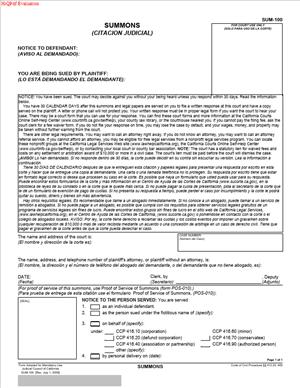
SUM-100 – Summons (Citation Judicial)
Fill out nowJurisdiction: Country: United States | Province or State: California
The SUM-100 – Summons (Citation Judicial) is one of the first documents issued in a civil lawsuit in California. If you are starting a case or have just been served with papers, this form is central to what happens next. It sets the timeline and formally notifies the other party that a case has been filed.
You may be looking at this form because you filed a complaint, or because someone handed you court papers. Either way, this document signals that a civil case is active in the California Superior Court. It explains important deadlines and basic legal warnings.
This form is not a detailed explanation of the claims. Instead, it works together with a complaint or petition. The summons tells the defendant that they must respond within a specific time or risk a default judgment.
Understanding how this document works can help you avoid missed deadlines and procedural mistakes. It frames the entire case and controls how the court gains authority over the defendant.
What is SUM-100 – Summons (Citation Judicial)?
Clear definition
SUM-100 – Summons (Citation Judicial) is an official court form used in California civil cases. It is issued by the Superior Court when a plaintiff files a complaint. The form notifies the defendant that they are being sued and must file a written response within a set time.
The summons contains the court’s name, the case number, and the names of the parties. It also includes standard language explaining the consequences of not responding. Once issued, it must be properly served on the defendant along with the complaint.
This document is procedural. It does not argue facts or present evidence. Its role is to trigger the defendant’s obligation to respond.
Who typically uses this form?
A plaintiff or their representative uses this form when starting a civil lawsuit. After filing a complaint with the California Superior Court, the clerk issues the summons. The plaintiff then arranges for service on the defendant.
Defendants interact with the form when they are served. It informs them of their deadline to file a response, often within 30 calendar days after service in most standard civil cases.
Court staff also handle the document at the filing stage. They assign the case number and confirm that the summons matches the complaint.
Why might you need this form?
You need this form if you are initiating a civil lawsuit in the California Superior Court. Without a summons, the defendant cannot be formally notified of the case. Proper notice is required before the court can proceed.
If you are a defendant, you need to understand this form because it sets your response timeline. Ignoring it can lead to a default judgment. That means the court may decide the case without hearing your side.
The summons is also necessary for enforcing court procedures. It establishes the court’s authority over the defendant once properly served.
Typical real-life scenarios
- You file a lawsuit for unpaid money after a written agreement was not honored. After filing your complaint, the court issues the summons. You then serve both documents on the person or business you are suing.
- A contractor files a claim for unpaid services. The SUM-100 – Summons (Citation Judicial) is issued so the property owner receives formal notice of the case. The contractor cannot move forward without proper service.
- A tenant sues a landlord for property damage unrelated to eviction. The tenant files a civil complaint. The summons tells the landlord they must respond within the stated deadline.
- A business is sued for breach of contract. An employee receives the summons on behalf of the company through authorized service. The company’s response period begins once service is completed according to the rules.
When would you use SUM-100 – Summons (Citation Judicial)?
You use this form at the very beginning of a civil lawsuit in California. It follows the filing of a complaint. The court clerk typically issues it after accepting the complaint for filing.
The plaintiff uses it to notify each defendant named in the complaint. If there are multiple defendants, each one must receive a copy of the summons and complaint.
This form is commonly used in general civil cases involving money disputes, property issues, personal injury claims, contract disagreements, and other non-criminal matters. It is not limited to one type of civil action.
Defendants use the information on the form to calculate their response deadline. The role of the defendant at this stage is to prepare and file an appropriate response, such as an answer or another permitted pleading.
If a defendant is served outside California, different response periods may apply. The summons still serves the same purpose, but timelines can vary depending on how and where service occurs.
Legal characteristics of SUM-100 – Summons (Citation Judicial)
This document becomes effective once it is issued by the court and properly served on the defendant. Proper issuance typically means the clerk has stamped or signed it and assigned a case number.
Service must follow California procedural rules. That often includes personal delivery by someone who is not a party to the case and is at least 18 years old. Improper service can delay the case or create grounds to challenge the court’s authority.
Common problems include incomplete party names, incorrect court information, or mismatched case numbers. Errors between the complaint and the summons can lead to rejection at filing or complications later.
The summons must accompany a filed complaint. On its own, it does not describe the claims in detail. The complaint provides the substance of the case.
In California, the summons includes a standard notice warning that failure to respond may result in a default judgment. This language is not optional. Altering required text can create issues with acceptance or enforceability.
This form does not prove that the claims are true. It does not establish liability. It only starts the formal notice and response process.
Is it legally binding?
The SUM-100 – Summons (Citation Judicial) is legally significant once properly issued and served. It binds the defendant to respond within the required time frame under court rules. Ignoring it can lead to serious procedural consequences.
Its binding effect comes from court rules and statutes governing civil procedure. Once valid service occurs, the court generally has jurisdiction over the defendant for that case, assuming other requirements are met.
However, the form itself does not create liability. It does not mean the plaintiff will win. It simply activates the defendant’s obligation to participate in the legal process.
If service is defective, the defendant may challenge the court’s jurisdiction. In that situation, the summons may not have its intended legal effect until proper service is completed.
How to fill out SUM-100 – Summons (Citation Judicial)
Step 1 – Complete the attorney or party information section
At the top of the form, enter the name, address, phone number, and email of the attorney or self-represented party. If you are representing yourself, list your own contact information. This tells the court and other parties where to send documents.
Step 2 – Identify the court
Fill in the name and address of the California Superior Court where the complaint is filed. Use the correct branch location if applicable. The court information must match the complaint exactly.
Step 3 – Enter the plaintiff and defendant names
Write the full legal names of the plaintiff and each defendant. These names must be consistent with the complaint. Spelling and formatting should match to avoid confusion or rejection.
Step 4 – Insert the case number
Once the complaint is filed, the clerk assigns a case number. Enter that number in the designated space. This number will appear on all future filings in the case.
Step 5 – Review the notice to defendant section
The summons includes preprinted language informing the defendant of the time to file a response. Confirm that this section is intact and not altered. The response period stated on the form applies based on the method and location of service.
Step 6 – Clerk’s issuance
The summons must be issued by the court clerk. This typically involves a stamp, seal, or signature. Do not attempt to serve the document before it is officially issued.
Step 7 – Prepare copies for service
Make copies of the issued summons and the filed complaint. Each defendant must receive a copy. Keep at least one copy for your records.
Step 8 – Arrange for proper service
Have someone who is not a party to the case and meets age requirements serve the summons and complaint. The server completes a proof of service form after delivery. That proof is filed with the court to show that service was completed.
Legal terms you might encounter in SUM-100 – Summons (Citation Judicial)
- Summons: A summons is the official notice from the court that a lawsuit has been filed. In this document, it tells the defendant that they are being sued and sets a deadline to respond. It is issued under the court’s authority and must be properly served to be effective.
- Plaintiff: The plaintiff is the person or entity who starts the lawsuit. On this form, the plaintiff’s name must match the name listed on the complaint exactly. Any difference in spelling or format can cause confusion or filing issues.
- Defendant: The defendant is the person or entity being sued. The summons identifies each defendant who must respond. Every named defendant must be served separately unless the law allows combined service.
- Case Number: The case number is assigned by the court when the complaint is filed. It appears on the summons and must match the number on all other court documents. This number helps the court track your case in its system.
- Court Seal: The court seal is placed on the summons when the clerk issues it. This seal shows that the document is officially authorized. Without issuance by the clerk, the summons is not valid for service.
- Proof of Service: Proof of service is a separate document showing when and how the defendant received the summons and complaint. It must be completed by the person who served the papers, not by you if you are a party to the case. The court relies on this proof to confirm proper notice.
- Response Deadline: The response deadline is the number of days the defendant has to file an answer or other response after being served. The summons states this time clearly. If the defendant does not respond by that deadline, the plaintiff may request a default.
- Default: A default occurs when a defendant fails to respond within the required time. After proper service and the deadline passes, the plaintiff can ask the court to enter default. This may lead to a judgment without a trial.
- Jurisdiction: Jurisdiction refers to the court’s authority to hear the case. By serving the summons, the court asserts its authority over the defendant. If jurisdiction is challenged, it often relates to how or where the defendant was served.
- Service of Process: Service of process is the formal delivery of court documents to a defendant. The summons must be served according to strict rules. Improper service can delay the case or result in dismissal.
FAQs
What happens after the clerk issues the SUM-100 – Summons (Citation Judicial)?
Once the clerk signs, dates, and places the court seal on this document, it becomes officially issued. You must then have it served on each defendant along with the complaint. The response clock does not start until service is completed.
Do I fill in the case number myself?
You enter the case number only if the court has already assigned one when you filed the complaint. If you are submitting the summons together with the complaint, the clerk will assign the number, and you must update all copies to match before service. Always confirm that the number on this document matches the complaint exactly.
What if I made a mistake in a defendant’s name?
Names must match exactly as they appear in your complaint. If you discover an error before issuance, correct it and submit a clean version. If the error is found after issuance but before service, you usually need a corrected summons. If service already occurred, you may need to amend your complaint and re-serve, because the court record must clearly show who was notified.
Can I serve the papers myself?
No. A party to the case cannot serve the summons and complaint. You must use someone who meets the court’s service requirements. The person who serves the documents must complete a proof of service form with accurate dates, times, and method of service.
When does the response deadline start?
The deadline begins the day after the defendant is properly served, not the day the clerk issues this form. The number of days to respond is stated in the summons. You should count calendar days and confirm the final date carefully so you know when further action may be taken.
Do I file the proof of service right away?
Yes. After the defendant is served, the completed proof of service should be filed with the court promptly. The court uses that filing date to track whether the defendant’s response is timely. Keep a file-stamped copy for your records.
What if the court rejects my SUM-100 – Summons (Citation Judicial)?
If the clerk rejects it, review the rejection reason carefully. Common issues include missing party names, mismatched case numbers, or incomplete attorney information. Correct the problem and resubmit a clean version so the clerk can issue it properly.
Does this document become part of the public record?
Yes. Once filed and issued, it becomes part of the court file. The names of parties, the case number, and the fact that a lawsuit has been filed are generally public. Make sure all information is accurate before submission because it will appear in the court’s records.
Checklist: Before, During, and After SUM-100 – Summons (Citation Judicial)
Before
- Confirm the complaint has been completed and is ready to file.
- Verify the exact legal names of all plaintiffs and defendants.
- Check the correct court location and division.
- Prepare enough copies for each defendant and your records.
- Review the attorney or self-represented party contact information for accuracy.
- Leave signature and issuance sections for the clerk as required.
- Make sure the case caption matches the complaint word for word.
During
- Submit the summons together with the complaint if filing a new case.
- Pay the required filing fee or submit a fee waiver request if applicable.
- Confirm the clerk assigns a case number and places it on all documents.
- Check that the clerk signs, dates, and seals the summons.
- Review issued copies before leaving the courthouse or closing the e-filing session.
- Organize issued copies for each defendant separately.
After
- Arrange for proper service on each defendant within the allowed time.
- Provide the server with filed copies of the summons and complaint.
- Track the date and method of service for each defendant.
- File the completed proof of service with the court promptly.
- Calendar each defendant’s response deadline.
- Monitor the court docket for any filed responses.
- Prepare next steps if no response is received by the deadline.
Common mistakes to avoid with SUM-100 – Summons (Citation Judicial)
- Mistake: Misspelling a party’s name because you rely on memory instead of checking official documents, which can lead to challenges to service or delays, so do not forget to verify exact legal names before submission.
- Mistake: Serving the summons before it is issued by the clerk, often due to a misunderstanding of the process, which makes service invalid, so do not forget to confirm that the court seal and signature are present.
- Mistake: Forgetting to update all copies with the assigned case number, which happens when filing and copying at different times and can cause confusion in the record, so do not forget to ensure every page shows the same number.
- Mistake: Attempting to serve the papers yourself because it seems faster or cheaper, which violates service rules and may void service, so do not forget that a non-party must complete service.
- Mistake: Failing to file the proof of service after delivery, often due to assuming service alone is enough, which prevents the court from tracking deadlines, so do not forget to submit the signed proof to the clerk.
- Mistake: Ignoring response deadlines after service because you expect immediate action, which can delay your request for default, so do not forget to calculate and calendar the exact due date.
- Mistake: Using an outdated version of the form downloaded long ago, which can result in rejection by the clerk, so do not forget to confirm you are using the current version before filing.
- Mistake: Listing an incorrect court location due to copying from another case, which may cause transfer or rejection, so do not forget to double-check the court name and branch.
What to do after filling out SUM-100 – Summons (Citation Judicial)
Once the summons is completed and issued, your focus shifts to proper service and tracking deadlines. This stage is critical. If the service is not done correctly, the case cannot move forward.
- Step 1: Make at least one file-stamped copy for your records and one copy for each defendant.
- Step 2: Select a qualified server who meets the age and non-party requirements.
- Step 3: Provide the server with the issued summons and a filed copy of the complaint for each defendant.
- Step 4: Instruct the server on any known addresses and best times for service, without directing them to act improperly.
- Step 5: Confirm the exact date service is completed and write it down immediately.
- Step 6: Have the server complete and sign the appropriate proof of service form fully and accurately.
- Step 7: Review the proof of service to ensure names, dates, addresses, and methods are correct before filing.
- Step 8: File the proof of service with the court and keep a file-stamped copy.
- Step 9: Calculate each defendant’s response deadline based on the service date and mark it on your calendar.
- Step 10: Monitor the case docket for any answer, motion, or other response filed by the defendant.
- Step 11: If the deadline passes without a response, prepare the documents needed to request entry of default.
- Step 12: Keep all originals, copies, and confirmations organized in a dedicated case file so you can reference them quickly during later stages of the case.
Staying organized and proactive after issuance ensures your case moves forward without unnecessary delay. Careful tracking of service and deadlines protects your position and keeps the court record clear and accurate.
Disclaimer: This guide is provided for informational purposes only and is not intended as legal advice. You should consult a legal professional.