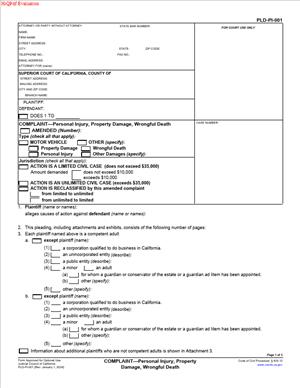
PLD-PI-001 – Complaint – Personal Injury, Property Damage, Wrongful Death
Fill out nowJurisdiction: Country: United States | Province or State: California
If you are preparing to start a lawsuit for an injury or damage you suffered, PLD-PI-001 – Complaint – Personal Injury, Property Damage, Wrongful Death is the document that formally opens your case in a California civil court. This form tells the court and the other side what happened, who you believe is responsible, and what you are asking for.
This is not just paperwork. It is the foundation of your case. Everything that follows in the lawsuit grows out of what you include in this document.
You may be using this form because you were hurt in an accident, your property was damaged, or a family member died due to someone else’s actions. The form creates an official record of your claims and starts the legal process.
If you are representing yourself, understanding this form is essential. You need to know what information belongs in it, how it is structured, and how it fits into the broader court process.
This document belongs to the California Department of Justice system and is designed for use in California civil courts.
What is PLD-PI-001 – Complaint – Personal Injury, Property Damage, Wrongful Death?
Clear definition
PLD-PI-001 – Complaint – Personal Injury, Property Damage, Wrongful Death is a standardized California court form used to begin a civil lawsuit involving physical injuries, damage to property, or a wrongful death claim.
A “complaint” is the document that starts a civil case. It explains who you are, who you are suing, what happened, how you were harmed, and what compensation you are seeking. When you file this form with the court, you officially initiate legal proceedings.
The form provides checkboxes and structured sections. This helps ensure you include the key legal elements required for personal injury and related claims.
Who typically uses this form?
Individuals who believe they were harmed by someone else’s negligence or wrongful conduct commonly use this form. This includes people injured in car accidents, slip and fall incidents, or other accidents.
Property owners use it when their property was damaged due to another person’s actions. Family members may use it to bring a wrongful death claim if a loved one died because of someone’s conduct.
Attorneys frequently use this form as well. It is designed to be clear enough for self-represented litigants but structured enough to meet court requirements.
Why might you need this form?
You need this form if you want the court to resolve a dispute involving personal injury, property damage, or wrongful death, and no settlement has been reached.
Filing this complaint allows you to seek compensation for medical expenses, lost income, repair costs, pain and suffering, or other damages recognized under civil law.
Without filing a complaint, the court does not have authority to act. The submission of this document is what gives the court jurisdiction over your dispute and notifies the defendant of the claims against them.
Typical real-life scenarios
- You were rear-ended at a stoplight and suffered neck and back injuries. The other driver’s insurance company refuses to pay what you believe is fair compensation. You use this form to formally state your claim.
- You slipped on a wet floor in a store and broke your wrist. You believe the store failed to maintain safe conditions. The complaint outlines how the injury occurred and what losses you experienced.
- A contractor damaged your home during a renovation. Repair costs are high, and informal discussions have not resolved the issue. You use this form to seek payment for the property damage.
- A family member died in a traffic collision caused by another driver. A wrongful death claim may be brought by eligible relatives using this complaint to describe the incident and the resulting losses.
- You were bitten by a dog while walking in your neighborhood. You required medical treatment and missed work. This form allows you to state the facts and request compensation.
When would you use PLD-PI-001 – Complaint – Personal Injury, Property Damage, Wrongful Death?
You use this form at the beginning of a civil lawsuit in a California court when your claim involves bodily injury, damage to personal or real property, or wrongful death.
This typically happens after an incident has occurred and attempts to resolve the matter informally have not resulted in an agreement. The complaint marks the transition from negotiation to formal legal action.
The person filing the form is called the plaintiff. The person or entity being sued is the defendant. The plaintiff completes and files the complaint, then arranges for it to be formally delivered to the defendant through service of process.
Timing can matter. Civil claims are often subject to statutes of limitations, which set deadlines for filing. While deadlines vary by type of claim, the complaint must generally be filed within the legally allowed period for the court to consider it.
This form is used in civil court, not criminal court. It seeks monetary damages or other civil remedies, not criminal penalties.
Legal characteristics of PLD-PI-001 – Complaint – Personal Injury, Property Damage, Wrongful Death
This document has a defined legal function. It sets out the factual and legal basis of your claims. It must identify the parties, describe what happened, state the legal theories involved, and specify the damages sought.
For a complaint to be effective, it generally needs to include enough detail to give the defendant notice of what they are accused of and what relief you are requesting. Vague or incomplete allegations may lead to challenges by the defendant.
Common problems that cause delays or rejection include missing party information, failure to state a recognizable legal claim, incorrect court selection, or incomplete signatures. Errors in identifying defendants can also complicate the case.
The form often includes checkboxes for common causes of action, such as motor vehicle negligence or premises liability. Selecting the appropriate category helps clarify the legal theory behind your claim.
Filing the complaint does not automatically mean you will win. It does not establish fault by itself. It only begins the judicial process and frames the issues to be decided.
Court procedures and filing requirements can vary between limited civil and unlimited civil cases, often depending on the amount of damages claimed. The structure of the complaint remains similar, but filing fees and procedural rules may differ.
Is it legally binding?
Once filed with the court and properly served on the defendant, the complaint becomes a formal court document. It has legal effect in that it initiates a lawsuit and requires the defendant to respond within a specified time.
The statements you include carry legal significance. You are representing that the facts are true to the best of your knowledge. Signing the complaint confirms that you are making those statements in good faith.
The document itself does not create liability. Instead, it sets the stage for the court to determine liability after both sides present their arguments and evidence.
If a defendant fails to respond after proper service, the court may enter a default. In that situation, the complaint can form the basis for a judgment. This shows how important accuracy and completeness are at the beginning of the case.
How to fill out PLD-PI-001 – Complaint – Personal Injury, Property Damage, Wrongful Death
Step 1 – Complete the caption section
At the top of the first page, fill in your name, address, and contact information in the space for the attorney or party without an attorney. Identify yourself as the plaintiff if you are filing the case. Enter the name of the court, including the county, and leave the case number blank if it has not yet been assigned.
Step 2 – Identify the parties
List your full legal name as the plaintiff. Then list each defendant you are suing. Use complete names for individuals and correct legal names for businesses or entities. If you do not know a defendant’s name, the form may allow placeholder names, but clear identification helps avoid delays.
Step 3 – Select the case type
Indicate whether the case is a limited civil case or an unlimited civil case, based on the amount of damages you are claiming. The form includes checkboxes for this purpose. The classification affects filing fees and procedural rules.
Step 4 – State the cause of action
Check the boxes that describe the type of claim you are bringing, such as motor vehicle, general negligence, premises liability, or wrongful death. If your claim does not fit neatly into one category, use the space provided to describe it clearly.
Step 5 – Describe the incident
Provide the date and location of the incident. Briefly explain what happened. Focus on clear facts. Identify what the defendant did or failed to do that caused harm. Avoid unnecessary detail, but include enough information to show the basis of your claim.
Step 6 – Explain the injuries or damages
Describe the injuries you suffered or the property damage that occurred. This may include physical injuries, emotional distress, repair costs, medical expenses, or lost income. The form may include general categories rather than detailed dollar amounts at this stage.
Step 7 – State the damages requested
Indicate the types of compensation you are seeking. This can include general damages, special damages, medical expenses, lost earnings, and other related losses. In unlimited civil cases, you may state that damages exceed a certain amount without listing a specific total.
Step 8 – Address additional allegations if applicable
Some sections allow you to add details about agency, employment relationships, or other legal theories. Complete these only if they apply to your situation. Make sure the information matches the facts of your case.
Step 9 – Review for accuracy and completeness
Carefully read through the entire form. Confirm that names are spelled correctly, dates are accurate, and all relevant boxes are checked. Ensure your narrative matches the selected causes of action.
Step 10 – Sign and date the complaint
Sign the form where indicated. Print your name below your signature and add the date. By signing, you confirm that the information provided is true to the best of your knowledge.
Step 11 – Prepare for filing and service
Make the required copies of the completed complaint. The original is filed with the court clerk. Copies are used for service on each defendant and for your records. Once filed, the complaint must be formally served on every defendant to move the case forward.
Legal terms you might encounter in PLD-PI-001 – Complaint – Personal Injury, Property Damage, Wrongful Death
- Plaintiff: The plaintiff is the person or entity bringing the lawsuit. On this form, you will list yourself or the injured party as the plaintiff in the caption and throughout the allegations. The name must match your legal name exactly as it appears on official identification or business records.
- Defendant: The defendant is the person, business, or entity you claim is legally responsible for your injury or loss. You must identify each defendant clearly, using full legal names. If you sue a business, you must use its correct legal name, not just a brand or trade name.
- Cause of Action: This refers to the legal reason you are suing. In this document, you check or specify the legal theory, such as negligence or wrongful death. Each cause of action must connect to specific facts you describe in the complaint.
- Negligence: Negligence means someone failed to act with reasonable care, and that failure caused harm. In this form, you may allege that the defendant owed you a duty, breached that duty, and caused your injuries. You must describe what the defendant did or failed to do.
- Damages: Damages are the losses you claim as a result of the incident. The form asks you to state the types of damages you seek, such as medical expenses, lost income, property repair costs, or pain and suffering. You must clearly state whether you are requesting a specific dollar amount or according to proof at trial.
- Jurisdiction: Jurisdiction refers to the court’s authority to hear your case. In the caption area and case classification section, you indicate the type of court and whether the amount in controversy qualifies as limited or unlimited. This affects filing fees and procedures.
- Prayer for Relief: The prayer for relief is the section where you state what you want the court to order. On this form, you list the remedies you are requesting, including monetary damages and any other appropriate relief. This section sets the boundaries of what you can recover.
- Verification: A verification is a sworn statement confirming that the facts in your complaint are true to the best of your knowledge. Some complaints require verification. If you include one, you must sign it under penalty of perjury.
- Statute of Limitations: This is the legal deadline for filing your lawsuit. While the form does not calculate this for you, your filing date is critical. If you file after the deadline, your case can be dismissed even if your claims are valid.
FAQs
What information must match exactly in the caption section?
The court name, party names, and case classification must be consistent throughout the document. Your name should match your identification, and each defendant’s name should match public or business records. Any mismatch can delay filing or create confusion when the clerk processes your complaint.
Do I need to attach evidence like medical records to this form?
You generally do not need to attach full evidence at the pleading stage. This document is meant to state your claims, not prove them. However, if you reference attachments, label them clearly and make sure they are mentioned in the body of the complaint.
How do I know if I should mark the case as limited or unlimited?
You must look at the total amount of damages you are claiming. If your claimed damages exceed the limited case threshold, you mark it as unlimited. This choice affects filing fees and certain procedural rights, so review your damage calculations before selecting.
What happens after I file PLD-PI-001 – Complaint – Personal Injury, Property Damage, Wrongful Death?
After filing PLD-PI-001 – Complaint – Personal Injury, Property Damage, Wrongful Death, the clerk assigns a case number and returns stamped copies to you. You must then arrange for proper service of the complaint and summons on each defendant. The case officially moves forward once service is completed.
Can I correct mistakes after I submit this document?
Yes, but you may need to file an amended complaint. If the clerk rejects it for technical errors, you can correct and resubmit. If the court has already accepted it, you may need permission or follow amendment procedures to update facts or names.
Who is allowed to sign the complaint?
You sign if you are representing yourself. If a business is the plaintiff, an authorized representative must sign. The signature confirms that the information in PLD-PI-001 – Complaint – Personal Injury, Property Damage, Wrongful Death is accurate to the best of your knowledge.
What if I do not know a defendant’s full name yet?
You may use a placeholder name if permitted, often referred to as a fictitious name. You must later amend the complaint once you discover the true identity. Be consistent in how you refer to that defendant throughout this form.
Will this document become part of the public record?
Yes. Once filed, this form becomes part of the court’s public file. The allegations, names, and requested damages may be accessible to others, so review carefully before submitting PLD-PI-001 – Complaint – Personal Injury, Property Damage, Wrongful Death.
Checklist: Before, During, and After PLD-PI-001 – Complaint – Personal Injury, Property Damage, Wrongful Death
Before
- Confirm you are within the statute of limitations.
- Gather the full legal names and addresses of all defendants.
- Calculate your total damages and determine case classification.
- Outline the facts of the incident in chronological order.
- Identify each legal cause of action you plan to assert.
- Prepare a clear summary of your injuries or property damage.
- Check whether a verification is required.
- Review court filing fees and fee waiver options if needed.
During
- Complete the caption exactly as required by the court.
- List each plaintiff and defendant clearly and consistently.
- Select the correct case type and classification.
- State each cause of action separately and clearly.
- Describe the incident with specific dates and locations.
- Connect each defendant’s conduct to your injuries.
- Specify the types of damages you seek.
- Review every page for completeness and accuracy before signing.
After
- Make multiple copies of the signed complaint.
- File the original with the court clerk.
- Obtain a filed-stamped copy with the case number.
- Prepare a summons for each defendant.
- Arrange for proper service by an eligible adult.
- Keep proof of service documents once completed.
- Create a file to organize all court papers.
- Calendar deadlines for responses and future filings.
Common mistakes to avoid with PLD-PI-001 – Complaint – Personal Injury, Property Damage, Wrongful Death
- Mistake: Using a nickname or an incomplete business name for a defendant, which happens when you rely on informal information, leading to service problems or dismissal, and you must not forget to verify the exact legal name before filing.
- Mistake: Failing to clearly connect each defendant to specific actions, often because you assume the court will infer responsibility, which can weaken your claim, and you must not forget to describe what each person did or failed to do.
- Mistake: Leaving out categories of damages, usually because you focus only on medical bills, which may limit recovery later, and you must not forget to include all types of losses you experienced.
- Mistake: Marking the wrong case classification, which happens when you miscalculate damages, resulting in procedural complications or additional fees, and you must not forget to total your claims carefully.
- Mistake: Submitting an unsigned complaint, often due to rushing to meet a deadline, which can cause rejection by the clerk, and you must not forget to sign and date in the correct place.
- Mistake: Missing the filing deadline, commonly because you misunderstand the statute of limitations, which can result in dismissal of your case, and you must not forget to confirm the final filing date before submitting.
- Mistake: Including unnecessary personal identifiers, such as full financial account numbers, because you think more detail helps, which can expose private information in the public record, and you must not forget to limit sensitive data.
- Mistake: Forgetting to prepare enough copies, which happens when you focus only on the original document, causing delays in service, and you must not forget to make copies for yourself and each defendant.
What to do after filling out PLD-PI-001 – Complaint – Personal Injury, Property Damage, Wrongful Death
Once you complete the form, shift your focus to filing and service. Your complaint does not start the case until it is officially filed with the court and assigned a case number.
- Step 1: Review every page for accuracy, signatures, and completeness.
- Step 2: Make at least one copy for yourself and one copy for each defendant.
- Step 3: Prepare the required summons form to submit with your complaint.
- Step 4: File the original complaint and summons with the court clerk, either in person or through an accepted submission method.
- Step 5: Pay the filing fee or submit a fee waiver request if you qualify.
- Step 6: Receive filed-stamped copies showing the case number and filing date.
- Step 7: Arrange for proper service of the summons and complaint by someone legally permitted to serve documents.
- Step 8: Ensure proof of service is completed and filed with the court.
- Step 9: Create a case file where you store stamped copies, proof of service, and all correspondence.
- Step 10: Track response deadlines so you know when the defendant’s answer is due.
After service is complete, monitor the case docket for updates. Keep your contact information current with the court. If your address changes, file a notice promptly so you continue receiving all court communications. Staying organized and meeting deadlines will help your case move forward smoothly.
Disclaimer: This guide is provided for informational purposes only and is not intended as legal advice. You should consult a legal professional.