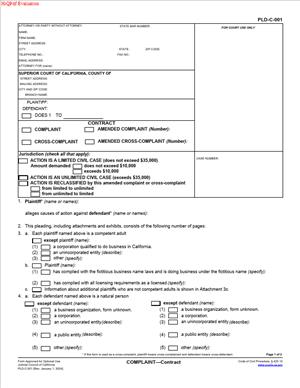
PLD-C-001 – Complaint — Contract
Fill out nowJurisdiction: Country: United States | Province or State: California
PLD-C-001 – Complaint —Contract is a California court form used to start a lawsuit based on a contract dispute. You file it when you claim someone failed to honor an agreement, and you want the court to step in.
This document opens a civil case in the California Superior Court. It tells the court and the other party what happened, what agreement was involved, and what remedy you are asking for.
If you are representing yourself, this form becomes your formal statement of the dispute. The court relies on it to understand your claims. The defendant relies on it to prepare a response.
Because it begins a lawsuit, accuracy matters. The details you include shape the entire case. Once filed, the claims in this document guide what issues the court will consider.
Understanding how this form works before you complete it can help you avoid delays and confusion during the filing process.
What is PLD-C-001 – Complaint —Contract?
Clear definition
PLD-C-001 – Complaint —Contract is a standardized pleading used in California civil court to allege breach of contract. A pleading is a formal written statement filed with the court that explains your legal claims.
This form provides structured sections where you identify the parties, describe the agreement, explain how it was breached, and state the damages or other relief you seek. It may be used alone or together with additional attachment pages that give more detailed facts.
The form is designed to meet general court formatting rules. It includes checkboxes and prompts to help you identify whether the contract was written, oral, or implied by conduct.
Once filed and served, this document officially starts the lawsuit process against the defendant.
Who typically uses this form?
Individuals use this form when they believe another person or business has broken a contract. This often includes consumers, tenants, landlords, independent contractors, or small business owners.
Businesses may also use it to pursue unpaid invoices, failed service agreements, or breached purchase contracts.
Self-represented plaintiffs often rely on this form because it follows California pleading requirements in a structured format. Attorneys also use it, especially for straightforward contract cases.
Anyone who claims financial harm from a broken agreement and chooses to file in the California Superior Court may use this document.
Why might you need this form?
You may need this form if informal efforts to resolve a dispute have failed. If the other party refuses to pay, perform services, deliver goods, or honor agreed terms, filing a complaint may be the next step.
The form allows you to clearly state what the contract required and how the other party did not meet those obligations. It also allows you to request a specific amount of money or another form of relief.
Without filing a complaint, the court cannot act. The document is what gives the court authority to schedule hearings, accept evidence, and eventually issue a judgment.
If the amount in dispute exceeds small claims limits, this form is often used instead of a small claims complaint.
Typical real-life scenarios
- A homeowner hires a contractor to remodel a kitchen. The contract requires completion within three months. The contractor stops work halfway through and refuses to return. The homeowner files a complaint alleging breach of a written contract.
- A business provides consulting services under an agreement requiring monthly payments. After several months, the client stops paying but continues using the services. The business files this form to seek unpaid fees.
- Two individuals agree verbally that one will sell a vehicle to the other for a set price. The buyer pays, but the seller never transfers the title. The buyer files a complaint based on an oral contract.
- A supplier delivers goods under a purchase agreement. The buyer refuses to pay, claiming dissatisfaction without contractual grounds. The supplier files a complaint seeking payment and possibly interest.
- In each situation, the dispute centers on an agreement and an alleged failure to perform according to its terms.
When would you use PLD-C-001 – Complaint —Contract?
You use this form when you want to formally accuse someone of breaching a contract and request court intervention. The dispute must relate to an agreement that created enforceable obligations.
This form is typically used in general civil cases, not in small claims court. If the amount in dispute is higher than the small claims limits or if you prefer the formal discovery process, you may file in Superior Court using this complaint.
The plaintiff is the person or business filing the complaint. The defendant is the person or business accused of breaching the agreement.
You would not use this form for disputes involving personal injury, property damage unrelated to a contract, or family law matters. It is specific to contract-based claims.
You might also use this form when the agreement includes multiple terms and the dispute involves more than one alleged breach. The structure allows you to describe separate causes of action if needed, often through attachments.
Timing can matter. Contract claims are subject to filing deadlines that vary depending on whether the agreement was written or oral. The complaint must generally be filed within the applicable time period after the breach.
Legal characteristics of PLD-C-001 – Complaint —Contract
This form functions as a formal pleading. For it to be effective, it must identify the parties, state that a contract existed, describe its essential terms, explain how the defendant breached it, and describe the damages.
The complaint must be complete and clear enough to give the defendant notice of the claims. If the allegations are too vague, the defendant may challenge the complaint through procedural motions.
The form becomes part of the public court record once filed. It sets the framework for the lawsuit. Later amendments may be possible, but the original filing establishes the starting point.
Common issues that cause problems include failing to identify the correct legal name of a defendant, omitting key contract terms, not specifying whether the contract was written or oral, or failing to state the amount of damages sought.
Attachments are often necessary when the space on the form is not enough. For example, a written contract may be attached as an exhibit. If you rely on an oral agreement, you may need to describe when and where it was made and what each party agreed to do.
The form does not by itself prove your case. Filing it only begins the process. You must still serve the defendant and later present evidence to support your claims.
Procedural requirements, such as payment of filing fees and proper service of process, affect whether the case moves forward. Even a well-written complaint can be delayed if these steps are incomplete.
Is it legally binding?
PLD-C-001 – Complaint —Contract becomes legally significant once it is filed with the court and properly served on the defendant. At that point, it triggers the defendant’s obligation to respond within a set time.
The document itself is not a contract. It is a statement of allegations. Its legal effect comes from court rules that require the defendant to answer or risk a default judgment.
If the defendant does not respond within the required time, you may request that the court enter default. That can lead to a judgment based on the claims stated in the complaint.
If the defendant does respond, the case proceeds through litigation. The complaint remains the foundation of the claims unless it is amended.
The binding outcome, if any, comes later in the form of a court judgment or settlement agreement. The complaint is the first formal step toward that result.
How to fill out PLD-C-001 – Complaint —Contract
Step 1 – Caption and Court Information
At the top of the form, fill in your name, address, and contact information in the section for the plaintiff or attorney. If you are representing yourself, you list your own details. Then enter the name of the California Superior Court where you are filing, including the branch location. The court name must match the county and branch handling your case.
Step 2 – Identify the Parties
In the section labeled for plaintiff and defendant, write your full legal name as the plaintiff. Then list the full legal name of each defendant. If the defendant is a business, use its complete registered name. Accuracy here matters because the case will proceed against the names you list.
Step 3 – Jurisdiction and Case Type
Indicate that the case is a limited civil case or an unlimited civil case, depending on the amount of money involved. The form includes checkboxes for this purpose. The classification affects filing fees and certain procedural rules.
Step 4 – Statement of Parties
Complete the section that describes the legal status of the parties. For example, indicate whether a party is an individual, a corporation, or another type of entity. This helps clarify who is involved and how they may be held responsible.
Step 5 – Description of the Contract
Check the box that identifies whether the contract was written, oral, or implied by conduct. If the contract was written, you may attach a copy as an exhibit. If it were oral, describe the essential terms, including what each side agreed to do and when the agreement was made.
Step 6 – Plaintiff’s Performance
State that you performed all obligations required under the contract or explain why performance was excused. This section shows that you upheld your side of the agreement or had a lawful reason for not doing so.
Step 7 – Defendant’s Breach
Describe how the defendant failed to meet their obligations. Be specific about what was not done, what was done incorrectly, or what payment was not made. Include dates and actions where possible to make the sequence of events clear.
Step 8 – Damages
Enter the amount of money you claim to have lost as a result of the breach. If you are requesting additional remedies, such as interest or costs, indicate that in the appropriate section. The amount listed should reflect the harm you claim resulted from the defendant’s actions.
Step 9 – Additional Causes of Action or Attachments
If the space on the form is not enough, attach additional pages labeled clearly. Each attachment should reference the relevant paragraph number on the form. If you are alleging more than one cause of action, organize them in separate, clearly titled sections.
Step 10 – Prayer for Relief
Complete the section where you state what you are asking the court to award. This may include damages, interest, costs of suit, or other relief the court considers proper. This tells the court the outcome you seek if you prevail.
Step 11 – Date and Signature
At the end of the form, write the date and sign your name. Your signature confirms that the information in the complaint is true to the best of your knowledge. Once signed, the document is ready for filing with the court clerk.
Legal terms you might encounter in PLD-C-001 – Complaint —Contract
- Cause of Action: A specific legal claim you are making against the defendant. In this form, you may check boxes or attach pages describing different causes of action, such as breach of written contract or common counts. Each cause of action explains a separate legal reason why you believe you are entitled to relief.
- Breach: The failure to do what the contract required. In this document, you describe exactly how the defendant did not perform as promised. You must connect the breach to specific contract terms or obligations.
- Damages: The money or other relief you are asking the court to award. You state the amount of damages you believe you suffered because of the breach. The form may ask whether damages exceed a certain amount, which affects case classification.
- Jurisdiction: The court’s authority to hear your case. On this form, you indicate why the Superior Court can hear your contract dispute. This may relate to where the contract was made, performed, or where the defendant lives or does business.
- Common Counts: Standardized claims are used when you are seeking money owed, often without attaching a detailed contract. The form includes an option to attach a common counts page if your claim fits into categories like money lent or goods sold.
- Prayer for Relief: The section where you clearly state what you want the court to order. This may include damages, interest, costs of suit, or other specific remedies. The court generally cannot award more than what you request here.
- Attachment: Additional pages you add to provide more detail. If there is not enough space on the form to explain the contract or breach, you attach separate sheets labeled properly. Each attachment should clearly refer back to the relevant section.
- Verification: A signed statement confirming that the facts in your complaint are true. Not all complaints require verification, but if included, you are declaring under penalty of perjury that the information is accurate.
- Statute of Limitations: The deadline for filing your claim. While not fully explained in the form, your complaint must be filed within the legally allowed time after the breach. Filing after the deadline can result in dismissal.
- Interest: Additional money you may claim on top of the original amount owed. The form allows you to request interest if the contract provides for it or if you are legally entitled to it. You should state the rate and the time period if known.
FAQs
What if I do not know the exact date the contract was signed?
You should provide the most accurate date you can based on your records. If you do not know the exact day, you can state an approximate date, such as the month and year, if that is truthful. Make sure your description in this form matches any contract copy you attach. Inconsistent dates can create confusion or challenges later.
Do I need to attach a copy of the contract to this document?
If the contract is written, attaching a copy helps the court understand your claim. You should label the attachment clearly and refer to it in the section where you describe the agreement. If the contract was oral, you cannot attach a written agreement, so you must clearly describe the terms in the space provided or on an attachment page.
What if the defendant used a business name instead of a personal name?
You must list the defendant exactly as they are legally identified. If you are suing a business, confirm whether it is a corporation, limited liability company, partnership, or sole proprietorship. The name you enter must match official records. Errors here can delay service or cause problems enforcing a judgment.
Can I include more than one cause of action on PLD-C-001 – Complaint —Contract?
Yes. You can include multiple causes of action if they arise from the same dispute. Each one should be clearly stated and supported with facts. Make sure each cause of action explains what the defendant did, how that action violated the agreement, and how it caused you harm.
What amount of damages should I list if I am still calculating losses?
You should list the best good-faith estimate based on available information. Do not guess without support. Review invoices, payment records, and communications before writing the number. The amount you request in this document can affect how the case proceeds.
What happens after I file this form with the court?
After filing, the clerk assigns a case number if one has not already been issued. You must then arrange for the defendant to be formally served with the filed documents. Filing alone does not notify the defendant. Proper service is a separate and required step.
Can I change information after filing if I realize I made a mistake?
If you discover an error, you may need to file an amended complaint. The process depends on whether the defendant has already responded. Review what you originally submitted in PLD-C-001 – Complaint —Contract so that any correction is consistent and complete.
Will everything I write in this document become part of the public record?
In most cases, yes. Complaints filed in civil court are generally public. You should avoid including unnecessary personal information that is not required to explain your claim. Only include details that directly support your cause of action.
Checklist: Before, During, and After PLD-C-001 – Complaint —Contract
Before
- Gather the full written contract and any amendments.
- Collect emails, invoices, payment records, and correspondence.
- Confirm the correct legal names and addresses of all parties.
- Calculate your damages with supporting documentation.
- Check the filing deadline based on when the breach occurred.
- Decide which causes of action apply to your situation.
- Review court fee requirements and possible fee waivers.
During
- Enter the court name and location exactly as required.
- Spell all party names consistently throughout the form.
- Clearly describe the contract terms in plain language.
- State how you performed your obligations.
- Explain specifically how the defendant breached the agreement.
- List the total amount of damages and any interest requested.
- Attach labeled pages if you need more space.
- Sign and date the complaint where indicated.
After
- Make copies of the signed complaint and all attachments.
- File the original with the court clerk.
- Pay the filing fee or submit a fee waiver request.
- Obtain a stamped copy showing the filing date.
- Arrange for proper service on each defendant.
- Keep proof of service once completed.
- Calendar the deadline for the defendant’s response.
- Organize a case file with all documents and receipts.
Common mistakes to avoid with PLD-C-001 – Complaint —Contract
- Mistake: Listing the wrong legal name of the defendant because you rely on a trade name; this happens when you do not check official records, and it can delay service or make a judgment unenforceable, so do not forget to confirm the exact legal entity name.
- Mistake: Failing to describe the contract terms clearly because you assume the court will read between the lines; this leads to confusion or dismissal, so do not forget to explain who promised what and when.
- Mistake: Claiming an unsupported damages amount because you have not calculated your losses carefully; this can hurt your credibility, so do not forget to base your number on documents.
- Mistake: Forgetting to attach additional pages when space is insufficient; this happens when you try to squeeze in details, and it may leave out key facts, so do not forget to label and reference attachments.
- Mistake: Omitting your signature or date because you focus only on the narrative sections; unsigned complaints may be rejected, so do not forget to complete the signature block.
- Mistake: Filing in the wrong court location because you assume any branch will work; this can cause transfer or delay, so do not forget to verify the correct venue.
- Mistake: Missing the statute of limitations because you wait too long to prepare your documents; this can result in dismissal, so do not forget to confirm your filing deadline before submitting.
What to do after filling out PLD-C-001 – Complaint —Contract
Once you complete the form, pause and review every page. Read it as if you were the judge seeing the dispute for the first time. Make sure the story is clear, chronological, and supported by attachments.
- Step 1: Review all names, dates, and dollar amounts for accuracy.
- Step 2: Confirm that all attachments are labeled and referenced in the complaint.
- Step 3: Sign and date the complaint in the correct place.
- Step 4: Make at least two complete copies of everything, including attachments.
- Step 5: File the original with the court clerk in the appropriate Superior Court location.
- Step 6: Pay the required filing fee or submit a fee waiver application if needed.
- Step 7: Obtain stamped copies showing the case number and filing date.
- Step 8: Arrange for proper service of the filed complaint on each defendant through an authorized method.
- Step 9: File proof of service with the court once service is completed.
- Step 10: Track the deadline for the defendant’s response and prepare for the next stage.
After filing and service, keep a dedicated case folder. Store copies of the complaint, proof of service, court receipts, and any future filings. Keep notes of important dates, including hearings and response deadlines.
Monitor your mail and any electronic notices from the court. If the defendant files a response, review it carefully and note what issues are disputed. If no response is filed within the allowed time, you may explore the next procedural steps available in your case.
Stay organized. Civil litigation often moves in stages. Clear records and consistent documentation will make each next step easier.
Disclaimer: This guide is provided for informational purposes only and is not intended as legal advice. You should consult a legal professional.