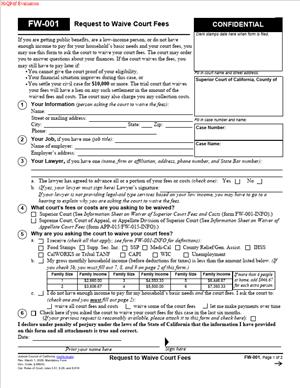
FW-001 – Request to Waive Court Fees
Fill out nowJurisdiction: Country: United States | Province or State: California
The FW-001 – Request to Waive Court Fees is a court form used in California when you cannot afford to pay filing fees and other court costs. It allows you to ask the court for permission to proceed without paying those fees upfront.
If you are about to file a case or respond to one and are concerned about the cost, this document is often the first step. Court fees can include filing charges, motion fees, and other standard costs required to move your case forward.
The FW-001 – Request to Waive Court Fees is designed for people with limited income or those who receive certain public benefits. It asks for detailed financial information so the court can evaluate your situation.
Understanding this form matters because incomplete or inaccurate information can delay your case. When filled out carefully, it can remove a significant financial barrier to accessing the court system.
This guide explains what the form does, who uses it, and how to complete it clearly and accurately.
What is FW-001 – Request to Waive Court Fees?
Clear definition
The FW-001 – Request to Waive Court Fees is a formal written request asking a California court to excuse you from paying required court fees. It is not a lawsuit or motion about your case’s legal issues. Instead, it focuses only on your financial eligibility.
The form collects information about your income, public benefits, household size, monthly expenses, and property. The court reviews this information to decide whether you qualify for a full waiver, a partial waiver, or no waiver.
When approved, the court may waive filing fees and certain other standard costs. The decision is typically documented in a separate order issued by the court.
Who typically uses this form?
People who file civil, family, probate, or other court matters and cannot afford filing fees commonly use this form. This includes plaintiffs, petitioners, respondents, and sometimes other parties involved in a case.
Self-represented individuals use it frequently. However, even people represented by an attorney may submit it if they meet financial eligibility guidelines.
Individuals who receive public assistance, have low income, or face temporary financial hardship are typical users. The form is meant to make court access possible regardless of income level.
Why might you need this form?
Court cases often require payment at the time of filing. If you cannot pay, the court may not process your documents unless a fee waiver request is submitted at the same time.
You might need this form if paying court fees would prevent you from covering basic living expenses. The court evaluates whether you can meet essential needs such as housing, food, and utilities.
You may also need it if your income is low compared to your household size. The court considers both total income and how many people depend on that income.
In some situations, unexpected events such as job loss, illness, or reduced work hours make it difficult to pay fees. This form provides a structured way to explain those circumstances.
Typical real-life scenarios
- You are filing for divorce and cannot afford the filing fee. You complete this form and submit it with your petition so the court can review your financial eligibility before requiring payment.
- You are being sued and need to file a response. The response requires a filing fee. Because your income is limited, you include this request with your response so your case can move forward without immediate payment.
- You are asking the court for a restraining order. Although some restraining order filings may not require fees, related filings or services might. If you are unsure about costs and cannot afford them, this form can address potential fees.
- You are starting a small claims appeal. Appeals often require additional fees. If your financial situation qualifies, this request allows the court to consider reducing or waiving those costs.
- You are involved in a guardianship or probate matter, and the filing fees are higher than expected. If those costs would cause financial strain, this document allows you to provide a full financial picture for review.
When would you use FW-001 – Request to Waive Court Fees?
You use this form at the time you submit documents that require a filing fee. It is commonly filed together with the first document in your case, such as a complaint, petition, or response.
You may also use it later in case additional fees arise and your financial situation prevents payment. Some court actions, such as filing certain motions or requesting transcripts, may require separate fees.
If you are initiating a new case, you often include this request in the same packet as your initial filing. This allows the clerk to process your paperwork without collecting fees immediately, pending review of your request.
If you are responding to a case, you can attach this request to your response so the court can evaluate your eligibility before rejecting your filing for nonpayment.
In general, this form is used whenever a required court fee creates a financial obstacle, and you believe you meet income or benefit criteria for a waiver.
Legal Characteristics of FW-001 – Request to Waive Court Fees
This form functions as a sworn financial statement. When you sign it, you declare under penalty of perjury that the information is true and correct. That declaration gives the court authority to rely on the details you provide.
For the request to be effective, it must be complete and accurate. Missing income figures, unsigned declarations, or unclear household information can result in delays or denial. The court may request additional documentation if information appears inconsistent or incomplete.
The court reviews several factors, including whether you receive certain public benefits, whether your income falls below established thresholds, and whether paying fees would interfere with basic living expenses. These standards are applied within California’s court system.
A common reason for rejection is leaving sections blank without explanation. If a question does not apply, it is generally addressed directly rather than ignored. Another frequent issue is underreporting or miscalculating monthly income or expenses.
This form does not decide your case. It does not affect the legal merits of your claims or defenses. It only addresses whether you must pay certain court costs.
The fee waiver may cover standard court filing fees and some additional costs, but it may not automatically cover every possible expense related to your case. The scope of the waiver depends on the court’s order.
Courts in different states use different forms and eligibility rules. Even within California, procedures may vary slightly by court location, but the overall structure and purpose of this document remain consistent statewide.
Is it legally binding?
The FW-001 – Request to Waive Court Fees is legally significant because it is signed under penalty of perjury. This means the information you provide carries legal weight. Providing false information can have serious consequences.
However, the form itself does not create a contract between you and another party. It is a request directed to the court. It becomes effective only if the court grants the waiver in a separate order.
Once approved, the court’s order regarding fee waiver status is binding within that case. If your financial situation changes, the court may reassess eligibility in some circumstances.
If the request is denied, you are typically responsible for paying the required fees for your case to proceed. The binding element lies in the court’s decision, not in the request alone.
How to fill out FW-001 – Request to Waive Court Fees
Step 1 – Provide your case information
At the top of the form, enter your name and contact information in the spaces provided. If you already have a case number, include it exactly as shown on your other court documents. If you are filing a new case and do not yet have a case number, leave that section blank for the court to complete.
Step 2 – Identify your role in the case
Indicate whether you are the plaintiff, petitioner, defendant, respondent, or another party. This clarifies your position in the proceeding and connects the request to your role in the case.
Step 3 – State your eligibility based on public benefits
The form asks whether you receive certain public assistance benefits. Read the listed programs carefully and check the box that applies, if any. If you receive one of the listed benefits, you typically indicate that directly in this section.
Provide accurate information about the type of benefit. This section can simplify the court’s review if you qualify through benefit eligibility.
Step 4 – Provide your income information
If you do not qualify through public benefits alone, complete the section that lists your gross monthly income. Gross income generally means income before taxes and deductions.
Include wages, self-employment earnings, unemployment benefits, disability payments, child support received, and any other income sources requested on the form. Enter monthly amounts clearly and calculate totals carefully.
If you are unemployed, indicate that status where requested and provide any income you currently receive from other sources.
Step 5 – List your household size
State how many people live in your household and depend on the same income. This may include children, a spouse, or other dependents.
The court uses this number to evaluate your income level in context. A larger household may affect how your income is assessed relative to eligibility guidelines.
Step 6 – Describe your monthly expenses
Complete the section that asks about regular monthly expenses. This often includes rent or mortgage payments, utilities, food, transportation, medical costs, and child care.
Enter realistic monthly averages. If an expense varies, use a reasonable estimate based on recent months. Clear and consistent figures help the court understand your financial situation.
Step 7 – List your assets
The form may ask about property you own, such as cash, bank accounts, vehicles, or real estate. Provide approximate current values if requested.
Do not skip this section. Even if you have minimal assets, state the information clearly. The court considers both income and available resources when reviewing the request.
Step 8 – Review all answers for accuracy
Before signing, read through every section. Confirm that totals are correct and that no required fields are left blank without explanation.
Check that your income, expenses, and household size are consistent across the form. Small errors can create confusion and delay processing.
Step 9 – Sign under penalty of perjury
Sign and date the declaration where indicated. By signing, you confirm that the information is true and correct to the best of your knowledge.
Ensure your signature matches the name provided at the top of the form. An unsigned form is generally incomplete and cannot be processed.
Step 10 – Submit the form with your court documents
Attach the completed form to the filing that requires a fee. Submit it to the court clerk in the same manner as your other documents.
After submission, the court will review your request and issue a written decision. Keep a copy of everything you file for your records.
Legal terms you might encounter in FW-001 – Request to Waive Court Fees
- Fee Waiver: A court’s permission allowing you to avoid paying filing fees and certain other court costs. In this document, you are formally asking the court to grant this benefit based on your financial situation. If approved, the waiver can apply to filing fees, sheriff’s fees, and other listed court charges.
- Public Benefits: Government assistance programs that may automatically qualify you for a fee waiver. The form asks whether you receive specific types of benefits. If you check one of these boxes, you usually do not need to provide detailed income and expense information.
- Gross Monthly Income: Your total income before taxes or deductions. This includes wages, self-employment income, disability payments, unemployment benefits, and other sources. The court uses this number to evaluate whether you meet financial eligibility limits.
- Household Size: The number of people who live with you and depend on your income. The form requires you to count yourself and any dependents you support. This number matters because income limits are often based on how many people are in your household.
- Assets: Property or financial resources you own. The form may ask about cash, bank accounts, vehicles, real estate, or other valuable property. The court reviews this information to determine whether you have resources available to pay court fees.
- Monthly Expenses: Your regular financial obligations, such as rent, utilities, food, transportation, medical costs, and child support. You list these amounts to show how much of your income is already committed. This helps the court understand your overall financial picture.
- Order on Court Fee Waiver: A separate court document where a judge decides whether to grant or deny your request. After you submit your paperwork, the court completes this order. You must wait for this decision before assuming your fees are waived.
- Perjury: A criminal offense that involves lying on a sworn document. When you sign this form, you declare under penalty of perjury that everything you wrote is true and correct. Providing false information can lead to serious legal consequences.
- Clerk: The court official who receives and processes your documents. You submit this form to the clerk along with your other court papers. The clerk cannot give legal advice but can explain filing procedures.
FAQs
Do I have to submit FW-001 – Request to Waive Court Fees at the same time as my other court papers?
Yes. You generally submit this document together with the papers that require a filing fee. If you wait and try to file it later, you may be asked to pay the fee upfront before your case can move forward. Filing both at the same time allows the clerk to process your request without delaying your case.
What if my income changes after I file this form?
You are responsible for keeping your information accurate. If your financial situation improves significantly, the court may require you to update your information. In some situations, the court can reconsider your eligibility and order you to pay fees if you no longer qualify.
Do I need to attach proof of income or benefits?
The court may ask for proof, especially if your eligibility is not clear from your answers. This can include pay stubs, benefit award letters, or bank statements. Even if attachments are not required at filing, you should have documentation available in case the court requests it later.
What happens if the court denies my request?
You will receive notice that your request was denied. The court may give you a deadline to pay the required fees. If you do not pay by that deadline, your documents may not be processed, and your case could be delayed or dismissed.
Can I use this document for more than one case?
No. This document applies to a specific case and court location. If you file a separate case, you must complete a new request and provide updated financial information.
Whose name must appear on the form?
The name on this document must match the name used in your court case exactly. If you are the petitioner or plaintiff, use your full legal name as listed in the case caption. If the names do not match, the clerk may reject your paperwork.
Does this form become part of the public court record?
In most situations, yes. Financial details you provide may become part of the court file. Some courts handle sensitive financial information carefully, but you should assume the information is part of the official record.
When does the fee waiver take effect?
It takes effect only after the court signs and issues the order granting your request. Simply submitting the paperwork does not automatically waive fees. Wait for confirmation before assuming you do not owe payment.
Checklist: Before, During, and After FW-001 – Request to Waive Court Fees
Before
- Confirm you are filing a case that requires a court fee.
- Gather recent pay stubs, benefit letters, or income records.
- Calculate your total gross monthly income from all sources.
- Count everyone in your household who depends on your income.
- Estimate your average monthly expenses.
- Review your bank balances and other assets.
- Make sure your name matches your court documents exactly.
During
- Fill in the court name and case information accurately.
- Check the correct box if you receive qualifying public benefits.
- Enter income amounts clearly and without rounding excessively.
- List all household members who rely on your income.
- Provide honest estimates of your monthly expenses.
- Disclose assets even if you believe they are minimal.
- Read each question carefully before answering.
- Sign and date the form under penalty of perjury.
After
- Make at least one copy of the completed form for your records.
- Submit the form with your other court filings.
- Ask the clerk how you will be notified of the court’s decision.
- Monitor your mail or court account for the signed order.
- Pay attention to any deadlines if the request is denied.
- Keep the approved order with your important court papers.
- Inform the court if your financial situation changes significantly.
Common mistakes to avoid with FW-001 – Request to Waive Court Fees
- Mistake: Leaving income sections blank because you think they do not apply, which often happens when you have irregular work; this can cause delays or rejection, so do not forget to enter “0” where appropriate or provide an explanation.
- Mistake: Reporting net income instead of gross income because it feels more accurate to your take-home pay; this may make your application incorrect, so do not forget to list income before taxes and deductions.
- Mistake: Forgetting to include all household members due to confusion about who qualifies; this can affect eligibility calculations, so do not forget to count everyone you financially support.
- Mistake: Failing to disclose assets like small savings accounts because they seem insignificant; this can raise credibility concerns, so do not forget to list all accounts and property.
- Mistake: Signing without reviewing your answers because you are in a hurry; errors can lead to denial or allegations of false statements, so do not forget to double-check every section.
- Mistake: Assuming the waiver is automatic upon filing, which leads people to ignore payment deadlines; this can stall your case, so do not forget to wait for the signed court order.
- Mistake: Using a nickname or a different spelling of your name than what appears on your court papers; this can cause filing mismatches, so do not forget to match the case caption exactly.
- Mistake: Not updating the court if your finances improve significantly because you think the waiver is permanent; this can result in repayment orders, so do not forget your ongoing duty to provide accurate information.
What to do after filling out FW-001 – Request to Waive Court Fees
Once you complete the form, pause and review it slowly. Accuracy matters more than speed. Make sure every section is filled in clearly and that your handwriting is readable if you completed it on paper.
- Step 1: Make at least two copies of the completed form, one for your records and one as a backup.
- Step 2: Attach the form to the front of your main filing documents if you are submitting them together.
- Step 3: File the documents with the court clerk, either in person or through the court’s accepted filing method.
- Step 4: Ask the clerk how you will receive the court’s decision, whether by mail, electronic notice, or pickup.
- Step 5: Note the date you filed and keep any receipt or confirmation number.
- Step 6: Check your mail and court notifications regularly for the signed order.
- Step 7: If the request is approved, keep the signed order in a safe place with your case documents.
- Step 8: If the request is denied, review the deadline to pay the required fees and mark it on your calendar.
- Step 9: Pay any required fees by the stated deadline if your request is not granted.
- Step 10: Update your personal file to reflect whether fees were waived or paid, so your records stay complete.
Stay organized throughout the process. Keep all related papers together in a single folder, including your copy of the request, the court’s order, and any correspondence. If your financial situation changes while your case is ongoing, be prepared to provide updated information if the court asks.
Being thorough now reduces stress later. Careful preparation, accurate reporting, and consistent follow-up will help ensure your request is handled smoothly and your case moves forward without unnecessary delay.
Disclaimer: This guide is provided for informational purposes only and is not intended as legal advice. You should consult a legal professional.