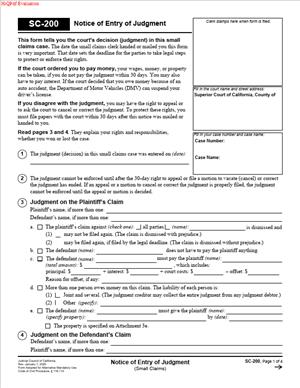
SC-200 – Notice of Entry of Judgment
Fill out nowJurisdiction: Country: United States | Province or State: California
The California SC-200, Notice of Entry of Judgment, is a court document used in small claims cases. It communicates the outcome of a case after the court has made a decision. This document matters because it formally records that a judgment has been entered.
You usually encounter this form after a hearing has already happened. The judge has decided the case, and the court needs to notify the parties. This form serves as that notice.
If you are representing yourself, this document can feel confusing at first. It looks procedural, but it carries practical consequences. Understanding what it says helps you know where things stand.
This form does not reopen the case or explain the judge’s reasoning. It focuses on recording and sharing the judgment. Reading it carefully helps you understand the result and what may happen next.
Although it is a court document, it is not something you argue or negotiate. It reflects what the court has already done. Your role is to understand the information it contains.
What is SC-200 – Notice of Entry of Judgment?
Clear definition
SC-200 – Notice of Entry of Judgment in California is a written notice that a judgment has been officially entered in a small claims case. It identifies the case, the parties, and the result. It is issued after the court finalizes its decision.
The document acts as a formal record that the judgment exists. It is not the judgment itself. Instead, it confirms that the judgment has been entered into the court record.
This form often includes the date of entry and basic information about the outcome. That date can matter for timing-related issues later. The document is designed to be brief and factual.
Who typically uses form SC-200?
This document is commonly used by the court to notify the parties. The clerk typically prepares and sends it. Plaintiffs and defendants receive it after the case is decided.
People who represent themselves in small claims often rely on this notice. It may be the first written confirmation of the court’s decision. Both sides usually receive the same type of notice.
Attorneys are less common in small claims, but when involved, they also receive this document. Anyone named in the case may be listed or referenced in it.
Why might you need the SC-200 form?
You may need this document to confirm the outcome of your case. It provides written proof that a judgment was entered. This can be useful for your personal records.
The form can also clarify when the judgment became official. The entry date can affect deadlines that exist outside the form itself. Knowing that date helps you understand the case timeline.
If questions arise later about whether a judgment exists, this notice helps answer that. It shows that the court completed a key step. It may be requested in follow-up court interactions.
Typical real-life scenarios
- You attended a small claims hearing and waited weeks for a decision. One day, you receive this notice in the mail. It confirms the judge has entered a judgment and shows the result.
- You did not attend the hearing and later received this document. It alerts you that the case moved forward and that a judgment was entered. The notice is your first indication of the outcome.
- You won a small claims case and received the notice. It confirms that the judgment is now part of the court record. You keep it with your case paperwork.
- You lost or partially lost a case and received the notice. It provides official confirmation of the decision. The document helps you understand what the court recorded.
When would you use SC-200 – Notice of Entry of Judgment?
You encounter SC-200 – Notice of Entry of Judgment after the court has decided a small claims case. It is used once the judge’s decision becomes an official judgment. The timing is tied to the court’s internal process, not to the parties’ actions.
This document is used whether the decision was made in court or after the hearing. In some cases, judges take matters under consideration. The notice is sent when the judgment is entered.
Both plaintiffs and defendants receive or review this form. It does not matter who won or lost. The purpose is to notify all parties of the entry.
People often refer to this document when reviewing their case history. It can come up when organizing records or clarifying a case’s status. It may also be referenced in later court filings.
Legal characteristics of SC-200 – Notice of Entry of Judgment
This form is effective because it reflects an action already taken by the court. Its validity derives from the court’s authority, not from the parties’ signatures. Accuracy of case information is essential.
Problems commonly arise when names, addresses, or case numbers are incorrect. Errors can cause confusion about who was notified. They do not usually change the judgment itself.
In California, small claims procedures are standardized. Other jurisdictions may use different forms or terminology. The concept of a notice of entry of judgment is common, but details vary.
This document does not explain how the judge reached the decision. It does not provide instructions on the next steps. It also does not enforce the judgment on its own.
Is it legally binding?
The notice itself is not a binding agreement between the parties. It does not create obligations by signing. Instead, it confirms that a binding judgment exists.
The legal effect comes from the judgment, not the notice. The notice serves as proof that the judgment was entered. Its role is informational, not contractual.
How to fill out SC-200 – Notice of Entry of Judgment
Step 1 – Case identification
You start by confirming the case name and case number. These details match the original small claims filing. Accuracy here ensures the notice applies to the correct case.
Step 2 – Court information
Review the court name and location listed on the form. This identifies which court entered the judgment. It ties the document to the proper jurisdiction.
Step 3 – Party names
Check that the names of the plaintiff and defendant are correctly stated. These names should match earlier filings. Correct identification avoids confusion about who is affected.
Step 4 – Judgment entry date
Look for the date the judgment was entered. This is not always the hearing date. The entry date reflects when the court officially recorded the decision.
Step 5 – Judgment result
Review the section that indicates the outcome. This may show who prevailed or how the case was resolved. The language is usually brief and factual.
Step 6 – Clerk certification
Notice any indication that the clerk issued or certified the notice. This shows the document was generated by the court. It confirms the notice is official.
Step 7 – Distribution information
Check how the notice was sent to the parties. This may include mailing details. It helps confirm that all parties were notified.
Step 8 – Final review
Read the entire form once more for consistency. Make sure all information aligns with your understanding of the case. Then keep the document with your records.
Legal terms you might encounter in SC-200 – Notice of Entry of Judgment
- Judgment: This is the court’s final decision in the case. On this form, it refers to the outcome entered by the judge, including who won and what was awarded. You are not restating arguments here; you are recording what the court already decided.
- Entry of Judgment: The moment the judgment is officially recorded by the court clerk. The date of entry on this document matters because many deadlines start running from that date rather than from the hearing date.
- Prevailing Party: This is the person or business that won the case, either in whole or in part. The form reflects this by identifying who the judgment favors. Make sure the name matches exactly how it appears in the case record.
- Judgment Debtor: The party ordered to pay money or perform an obligation. The form uses this term to identify the person against whom the judgment is issued. Errors here can cause confusion later if enforcement becomes necessary.
- Judgment Creditor: This is the party entitled to receive money or relief under the judgment. On the form, this is the person or entity the judgment benefits. Accurate naming matters for future collection steps.
- Clerk of the Court: The clerk is the court official who processes filings and certifies entries. In this document, the clerk’s role is to confirm that the judgment has been entered and that notice is being given.
- Notice: In this context, notice means formal communication that the judgment has been entered. This form serves as proof that parties were informed, which can affect appeal and payment timelines.
- Service: The delivery of a copy of the notice to the parties. The form often includes information about how and when copies were sent, which becomes part of the court record.
- Appeal Period: This is the limited time in which a party may challenge the judgment. The entry date recorded on this document is what usually triggers that countdown.
FAQs
What exactly does SC-200 – Notice of Entry of Judgment do?
This document records that the court’s decision has been officially entered into the record. It does not decide anything new. It tells you the judgment date, the result, and confirms that notice of that entry is being provided to the parties.
Is this form the same as the judgment itself?
No. The judgment is the court’s decision. This form is a notice that the clerk has entered the decision. You should read it alongside the judgment to understand both the outcome and the timing.
Which date on this form controls deadlines?
Look for the entry date shown on this document. That date usually controls when time limits begin, such as the time to appeal or to take the next steps related to payment.
Who fills out and signs this form?
The clerk of the court typically completes and certifies it. As a self-represented person, you usually receive a copy rather than filling it out yourself, but you still need to review it carefully for accuracy.
What if the names or amounts listed are wrong?
Compare every name and number to the judgment and the case caption. If something does not match, you should act quickly to raise the issue with the court so the record can be corrected.
Do I need to attach anything to this document?
This form usually stands alone. However, you should keep it together with a copy of the judgment and any proof showing when notice was sent or received.
How do I know if the notice was properly sent?
Check the section showing distribution or mailing. It should indicate who received copies and when. That information becomes important if someone later disputes timing.
Does receiving this form mean the case is completely finished?
It means the court has finalized and entered the decision. Other steps may still follow, such as payment, compliance, or enforcement, depending on what the judgment requires.
Checklist: Before, During, and After SC-200 – Notice of Entry of Judgment
Before
- Review the judgment so you understand the outcome being recorded.
- Confirm the full legal names of all parties as they appear in the case.
- Note the hearing date and compare it to the expected entry date.
- Prepare a file to keep this document with related case papers.
- Understand which deadlines depend on the entry date.
- Check whether you are expecting the clerk to mail this notice.
- Set reminders for follow-up actions tied to the entry date.
During
- Read every field to confirm it matches the judgment.
- Verify that the case number and court name are correct.
- Check the judgment entry date carefully.
- Confirm who is listed as the prevailing party and the opposing party.
- Review the clerk certification section for completeness.
- Look at the distribution section to see who was notified.
- Make a note of any discrepancies you see immediately.
After
- Make at least one copy for your personal records.
- Store the original or official copy in a secure place.
- Calendar any deadlines that run from the entry date.
- Share a copy with anyone who needs to know the result.
- Update your personal notes about the case outcome.
- Monitor for compliance with the judgment terms.
- Keep proof of when you received this notice.
Common mistakes to avoid with SC-200 – Notice of Entry of Judgment
- Mistake: Skimming the form, which happens because it looks routine, but leads to missed errors that can affect deadlines, so do not forget to read every line.
- Mistake: Confusing the hearing date with the entry date, often due to unfamiliarity with the court process, which can cause missed appeal periods, so always confirm the correct date.
- Mistake: Ignoring name discrepancies, which happens when parties assume minor spelling errors do not matter, but can cause enforcement problems, so verify exact matches.
- Mistake: Failing to note who received notice, which occurs when the distribution section is overlooked, leading to disputes later, so check that section carefully.
- Mistake: Misplacing the document, often because it seems less important than the judgment, but this can leave you without proof of notice, so file it properly.
- Mistake: Assuming no further action is needed, which happens when people think entry ends the process, but obligations may follow, so remember to track next steps.
- Mistake: Not calendaring deadlines, which occurs due to uncertainty about timing, but can forfeit rights, so always set reminders.
What to do after filling out SC-200 – Notice of Entry of Judgment
Once this document is complete and issued, your role shifts to confirming, organizing, and acting on the information it contains. Even if you did not prepare it yourself, you are responsible for understanding what it records and what it triggers. Treat it as a timing document, not just a summary.
Start by making sure you have a clear, readable copy. If you received it by mail, check that all pages are included. If you received it electronically, save it in a dedicated folder. This is the version you will rely on later if questions come up.
- Step 1: Compare the document line by line with the judgment to ensure accuracy.
- Step 2: Write down the judgment entry date in your calendar and notes.
- Step 3: Identify any deadlines that run from that date and mark them clearly.
Next, organize your records. Keep this notice with the judgment, any proofs of service, and your notes from the hearing. Having everything together saves time if you need to reference the case months later.
- Step 4: Make copies for personal files and for anyone else involved.
- Step 5: Update any internal logs or case summaries you maintain.
Then, think about compliance. If the judgment requires payment or another action, track whether it happens by the required time. This document helps show when the obligation became official.
- Step 6: Monitor whether the judgment terms are being followed.
- Step 7: Keep notes of any payments, communications, or actions taken.
Finally, stay alert for follow-up mail or notices from the court. Sometimes additional paperwork follows the entry of judgment. Keep everything together and in order.
- Step 8: Watch for additional court correspondence.
- Step 9: Store the document long-term in case enforcement or review becomes necessary.
Disclaimer: This guide is provided for informational purposes only and is not intended as legal advice. You should consult a legal professional.