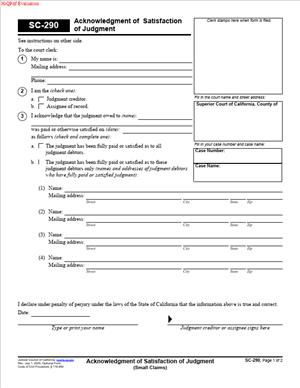
SC-290 – Acknowledgment of Satisfaction of Judgment
Fill out nowJurisdiction: Country: United States | Province or State: California
The SC-290 – Acknowledgment of Satisfaction of Judgment is a court form used after a judgment has been paid or otherwise resolved. It tells the court that the obligation created by the judgment is no longer outstanding. If you are about to fill it out, you are likely at the final stage of a small claims case.
This document matters because court records do not update themselves. Even when money has changed hands, the judgment remains active in the system until someone files this acknowledgment. The form connects what happened in real life with what appears in the court file.
People often encounter this form unexpectedly. You may have received payment and been asked to sign something. You may also be trying to clear a judgment that shows as unpaid. Understanding what the form does helps you complete it accurately.
This guide walks through the purpose, timing, and structure of the SC-290 – Acknowledgment of Satisfaction of Judgment. It explains how the form generally works and what each part is asking for, using plain language and practical context.
What is SC-290 – Acknowledgment of Satisfaction of Judgment?
Clear definition
The SC-290 – Acknowledgment of Satisfaction of Judgment is a written statement filed with the court to confirm that a judgment has been satisfied. Satisfaction usually means the full amount owed under the judgment has been paid. In some situations, it can also reflect a settlement or other agreed resolution.
The form becomes part of the court record. Once accepted, it shows that the judgment is no longer unpaid. This update affects how the case appears in searches and internal court systems.
This document does not reopen the case or change the original decision. It simply records that the judgment has been addressed. Think of it as closing the loop between the court’s order and what actually happened afterward.
Who typically uses this form/document?
The form is commonly completed by the judgment creditor. That is the person or entity who won the judgment and was entitled to receive payment. After receiving what the judgment requires, that party signs and submits the acknowledgment.
In some situations, the judgment debtor is involved in preparing the form. The debtor is the person who owes the money. This may happen when the creditor asks the debtor to file it, or when the debtor needs proof that the judgment is satisfied.
Court clerks interact with the form as part of processing. They review it for completeness and record it in the case file. The judge is usually not involved unless there is a dispute or problem.
Why you might need this form/document
You may need this form to update the court after payment. Without it, the court record can continue to show an unpaid judgment. That mismatch can create confusion later.
You may also need it as proof. A filed acknowledgment shows that the judgment has been satisfied as of a certain date. This can matter when explaining the case history or responding to questions about the judgment.
In some cases, the form is needed to release or clear follow-up actions connected to the judgment. Those actions might include enforcement steps that were started while the judgment was unpaid.
Typical real-life scenarios
- A common situation is full payment after a small claims hearing. The losing party pays the amount ordered, either right away or over time. Once the final payment is made, the winning party completes the form to reflect that result.
- Another scenario involves payment through enforcement. The judgment creditor may have taken steps to collect, and the judgment is eventually paid through those efforts. The acknowledgment then documents that the collection is complete.
- Sometimes the parties reach an agreement after judgment. The creditor agrees to accept a certain amount, and the debtor pays it. The form is used to record that the judgment is satisfied under that agreement.
- There are also cases where a third party pays on behalf of the debtor. For example, an insurer or another responsible party may cover the amount. The acknowledgment still serves the same purpose of updating the court record.
When would you use SC-290 – Acknowledgment of Satisfaction of Judgment?
You would use the SC-290 – Acknowledgment of Satisfaction of Judgment after the judgment has been satisfied. This usually means after the full amount ordered by the court has been paid. Timing matters because filing it too early can create inaccuracies.
The form is typically used once payment is complete, not while payments are ongoing. Partial payments are handled differently and are not what this document is designed to record. The acknowledgment signals completion, not progress.
In practice, the judgment creditor often initiates the filing. That person has the information needed to confirm receipt. The judgment debtor may be waiting for this filing to occur so the court record reflects the payment.
The form may also be used when satisfaction happens in a non-cash way that the parties have agreed on. Even then, the key point is that the judgment obligation has ended.
Legal characteristics of SC-290 – Acknowledgment of Satisfaction of Judgment
For the SC-290 – Acknowledgment of Satisfaction of Judgment to be effective, it must be completed clearly and accurately. The court looks for identifying details that match the original case, such as case number and party names. Missing or inconsistent information is a common source of problems.
Signatures are another important element. The form is intended to be signed by the party acknowledging satisfaction. If the signature is missing or unclear, the court may not process the filing.
Errors often arise from confusion about amounts or dates. The acknowledgment should reflect what the judgment required and when it was satisfied. Discrepancies can lead to delays or rejection by the clerk.
This form does not change the judgment itself. It does not erase the history of the case or reverse the court’s decision. It only records that the judgment has been satisfied.
Is it legally binding?
The SC-290 – Acknowledgment of Satisfaction of Judgment is legally meaningful once properly completed and filed. It represents a formal statement to the court about the status of the judgment. The court relies on this statement when updating its records.
Its binding effect comes from the accuracy of the information and the authority of the signer. The person signing is asserting that the judgment has been satisfied. That assertion carries weight in the court system.
However, the form does not create new obligations. It does not impose penalties or grant rights beyond recording satisfaction. Its role is limited to documenting what has already occurred.
How to fill out SC-290 – Acknowledgment of Satisfaction of Judgment
Step 1 – Review the case information
Start by gathering the details from the original small claims case. This includes the case number, court location, and the names of the parties as they appear on the judgment. Using the exact information from the judgment helps the clerk match the acknowledgment to the correct file.
Step 2 – Identify the judgment creditor
The form asks for information about the party acknowledging satisfaction. This is typically the judgment creditor. Make sure the name is written the same way it appears on the judgment, whether it is an individual or a business entity.
Step 3 – Identify the judgment debtor
Next, enter the name of the judgment debtor. This is the party who was ordered to pay. Accuracy matters here as well, especially if there were multiple parties in the case.
Step 4 – Confirm the judgment details
The form includes space to describe the judgment being satisfied. This often involves referencing the date of the judgment and the amount. The goal is to clearly identify which judgment is being acknowledged.
Step 5 – Indicate how the judgment was satisfied
You will be asked to state that the judgment has been satisfied. This is a confirmation, not a detailed explanation. The statement signals that the obligation under the judgment has been completed.
Step 6 – Review for completeness
Before signing, read through the entire form. Check that all required sections are filled in and that names, numbers, and dates are consistent. Small errors can slow down processing.
Step 7 – Sign and date the form
The person acknowledging satisfaction signs and dates the document. The signature shows that the information is being affirmed. Make sure the signature matches the name listed on the form.
Step 8 – Prepare the form for filing
Once signed, the form is ready to be submitted to the court. This step connects the completed document to the official court record, which is the purpose of the SC-290 – Acknowledgment of Satisfaction of Judgment.
Legal terms you might encounter in SC-290 – Acknowledgment of Satisfaction of Judgment
- Judgment: A judgment is the court’s final decision in a case. On this form, it refers to the money decision that was entered after the small claims hearing. You must use the exact judgment amount and date as they appear in the court record.
- Judgment creditor: This is the person or entity who won the judgment and is owed money. The creditor is usually the one who signs this document. The name must match the name shown on the judgment, not a nickname or shortened version.
- Judgment debtor: This is the person or entity who was ordered to pay. Their name must also match the judgment exactly. If there were multiple debtors, you need to be clear about which ones are covered by the satisfaction.
- Satisfaction of judgment: This phrase means the judgment has been paid or otherwise resolved. On this form, it shows whether the judgment was satisfied in full or in part. The court uses this information to update the public record.
- Partial satisfaction: A partial satisfaction means only some of the judgment amount has been paid. The form allows you to state this clearly. This matters because the remaining balance may still be enforceable.
- Clerk of the court: The clerk is the court official who processes filings. When this document is filed, the clerk updates the case record to show the judgment’s status. The clerk does not decide whether the payment was correct.
- Case number: This is the unique number assigned to the small claims case. It appears at the top of the judgment and must be entered exactly. A wrong case number can cause the filing to be rejected or misfiled.
- Accrued interest: Interest may have added to the judgment amount over time. When completing this form, you need to be clear whether the satisfaction includes interest. The form records what portion of the total obligation has been satisfied.
- Authorized signer: An authorized signer is someone legally allowed to sign on behalf of the judgment creditor. This could be the creditor personally or a representative. The form relies on the signer’s authority to make the satisfaction effective.
FAQs
Who is supposed to file SC-290 – Acknowledgment of Satisfaction of Judgment?
This document is usually completed and signed by the judgment creditor, because that person is confirming payment. In some situations, the judgment debtor may complete it if the creditor refuses, but the court record must show proper authority. You should look at who actually received the payment and who has the right to acknowledge it.
What does it mean if the judgment is satisfied in full versus in part?
Satisfied in full means the entire amount owed under the judgment has been paid or resolved. Satisfied in part means only a portion has been paid, and a balance remains. On this form, you must clearly mark which applies so the public record is accurate.
Do the names on this document have to match the judgment exactly?
Yes. The names must match the judgment as entered by the court. Even small differences can cause confusion when the clerk updates the record, so you should copy the names directly from the judgment paperwork.
What date should I use as the satisfaction date?
Use the date when payment was actually completed, or the obligation was otherwise satisfied. This is not the judgment date. The satisfaction date tells the court when the obligation ended or was reduced.
Can this form cover more than one judgment or case?
No. This document is tied to a single case number. If there are multiple judgments, each one needs its own completed form so the court can update each case separately.
What happens to the public record after this form is filed?
Once accepted, the court updates the case to show that the judgment has been satisfied in full or in part. This change becomes part of the court record. The form itself is evidence of that update.
Do I need to attach proof of payment?
This form does not require proof of payment to be attached. However, you should keep your own records in case questions come up later. The court relies on the signed acknowledgment rather than reviewing receipts.
What if the creditor signed but later claims the judgment was not paid?
The signed acknowledgment is a formal statement filed with the court. It carries weight because it is part of the case record. Any later dispute would have to address what is already recorded in this document.
Checklist: Before, During, and After SC-290 – Acknowledgment of Satisfaction of Judgment
Before
- Confirm the judgment has actually been paid or resolved.
- Locate the original judgment paperwork.
- Verify the exact case number and court name.
- Check the full legal names of all parties.
- Confirm whether satisfaction is full or partial.
- Identify who is authorized to sign.
- Gather your payment records for reference.
During
- Enter the case information exactly as shown on the judgment.
- Clearly mark full or partial satisfaction.
- Write the amount paid if it was partial.
- Double-check spelling of names.
- Use the correct satisfaction date.
- Review the signer’s name and title.
- Sign and date the form in the correct place.
After
- Make copies of the completed form.
- File the original with the court clerk.
- Confirm the filing was accepted.
- Provide a copy to the other party.
- Keep a copy with your financial records.
- Monitor the case record for updates.
- Note the satisfaction in your own tracking system.
Common mistakes to avoid with SC-290 – Acknowledgment of Satisfaction of Judgment
- Mistake: Using a nickname instead of the full legal name, which happens when people rely on memory, leading to record mismatches, so do not forget to copy names exactly from the judgment.
- Mistake: Marking full satisfaction when only partial payment was made, which often comes from misunderstanding the options, causing the record to show the debt as fully resolved, so do not forget to verify the total amount paid.
- Mistake: Listing the judgment date instead of the payment completion date, which occurs because both dates appear in case papers, affecting the accuracy of the court record, so do not forget to confirm when the payment actually occurred.
- Mistake: Leaving out the case number, which happens when people focus on names and amounts, delaying or rejecting filing, so do not forget to check the top of the judgment.
- Mistake: Having someone sign without proper authority, which can occur in business or family situations, makes the acknowledgment questionable, so do not forget to confirm the signer’s authority.
- Mistake: Filing the form without keeping copies, which often happens in a rush, making later proof difficult, so do not forget to save copies for yourself.
- Mistake: Assuming filing is automatic after signing, which happens when people think a signature alone is enough, leaving the record unchanged, so do not forget to actually submit it to the clerk.
- Mistake: Forgetting to give the other party a copy, which can cause confusion or disputes later, so do not forget to share the filed document.
What to do after filling out SC-290 – Acknowledgment of Satisfaction of Judgment
Once the form is complete, your focus shifts to making sure it is properly recorded and preserved. This document only has value if it reaches the court and becomes part of the official case file. Treat the next steps as part of the process, not an afterthought.
Step 1: Make at least two copies of the signed form. One is for your records, and one is for the other party. Keep them clean and readable.
Step 2: Decide how you will submit the original to the court. This may involve in-person filing or another accepted submission method. The goal is to get the form into the clerk’s hands.
Step 3: Submit the original form to the clerk of the court handling the case. Make sure the case number is visible so it is filed in the correct folder.
Step 4: Ask for confirmation that the form was received. This could be a stamped copy or another acknowledgment. Keep this with your records.
Step 5: Provide a copy to the judgment debtor or creditor, depending on your role. This helps both sides stay aligned on the status of the judgment.
Step 6: Check the case record after some time to confirm that the judgment status was updated. The record should reflect full or partial satisfaction as stated.
Step 7: Update your own financial or case tracking notes to reflect that the judgment has been satisfied. This avoids future confusion.
Step 8: Store all related documents together, including payment proof and the filed form. Organized records make future questions easier to answer.
Step 9: If you manage multiple cases or obligations, note this satisfaction in any internal systems you use. Consistency matters.
Step 10: Keep the documents for as long as you normally keep court records. Even satisfied judgments can come up later in background checks or disputes.
When done carefully, it prevents lingering legal exposure and ensures the court record accurately reflects that the matter is finished.
Disclaimer: This guide is provided for informational purposes only and is not intended as legal advice. You should consult a legal professional.