SC-140 – Notice of Appeal
Fill out nowJurisdiction: Country: United States | Province or State: California
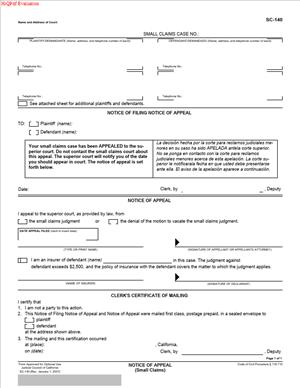
SC-140 – Notice of Appeal is a court form used to tell the court that you are asking for a review of a small claims decision. It is a formal way to start the appeal process after a judgment has been entered.
You encounter this form when a small claims case has ended, and you disagree with the outcome. The document does not argue your case. It simply gives notice that an appeal is being requested.
Timing matters with this filing. Courts expect this document to be completed accurately and submitted within a limited window after judgment.
If you are preparing to fill out SC-140 – Notice of Appeal, it helps to understand what information the court is asking for and why. That context makes the completion process more predictable and less stressful.
This form belongs to the California Small Claims Court. It reflects how appeals are initiated in that setting.
What is SC-140 – Notice of Appeal?
Clear definition
SC-140 – Notice of Appeal is a standardized court document used to notify the small claims court that a party wants a higher court to review the decision. It does not explain why the decision was wrong. It simply starts the appeal process.
The form records basic identifying information about the case, the parties, and the judgment being appealed. Once accepted, it signals that the case may move to the next procedural stage.
This document is administrative in nature. Its purpose is to preserve the right to appeal by meeting the court’s filing requirements.
Who typically uses this form/document?
This form is commonly used by people who were involved in a small claims case and are unhappy with the judgment. That includes individuals and businesses that were plaintiffs or defendants in the original case.
In many situations, the person filing is self-represented. Small claims courts are designed for people without attorneys, and this form reflects that simplicity.
Court clerks, judges, and appellate staff rely on the information in this document to track the appeal and connect it to the original case record.
Why you might need this form/document
You may need this form if a judgment has been entered in a small claims case and you want the decision reviewed. Filing the notice is what formally tells the court system that you are pursuing that option.
Without this document, the judgment typically becomes final. The form acts as the procedural bridge between the small claims decision and the appeal process.
Completing the form correctly helps avoid delays. It ensures the court can identify the case and apply the correct rules going forward.
Typical real-life scenarios
- You went to small claims court over a disputed service bill. The judge ruled against you, and you believe important information was misunderstood. Filing this document starts the process of having the decision reviewed.
- You were sued in small claims court by a former tenant. After judgment was entered, you disagreed with how damages were calculated. This form is how you notify the court that you are appealing.
- You ran a small business and lost a case involving a customer refund. The amount at issue matters to your finances, and you want another look at the outcome. This document begins that request.
- You represented yourself in a small claims case involving property damage. After the decision, you felt the evidence was not fully considered. Filing this form preserves the appeal pathway.
When would you use SC-140 – Notice of Appeal?
You would use SC-140 – Notice of Appeal after a small claims judgment has been entered and before the appeal deadline passes. The form is tied to a specific stage in the case lifecycle.
This filing comes after the trial is over, not during it. It is not used to ask for a new hearing in the same court at the same level. It is used to signal movement to an appellate review process.
People often prepare this document soon after receiving notice of the judgment. That is because appeal windows are commonly short in small claims matters.
The form may be used by either side of the case, depending on who is permitted to appeal in that situation. The court uses the filing date to determine whether the appeal was timely.
Legal characteristics of SC-140 – Notice of Appeal
This document has legal effect because it is recognized by the court as the formal notice required to start an appeal. It must be completed with accurate case information to be accepted.
Courts typically look for completeness and clarity. Missing case numbers, unclear party names, or inconsistent judgment details commonly cause processing problems.
Filing the form does not guarantee that the appeal will succeed. It only initiates the process that allows a higher court to review the matter.
Procedural rules may vary in how appeals are handled, but the core function of this form is consistent. It acts as a notice, not an argument or evidence submission.
This document does not pause enforcement automatically in all situations. Its role is limited to notifying the court of the appeal request.
Is it legally binding?
The form itself is not a contract or agreement between parties. It is legally effective because it is a required procedural filing recognized by the court.
Once filed and accepted, it binds the process rather than the people. It commits the case to the appellate track under the court’s rules.
The information you provide is expected to be truthful and accurate. The court relies on it to manage the case properly.
How to fill out SC-140 – Notice of Appeal
Step 1 – Identify the court
You begin by indicating the court where the original small claims case was filed. This helps ensure the appeal is connected to the correct case record.
Step 2 – Enter the case number
The form asks for the small claims case number. This number links the notice to the exact judgment being appealed.
Step 3 – List the parties
You provide the names of the parties involved in the case as they appeared in the original judgment. Consistency with prior filings is important for clarity.
Step 4 – Identify the judgment
The form includes space to identify the judgment you are appealing. This usually involves the date the judgment was entered.
Step 5 – Indicate who is filing the appeal
You specify whether you are the plaintiff or the defendant in the original case. This helps the court understand your role in the appeal.
Step 6 – Provide contact information
The form requests your contact details. The court uses this information to send notices and updates about the appeal.
Step 7 – Review the form for completeness
Before signing, you review the document to confirm all sections are filled in and the information matches the original case record.
Step 8 – Sign and date the form
You sign and date the form to confirm that the information provided is accurate to the best of your knowledge. This signature finalizes the notice for submission.
Legal terms you might encounter in SC-140 – Notice of Appeal
- Notice of Appeal: This is the document that tells the court you want a higher court to review the small claims judgment. On this form, it records who is appealing and which decision is being challenged. It does not explain your arguments.
- Judgment: The judgment is the court’s final decision in your small claims case. On the form, you identify the date the judgment was entered and whether it was for money or other relief.
- Appellant: The appellant is the person or entity asking for the appeal. You check boxes and list names to show who is filing the appeal and who is not.
- Respondent: The respondent is the other party who is not filing the appeal. The form captures this role so the court knows who must be notified.
- Case Number: This is the unique number the court assigned to your small claims case. You must copy it exactly as it appears on prior court papers so the appeal is matched to the correct file.
- Entry of Judgment: This refers to when the clerk officially records the judgment in the court record. The appeal period usually runs from this entry date, which is why the form asks for it.
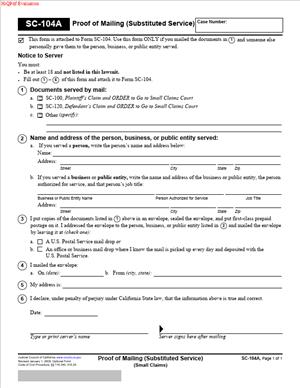
- Service: Service means delivering a copy of the filed form to the other party in an approved way. The form itself may not include proof of service, but the appeal process requires it.
- Clerk of the Court: The clerk is the court office that accepts filings and maintains records. You submit this document to the clerk, not to the judge directly.
- Filing Fee: This is the amount charged by the court to process the appeal. The form does not calculate the fee, but filing is not complete until the fee issue is addressed.
FAQs
How do I know which judgment date to write on this form?
Look at the notice you received after the hearing and find the date the judgment was entered by the clerk. That is the date you copy onto this document, not the hearing date or the day you received the notice.
What if my name is spelled differently on older court papers?
Use the exact spelling that appears on the judgment. If your name has changed or was misspelled before, keep it consistent here so the court links the appeal correctly.
Can more than one person file an appeal using the same form?
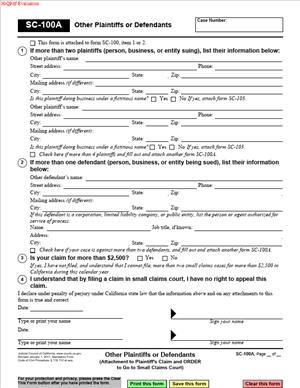
Yes, if multiple parties on the same side are appealing the same judgment, they can be listed together. Make sure every appealing party is clearly identified as an appellant on this document.
Do I need to explain why I am appealing in SC-140 – Notice of Appeal?
No. This form only records that you are appealing and identifies the judgment. Reasons, evidence, or arguments are not entered here and are handled later in the process.
What happens if I file this document but forget to serve the other party?
Filing alone does not complete the appeal process. If service is required and not done, the appeal can be delayed or rejected, so you need to track service separately.
Can someone else sign the form for me?
The person filing the appeal signs the document. If a representative signs, their authority must match the role listed, or the clerk may question the filing.
How will I know the court accepted this form?
After filing, the clerk typically stamps the form or issues a receipt or notice. Keep that confirmation with your records because it shows the appeal was received.
Does filing this document change the public court record?
Yes. Once filed, it adds an appeal entry to the case history. The original judgment remains visible, but the record will show that it is being appealed.
Checklist: Before, During, and After SC-140 – Notice of Appeal
Before
- Confirm the judgment has been entered by the clerk.
- Locate the exact case number from prior court papers.
- Verify the full legal names of all parties.
- Decide which parties are appealing and which are not.
- Check any deadlines you are tracking internally.
- Prepare payment or fee waiver paperwork if applicable.
During
- Write the court name exactly as shown on the judgment.
- Enter the case number without adding or dropping digits.
- Mark the correct boxes for appellant and respondent.
- Record the judgment date accurately.
- Review every field for blanks or inconsistencies.
- Sign and date the form in the designated area.
After
- Make copies for your records and other parties.
- File the original with the court clerk.
- Arrange service for the other party if required.
- Keep proof of filing and any receipts.
- Watch for notices from the court about next steps.
- Update your personal case file with the appeal details.
Common mistakes to avoid with SC-140 – Notice of Appeal
- Mistake: Writing the hearing date instead of the entry of judgment date, because it seems more familiar, which can affect appeal timing, so do not forget to confirm the clerk’s entry date.
- Mistake: Using a nickname or shortened business name, because it feels informal, which can cause record mismatches, so do not forget to copy names exactly.
- Mistake: Leaving out a co-party who wants to appeal, because roles are confusing, which can limit who is included, so do not forget to list every appellant.
- Mistake: Forgetting to sign the form, because the focus is on content, which can lead to rejection, so do not forget the signature line.
- Mistake: Filing without keeping copies, because filing feels final, which can leave you without proof, so do not forget to save stamped copies.
- Mistake: Assuming filing alone notifies the other side, because the process feels automatic, which can delay the appeal, so do not forget service responsibilities.
What to do after filling out SC-140 – Notice of Appeal
Once the form is complete, your focus shifts to filing, tracking, and follow-through. Appeals create a paper trail, and staying organized helps you respond quickly to court notices. Treat the filing as the start of a new phase, not the end of the task.
- Step 1: Make at least two copies of the completed and signed form.
- Step 2: File the original with the court clerk using the accepted submission method.
- Step 3: Address the filing fee or fee waiver at the time of filing.
- Step 4: Obtain confirmation that the clerk accepted the filing.
- Step 5: Serve a copy on the other party if required by the process.
- Step 6: Keep proof of service with your records.
- Step 7: Create a simple appeal file with dates, copies, and notes.
- Step 8: Watch for mail or notices about the next court date or instructions.
- Step 9: Update any internal timelines you are tracking for the appeal.
- Step 10: Bring your file to any future court interactions related to the appeal.
Disclaimer: This guide is provided for informational purposes only and is not intended as legal advice. You should consult a legal professional.