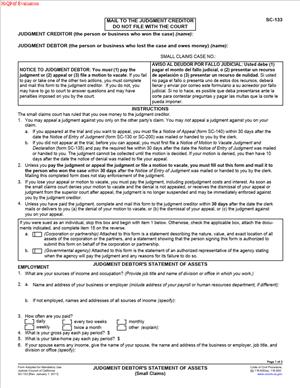
SC-133 – Judgment Debtor’s Statement of Assets (Small Claims)
Fill out nowJurisdiction: Country: United States | Province or State: California
SC-133 – Judgment Debtor’s Statement of Assets (Small Claims) is a court form used after a small claims judgment. It focuses on money, property, and income. The goal is to create a clear picture of a judgment debtor’s financial situation.
You usually encounter this form after a court has already decided the case. The judgment is final. What remains is understanding how, or whether, payment may occur.
This document matters because it asks for detailed financial information. That information can affect what happens next in the case. Accuracy and completeness are central to its purpose.
If you are filling this out yourself, it often feels high stakes. You may be unsure why each question is asked. You may also worry about what must be disclosed.
This guide walks you through the form in plain language. It explains what the document is designed to do, when it comes up, and how people commonly complete it.
What is SC-133 – Judgment Debtor’s Statement of Assets (Small Claims)?
Clear definition
SC-133 – Judgment Debtor’s Statement of Assets (Small Claims) is a court filing used in small claims cases after a judgment. It requires the judgment debtor to list assets, income sources, and certain financial details.
The form is structured as a sworn statement. The person completing it signs under penalty of perjury. That signature confirms the information provided is true and complete to the best of the signer’s knowledge.
This document does not decide who wins or loses the case. That decision already happened. Instead, it focuses on what resources exist to satisfy the judgment.
Who typically uses this form/document?
This form is typically completed by a judgment debtor. That is the person or business the court ordered to pay money in a small claims case.
Individuals often use the form after a court appearance or after receiving a notice from the court. Small business owners may also be required to complete it if the judgment was entered against the business.
While the judgment creditor does not complete the form, they are often the reason it is requested. The information helps them understand potential payment options.
Why you might need this form/document
You may need this document because the court requires financial disclosure after a judgment. The form creates a standardized way to provide that information.
Courts use it to track whether a judgment debtor has income or assets that could be used toward payment. It helps the court manage enforcement-related issues.
For the judgment debtor, the form serves as a record. It shows what was disclosed at a specific point in time.
Typical real-life scenarios
- A person loses a small claims case involving unpaid rent. The court enters a money judgment. Shortly after, the person is asked to complete a statement of assets.
- A driver is found responsible for property damage after a minor accident. The judgment includes repair costs. The driver later fills out this form to disclose income and property.
- A small business owner loses a dispute over services. The business does not immediately pay the judgment. The owner is required to submit financial details using this document.
- An individual agrees they owe the money but cannot pay in full. The form is used to document what funds and assets exist at that time.
When would you use SC-133 – Judgment Debtor’s Statement of Assets (Small Claims)?
This form is used after a small claims judgment has already been entered. It does not come up during the trial itself.
It commonly appears when payment has not been made right away. The court may request it to understand the judgment debtor’s financial position.
The timing often follows a court order or notice. The form may be due by a specific date set by the court.
Both individuals and businesses may be involved. The key factor is that the court has already determined liability and issued a money judgment.
This document is not used to negotiate the amount owed. It is used to disclose information after the amount has been set.
Legal characteristics of SC-133 – Judgment Debtor’s Statement of Assets (Small Claims)
This form has legal significance because it is a sworn statement filed with the court. The information is expected to be truthful and complete.
Its effectiveness depends on proper completion and signing. Missing information, unclear entries, or unsigned forms commonly cause problems.
Courts generally expect the form to reflect current financial information. Outdated or estimated figures can raise questions.
While the structure is standardized, details may vary by jurisdiction. Courts may differ in how strictly they review entries or follow up on incomplete disclosures.
This document does not automatically result in payment. It does not create a payment plan or change the judgment amount. It also does not protect assets or limit future enforcement actions.
Is it legally binding?
The form is legally binding in the sense that it is signed under penalty of perjury. The signer is making a formal declaration to the court.
It does not bind the parties to a new agreement. It does not replace the judgment or modify its terms.
The binding effect relates to the truthfulness of the information provided. Courts rely on that information when deciding next steps related to the judgment.
How to fill out SC-133 – Judgment Debtor’s Statement of Assets (Small Claims)
Step 1 – Identify the case and parties
The first section asks for basic case information. This usually includes the court name, case number, and the names of the parties. Enter this information exactly as it appears on the judgment or court notices. Consistency helps the court match the form to the correct case.
Step 2 – Provide personal or business details
Next, the form asks for identifying details about the judgment debtor. This may include an address, contact information, and employment or business status. The purpose is to confirm who is providing the information and how they can be reached.
Step 3 – Disclose employment and income sources
This section focuses on income. It often asks about employment, self-employment, or other regular sources of money. The form is designed to capture where income comes from, not just how much is received.
Step 4 – List cash and bank accounts
You are asked to identify cash on hand and financial accounts. This includes checking and savings accounts. The form typically asks for approximate balances rather than precise daily figures.
Step 5 – Describe real property interests
If you own or have an interest in real estate, the form asks for details. This may include the type of property and how it is held. The goal is to identify ownership, not to appraise value in detail.
Step 6 – Identify vehicles and valuable personal property
This step covers vehicles and other significant personal property. Examples include cars, motorcycles, or equipment. The form usually focuses on items of notable value rather than everyday household goods.
Step 7 – Report other assets and rights to payment
Some sections ask about additional assets. These can include money owed to you, pending claims, or other rights to receive funds. This captures financial interests that are not physical property.
Step 8 – Note debts and obligations
The form may ask about existing debts. This provides context for the overall financial picture. It helps show how income and assets relate to existing financial responsibilities.
Step 9 – Review and sign the declaration
The final step is the declaration. Read it carefully. By signing, you confirm the information is accurate and complete. The signature turns the form into a sworn statement filed with the court.
Legal terms you might encounter in SC-133 – Judgment Debtor’s Statement of Assets (Small Claims)
- Judgment Debtor: This is you if the court decides you owe money. On this form, that label tells the court whose assets are being listed. Your name must match the judgment exactly, including any middle initials or business suffixes.
- Judgment Creditor: This is the person or business you owe. Their name appears so the court can connect your asset statement to the correct judgment. You do not list their assets here.
- Case Number: This number ties your statement to a specific small claims case. It appears in the judgment and on other court papers. Entering the wrong number can cause your filing to be rejected or misfiled.
- Declaration: This is your sworn statement that everything you listed is true and complete. When you sign, you are saying you did not hide assets or leave things out. The declaration is why accuracy matters throughout the form.
- Assets: Assets are things you own or have a legal right to receive. In this document, assets include cash, bank accounts, vehicles, real property, and money owed to you. You list assets even if they are shared or hard to sell.
- Exempt Property: Some assets may be protected by law from collection. This form still asks you to list them. The court decides how exemptions apply, not you.
- Earnings: Earnings include wages, salary, commissions, and similar income. The form asks for current employment and pay details to show how money comes in. Report gross amounts as requested, not just what you take home.
- Personal Property: This covers items you own that are not real estate. Vehicles, equipment, jewelry, and valuable household items often fall here. You usually describe the item, its location, and its estimated value.
- Accounts Receivable: This means money others owe you. It could be from work you already did, loans you made, or settlements pending payment. If you expect to receive money, it usually belongs in this section.
FAQs
Do I have to list everything I own on SC-133 – Judgment Debtor’s Statement of Assets (Small Claims)?
Yes. This form is designed to show a full financial picture at the time you complete it. You list assets even if you think they are exempt, shared, or worth very little.
What date should I use for the information I enter?
Use the date you actually complete and sign this document. The entries should reflect what you own and earn as of that day. Do not backdate or guess about future changes.
What if an asset is jointly owned with someone else?
You still list it and explain your share. Describe who else owns it and how ownership is divided. This helps the court understand what portion belongs to you.
How exact do values need to be?
You are expected to give reasonable estimates. Use recent statements, pay stubs, or market values if you have them. If you are unsure, explain how you arrived at the number.
What if I do not have a bank account or steady job?
You still complete those sections and write “none” or “not applicable” where appropriate. Leaving blanks can look like you skipped information. Clear answers avoid follow-up problems.
Can I attach extra pages or documents?
Yes, if you need more space. Make sure your name and case number appear on each attachment. Refer to the attachment in the relevant section so it is clear what it supports.
Who signs this form if the judgment debtor is a business?
An authorized person signs, such as an owner or officer. The signer confirms they have authority and personal knowledge of the business finances. The signature makes the declaration binding on the business.
What happens after I file this document?
The court records it, and the judgment creditor can review it. It becomes part of the case file. If the information later changes, you may need to update what you reported.
Checklist: Before, During, and After SC-133 – Judgment Debtor’s Statement of Assets (Small Claims)
Before
- Gather the judgment, case number, and party names
- Collect recent pay stubs or income records
- Obtain bank statements and account balances
- List vehicles, property, and valuable items you own
- Identify any money others owe you
- Note shared ownership details for assets
- Set aside time to complete the form carefully
During
- Write names exactly as they appear on the judgment
- Fill in every section, even if the answer is “none”
- Use clear descriptions for property and accounts
- Enter estimated values honestly and consistently
- Attach extra pages if space runs out
- Review each section for completeness
- Sign and date the declaration
After
- Make at least one copy for your records
- Submit the form using the required method
- Confirm the court accepted your filing
- Keep proof of submission
- Calendar any follow-up deadlines
- Update your records with what you disclosed
- Be ready to explain entries if asked later
Common mistakes to avoid with SC-133 – Judgment Debtor’s Statement of Assets (Small Claims)
- Mistake: Leaving blanks instead of writing “none,” often caused by rushing, which can lead to rejection or suspicion, so do not forget to address every line.
- Mistake: Guessing wildly at values without a basis, usually from lack of records, which can undermine credibility, so do not forget to explain reasonable estimates.
- Mistake: Using a nickname or shortened business name, which happens when copying from memory, causing name mismatches, so do not forget to match the judgment exactly.
- Mistake: Omitting jointly owned property because it feels complicated, which can appear misleading, so do not forget to list it with an explanation.
- Mistake: Forgetting to attach extra pages when space runs out, often due to formatting limits, which leaves information missing, so do not forget to label attachments.
- Mistake: Signing without reviewing the declaration, caused by fatigue, which carries legal consequences, so do not forget to read what you are swearing to.
- Mistake: Listing net pay instead of gross earnings, which happens from habit, leading to confusion, so do not forget to follow the form’s income instructions.
- Mistake: Using outdated information, caused by preparing early, which makes the statement inaccurate, so do not forget to update before signing.
What to do after filling out SC-133 – Judgment Debtor’s Statement of Assets (Small Claims)
Once the form is complete, slow down and shift from writing to managing the process. What you do next affects whether the court accepts it and how it is used. Keep everything organized and traceable.
- Step 1: Make clean copies of the signed form and any attachments.
- Step 2: Check the submission method required for your case and prepare accordingly.
- Step 3: Submit the form using the proper channel and keep proof of submission.
- Step 4: Confirm acceptance by the court, if confirmation is provided.
- Step 5: File your copy in a safe place with the judgment paperwork.
- Step 6: Update your personal or business records to match what you disclosed.
- Step 7: Watch for communications related to the judgment after filing.
- Step 8: Be prepared to explain or clarify entries if questions arise.
- Step 9: Note any changes in your assets after filing.
- Step 10: If circumstances change, track dates and details so updates are accurate.
Additional guidance to avoid issues:
- Include vehicles that are not currently running, leased vehicles with equity, or vehicles used primarily for work.
- If a vehicle is financed, list it anyway and note the lender and approximate balance.
- For valuable personal property, focus on resale or market value rather than sentimental value.
- If you are unsure whether an item is “valuable enough,” it is safer to disclose it with an estimate.
Disclaimer: This guide is provided for informational purposes only and is not intended as legal advice. You should consult a legal professional.