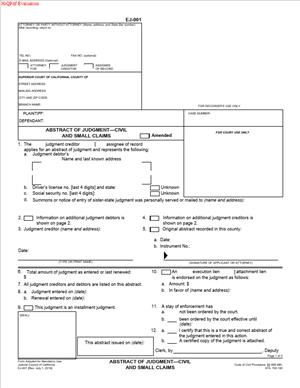
EJ-001 – Abstract of Judgment—Civil and Small Claims
Fill out nowJurisdiction: Country: United States | Province or State: California
The EJ-001 – Abstract of Judgment—Civil and Small Claims is a court form used after a money judgment has already been entered. It is not about deciding who wins. It is about recording that decision in a way that can affect property ownership.
You typically encounter this document when you are trying to understand what happens next after a judgment. The form plays a role in turning a court decision into a public record connected to real property.
This form matters because it can impact someone’s ability to sell, refinance, or transfer real estate. It creates a link between a judgment and property records.
If you are filling it out yourself, details matter. Small errors can cause delays or rejection. Understanding what the form does before you complete it can save time and confusion.
This document is commonly used in both civil and small claims cases. Even though small claims is informal in many ways, this form carries formal consequences once recorded.
What is EJ-001 – Abstract of Judgment—Civil and Small Claims?
Clear definition
EJ-001 – Abstract of Judgment—Civil and Small Claims is a standardized court form that summarizes a money judgment. It captures key information from the court’s judgment and presents it in a format used for recording.
The abstract does not restate the entire case. It highlights essential facts, such as who owes money, how much is owed, and when the judgment was entered.
Once completed and issued by the court, this document can be recorded with a county recorder. Recording is what allows the judgment to attach to certain types of property.
The form acts as an official snapshot of the judgment at a specific point in time. It reflects the judgment as entered, not later payments or changes.
Who typically uses this form/document?
This form is commonly used by judgment creditors. That is the party that was awarded money by the court.
Self-represented individuals often encounter this document after winning a small claims case. It may be one of the first post-judgment forms they see.
Attorneys and collection professionals also use this form in civil cases. In small claims matters, individuals frequently prepare it themselves.
Court clerks interact with this document as well. They review it, certify it, and issue it for recording when it meets requirements.
Why you might need this form/document
You may need this form if you want the judgment to appear in property records. That connection is what can create a judgment lien on real property.
Without this document, a judgment may exist only in the court file. That limits how visible it is outside the courtroom.
The form is also used to preserve priority. Recording earlier can matter when multiple claims exist against the same property.
In some situations, people use this document simply to understand the official details of their judgment. The form consolidates information in one place.
Typical real-life scenarios
- You win a small claims case for unpaid rent. The defendant does not pay right away. You start looking into what options exist after judgment, and this form comes up.
- You are owed money from a contractor dispute decided in civil court. You learn that the contractor owns real estate, and recording an abstract is discussed.
- You are on the receiving end of a judgment. During a refinance, a title report shows an abstract recorded years earlier, and you want to understand where it came from.
- You are helping a family member who represented themselves in small claims. They ask what paperwork turns the judgment into something that affects property.
When would you use EJ-001 – Abstract of Judgment—Civil and Small Claims?
This form is used after a court has entered a money judgment. It is not used before the case is decided.
People typically use it when payment has not been made voluntarily. It often comes up during post-judgment enforcement discussions.
The timing usually follows the entry of judgment and any required waiting period. The form reflects the judgment as it exists at that time.
Different roles interact with the form at different stages. The judgment creditor prepares it. The court issues it. A recorder later receives it for recording.
In small claims cases, this step often feels more formal than earlier parts of the case. That is because it connects the judgment to public property records.
Legal characteristics of EJ-001 – Abstract of Judgment—Civil and Small Claims
This document has legal effect because it is issued by the court based on an entered judgment. Its effectiveness depends on accuracy and proper handling.
Common problems include missing information, mismatched names, or incorrect judgment amounts. Even small inconsistencies can cause rejection.
Another issue is using outdated information. The form reflects a moment in time and does not automatically update if circumstances change.
High-level differences can exist depending on the type of case. Small claims judgments and civil judgments both use this form, but underlying procedures may vary.
This document does not collect money by itself. It does not garnish wages, levy bank accounts, or force payment.
It also does not determine ownership of property. It creates a recorded notice that may affect property interests.
Is it legally binding?
The abstract itself is not a separate judgment. It is legally effective because it is based on an existing judgment.
Its binding nature comes from the court’s authority and the accuracy of the information provided. If properly issued and recorded, it carries legal consequences.
If the underlying judgment is changed or satisfied, the abstract does not automatically disappear. Additional steps are typically required to reflect changes.
How to fill out EJ-001 – Abstract of Judgment—Civil and Small Claims
Step 1 – Identify the court
You begin by identifying the court that entered the judgment. This includes the court’s name and location. The information must match the judgment exactly.
This section anchors the document to a specific case file. Errors here can disconnect the abstract from the actual judgment.
Step 2 – Enter the case number
The case number is the unique identifier assigned by the court. It must be entered exactly as it appears on the judgment.
This number allows court staff and recorders to trace the abstract back to the original case. Even a single missing digit can cause problems.
Step 3 – List the judgment creditor
You provide the name of the judgment creditor. This is the person or entity awarded money.
Names should be entered in full. Abbreviations or informal versions can lead to mismatches with other records.
Step 4 – List the judgment debtor
You list the judgment debtor or debtors. These are the individuals or entities ordered to pay money.
Accuracy matters here because this information connects the judgment to property records. Name variations can affect search results.
Step 5 – Provide the judgment amount
You enter the amount of the judgment as ordered by the court. This reflects the principal amount at the time of entry.
This section does not track payments made later. It is a snapshot of the judgment when entered.
Step 6 – Include interest information
The form includes space for interest details. This typically reflects statutory interest associated with the judgment.
The information entered should align with the judgment and applicable rules. This section helps clarify how the amount may change over time.
Step 7 – Enter the date of judgment
You provide the date the judgment was entered by the court. This is not the hearing date unless they are the same.
The date helps establish timing for recording and priority purposes.
Step 8 – Identify additional debtors if applicable
If there is more than one judgment debtor, additional names may be listed. Each name must be clear and complete.
This ensures the abstract accurately reflects all parties bound by the judgment.
Step 9 – Review for consistency
Before submission, you review the form for consistency with the judgment. Names, numbers, and dates should align.
This step helps catch common errors that lead to rejection or delays.
Step 10 – Submit to the court for issuance
The completed form is submitted to the court. The court reviews it and issues the abstract if it meets the requirements.
Once issued, the document is ready for the next stage in the process.
Legal terms you might encounter in EJ-001 – Abstract of Judgment—Civil and Small Claims
- Abstract of Judgment: This is a court-issued summary of a money judgment. This document captures key details like who won, who owes money, and how much is owed. It is designed to be recorded so the judgment becomes part of the public record.
- Judgment Creditor: This is you if the court awarded you money. Your name and address must match the judgment exactly because this document relies on precise identification. Any mismatch can cause recording or enforcement problems later.
- Judgment Debtor: This is the person or business ordered to pay. You must list the debtor’s legal name as it appears in the judgment. Variations, nicknames, or incomplete business names can weaken the usefulness of this document.
- Case Number: This is the unique number assigned by the court to the case. It ties this document to the correct judgment in the court system. A wrong case number can cause rejection or misapplication.
- Date of Entry of Judgment: This is the date the court officially entered the judgment, not the hearing date. It affects interest calculations and how long the judgment can be enforced. You must copy it exactly from the judgment.
- Principal Amount of Judgment: This is the original amount the court awarded, before interest and costs. It appears as a specific line on the form. You should not recalculate or adjust it when completing this document.
- Interest on Judgment: This refers to the interest that accrues over time on the unpaid judgment. The form asks for interest information because it affects the total owed. You usually record what applies as stated in the judgment.
- Court Clerk: This is the court official who reviews and issues the abstract. The clerk’s role is administrative, not advisory. The document is not effective until the clerk signs or certifies it.
- Recording: Recording means filing the issued abstract with a county office so it becomes part of the public records. This step is separate from the court filing. Recording is what gives the document its practical effect against property interests.
FAQs
What does this form actually change once it is issued?
This document does not change the judgment itself. It creates a public record that reflects the judgment’s key details. Once issued and recorded, it allows the judgment to be visible in public records tied to the debtor’s name.
Do I fill this out before or after I win my case?
You complete this document after the court has entered a money judgment. You need the final judgment details to fill it out accurately. Without a judgment, the clerk cannot issue it.
Whose name must match exactly in this document?
The debtor’s name must match the judgment word for word. That includes spelling, punctuation, and business identifiers. This form relies on exact matching to connect the public record to the correct person or entity.
Is this form filed with the court or somewhere else?
You submit this document to the court first so it can be issued. After the clerk issues it, you typically take the issued copy to another office to record it. The court step and the recording step are separate actions.
Can I include more than one debtor on the same document?
Yes, if the judgment lists multiple debtors, you can include them as allowed by the form. Each debtor must be clearly identified. Do not combine names in a way that makes it unclear who owes the judgment.
What happens if the amount I enter is wrong?
An incorrect amount can make the issued document unreliable. It may be rejected for recording or cause disputes later. Always copy amounts directly from the judgment without rounding or estimating.
Does issuing this document mean I will automatically get paid?
No, it does not trigger payment by itself. It creates a record that may help with collection. You still need to take additional steps to pursue payment.
Can I correct errors after it is issued?
Corrections usually require issuing a new document. Small errors can have big effects once the record is public. With EJ-001 – Abstract of Judgment—Civil and Small Claims, accuracy before issuance matters more than speed.
Checklist: Before, During, and After EJ-001 – Abstract of Judgment—Civil and Small Claims
Before
- Locate the final judgment document and confirm it is entered.
- Verify the exact spelling of all names as shown on the judgment.
- Confirm the case number from the court file.
- Note the date the judgment was entered by the court.
- Identify the principal amount awarded.
- Check whether the relevant information is listed in the judgment.
- Confirm whether there are multiple debtors to include.
- Make sure you have the correct court name and location.
During
- Write names exactly as they appear on the judgment.
- Enter the case number carefully without extra characters.
- Copy the judgment amount directly without recalculating.
- Use clear, readable handwriting or clean typing.
- Leave sections blank if they truly do not apply.
- Double-check dates against the judgment.
- Review all entries for consistency across the form.
- Avoid adding explanations or attachments not requested.
After
- Review the completed form line by line before submission.
- Make a copy of the unsigned form for your records.
- Submit the form to the court clerk for issuance.
- Ask how you will know when it is ready.
- Obtain certified or issued copies if required.
- Keep a copy of the issued document.
- Track where and when you record it.
- Update your personal case file with dates and copies.
Common mistakes to avoid with EJ-001 – Abstract of Judgment—Civil and Small Claims
- Mistake: Using a nickname or shortened business name because it seems close enough, which happens when copying from memory, can make the public record ineffective, so do not forget to copy names exactly from the judgment.
- Mistake: Guessing the judgment amount instead of copying it, often due to rushing, can lead to rejection or disputes, so do not forget to verify every dollar figure.
- Mistake: Entering the hearing date instead of the entry date because the terms sound similar, which affects interest and timing, so do not forget to confirm the correct date from the judgment.
- Mistake: Leaving out a debtor because there are multiple parties, which happens when the judgment is complex, can limit enforcement, so do not forget to list all judgment debtors allowed.
- Mistake: Submitting the form without reviewing it, often due to confidence after filling it out, can lock in errors once issued, so do not forget a final line-by-line check.
- Mistake: Assuming the court will fix mistakes for you, which happens when you expect clerk review to be substantive, can delay issuance, so do not forget that accuracy is your responsibility.
- Mistake: Recording an unissued or incomplete document, which happens when steps are misunderstood, can waste time and fees, so do not forget to wait for proper issuance.
- Mistake: Failing to keep copies, which happens after submission relief, can create confusion later, so do not forget to retain your own records.
What to do after filling out EJ-001 – Abstract of Judgment—Civil and Small Claims
After you complete the form, pause and review it carefully. This document affects the public record, so accuracy matters more than speed. Read every line as if you were seeing it for the first time. Compare it directly to the judgment and correct anything that does not match exactly.
- Step 1: Make at least one copy of the completed but unissued form for your records.
- Step 2: Submit the original to the court clerk who handled your case.
- Step 3: Ask how the court will notify you when the document is issued or ready for pickup.
- Once the clerk issues the document, check it again. Look for the clerk’s certification or signature. Confirm that nothing changed from what you submitted. If you see an error, address it immediately before taking further action.
- Step 4: Obtain the number of issued copies you need, keeping at least one for yourself.
- Step 5: Identify the correct office where issued documents are recorded.
- Step 6: Present the issued copy for recording and follow their intake process.
- After recording, organize your paperwork. Keep the judgment, the issued abstract, and proof of recording together. Write down dates and locations so you can track what has been done. This helps you stay organized if enforcement takes time.
- Step 7: Update your personal case log with recording details.
- Step 8: Monitor your case file for any changes or payments.
- Step 9: Keep copies accessible in case you need to reference the public record later.
If circumstances change, such as payment or satisfaction of the judgment, note that clearly in your records. Staying organized helps you respond quickly and accurately if questions arise.
Disclaimer: This guide is provided for informational purposes only and is not intended as legal advice. You should consult a legal professional.