SC-134 – Application and Order to Produce Statement of Assets and to Appear For Examination
Fill out nowJurisdiction: Country: United States | Province or State: California
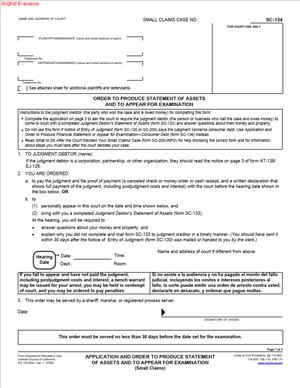
SC-134 – Application and Order to Produce Statement of Assets and to Appear for Examination is a court form used after a small claims judgment. It focuses on gathering financial information from a judgment debtor. This document helps move a case forward when payment has not occurred.
You usually encounter this form after a court has already decided who owes money. It is not about proving your case. It is about learning what assets or income may exist to satisfy the judgment.
The form combines two functions. It asks the court to order the other party to appear. It also requires that person to bring a written statement of assets.
Timing matters. This form is commonly used when voluntary payment has stalled or communication has stopped. It creates a structured way to obtain financial details under court supervision.
For self-represented people, the form can feel intimidating. Each section has a clear purpose tied to enforcement, not argument. Understanding what the form does makes completion more manageable.
What is SC-134 – Application and Order to Produce Statement of Assets and to Appear For Examination?
Clear definition
SC-134 – Application and Order to Produce Statement of Assets and to Appear For Examination is a California Small Claims Court document. It requests a court order requiring a judgment debtor to attend an examination. At that examination, the debtor provides information about assets, income, and financial accounts.
The document includes both an application and a proposed court order. One part asks the court to act. The other part reflects what the judge may sign if the request is granted.
This form does not decide liability or damages. Those issues are already resolved by the judgment. The form focuses only on post-judgment financial disclosure.
Who typically uses this form/document?
This form is most often used by a judgment creditor. That is the person or business who won money in small claims court.
Self-represented individuals commonly use it when collecting on a judgment. Businesses may also use it, especially when the debtor is an individual or another small entity.
The judgment debtor is the person ordered to appear and disclose information. That party does not file the form but is directly affected by it.
Court clerks and judges interact with the form as part of enforcement procedures. The clerk processes the filing. The judge reviews and signs the order portion if appropriate.
Why you might need this form/document
You might need this form when payment has not occurred after judgment. The court does not automatically collect money for you. This form is one way the court becomes involved again.
The form helps you learn what financial resources may exist. Without that information, enforcement options are limited or unclear.
It also creates a formal requirement to appear. Informal requests for information often go unanswered. A court-ordered examination carries different consequences.
The form can clarify whether nonpayment is due to a lack of assets or a lack of cooperation. That distinction matters in later enforcement steps.
Typical real-life scenarios
- A common scenario involves a small claims judgment that remains unpaid for months. The creditor has tried contacting the debtor without success. The form is used to bring the debtor back before the court.
- Another scenario arises when partial payments stop unexpectedly. The creditor needs updated information about income or employment. The examination can reveal changes since the trial.
- Sometimes the debtor claims inability to pay. The form allows the court to require documentation supporting that claim. This helps replace uncertainty with verified information.
- In business-related cases, a creditor may need to identify bank accounts or receivables. The form prompts disclosure of those assets during the examination.
When would you use SC-134 – Application and Order to Produce Statement of Assets and to Appear for Examination?
This form is used after a small claims judgment has been entered. It is not used during the lawsuit itself. The case must already be decided.
People commonly use it when voluntary compliance has not occurred. That may include missed deadlines or ignored payment demands.
The form may also be used when you need clarity. Even if the debtor communicates, details about assets may be vague or incomplete.
Timing often depends on patience and practicality. Some people wait a short period after judgment. Others wait longer, hoping for payment without court involvement.
In cases with multiple debtors, the form can be used to examine one or more individuals. Each examination focuses on the specific person ordered to appear.
Legal characteristics of SC-134 – Application and Order to Produce Statement of Assets and to Appear for Examination
This document has legal effect once signed by a judge. The application alone does not compel action. The signed order is what creates obligations.
Accuracy matters. Incomplete or incorrect information can delay processing or lead to rejection. Courts expect a clear identification of the parties and judgment.
Common problems include using outdated case information or failing to match the judgment exactly. Small discrepancies can create confusion.
Procedures can vary by court location. Filing methods, hearing scheduling, and local practices may differ. The core purpose of the form remains consistent.
This form does not seize property or garnish wages by itself. It also does not guarantee payment. It is an information-gathering and appearance order only.
Is it legally binding?
The order portion becomes legally binding when signed and properly issued by the court. At that point, the person named is required to appear and comply.
The obligation arises from the court’s authority, not from an agreement between the parties. Compliance is tied to the order, not to voluntary cooperation.
If the order is not signed, there is no binding effect. The application stage alone does not impose duties.
Consequences for noncompliance are not part of the form itself. The form’s role is to create the requirement to appear and disclose information.
How to fill out SC-134 – Application and Order to Produce Statement of Assets and to Appear for Examination
Step 1 – Identify the case and parties
Begin by reviewing the case caption at the top of the form. This section ties the document to an existing small claims case.
You enter the same names used in the judgment. Consistency helps the court link the request to the correct file.
The case number is critical. It tells the clerk and judge exactly which judgment you are seeking to enforce.
Step 2 – Confirm the judgment information
The form asks for details about the judgment. This usually includes the date and amount.
This section establishes why the examination is being requested. It shows that a valid judgment exists.
Careful transcription matters here. The information should reflect the judgment as entered, not estimates or later calculations.
Step 3 – Identify the person to be examined
This step focuses on the judgment debtor. The name should match the judgment precisely.
If the debtor is an individual, the form reflects that. If the debtor is a business entity, the form identifies the appropriate representative.
The address listed affects notice and scheduling. It is the location the court uses to reach the person ordered to appear.
Step 4 – Request the examination and asset statement
This section is the heart of the application. It asks the court to order the debtor to attend an examination.
It also requests that the debtor bring a statement of assets. This typically covers income, accounts, and property.
The language here is standardized. The form guides the request without requiring detailed explanation.
Step 5 – Review the order section
The latter part of the form contains the proposed order. This is the portion the judge may sign.
You do not fill in the judge’s signature or date. Those areas are reserved for the court.
Reading this section helps you understand what the court may require if the order is issued.
Step 6 – Sign and date where indicated
The application includes a signature area. This confirms who is making the request.
The signature represents that the information provided is accurate to the best of your knowledge.
Dates help establish when the request was made. They also assist the court with processing timelines.
Step 7 – Prepare the form for submission
Before submission, review the entire document. Look for missing fields or inconsistencies.
Legibility matters. Clear writing or typing helps avoid delays.
At this stage, the form is ready to be submitted according to court procedures.
Step 8 – Understand what happens after submission
Once submitted, the court reviews the application. A judge decides whether to sign the order.
If signed, the order sets the requirement to appear and produce information. The examination is then scheduled through the court process.
The form’s role ends once the order is issued. What follows depends on compliance and court handling.
Legal terms you might encounter in SC-134 – Application and Order to Produce Statement of Assets and to Appear For Examination
- Judgment creditor: This is the person or business that won the case and is owed money. On this document, the judgment creditor is the one asking the court to order an examination. You must list the name exactly as it appears on the judgment so the court connects this request to the right case.
- Judgment debtor: This is the person or business that owes money under the judgment. The examination is directed at the judgment debtor. The name you use here must match the judgment exactly, including spelling, punctuation, and any business designation.
- Judgment: A judgment is the court’s final decision that one side owes money to the other. This form relies on an existing judgment. You will be asked to identify the judgment date and amount so the court can confirm that enforcement is allowed.
- Statement of assets: This is a written list of the debtor’s income, property, bank accounts, and other financial resources. The order section of this document requires the debtor to bring or complete this statement. The purpose is to give you clear, usable information about what assets may be available.
- Order: The order is the part signed by a judge or clerk that makes the examination mandatory. Until the order is signed, this document is only a request. Once signed, it carries the court’s authority and must be followed by the person named.
- Examination: An examination is a court-supervised questioning of the debtor about finances. This form asks the court to set that examination. The details in the order tell the debtor when and where to appear and what to bring.
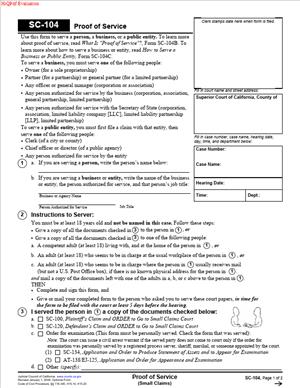
- Service: Service means formally delivering the signed order to the person who must appear. Proper service is critical because the court relies on proof that the debtor was notified. This document works only if the service is completed correctly and on time.
- Clerk: The clerk is the court staff member who processes filings and may issue the order. Parts of this form are reserved for the clerk’s use. You should not write in those sections unless instructed.
- Declaration: A declaration is a signed statement made under penalty of perjury. When you sign this document, you are declaring that the information you provided is true. Accuracy matters because the court relies on your declaration to issue the order.
FAQs
What does SC-134 – Application and Order to Produce Statement of Assets and to Appear For Examination actually do?
This form asks the court to require the person who owes money to come to court and answer questions about finances. It also orders that person to bring a completed statement listing assets and income. The goal is to give you clear information you can use to understand how the judgment might be paid.
Who fills out this form and who signs it?
You complete the application section as the person owed money. You sign the declaration portion to confirm the details are correct. The judge or clerk signs the order section, which is what turns your request into a court command.
What information do I need to have ready before I start filling it out?
You need the case number, the exact names of the parties as they appear on the judgment, and the judgment date and amount. You also need to identify the person or business you want examined. Having the judgment paperwork in front of you helps prevent name and number errors.
Where do I write the examination date and time?
You do not choose the date and time yourself. That information is completed in the order section after the court reviews the request. You leave those lines blank and wait for the court-issued version.
Does this document change the amount owed on the judgment?
No. This document does not alter the judgment amount. It only creates a process for gathering information about assets so enforcement can move forward.
What happens if the debtor does not show up after being served?
The order requires attendance. If the debtor does not appear, the court can respond based on its rules and records. Your role is to make sure the signed order was properly served and that you keep proof of that service.
Do I attach financial documents to this form?
You do not attach the debtor’s financial documents to the application. The order requires the debtor to bring or complete the statement of assets. Your job is to request the examination and ensure the order is issued and served.
How many times can I use this form in the same case?
You can request an examination when it is appropriate and allowed by the court. Each request must be complete and tied to the same judgment. If circumstances change, you must reflect that accurately on any later request using this document.
Checklist: Before, During, and After SC-134 – Application and Order to Produce Statement of Assets and to Appear For Examination
Before
- Confirm you have a final judgment and the correct case number
- Review the judgment to match names exactly as entered by the court
- Verify the judgment amount and date from court records
- Decide who you are asking the court to examine
- Check that your contact information is current and readable
- Set aside copies of prior filings for reference
- Plan how you will submit the form to the court
During
- Write clearly and use the same names and order as the judgment
- Complete only the application sections meant for you
- Leave the order sections blank for the court
- Double-check numbers and spelling before signing
- Sign and date the declaration where indicated
- Make copies of the completed but unsigned order section
- Keep your tone factual and neutral throughout
After
- Submit the form using the court’s accepted method
- Wait for confirmation that the order has been issued
- Obtain copies of the signed order
- Arrange for proper service on the person ordered to appear
- Keep proof of service in your records
- Calendar the examination date and time
- Bring your copy of the signed order to court
Common mistakes to avoid with SC-134 – Application and Order to Produce Statement of Assets and to Appear For Examination
- Mistake: Using a nickname or shortened business name, which happens when people rely on memory instead of the judgment, can cause the court to reject the request, so do not forget to copy names exactly.
- Mistake: Filling in the examination date yourself, which happens when you want to move quickly, can invalidate the order, so do not forget that the court sets those details.
- Mistake: Skipping a signature, which happens when rushing, can delay issuance of the order, so do not forget to sign and date the declaration.
- Mistake: Writing in the clerk or judge sections, which happens due to confusion about the layout, can create processing errors, so do not forget to leave those areas blank.
- Mistake: Failing to make copies, which happens when filing feels final, can leave you without proof later, so do not forget to keep complete records.
- Mistake: Serving the unsigned application, which happens when steps are mixed up, means there is no enforceable order, so do not forget to wait for the signed version.
- Mistake: Using outdated contact information, which happens when details are reused, can cause missed notices, so do not forget to update your address and phone number.
- Mistake: Assuming the debtor will bring documents without being ordered, which happens due to expectations, can limit useful information, so do not forget that the order must clearly require a statement of assets.
What to do after filling out SC-134 – Application and Order to Produce Statement of Assets and to Appear For Examination
After you complete the application, your focus shifts from writing to follow-through. This document only works if it moves through the system correctly and ends with a signed order that is properly served. Staying organized at this stage saves time and prevents missed opportunities to gather information.
- Step 1: Make at least two copies of the completed form before submitting it.
- Step 2: Submit the original to the court using the accepted filing method for small claims.
- Step 3: Wait for the court to review the request and issue the order section.
- Step 4: Obtain certified or file-stamped copies of the signed order.
- Step 5: Review the signed order carefully to confirm the examination details are complete.
- Step 6: Arrange for service of the signed order on the person required to appear.
- Step 7: Keep proof of service with your case records.
- Step 8: Calendar the examination date and plan to attend with your paperwork.
- Step 9: Prepare questions you want to ask based on the statement of assets requirement.
- Step 10: Bring your copies of the judgment and order to the examination.
- Step 11: Update your internal notes after the examination with any new information learned.
- Step 12: Store all documents together so you can act quickly on the information obtained.
Disclaimer: This guide is provided for informational purposes only and is not intended as legal advice. You should consult a legal professional.