SC-222 – Order on Request to Make Payments
Fill out nowJurisdiction: Country: United States | Province or State: California
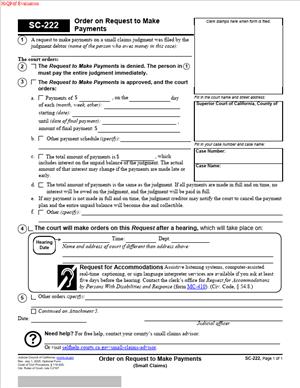
SC-222 – Order on Request to Make Payments is a court document used after a small claims judgment. It addresses how money will be paid when paying all at once is not realistic. The form records the court’s decision on a request to make payments over time. You will usually encounter SC-222 – Order on Request to Make Payments after a judgment has already been entered. It does not decide who wins the case. It focuses only on the timing and structure of payment. This document matters because it affects how and when money changes hands. It can set expectations for both sides and reduce confusion after judgment. If you are about to fill this out, you are likely responding to a court process that is already underway. Understanding what the form does helps you complete it accurately and avoid delays. The form reflects a judge’s order, not a private agreement. Once completed and issued, it becomes part of the court record.
What is SC-222 – Order on Request to Make Payments?
Clear definition
The California SC-222 – Order on Request to Make Payments is a written court order related to the payment of a small claims judgment. It states whether payments will be made in installments and outlines the terms approved by the court. The document typically follows a request asking the court to allow payment over time. The order shows the court’s decision on that request. It does not change the judgment amount. It only addresses how that amount will be paid. Once issued, the order provides a clear payment structure. This helps both parties understand their obligations.
Who typically uses form SC-222?
This form is commonly used by people involved in a small claims case after judgment. That includes the person who owes money and the person who is owed money. The person who owes the judgment often initiates the process by asking for installment payments. The court then issues SC-222 – Order on Request to Make Payments to confirm the decision. The person owed money receives the order as notice of how payment will occur. Court staff also rely on the document to track compliance. Attorneys are not required in small claims, so self-represented individuals frequently interact with this form.
Why you might need SC-222 form
You may need this document when immediate full payment is not possible. The court uses it to decide whether payments over time are allowed. The form matters because it replaces uncertainty with a defined schedule. Without it, there may be disputes about timing or amounts. It also provides written confirmation of the court’s ruling. That confirmation can be important if questions arise later. The document helps ensure that payment expectations are consistent with what the judge approved.
Typical real-life scenarios
- A person loses a small claims case and owes a judgment, but cannot pay the full amount at once. The court considers the person’s request and issues an order allowing monthly payments.
- A business wins a small claims judgment against an individual. The court issues an order explaining how the individual will pay over time instead of in a lump sum.
- Two former roommates go to small claims court over unpaid rent. After judgment, the court issues an order setting installment payments to resolve the debt gradually.
- A consumer wins a case over property damage. The court issues an order confirming that the losing party will pay in scheduled amounts rather than immediately.
When would you use SC-222 – Order on Request to Make Payments?
You encounter SC-222 – Order on Request to Make Payments after the court has already decided the case. The timing is tied to the judgment, not the trial. This form comes into play when someone asks the court to approve payments over time. The request may be based on income, expenses, or other financial factors. Judges commonly use this order to formalize payment arrangements. It creates a clear record that applies to both sides. The document may be relevant to both the judgment debtor and the judgment creditor. Each relies on it to understand how payment will proceed. It is not used before a judgment. It is also not used to negotiate privately outside of court.
Legal characteristics of SC-222 – Order on Request to Make Payments
SC-222 – Order on Request to Make Payments has legal effect because it is issued by the court. Its authority comes from the judge’s decision, not from agreement between the parties. For the order to be effective, it must be properly completed and signed by the court. Missing information or unclear terms can create enforcement problems. Problems often arise when payment terms are vague or inconsistent with the judgment. Errors in case numbers or party names can also cause confusion. In California, small claims and installment payment orders are handled within the small claims framework. Other jurisdictions may use different forms or procedures. This document does not erase the judgment. It does not reduce the amount owed. It also does not prevent future enforcement if payments are missed.
Is it legally binding?
Yes, the order is legally binding once issued by the court. It reflects the court’s authority over the judgment. The binding effect applies to both parties. The person who owes money is expected to follow the payment terms. The person owed money is expected to accept payment as ordered. The order remains effective unless the court changes it. Private side agreements do not replace the court order unless the court approves them.
How to fill out SC-222 – Order on Request to Make Payments
Step 1 – Identify the case
Start by reviewing the case caption at the top of the form. This section identifies the court, the case number, and the parties involved. Accuracy here connects the order to the correct small claims case. Make sure names match the judgment exactly. Even small differences can cause processing delays.
Step 2 – Confirm the judgment information
Locate the section that references the existing judgment. This part ties the order to the amount already decided by the court. Check that the judgment amount is consistent with the court’s records. The order does not change this amount.
Step 3 – Review the payment request context
The form reflects a request to make payments. Read this section to understand what was asked and what the court considered. This context helps explain why the order exists. It also frames the payment terms that follow.
Step 4 – Read the court’s decision on payments
Focus on the portion where the judge indicates whether installment payments are allowed. This is the core of SC-222 – Order on Request to Make Payments. The language shows whether payments are approved, denied, or modified. It may include specific conditions.
Step 5 – Understand the payment schedule
Look closely at how payments are structured. This may include amounts, due dates, and frequency. These details define how the judgment will be paid over time. A clear understanding helps avoid misunderstandings later.
Step 6 – Note any additional conditions
Some orders include extra terms related to payment. These may address missed payments or changes in circumstances. These conditions are part of the court’s order and apply along with the schedule.
Step 7 – Check for signatures and dates
Confirm that the order includes the judge’s signature or court authorization. This shows that the order is official. Also, note the date the order was made. Timing can matter for tracking payments.
Step 8 – Review distribution and copies
The form typically indicates that copies are provided to the parties. This ensures everyone receives the same information. Keep a copy for your records. It serves as the reference point for future payments.
Legal terms you might encounter in SC-222 – Order on Request to Make Payments
- Judgment: This is the court’s final decision about who owes money and how much. In this document, the judgment amount is the starting point for any payment plan. You will see it referenced to confirm what is being paid and whether interest applies.
- Judgment creditor: This is the person or business that is owed money under the judgment. The name must match the judgment exactly in this form. If it does not, the order can be hard to enforce.
- Judgment debtor: This is the person or business ordered to pay the judgment. The payment schedule in this document applies to the debtor listed. Any mismatch in name can cause confusion about who must pay.
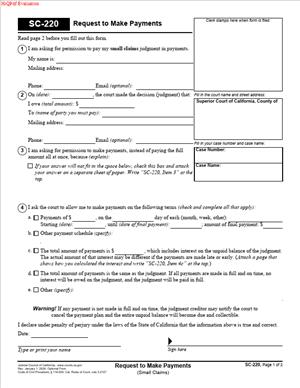
- Request to make payments: This is the formal request asking the court to allow payments over time instead of a single lump sum. The court reviews this request before issuing the order. This document reflects the court’s decision on that request.
- Order: An order is a directive from the judge. In this form, it tells you whether payments are approved, denied, or changed. Once signed, it controls how payments must be made.
- Payment schedule: This lists the amount, frequency, and due dates of payments. It may be monthly or follow another pattern set by the court. You must follow it exactly as written.
- Due date: This is the specific date each payment must be made. The form may list a first due date and later recurring dates. Missing a due date can trigger collection actions.
- Balance: This is the amount still owed after payments are credited. The form may state the total balance at the time the order is made. Keeping track of the balance helps you know when the judgment is satisfied.
- Interest: Interest is the added amount that may accrue on the unpaid judgment. The order may confirm whether interest continues during the payment plan. This affects how long payments will last.
FAQs
What does SC-222 – Order on Request to Make Payments actually decide?
It records the court’s decision on whether payments can be made over time and on what terms. You are not proposing terms here; you are reading what the judge approved. The document tells you exactly how to pay or what to expect to receive.
Is this form the same as the original judgment?
No. The judgment decides who owes money and how much. This document deals only with how payments will be made after that decision.
Where do I find the effective date of the payment order?
Look near the judge’s signature and the date the order was signed. That date controls when the payment schedule starts unless the order states a different start date. Use that date to count deadlines.
Who has the authority to sign this document?
Only a judge or authorized court officer signs it. If there is no court signature or date, the order is not complete. Do not rely on an unsigned copy.
Do I need to attach anything to this form?
Usually, no attachments are added at this stage because the court has already decided the request. If attachments are listed, make sure you have the same pages in every copy. Missing pages can change how the order is read.
What if the names on this document do not exactly match the judgment?
That is a problem you should notice right away. The names must be consistent across the judgment and this document. A mismatch can cause payment disputes or enforcement delays.
Does this document change what appears in the public court record?
Yes. Once filed, the payment terms become part of the case record. Anyone reviewing the file can see the approved schedule.
How many times should I reference SC-222 – Order on Request to Make Payments in my records?
Once is usually enough. Keep a clear copy of your judgment paperwork so you can show the exact payment terms if questions come up.
What happens if a payment is missed under SC-222?
Missing a payment can trigger consequences described in the order. In many cases, a missed payment allows the judgment creditor to pursue collection of the remaining balance. Always review the specific language of the order to understand what applies in your case.
Can the payment order be changed after it is issued?
Yes, but only by the court. A party must request a modification and explain the changed circumstances. Until the court issues a new order, the original SC-222 payment terms remain in effect.
Does an installment order stop all collection activity?
Not automatically. Timely payments usually prevent enforcement, but if a default occurs, collection actions may begin or resume as allowed by law and the terms of the order.
Checklist: Before, During, and After SC-222 – Order on Request to Make Payments
Before
- Read the entire order from top to bottom.
- Confirm the case number matches your case.
- Check both party names against the judgment.
- Locate the total judgment amount listed.
- Identify whether interest is mentioned.
- Note the first payment due date.
- Prepare a simple payment log for tracking.
During
- Focus on the payment schedule section.
- Write down each due date and amount.
- Check for instructions on where to send payments.
- Look for any conditions tied to late payments.
- Confirm the judge’s signature and date.
- Make copies of the signed order.
After
- Calendar every payment due date.
- Keep proof of each payment made or received.
- Update your balance after each payment.
- Store the order with your judgment records.
- Monitor for any missed or late payments.
- Refer to the order if a dispute arises.
Common mistakes to avoid with SC-222 – Order on Request to Make Payments
- Mistake: Skimming the order, because it looks short, which leads to missed due dates, enforcement problems, and forgetting to calendar payments.
- Mistake: Assuming the payment plan starts when you receive the form, which happens because people overlook the signature date, causing late payments if you forget to confirm the effective date.
- Mistake: Ignoring name mismatches, often due to typos, which can block enforcement later if you forget to compare it to the judgment.
- Mistake: Paying the wrong amount, usually from misreading the schedule, which can leave an unpaid balance if you forget to follow the exact figures.
- Mistake: Failing to keep proof of payment, because it feels unnecessary, which can hurt you if a dispute comes up and you forget to save receipts.
- Mistake: Thinking interest stops automatically, which happens when the order language is unclear, leading to underpayment if you forget to check that section.
- Mistake: Not making enough copies, because it seems minor, which causes delays when you need a copy and forget to keep extras.
- Mistake: Assuming the order replaces the judgment, which confuses many people, and can lead to recordkeeping errors if you forget they work together.
What to do after filling out SC-222 – Order on Request to Make Payments
Once you have reviewed the completed order, your job is to follow it closely and keep clean records. This document controls the timing and amounts of payments, so treat it like a checklist you return to often. Organization now saves stress later.
- Step 1: Make at least two copies of the signed order for your records.
- Step 2: Place one copy with the original judgment paperwork.
- Step 3: Highlight or circle the payment amounts and due dates on your copy.
- Step 4: Set calendar reminders several days before each due date.
- Step 5: Create a simple log to track payments made or received.
- Step 6: Keep proof of every payment with the log.
- Step 7: Update the remaining balance after each payment.
- Step 8: Review the order if a payment is late or missed to understand the next steps.
- Step 9: Store all related documents together so you can find them quickly.
Disclaimer: This guide is provided for informational purposes only and is not intended as legal advice. You should consult a legal professional.