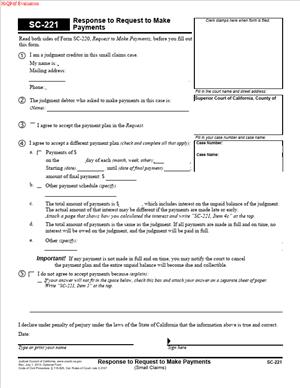
SC-221 – Response to Request to Make Payments
Fill out nowJurisdiction: Country: United States | Province or State: California
SC-221 – Response to Request to Make Payments is a court form used in California small claims cases. It is part of the process for addressing how a money judgment will be paid. You complete it when the court asks for your response to a proposed payment plan.
This document matters because it affects how and when money is paid after a judgment. It gives you a structured way to explain your financial situation in writing. The court uses this information when deciding whether to approve payment terms.
People often encounter this form at a stressful moment. A judgment has already been entered, and payment details are now being discussed. This form helps keep that conversation clear and on the record.
SC-221 – Response to Request to Make Payments is not about arguing the case again. It focuses on payment logistics after the court has decided who owes money. Understanding that purpose helps you fill it out calmly and accurately.
You usually complete this form within a short time frame. Knowing what information it asks for can save time and reduce mistakes. That preparation is especially important if you are representing yourself.
What is SC-221 – Response to Request to Make Payments?
Clear definition
SC-221 – Response to Request to Make Payments is a California small claims court form. It allows a person who owes money under a judgment to respond to a request for installment payments or other payment terms. The form communicates your position to the court in a standardized format.
The document focuses on payment ability and proposed schedules. It is not a negotiation letter between private parties. It becomes part of the court file once submitted.
The form typically asks for basic case information, your response to the payment request, and financial details. The goal is to give the court enough context to make a practical decision.
Who typically uses this form/document?
This form is commonly used by judgment debtors in small claims cases. That is the person the court decided must pay money. It may also be used by someone responding on behalf of a business, depending on how the case was filed.
Self-represented individuals use this form frequently. Many small claims participants do not have attorneys, so the form is designed to be direct and structured.
You may encounter this document whether the original case involved a personal dispute, property damage, unpaid services, or a loan. The type of case matters less than the existence of a money judgment.
Why you might need this form/document
You might need this document when the court sends you a request to address payment terms. That request may follow a judgment where immediate full payment is not expected or has not happened.
The form gives you a way to explain whether you can pay in installments, pay later, or address a proposed schedule. Without this response, the court may rely only on the information already available.
Completing the form allows you to participate in the payment decision. It helps avoid assumptions about your income or expenses. It also creates a written record of your response.
Typical real-life scenarios
- A common situation involves a small claims judgment where the full amount is difficult to pay at once. The other party asks the court to set monthly payments. You receive SC-221 – Response to Request to Make Payments to explain what you can realistically manage.
- Another scenario arises when a business owner loses a small claims case. The court requests information about cash flow and expenses before approving a payment plan. This form becomes the place to provide that snapshot.
- Sometimes the court initiates the request without either party asking. After judgment, the court may automatically explore installment payments. You then use this document to respond.
- In some cases, the judgment debtor disagrees with the proposed payment schedule. The form allows you to explain why a different approach may fit your situation better, without reopening the case itself.
When would you use SC-221 – Response to Request to Make Payments?
You would use SC-221 – Response to Request to Make Payments after a small claims judgment has been entered. The timing usually comes after the court or the other party raises the issue of how payment will occur.
This form is used during the post-judgment phase. That phase focuses on collection and payment, not liability. The roles are typically judgment creditor and judgment debtor, even if those terms are not used on the form.
You may be prompted to use this document if the creditor requests installment payments through the court. You may also receive it directly from the court as part of routine follow-up.
The form is relevant when payment ability is an open question. If payment has already been made in full, this document may not be part of the process. Its use depends on what the court is trying to resolve.
Legal characteristics of SC-221 – Response to Request to Make Payments
This form has legal effect because it is filed in an active court case. Information provided on it is given under penalty of perjury. Accuracy and completeness matter for that reason.
A form is commonly considered effective when it is complete, signed, and submitted as directed by the court. Missing information, unclear handwriting, or skipped sections often cause delays or follow-up requests.
Problems can also arise when numbers do not add up or conflict with other court filings. Inconsistent financial information may raise questions. The court may ask for clarification or additional documents.
While this is a California form, courts in different locations may handle payment decisions differently. Procedures and expectations can vary, even when the form itself is the same. Outcomes depend on the specific circumstances of each case.
This document does not change the judgment amount. It does not erase the debt or reverse the decision. It only addresses how payment may occur.
Is it legally binding?
The form itself is not a contract between you and the other party. Its legal effect comes from how the court uses the information provided. The court may issue an order based on your response.
If the court approves a payment plan, that order can be binding. Failure to follow a court-ordered payment schedule can have consequences. Those consequences come from the order, not the form alone.
Your statements on the form are treated as sworn statements. That means honesty is essential. The binding aspect relates to the truthfulness of what you submit and the resulting court action.
How to fill out SC-221 – Response to Request to Make Payments
Step 1 – Identify the case
You start by entering the case name and number exactly as they appear on court documents. This ensures your response is matched to the correct small claims file. Even small errors can cause processing delays.
Step 2 – Confirm the parties
This step asks you to identify yourself in relation to the case. You indicate whether you are the person ordered to pay or are responding on behalf of an entity. This helps the court understand who is providing the information.
Step 3 – Address the payment request
Here you respond to the proposed payment plan or request. You indicate whether you agree, disagree, or need different terms. The form structure guides you to make that position clear.
Step 4 – Provide financial information
You are asked to share details about income, expenses, and assets. The purpose is to give the court a general picture of your ability to pay. Clear numbers help the court evaluate feasibility.
Step 5 – Explain special circumstances
This section allows you to describe factors affecting payment ability. These may include temporary income changes or necessary expenses. Keep explanations factual and focused on finances.
Step 6 – Review for completeness
Before signing, you review each section for accuracy. Check that all required fields are filled in and that figures are consistent. This step reduces the chance of follow-up questions.
Step 7 – Sign and date the form
You sign the document to confirm the information is true and complete. The date shows when the response was made. Unsigned forms are typically treated as incomplete.
Step 8 – Submit the form as instructed
The final step is providing the completed form to the court using the method requested. This may involve filing with the clerk or following instructions included with the request. Submission completes your response in the process.
Legal terms you might encounter in SC-221 – Response to Request to Make Payments
- Judgment creditor: This is the person or business that won the case and is asking for payment. In this form, you identify the judgment creditor so the court knows who is requesting money from you. Names must match the judgment exactly.
- Judgment debtor: This is you, the person ordered to pay. The form uses this term to connect your response to the correct obligation. Your name must be written the same way it appears on the judgment.
- Request to Make Payments: This refers to the creditor’s request for installment payments instead of one lump sum. Your response explains whether you agree, disagree, or need different terms. The court relies on this response to decide what happens next.
- Installment payments: These are scheduled payments over time. The form asks about your ability to make regular payments and the amount you can afford. The schedule you describe can become enforceable.
- Lump-sum payment: This means paying the full amount at once. The form may ask whether you can pay immediately or by a certain date. Your answer affects whether the court orders installments or immediate payment.
- Financial hardship: This describes limits on your ability to pay due to income, expenses, or other obligations. The form allows you to explain hardship so the court can consider realistic payment terms. Be specific and truthful.
- Declaration: This is your written statement made under penalty of perjury. When you sign, you confirm the information is accurate. Errors here can affect the court’s trust in your response.
- Proof of service: This shows that the other party received a copy of your response. While it may be a separate step, the court often expects confirmation that you shared what you filed. Missing this can delay or invalidate your response.
- Court order: This is the judge’s decision after reviewing the request and your response. The form contributes information the court uses to issue or modify an order. Once issued, you must follow it.
FAQs
Do I have to respond if I agree with the payment request?
Yes. This document records your position for the court. Even if you agree, you confirm the terms and show you understand what is being requested. Without a response, the court may assume you have no objections and issue an order without your input.
Where do I find the case number and court name to enter?
Look at the top of earlier court papers, such as the judgment or the original claim. The case number and court name must match exactly. Entering different information can cause the clerk to reject this form.
What if my income changes after I submit this form?
This form captures your situation at the time you sign it. If your income later changes, keep records of the change. You may need to bring updated information to a hearing or submit another document if the court allows it.
Do I attach proof of income or expenses?
Attach documents only if the form asks for them or if you choose to support your statements. Common examples include pay stubs or a simple expense list. Make sure attachments are labeled and referenced in your answers.
Who must sign the form?
You sign if you are the person responsible for paying. If you are responding for a business, the signer must have authority to act for that business. The signature confirms that everything written is true.
How does SC-221 – Response to Request to Make Payments affect the public record?
The information you submit becomes part of the court file. Payment terms, names, and amounts may be visible to others who review the case. Write clearly and stick to relevant facts.
What happens if I miss the deadline to respond?
The court may proceed without your input. That can result in payment terms you cannot manage. Filing on time gives the judge a full picture of your situation.
How will I know if the court accepted my response?
After filing, the clerk usually stamps or marks your copy. Keep that copy. If a hearing is scheduled or an order is issued, you may receive notice by mail.
Checklist: Before, During, and After SC-221 – Response to Request to Make Payments
Before
- Read the request you received from the creditor carefully.
- Locate your judgment and confirm names and case number.
- Gather recent income information and regular expenses.
- Decide whether you can pay in full or need installments.
- Think about a realistic payment amount and schedule.
- Set aside time to complete the form without rushing.
During
- Write the case number and court name exactly as shown.
- Check that all party names match the judgment.
- Answer every required question, even if the answer is zero.
- Be specific about amounts and dates you can manage.
- Explain hardship clearly and briefly.
- Review each page for completeness before signing.
After
- Make at least one copy for your records.
- Deliver or file the form using the method required.
- Send a copy to the other party if required.
- Watch for notices from the court about a hearing or order.
- Update your personal budget based on possible outcomes.
- Store all documents together for easy reference.
Common mistakes to avoid with SC-221 – Response to Request to Make Payments
- Mistake: Leaving blanks because you are unsure, which happens when people rush, can lead to rejection or assumptions against you, so do not forget to answer every required line.
- Mistake: Using different names than the judgment, which happens when nicknames or shortened business names are used, can cause confusion or delays, so do not forget to copy names exactly.
- Mistake: Overstating what you can pay, which happens out of optimism or pressure, can result in an unmanageable order, so do not forget to base amounts on real numbers.
- Mistake: Forgetting to sign and date, which happens at the final step, makes the declaration incomplete, so do not forget to check the signature line.
- Mistake: Missing the filing deadline, which happens when notices are overlooked, can result in an order without your input, so do not forget to note due dates.
- Mistake: Failing to keep copies, which happens when people rely on memory, makes follow-up difficult, so do not forget to save stamped copies.
- Mistake: Attaching unclear documents, which happens without labels, can confuse the court, so do not forget to identify each attachment.
- Mistake: Ignoring court follow-up mail, which happens when addresses change, can cause missed hearings, so do not forget to update your contact information.
What to do after filling out SC-221 – Response to Request to Make Payments
Once the form is complete, your focus shifts to submission and follow-through. This is where many people lose momentum. Staying organized helps you avoid surprises and respond quickly if the court contacts you.
- Step 1: Make clean copies of the completed form for yourself and for the other party.
- Step 2: Check the filing method required by the court handling your case.
- Step 3: Submit the original form using the accepted method and confirm it was received.
- Step 4: If required, deliver a copy to the judgment creditor and note when you did so.
- Step 5: File any proof showing that the other party received your response.
- Step 6: Watch your mail or online case access for a court decision or hearing notice.
- Step 7: If a hearing is set, bring copies of your form and any financial documents.
- Step 8: Once an order is issued, update your budget and calendar with payment dates.
- Step 9: Keep all related papers together, including receipts and court notices.
- Step 10: Track each payment you make so you can show compliance if asked.
Staying proactive after filing helps you stay in control. Clear records and timely action make it easier to handle questions, changes, or future court communications.
Disclaimer: This guide is provided for informational purposes only and is not intended as legal advice. You should consult a legal professional.