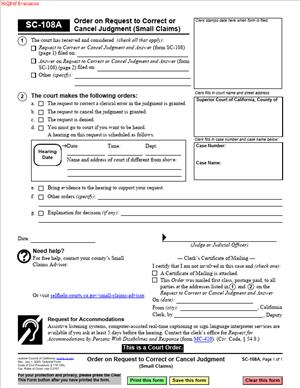
SC-220- Request to Make Payments (Small Claims)
Fill out nowJurisdiction: Country: United States | Province or State: California
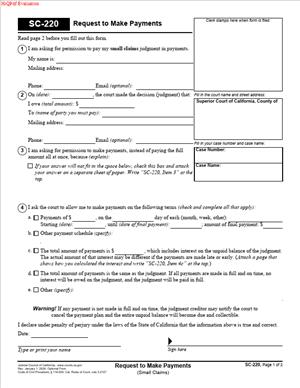
The SC-220- Request to Make Payments is a court form used after a small claims judgment. It lets a person ask for permission to pay a judgment over time instead of all at once. This document focuses on payment structure, not on whether the judgment was correct.
You usually see this form after a case has ended and money is owed. At that point, the court has already decided who owes what. The SC-220- Request to Make Payments addresses how payment might happen.
This form matters because unpaid judgments can lead to collection activity. A payment plan can create a clear schedule that both sides can understand. It also creates a written record that the court can review.
People filling out this form are often doing so without a lawyer. The form is designed to collect practical information about income, expenses, and payment ability. Accuracy and clarity affect how the request is viewed.
Before you start filling it out, it helps to understand what the form does and what it does not do. It is about managing payment, not changing the outcome of the case. That distinction shapes every section of the document.
What is SC-220- Request to Make Payments?
Clear definition
The SC-220- Request to Make Payments is a written request to the small claims court asking to pay a judgment in installments. It explains your financial situation and proposes a payment amount and schedule. The court uses this information to decide whether to allow payments over time.
This form becomes part of the court file for the case. It is reviewed by a judge or court officer. The decision may be made based on the written submission or after a short hearing.
Who typically uses this form/document?
This form is typically used by a person who lost a small claims case and owes money. That person may be an individual, a business owner, or another party named in the judgment. The person requesting payments is often called the judgment debtor.
Less commonly, someone who represents a business entity may complete the form. The content still focuses on personal or business finances. The form is not limited to any specific type of debt within small claims.
Why you might need this form/document
You might need this form when paying the full judgment at once is not realistic. The form allows you to explain why a lump-sum payment is difficult. It creates a structured way to ask for time.
This document can also clarify expectations. A written payment schedule reduces confusion about amounts and due dates. It also gives the court a basis to approve, deny, or modify the request.
Typical real-life scenarios
- You lost a small claims case related to a car accident and owe a few thousand dollars. Paying the full amount immediately would strain your monthly budget. You use the form to propose monthly payments that fit your income.
- You are a small business owner who had a contract dispute in small claims court. Business revenue is uneven throughout the year. The form allows you to describe cash flow patterns and request manageable installments.
- You were sued by a former landlord for unpaid rent, and the court entered a judgment. You now have a new job but limited savings. The form lets you show current income and regular expenses.
- You guaranteed a debt for a family member, and the court ruled against you. You want to avoid aggressive collection actions. The form provides a way to formally request a payment plan through the court.
When would you use SC-220- Request to Make Payments?
This form is used after the court has entered a judgment in a small claims case. It is not used during the trial or before a decision is made. Timing matters because the request relates directly to an existing judgment.
People often use this form soon after receiving notice of the judgment. At that stage, the amount owed is clear. The remaining issue is how payment will happen.
Judgment debtors commonly use the form when they expect difficulty paying the full amount quickly. The form allows them to present financial details in an organized way. The court can then consider whether installment payments are appropriate.
In some situations, a judgment creditor may be involved in the process. The creditor may receive a copy of the request and have a chance to respond. The form sets the stage for that exchange.
Legal characteristics of SC-220- Request to Make Payments
This form works within the small claims system. It relies on truthful financial disclosure and clear identification of the case. Accuracy affects how the request is evaluated.
A common problem with this form is incomplete information. Missing income details, unclear expenses, or unsigned forms can delay or undermine the request. The court needs a full picture to make a decision.
Another issue can arise when the proposed payment amount does not align with the financial information provided. Large inconsistencies can raise questions. Clear explanations help reduce confusion.
Procedures and review practices may vary slightly by court location. Some courts decide based only on the paperwork. Others may set a brief hearing. These differences affect process, not the basic purpose of the form.
This document does not erase the judgment. It does not change who won or lost the case. It also does not stop interest from accruing if interest applies to the judgment.
Is it legally binding?
The form itself is a request, not a binding agreement. It becomes effective only if the court approves a payment plan. Once approved, the payment terms become part of a court order.
If a payment plan is ordered, both sides are expected to follow it. The order sets expectations for timing and amounts. Failure to follow the order can lead to further court action.
How to fill out SC-220- Request to Make Payments
Step 1 – Case and court information
Start by entering the case name and case number exactly as they appear on the judgment. Include the court location listed on the judgment paperwork. This information connects your request to the correct file.
Step 2 – Identify the parties
Fill in the names of the judgment creditor and judgment debtor as shown in the case records. Use full legal names when available. Consistency with prior filings helps avoid confusion.
Step 3 – Judgment details
Provide the date of the judgment and the total amount owed. This includes the principal amount and any listed costs. The court uses this to confirm the request applies to an active judgment.
Step 4 – Payment request
State that you are asking to make payments over time. Include the payment amount and how often payments would be made. This section sets out the structure you are requesting.
Step 5 – Income information
List your sources of income and the amounts received. This may include wages, benefits, or business income. The goal is to show what money comes in on a regular basis.
Step 6 – Expense information
Describe your regular expenses, such as housing, utilities, food, and transportation. Use realistic monthly figures. This section shows how income is already committed.
Step 7 – Additional financial details
Include information about assets or other financial obligations if the form asks for them. This may cover bank accounts, vehicles, or other debts. Provide clear and straightforward descriptions.
Step 8 – Explanation of hardship
Use the space provided to explain why paying the judgment all at once is difficult. Focus on facts rather than emotion. This narrative helps the court understand your situation.
Step 9 – Signature and date
Sign and date the form where indicated. Your signature confirms that the information is complete and accurate to the best of your knowledge. Unsigned forms are commonly rejected.
Step 10 – Filing and copies
Prepare the form for submission to the court handling your small claims case. The process usually involves filing the original and providing copies to the other party. The court then reviews the request and decides the next step.
Legal terms you might encounter in SC-220- Request to Make Payments
- Judgment debtor: This is you if the court ordered you to pay money. On this form, the judgment debtor is the person asking for a payment plan. Your name here must match the judgment exactly, including spelling.
- Judgment creditor: This is the person or business you owe money to under the judgment. Their name appears so the court and the other side clearly know who will receive the payments.
- Judgment amount: This is the total amount the court ordered you to pay. It usually includes the original claim plus court costs and may include interest. You must list the full amount, not just what you can pay now.
- Installment payments: These are smaller payments made over time instead of one lump sum. This form is specifically asking the court to approve installments based on your finances.
- Financial hardship: This means you do not have enough income to pay the judgment all at once without serious difficulty. You explain this in plain language on the form so the court understands your situation.
- Disposable income: This is the money left after necessary expenses like rent, food, utilities, and transportation. The court looks at this number to decide whether your proposed payment amount is realistic.
- Monthly expenses: These are your regular costs, such as housing, utilities, insurance, and child support. You list them to show where your money goes each month.
- Declaration: This is a written statement made under penalty of perjury. When you sign the form, you are declaring that everything you wrote is true and complete.
- Court approval: This means the judge agrees to your payment request. Until approval happens, the judgment remains enforceable as originally ordered.
FAQs
What is SC-220- Request to Make Payments used for?
This form is used when you owe money under a small claims judgment and cannot pay the full amount at once. It records your request for a payment plan and explains your income, expenses, and hardship. The court uses what you write to decide whether to allow monthly payments instead of a lump sum.
When should I file this form after judgment?
You usually file this document after the court has entered a judgment, and you know you cannot pay it in full right away. Look at the judgment date and confirm the amount owed before completing it. Timing matters because enforcement can start once judgment is entered.
Do I have to list all of my income on this form?
Yes. This form asks for a complete picture of your finances. You list wages, benefits, and other regular income so the court can understand what you actually receive each month.
What happens if my income or expenses change later?
This document records your financial situation as of the date you sign it. If your situation later changes, the information on file does not update automatically. You may need to file another request or take additional steps to reflect the change.
Does filing this form stop collection right away?
Filing alone does not automatically stop collection. The judgment stays in effect until the court reviews and approves your request. Always confirm whether any enforcement actions are pending while your request is being considered.
Will the other side see my financial information?
Yes. The information you provide becomes part of the court file. The judgment creditor can review what you submitted, which is why accuracy and consistency matter.
What if I cannot afford the payment amount I am requesting?
You should only request an amount you realistically can pay every month. The court compares your proposed payment to your listed income and expenses. If they do not match, the request may be denied or changed.
What does my signature legally mean?
Your signature means you declare under penalty of perjury that the information is true and complete. It also confirms you understand the request you are making and that the court may rely on your statements.
Checklist: Before, During, and After SC-220- Request to Make Payments
Before
- Gather the judgment paperwork showing the exact amount owed.
- Confirm the case number and court name.
- Collect proof of income, such as pay stubs or benefit statements.
- List your regular monthly expenses from memory or records.
- Decide on a realistic monthly payment amount.
- Check that your name matches the judgment exactly.
- Review whether you owe interest or additional costs.
- Plan how you will explain your hardship clearly.
During
- Write all information neatly and completely.
- Enter numbers as monthly amounts unless the form says otherwise.
- Double-check math for income and expenses.
- Be specific when describing financial hardship.
- Avoid leaving required sections blank.
- Sign and date the form in the correct place.
- Confirm that all names and addresses are accurate.
- Review the form once more before copying it.
After
- Make at least one copy for your records.
- Submit the form to the correct court location.
- Provide a copy to the judgment creditor if required.
- Track any response or order from the court.
- Keep proof of filing or submission.
- Follow any instructions included with the court’s response.
- Make payments on time if a plan is approved.
- Keep records of every payment you make.
Common mistakes to avoid with SC-220- Request to Make Payments
- Mistake: Listing incomplete income because you forget irregular pay, which happens when people focus only on wages, leading to credibility issues and denial if numbers do not add up, so do not forget side income or benefits.
- Mistake: Understating expenses to look better, which happens out of fear, but can result in an unrealistic payment order, so do not forget to include real living costs.
- Mistake: Requesting a payment amount you cannot maintain, which happens when you guess instead of calculating, causing missed payments and enforcement, so do not forget to test your budget.
- Mistake: Using a nickname or shortened name, which happens casually, but can cause confusion in the court record, so do not forget to match the judgment exactly.
- Mistake: Leaving sections blank, which happens when you think they do not apply, leading to delays or rejection, so do not forget to write “0” or “not applicable” when appropriate.
- Mistake: Forgetting to sign and date, which happens during last-minute filing, making the document invalid, so do not forget to check the signature line.
- Mistake: Filing without keeping a copy, which happens in a rush, leaving you without proof, so do not forget to save your own record.
- Mistake: Ignoring follow-up notices, which happens when you assume approval is automatic, risking enforcement, so do not forget to monitor mail and court updates.
What to do after filling out SC-220- Request to Make Payments
Once you finish the form, your next steps matter just as much as what you wrote. The court cannot consider your request unless it is properly submitted and tracked. Staying organized protects you and shows good faith.
Start by making copies. Keep one complete copy for yourself. If possible, keep an extra copy with your financial records. These copies help if there is any dispute about what you filed or when.
- Step 1: Submit the original form to the court listed on the judgment.
- Step 2: Confirm the submission method used, whether in person or by another accepted option.
- Step 3: Note the date you submitted it and how it was delivered.
After submission, watch for confirmation. Some courts stamp a copy, send a notice, or update the case record. This confirmation tells you the request is officially pending. Without it, you cannot assume the court received your form.
Next, pay attention to communication. You may receive a court order approving, modifying, or denying your request. Read it carefully. The order controls what you must pay and when.
If a payment plan is approved, follow it exactly. Make payments on time and for the correct amount. Late or partial payments can undo the benefit of the plan.
- Step 4: Set reminders for payment due dates.
- Step 5: Keep proof of every payment, such as receipts or confirmations.
- Step 6: Update your personal budget to reflect the new obligation.
If the court asks for more information or schedules a hearing, respond promptly. Bring copies of what you filed and any updated financial information. Being prepared shows seriousness and reliability.
If your financial situation changes significantly, review your options. The form you filed reflects a moment in time. Changes may require new action to stay aligned with the court’s expectations.
- Step 7: Store all court papers together in one place.
- Step 8: Track the remaining balance as you make payments.
- Step 9: Confirm when the judgment is fully paid.
Once paid in full, keep records showing satisfaction of the judgment. This protects you if questions arise later and helps ensure the court record is accurate.
Disclaimer: This guide is provided for informational purposes only and is not intended as legal advice. You should consult a legal professional.