If you inherited a car, check who can sign, which records you need, and how to complete the New York transfer.
You inherited a car, but the title still shows a person who has died. You may want to keep it, sell it, or pass it to another relative. Before signing anything, identify the correct transfer route.
New York uses different documents for a surviving spouse, certain children, next of kin, and estate representatives. A death certificate supports the process. It does not give every family member authority to transfer the vehicle.
This guide covers ordinary motor vehicles and New York paperwork. It provides general information, not personal legal or tax advice. Joint ownership, another state’s title, family disputes, and outstanding loans may require closer review.
Inherited a car in New York? Start with the ownership record
Find the latest title before choosing a form. Check the owner’s name, vehicle identification number, and issuing state. The vehicle identification number, or VIN, identifies the particular car.
Do not rely only on the registration card or insurance bill. Compare the records with the car itself. A family may have several vehicles with similar descriptions.
If you inherited a car with another person already named on the title, ask how that ownership is recorded. Do not assume the sole-owner process below applies. Bring the actual record when asking the DMV or an estate lawyer for guidance.
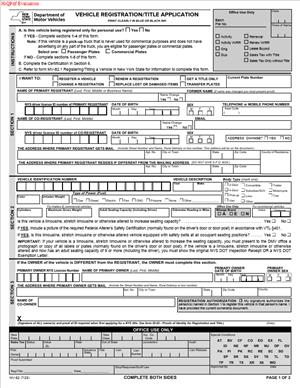
The New York Department of Motor Vehicles, called the DMV, publishes a deceased-owner checklist, MV-843. It calls for the latest original title or transferable registration, an application, identification, and documents supporting the transfer route.
Create a short fact sheet before completing forms:
- The deceased owner’s full name and date of death.
- The vehicle’s year, make, model, and VIN.
- The state that issued the ownership document.
- Any other owner or lienholder shown.
- The person who will receive the vehicle.
- The relationship and claimed authority of the signer.
- Whether a will or estate proceeding exists.

Mark uncertain facts as questions. A short list of missing answers is more useful than a signed form based on guesses.
Work out who has authority to transfer the car
If you inherited a car, your relationship to the owner matters. So does the estate’s legal status. Choosing the form comes after checking those facts.
Table description: Transfer routes to review if you inherited a car in New York.
| Situation | Route to review | Main caution |
| Eligible surviving spouse | Family transfer under section 5-3.1 and MV-349.1 | Check qualification, value, and the one-vehicle rule. |
| Qualifying child under 21 | Family transfer through the proper guardian arrangements | A child aged 21 or older does not qualify through this age-based route. |
| Eligible next of kin | MV-349 if all its conditions are met | A small value alone does not establish eligibility. |
| Estate representative | Court-issued authority and an endorsed ownership record | A will alone is not the same as appointment papers. |
| Ownership document from another state | Estate authority and interstate transfer requirements | New York’s family affidavits do not replace required estate documents. |
The table is a starting point. Read the current form and supporting instructions before deciding which row fits.
Check family eligibility if you inherited a car
New York Estates, Powers and Trusts Law section 5-3.1 protects certain property for an eligible surviving spouse. If there is no qualifying spouse, the relevant rights may pass to children under 21. The motor-vehicle provision concerns one vehicle.
The usual value figure is $25,000. However, the statute contains an option for an eligible spouse or qualifying children to acquire one higher-value vehicle by paying the excess to the estate. Its definition of value also accounts for outstanding security interests.
Do not turn those rules into a rough estimate based on the original purchase price. Gather current value information and loan records. Ask for advice where the calculation or entitlement is disputed.
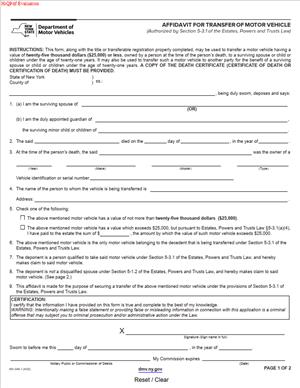
If you inherited a car as a surviving spouse, review MV-349.1. The official form includes the higher-value option and requires a sworn statement. It also confirms that only one vehicle is being transferred under section 5-3.1.
RunSensible lists this document as MV-3491 — Affidavit for Transfer of Motor Vehicle. The DMV’s official number includes a decimal: MV-349.1. Compare the prepared document with the current official version.
Check the narrower next-of-kin route
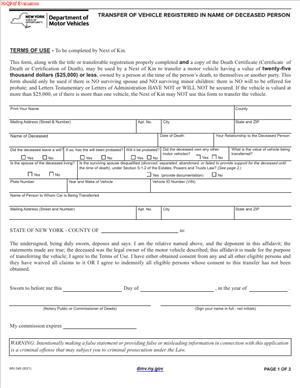
MV-349 is a different affidavit. Its stated conditions include one vehicle worth $25,000 or less, no surviving spouse or qualifying children under 21, no will to be offered for probate, and no Letters Testamentary or Letters of Administration obtained or planned.
If you inherited a car as an adult child, do not select this route simply because you are related. Check every condition, including other relatives and the estate’s plans.
The affidavit also contains statements about other eligible people’s claims. Read those statements carefully before signing. Get legal advice if relatives disagree about entitlement or consent.
RunSensible’s MV-349 form page can help you locate the document. Use the official terms of use to assess eligibility. The website label should not be read as a general registration shortcut for every deceased owner.
Use court authority when the estate must act
An executor manages an estate under court-issued authority connected with a will. An administrator acts under a different court appointment. New York courts explain that proof of authority can include Letters Testamentary, Letters of Administration, or voluntary-administration certificates.
Being named in a will does not mean you should sign the title before checking appointment requirements. Find the issued documents and confirm the authority they give you.
If you inherited a car through an estate, separate the representative’s role from the recipient’s role. The person entitled to receive the vehicle may not be the person authorized to transfer estate property.
For broader background, see RunSensible’s guide to probate without a will. Use New York court and DMV instructions for the actual appointment and vehicle transaction.
Gather the documents before signing
Keep one folder for ownership records and another for estate records. Add the receiving owner’s application and tax documents once the transfer route is clear.
The DMV checklist identifies several kinds of supporting authority. Depending on the route, these include the relevant family affidavit, court letters, or a voluntary administrator’s affidavit. It accepts a photocopy of the death certificate with MV-349 or MV-349.1.
If you inherited a car, make a separate list of originals and copies. A photocopy accepted for one purpose does not replace every original in the package.
For example, keep these questions separate:
- Is this the latest ownership document?
- Does the transfer require a sworn affidavit?
- Which court-issued document proves the signer’s authority?
- Does the receiving owner have the required identification?
- Is the application for title only, or registration as well?
Compare names across the title, death certificate, appointment papers, and application. Note middle initials, suffixes, and former names. Ask how to resolve a mismatch before altering an official document.
If you inherited a car from an owner whose title was issued elsewhere, flag that at the start. DMV guidance requires estate authority for an out-of-state deceased-owner title. Do not assume a New York affidavit and death certificate will be enough.
Deal with a missing title and any lien
A missing title can delay the entire transaction. Search the owner’s files, loan records, and recent mail before making an application for a replacement.
The official deceased-owner checklist says to obtain a duplicate title in the deceased owner’s name before transferring ownership when the title is missing.
If you inherited a car without its title, review MV-902 — Application for Duplicate Title. Its deceased-owner instructions address the applicant’s identity, relationship or court role, and supporting documents. A replacement request does not itself transfer ownership.
Record who requested the replacement and where it will be mailed. Keep the application and receipt together. Once it arrives, compare its VIN and owner details before moving to the transfer.
A lien is a lender’s recorded claim against the vehicle. If the loan has been paid, the DMV checklist calls for the original lien release to remove that entry. Without the release, the lien can remain on the new title.
If you inherited a car with a loan still outstanding, contact the estate representative and lender before promising a buyer a clear title. A family agreement does not settle the lender’s position.
Choose tax paperwork that matches the transaction
An inheritance, a gift, and a purchase from an estate describe different events. Do not use whichever label seems simplest on the form.
New York’s DTF-803 includes an exemption for a vehicle acquired in settlement of the previous owner’s estate. That category expressly excludes a vehicle purchased from the estate.
If you inherited a car through an estate distribution, review the exact exemption and supporting requirements. RunSensible’s DTF-803 sales and use tax exemption page can help you locate the document. Claim only a category that matches the facts.

NYC Civil Court Motor Vehicle Accident Lawsuit Insurance Law Forms
DTF-802 serves a different purpose. Its instructions cover transactions where sales tax was not collected at purchase, and gifts. They direct users claiming an exemption other than a gift to DTF-803.
For example, a beneficiary may receive a car from an estate and later sell it to a friend. Those are two transactions. The friend should not describe their purchase as the beneficiary’s inheritance.
If you inherited a car and pay money to the estate or another relative, explain that arrangement before choosing tax treatment. A statutory excess-value payment, a purchase, and a private family adjustment should not be assumed identical.
Keep the tax papers with the transaction they describe. State clearly who transferred the vehicle, who received it, and whether money or other value changed hands.
Complete the title without creating a new problem
Review the signature blocks before writing on the title. The signature must reflect the actual signer and the capacity in which that person acts.
For an estate transfer, DMV guidance explains that the executor or administrator signs in their own capacity and identifies the estate. A surviving spouse uses the applicable spouse wording.
If you inherited a car, do not copy the deceased owner’s signature. Also avoid having several relatives sign the same line while deciding who should act. Confirm the signer first.
New York DMV warns that altered, erased, or crossed-out title information can invalidate the document. If you make a mistake, ask for instructions before writing over it.
Complete mileage and damage disclosures where required. The certificate-of-title guidance distinguishes mileage rules by vehicle age, while the damage statement applies regardless of age. Follow the current document’s wording.
Do not guess the mileage because the vehicle has been parked. Check the odometer and relevant records. If the reading or damage history is uncertain, seek instructions about how to report that honestly.
Keep title and registration as separate decisions
If you inherited a car, decide whether you are keeping it off the road or applying to drive it. A title records ownership. Registration is a separate part of lawful road use.
MV-82TON is an application for title only. The official form expressly says it must not be used to register a vehicle. Check whether that route fits your transaction.
For registration, New York’s general instructions call for MV-82, ownership proof, identification, insurance evidence, and applicable tax and fee documents. The precise package depends on the vehicle and transaction.
Arrange insurance in the new registrant’s name and check the plate and registration requirements before driving. The DMV’s title guidance states that a new owner cannot legally drive before obtaining or properly transferring registration and plates.
If you inherited a car, do not assume the deceased owner’s plates automatically become yours. Ask about any surviving-spouse provision or other permitted plate transaction. Keep the insurer informed about the death and planned use.
Ownership transfer also differs from closing the old registration. DMV guidance explains a separate process for a possible deceased owner’s registration-fee refund. Check its receipt and estate-document requirements if seeking one.
Use these examples to spot missing questions
The following examples illustrate preparation. They do not decide anyone’s entitlement or promise DMV acceptance.
A spouse plans to keep one car
Maya’s spouse dies with one car titled only in that spouse’s name. Maya finds the title, confirms the VIN, and gathers value information. She checks the spouse route before choosing forms.
Because she inherited a car, Maya also checks the insurance and registration arrangements. Her document list separates the sworn affidavit, ownership record, tax proof, and registration application. She does not treat one completed form as the whole process.
An adult child finds two vehicles
Daniel’s parent leaves two cars. Daniel has the keys and a copy of a will. He initially considers using the next-of-kin affidavit for the less valuable car.
He then reads its terms about other vehicles and estate proceedings. He pauses to confirm the estate representative’s authority instead of signing based only on the smaller car’s value.
A beneficiary plans a later sale
Leila receives a car through an estate distribution. A neighbor offers to buy it. Leila keeps the inheritance records separate from the proposed sale documents.
She asks whether the representative will transfer directly to the buyer or whether she must complete an intervening transfer. That question matters before anyone fills in the buyer’s name on the title.
Avoid common mistakes before your DMV submission
If you inherited a car, review the package as a connected set of records. A correct form can still be paired with the wrong supporting document.
Common problems include:
- Choosing MV-349 and MV-349.1 as though they were interchangeable.
- Treating a family relationship as proof of every required condition.
- Treating a child aged 21 or older as eligible for the under-21 family route.
- Ignoring other vehicles or planned estate proceedings.
- Applying a simplified rule to an out-of-state title.
- Using a copy where an original ownership record is required.
- Leaving an old lien unexplained.
- Describing a purchase from an estate as an inheritance exemption.
- Altering a title to correct an entry without instructions.
- Assuming a title-only application permits driving.

Before submission, compare the VIN on every vehicle-related document. Then check names, addresses, dates, signatures, and the receiving owner. Read each certification aloud if the wording is unfamiliar.
Keep a complete copy of what you submit and any receipt. Record the submission date and office. If documents are returned, preserve the explanation and address the stated issue before resubmitting.
Review new records when they arrive. Check the owner’s name, VIN, address, and any lien entry. Store them with the estate transfer records so a later sale can be traced clearly.
Conclusion
If you inherited a car in New York, start with the latest ownership record and the person authorized to act. Choose the route that fits the family and estate facts. Then gather the ownership, tax, and registration documents for that route.
Clear records help you avoid signing too early, using the wrong affidavit, or missing a separate registration step. Ask for legal advice when entitlement, valuation, loans, or competing family claims remain uncertain.
RunSensible Forms helps users find, complete, validate, and download legal forms. It is not a law firm, DMV office, court, government agency, or official filing service.
Frequently Asked Questions
Can I transfer the car with only a death certificate?
No. The DMV checklist also requires ownership evidence and documents supporting the applicable transfer route. The death certificate does not replace those records.
Is $25,000 an absolute limit for every family transfer?
No. Section 5-3.1 and MV-349.1 include a limited higher-value option for eligible family members. Confirm the qualification and excess-payment requirements. MV-349 has different restrictions.
Can any adult child use the next-of-kin affidavit?
No. MV-349 has several conditions beyond relationship, including vehicle value, other vehicles, surviving family, and estate proceedings. Read all its terms before signing.
What if the title is lost?
Follow the deceased-owner replacement process using MV-902. Check the required identity and authority documents. Obtaining a duplicate and transferring ownership are separate steps.
Do I owe sales tax because I received the car from an estate?
DTF-803 includes an estate-settlement exemption, but it excludes purchases from the estate. The actual transaction determines the appropriate tax treatment and paperwork.
Can I drive while waiting for the title paperwork?
Do not treat a pending title application as permission to drive. Confirm current insurance, registration, and plates with the insurer and DMV before road use.
Do I need all ten forms listed below?
No. The list includes alternative and conditional documents. A duplicate-title application, title-only application, later-sale record, and refund request serve different purposes. Use only those that fit the transaction.
Resources
Official sources checked on November 9, 2026. Bracketed source numbers in the article refer to the entries below. Listed revision dates identify the official copies reviewed; check for later versions before use.
- New York DMV Transfer of Ownership When the Vehicle Owner Is Deceased, MV-843, revision 10/25. https://dmv.ny.gov/forms/mv843.pdf
- New York Estates, Powers and Trusts Law section 5-3.1, Exemption for Benefit of Family. https://www.nysenate.gov/legislation/laws/EPT/5-3.1
- New York DMV Affidavit for Transfer of Motor Vehicle, MV-349.1, revision 4/25. https://dmv.ny.gov/forms/mv3491.pdf
- New York DMV Transfer of Vehicle Registered in Name of Deceased Person, MV-349, revision 8/21. https://dmv.ny.gov/forms/mv349.pdf
- New York Courts Richmond County Surrogate’s Court Procedures, section Once an Executor, Administrator or Voluntary Administrator Is Appointed. https://www.nycourts.gov/courts/13th-judicial-district/richmond-county-surrogates-court/richmond-county-surrogates-court-procedures
- New York DMV Application for Duplicate Title, MV-902, revision 7/25. https://dmv.ny.gov/forms/mv902.pdf
- New York Department of Taxation and Finance Claim for Sales and Use Tax Exemption, DTF-803, revision 4/14. https://dmv.ny.gov/forms/dtf803.pdf
- New York Department of Taxation and Finance Statement of Transaction, DTF-802, revision 5/15. https://dmv.ny.gov/forms/dtf802.pdf
- New York DMV Certificate of Title. https://dmv.ny.gov/titles/certificate-of-title
- New York DMV Application for Title, MV-82TON, revision 5/25. https://dmv.ny.gov/forms/mv82ton.pdf
- New York DMV Register Title a Vehicle in New York State, MV-82.1, revision 10/25. https://dmv.ny.gov/forms/mv821.pdf
- New York DMV: If a Family Member Has Passed Away. https://dmv.ny.gov/more-info/if-a-family-member-has-passed-away
Disclaimer: The content provided on this blog is for informational purposes only and does not constitute legal, financial, or professional advice.
Contents