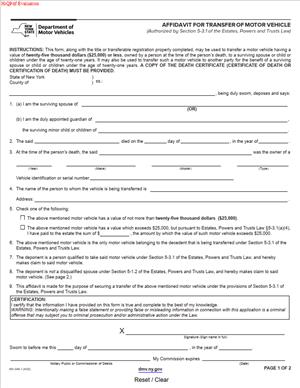
MV-3491 – Affidavit for Transfer of Motor Vehicle
Fill out nowJurisdiction: Country: United States | Province or State: New York
The MV-3491 – Affidavit for Transfer of Motor Vehicle is a sworn statement used in New York when a vehicle changes ownership under specific circumstances. You complete this form to explain and confirm the facts behind the transfer.
This document is often used when a standard title transfer is not enough on its own. It provides additional written confirmation about how and why the vehicle is being transferred.
If you are about to fill out this form, you are likely dealing with a unique ownership situation. You may be handling a family transfer, resolving a title issue, or responding to a request for more information about a vehicle’s ownership history.
Because it is an affidavit, you are swearing that the information you provide is true. That makes accuracy and clarity especially important.
What is MV-3491 – Affidavit for Transfer of Motor Vehicle?
Clear definition
The MV-3491 – Affidavit for Transfer of Motor Vehicle is a written statement made under oath to support the transfer of a motor vehicle in New York. An affidavit is a formal declaration of facts. By signing it, you confirm that the information is correct to the best of your knowledge.
This form does not replace a certificate of title. Instead, it supplements other transfer documents when additional explanation is required.
Who typically uses this form?
You might use this form if you are the current owner transferring the vehicle. You might also use it if you are the new owner and need to clarify how you obtained the vehicle.
Personal representatives of an estate may complete it when transferring a vehicle after someone’s death. In some cases, a family member, heir, or surviving joint owner fills it out.
It is commonly used by private individuals rather than dealerships. Businesses may also use it in limited situations involving internal transfers or corrections.
Why might you need this form?
You may need this form when the ownership history is not clear from the title alone. For example, if a signature is missing, if the title was lost, or if the transfer involves special circumstances, an affidavit helps explain what happened.
The form can also be used to clarify the relationship between the parties. In certain transfers, the reason for the transfer affects how the transaction is processed.
If there is a question about how the vehicle was obtained, the affidavit provides a written record. This can help prevent delays in processing your filing.
Typical real-life scenarios
- A common situation involves a vehicle transferred after the owner passes away. An heir may use the form to confirm their right to transfer the vehicle.
- Another scenario occurs when a vehicle is given as a gift. The parties may need to state clearly that no money was exchanged and explain the nature of the transfer.
- You might also use the form if there was an error on the title and the transfer history needs clarification. For example, a name may have been misspelled or a required signature omitted.
- In some cases, a vehicle is transferred between family members without a traditional sale. The affidavit can document the details of that transfer.
When would you use MV-3491 – Affidavit for Transfer of Motor Vehicle?
You would use MV-3491 – Affidavit for Transfer of Motor Vehicle when a standard title endorsement does not fully explain the transfer. It is typically submitted along with other required documents during the ownership change process.
This form is often used during private sales where documentation is incomplete. It may also be part of an estate administration process when a vehicle is distributed to an heir.
If you are responding to a request for more information about a vehicle’s ownership, this affidavit can provide the necessary explanation. It serves as a formal statement that fills in gaps.
The timing usually coincides with the title transfer and registration process. It is not a standalone filing. Instead, it supports a broader submission related to ownership.
Legal characteristics of MV-3491 – Affidavit for Transfer of Motor Vehicle
This form is a sworn statement. That means you are attesting that the facts are true. In many cases, affidavits must be signed in the presence of a notary public. The notary verifies your identity and witnesses your signature.
For the document to be effective, it must be complete and consistent with other submitted paperwork. Names, dates, and vehicle identification details must match the title and related forms.
Common reasons for rejection include missing signatures, incomplete vehicle information, or inconsistencies between documents. Even small errors, such as incorrect VIN numbers, can delay processing.
This form does not create ownership by itself. It does not replace a title, a bill of sale, or required tax forms. Instead, it supports them by explaining specific facts.
Requirements may vary depending on the type of transfer involved. Estate transfers, gifts, and corrections may each involve slightly different supporting documentation.
Is it legally binding?
Yes, an affidavit is legally binding in the sense that you are making a sworn statement. By signing, you are confirming that the information is true.
If the information is false, there may be legal consequences. Because of this, it is important that you only include facts you know to be accurate.
The affidavit becomes part of the official record related to the vehicle transfer. While it does not function as a contract between parties, it carries legal weight as a sworn declaration.
How to fill out MV-3491 – Affidavit for Transfer of Motor Vehicle
Step 1 – Identify the vehicle
Enter the full vehicle details exactly as they appear on the title. This usually includes the year, make, model, and vehicle identification number. Double-check each number and spelling to ensure it matches other documents.
Step 2 – Provide the names of the parties involved
List the full legal name of the current owner and the person receiving the vehicle. Use complete names, not nicknames. The names should match the title and any identification documents.
Step 3 – State the reason for the transfer
Explain clearly why the vehicle is being transferred. If the transfer is due to inheritance, a gift, or another special circumstance, describe that situation in plain language. Keep the explanation factual and concise.
Step 4 – Describe relevant details
Include any additional facts needed to clarify the ownership history. This may involve dates of transfer, the relationship between parties, or an explanation of missing documentation. Make sure the timeline makes sense and aligns with other records.
Step 5 – Review for accuracy
Read the entire form carefully before signing. Confirm that all sections are complete and consistent with your supporting paperwork. Correct any errors before moving forward.
Step 6 – Sign in the required manner
Sign the affidavit in the presence of a notary if the form requires notarization. Use your legal signature. The notary will complete their section after verifying your identity.
Step 7 – Submit with supporting documents
Include the completed affidavit with the rest of your vehicle transfer paperwork. Ensure all related forms are attached and properly signed so the submission can be processed without unnecessary delay.
Legal terms you might encounter in MV-3491 – Affidavit for Transfer of Motor Vehicle
- Affidavit: A written statement of facts that you swear or affirm is true. On this document, you are not just providing information. You are declaring under penalty that the details about the vehicle and the transfer are accurate.
- Transferor: The person or entity giving up ownership of the vehicle. This is often the prior owner, but it can also be an executor, administrator, or other authorized representative. The transferor’s name must match the current ownership record.
- Transferee: The person or entity receiving ownership of the vehicle. This is the new owner whose name will appear on the updated title and registration records. The transferee’s full legal name must be entered exactly as it should appear on official documents.
- Vehicle Identification Number (VIN): A unique 17-character number assigned to the vehicle. This number identifies the exact vehicle being transferred. If the Vehicle Identification Number is incorrect or incomplete, the transfer can be delayed or rejected.
- Decedent: A person who has died. If the transfer is happening because the registered owner passed away, the decedent’s name appears on the existing title. You must accurately identify the decedent and your relationship or authority connected to their estate.
- Estate: The legal term for the property and assets left behind by a person who has died. When a vehicle is part of an estate, this document may be used to confirm how ownership is being passed to a rightful heir or beneficiary.
- Executor or Administrator: A person legally authorized to manage a deceased person’s estate. An executor is usually named in a will. An administrator is appointed when there is no will. If you sign in this role, you must clearly indicate your title and authority.
- Notary Public: An official who verifies the identity of the person signing a document and witnesses the signature. If notarization is required, you must sign in the notary’s presence. The notary then completes their section and applies a seal or stamp.
- Odometer Disclosure: A statement of the vehicle’s mileage at the time of transfer. While mileage is often disclosed on the title itself, you may need to confirm that the odometer reading is accurate and has not been altered.
- Lienholder: A lender or entity that has a legal claim on the vehicle due to an unpaid loan. If a lien exists, it may need to be satisfied or properly documented before ownership can fully transfer.
FAQs
Do I need to use MV-3491 – Affidavit for Transfer of Motor Vehicle if I already have the signed title?
This form is typically used when the signed title alone is not enough to explain or support the transfer. For example, if the registered owner is deceased or if there is missing information on the title, you may need this document to clarify the situation. Review your title carefully. If any required details are incomplete or if the ownership history needs explanation, this document helps fill that gap.
What names must match exactly on this form?
The name of the current owner listed in official records must match the name you enter as the transferor. If the owner is deceased, the name must match the name shown on the title and death certificate. The transferee’s name should match their identification and the way they want it printed on the new title. Even small differences in spelling or middle initials can cause processing delays.
Who is allowed to sign this document?
The person with legal authority to transfer the vehicle must sign. This could be the registered owner, a court-appointed administrator, or an executor named in a will. If you are signing on behalf of someone else, you must indicate your role clearly. Make sure you understand your authority before signing because you are certifying that you have the legal right to complete the transfer.
Does the MV-3491 – Affidavit for Transfer of Motor Vehicle need to be notarized?
You should check whether a notary section appears on the document. If it does, you must sign in front of a notary public. Do not sign ahead of time. The notary will verify your identity and witness your signature, which strengthens the legal validity of the affidavit.
What supporting documents should I attach?
Common attachments include the existing certificate of title, a certified copy of the death certificate if the owner has passed away, and any court documents appointing an executor or administrator. You may also need proof that liens have been satisfied. Gather these documents before submission to avoid rejection.
What date should I list as the transfer date?
Enter the actual date when ownership legally changes hands. This is often the date you sign the document or the date the prior owner passed away, depending on the circumstances. Make sure the date is consistent across the title, this form, and any related paperwork.
What happens after this document is accepted?
Once processed, the vehicle record is updated to show the new owner. A new title is issued in the transferee’s name. This change also affects registration records and may impact insurance and tax responsibilities, so confirm that all related steps are completed.
Can I correct an error after submitting this form?
Minor errors may require you to complete a new document rather than altering the original. Do not use correction fluid or cross out major sections unless you are instructed to do so. If you notice a mistake before submission, start over with a clean copy to prevent delays.
Checklist: Before, During, and After MV-3491 – Affidavit for Transfer of Motor Vehicle
Before
- Confirm the reason you are using this affidavit instead of relying only on the title.
- Locate the current certificate of title and review it for accuracy.
- Gather supporting documents such as a death certificate or court appointment papers.
- Verify the full legal names and addresses of both transferor and transferee.
- Check the Vehicle Identification Number directly on the vehicle and compare it to the title.
- Determine whether a lien exists and whether it has been satisfied.
- Confirm whether notarization is required.
- Make copies of all documents before completing the form.
During
- Print clearly using black or blue ink.
- Enter the Vehicle Identification Number exactly as it appears on the vehicle and title.
- Provide the full legal name of the deceased owner if applicable.
- Clearly state your role if signing as executor or administrator.
- Double-check dates for consistency across all documents.
- Review each statement before signing to ensure accuracy.
- Sign only in the designated area.
- If required, sign in front of a notary and ensure the notary completes their section.
After
- Make a complete copy of the signed affidavit for your records.
- Attach all required supporting documents.
- Submit the packet through the appropriate filing method.
- Track confirmation of receipt if available.
- Wait for official notice or the new title issuance.
- Update insurance information to reflect the new owner.
- Store the new title in a safe location once received.
- Keep all related paperwork together for future reference.
Common mistakes to avoid with MV-3491 – Affidavit for Transfer of Motor Vehicle
- Mistake: Entering an incorrect Vehicle Identification Number because you copied it from memory instead of the vehicle, which can cause rejection and delay; do not forget to verify all 17 characters directly from the vehicle plate.
- Mistake: Using nicknames or shortened names because they seem informal and easier, which leads to mismatches with official records; do not forget to use full legal names exactly as shown on identification and the title.
- Mistake: Signing before meeting with a notary because you want to save time, which can invalidate the notarization; do not forget to wait and sign only in the notary’s presence if required.
- Mistake: Leaving sections blank because they seem irrelevant, which may result in processing delays or rejection; do not forget to complete every applicable field or clearly mark sections as not applicable if allowed.
- Mistake: Failing to attach required proof of authority, often because you assume the title is enough, which can prevent approval; do not forget to include court papers or death certificates when authority is based on estate matters.
- Mistake: Listing inconsistent dates across documents due to rushing, which can raise questions about the validity of the transfer; do not forget to align the transfer date on all related paperwork.
- Mistake: Ignoring an existing lien because you believe the loan was paid, which can block issuance of a clear title; do not forget to confirm and document lien satisfaction before submission.
- Mistake: Submitting original documents without keeping copies, which leaves you without proof if paperwork is lost; do not forget to retain complete copies for your records.
What to do after filling out MV-3491 – Affidavit for Transfer of Motor Vehicle
Once you complete the form, your focus shifts to proper submission and follow-up. Accuracy alone is not enough. You must ensure the document reaches the correct office with all required attachments.
- Step 1: Review the entire affidavit one more time for spelling, dates, Vehicle Identification Number accuracy, and signatures.
- Step 2: Confirm that notarization is complete if required, including the notary’s seal and signature.
- Step 3: Attach the current title and any supporting estate or lien documents.
- Step 4: Make a full copy of everything you plan to submit, including both sides of the title.
- Step 5: Organize the documents in a clear order so the reviewing clerk can easily follow them.
- Step 6: Submit the documents using the accepted filing method, whether in person or by mail.
- Step 7: Obtain proof of submission, such as a receipt, tracking number, or stamped acknowledgment.
- Step 8: Monitor for confirmation that the transfer has been processed.
- Step 9: Once the new title is issued, check it immediately for accuracy.
- Step 10: Update insurance policies and any internal records to reflect the new ownership.
- Step 11: Store the new title in a secure place separate from the vehicle.
- Step 12: Keep copies of the affidavit and related documents for future reference, especially if questions arise about the transfer.
By staying organized and proactive, you reduce the risk of delays and ensure the ownership change is properly recorded.
Disclaimer: This guide is provided for informational purposes only and is not intended as legal advice. You should consult a legal professional.