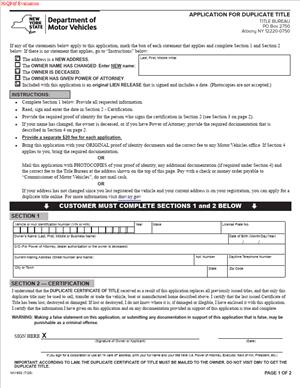
MV-902 – Application for Duplicate Title
Fill out nowJurisdiction: Country: United States | Province or State: New York
If you lost your vehicle title in New York, the MV-902 – Application for Duplicate Title is the form used to request a replacement. A vehicle title is the official document that proves ownership. Without it, you may not be able to sell, transfer, or refinance your vehicle.
The MV-902 – Application for Duplicate Title allows you to ask the state for a new title when the original has been lost, stolen, damaged, or destroyed. It is a formal request to have the record reissued in your name.
This form is commonly used by vehicle owners who discover their title is missing at the moment they need it most. That often happens during a sale or when a lender requires proof of ownership.
Understanding how this document works helps you avoid delays. Small mistakes can slow down the process or result in a rejected submission. Knowing what information is required before you begin makes the process smoother.
What is MV-902 – Application for Duplicate Title?
Clear definition
The MV-902 – Application for Duplicate Title is a written request submitted to the New York Department of Motor Vehicles to issue a replacement vehicle title. It applies to vehicles, trailers, and other titled motor vehicles registered in New York.
A duplicate title is not a new ownership record. It is a reissued copy of the existing title already on file with the state. The duplicate reflects the same ownership information that appears in the official record, unless changes are processed separately.
This form is typically required when the original title document cannot be produced. The state keeps electronic records of ownership, but the paper title is still necessary for many transactions.
Who typically uses this form?
Most commonly, the registered owner listed on the original title uses this form. That person requests the duplicate because the title was lost, misplaced, or destroyed.
Co-owners may also use the form if the vehicle title lists more than one name. In those cases, the names on the state record control who is allowed to request the duplicate.
Lenders may be involved if there is an active lien on the vehicle. If a lien is recorded, the duplicate title may be issued according to the lienholder’s recorded interest.
Occasionally, a personal representative or executor uses the form when handling the estate of a deceased owner. In those cases, additional documentation is often required to show authority to act.
Why might you need this form?
You may need this form if you are planning to sell your vehicle and cannot find the original title. Buyers generally expect the signed title at the time of sale.
You may also need it if your title was damaged beyond use. A torn, water-damaged, or partially destroyed title may not be accepted during a transfer.
Another reason is theft or loss. If your title was stolen, obtaining a duplicate helps prevent unauthorized use of the original document.
You might also need a duplicate when refinancing or securing a loan. Lenders often require proof of ownership before finalizing financing arrangements.
Typical real-life scenarios
- You clean out a file cabinet and realize the envelope containing your car title is gone. A week later, you agree to sell the car. Without the title, you cannot complete the transfer. You submit the form to obtain a replacement before finalizing the deal.
- You move to a new home and several documents are misplaced during the move. Months later, you decide to trade in your vehicle. The dealership asks for the title. You discover it never arrived at your new address and apply for a duplicate.
- Your basement floods and damages important paperwork stored in boxes. The vehicle title becomes unreadable. To avoid issues when transferring ownership later, you request a duplicate title.
- You pay off your vehicle loan and expect to receive the title. After waiting, you realize the document was never delivered or was lost in the mail. You file for a duplicate to ensure you have clear proof of ownership.
- An elderly family member passes away, and you are helping manage their estate. The vehicle title cannot be located among their papers. To transfer the vehicle properly, you apply for a duplicate in accordance with the ownership record.
When would you use MV-902 – Application for Duplicate Title?
You would use this form whenever the original title cannot be produced, and you need a valid replacement. Timing often becomes important when a transaction is pending.
For example, you may use it before selling or gifting a vehicle. A buyer typically requires the original signed title to complete the transfer. Without it, the sale cannot move forward.
You may also use it after discovering that your title was lost years ago but is now required for a legal or financial reason. Even if you are not planning to sell immediately, having a valid title can prevent future complications.
If there is a lien on the vehicle, you may use the form to ensure the title record reflects current information. The duplicate will generally show any recorded liens unless those liens have been properly released.
In estate situations, an executor or administrator may use the form as part of the broader process of transferring property. The duplicate title serves as the document needed to complete that transfer.
This form is not used to change ownership by itself. It is used to replace a missing document. Ownership transfers are handled through separate filings and endorsements once the duplicate is issued.
Legal characteristics of MV-902 – Application for Duplicate Title
The form is effective when it accurately matches the ownership information on record with the state. The name, vehicle identification number, and other details must align with existing records.
A submission may be rejected if key information is missing, incomplete, or inconsistent. Common issues include incorrect vehicle identification numbers, mismatched names, or unsigned forms.
If there is a lien recorded, the duplicate title may be subject to that lien. The presence of a lien can affect who receives the duplicate and how it is issued.
Identification requirements often apply. The person requesting the duplicate must generally be the same person listed as owner in state records, unless authorized documentation shows otherwise.
This form does not transfer ownership, remove a lien, or correct major errors in the original title record. Separate processes typically address those changes.
State procedures can vary in how duplicates are processed, especially if the vehicle has been moved out of state or if multiple owners are listed. While the purpose remains consistent, specific submission methods or requirements may differ slightly depending on circumstances.
Is it legally binding?
The form itself is a formal request rather than a contract. By signing it, you are affirming that the information provided is accurate to the best of your knowledge.
Your signature generally confirms that the original title was lost, stolen, or destroyed. Providing false information on a government form can carry consequences.
Once processed, the duplicate title issued by the state serves as an official ownership document. That document has legal significance in vehicle sales and transfers.
The binding effect comes from the accuracy of the state’s ownership record and the validity of the issued duplicate title, not from the form acting as an agreement between private parties.
How to fill out MV-902 – Application for Duplicate Title
Step 1 – Provide vehicle information
Begin by entering the vehicle’s identifying details. This typically includes the vehicle identification number, year, make, and other requested descriptors. Use the information exactly as it appears on prior registration documents to avoid mismatches.
Step 2 – Enter owner information
Fill in the full legal name of the owner as recorded on the current title. Include the correct mailing address and any other required contact details. The information must match the state’s ownership record.
Step 3 – Indicate reason for duplicate
State why you are requesting a duplicate title. Common reasons include loss, theft, or destruction of the original. Select or describe the reason clearly and consistently.
Step 4 – Address lien information
If there is a lien on the vehicle, provide the requested details about the lienholder. If the lien has been satisfied, ensure that any required release information has been properly recorded before submitting the form.
Step 5 – Review for accuracy
Carefully compare the completed form with your vehicle registration and any prior title information. Check spelling, numbers, and signatures. Even small errors in the vehicle identification number can delay processing.
Step 6 – Sign and date the form
Sign the form in the designated area. Use your legal signature as it appears on official records. Include the date of signing where required.
Step 7 – Submit with required fee and identification
Prepare the form for submission according to the instructions provided with it. Include any required fee and identification documents. Ensure all supporting materials are complete before sending or delivering the application.
Legal terms you might encounter in MV-902 – Application for Duplicate Title
- Duplicate Title: A duplicate title is a reissued certificate of title that replaces the original. It carries the same legal force as the first title but reflects the most current ownership and lien information on record. When you complete this document, you are formally asking the state to cancel the prior certificate and issue a new one.
- Certificate of Title: This is the official document that proves ownership of a vehicle. It lists the vehicle details, the registered owner, and any recorded lienholders. This form requests a replacement of that certificate when it is lost, stolen, or damaged.
- Registered Owner: The registered owner is the individual or business currently listed in state records as the vehicle’s legal owner. Only this person or entity, or an authorized representative, can request a duplicate. The name you enter must match the name on file exactly.
- Lienholder: A lienholder is a lender or other party with a financial interest in the vehicle. If a loan is still active, the lienholder may have rights to receive the duplicate title. This document requires you to disclose any existing lien information accurately.
- Vehicle Identification Number (VIN): The VIN is a unique 17-character code assigned to your vehicle. It is critical for identifying the exact vehicle tied to your request. A single incorrect character can delay or reject your application.
- Power of Attorney: A power of attorney is a written authorization allowing someone else to act on your behalf. If another person signs this document for you, they must have proper authority and may need to attach proof of that authority.
- Release of Lien: A release of lien is proof that a lender has been paid in full and no longer claims a financial interest in the vehicle. If your records show a lien that has already been satisfied, you may need documentation confirming the release before a clear duplicate title can be issued.
- Notarization: Notarization is the official verification of your signature by a notary public. Some title-related transactions require notarized signatures to confirm identity. If notarization is required, you must sign in the presence of the notary.
- Application Fee: This is the required payment submitted with your request. The fee covers processing and issuance of the duplicate certificate. If you submit the wrong amount or an invalid payment method, your request may be delayed.
FAQs
What if I find the original title after I submit this form?
Once a duplicate is issued, the original title is generally no longer valid. You should not use the old certificate for any transaction. Keep only the most recently issued title in your records to avoid confusion during a sale or transfer.
Can someone else sign this document for me?
Yes, but only if they have proper authority. If you use a power of attorney, the person signing must indicate their representative capacity and may need to attach proof of that authority. The name of the vehicle owner must still match the state’s records exactly.
How do I make sure my name matches the record on file?
Check your vehicle registration or prior title copy and copy your name exactly as shown. Include middle initials or suffixes if they appear in the record. Even small differences can cause processing delays because the agency matches your entry against its database.
What happens if there is still a lien on my vehicle?
If a lien is active, the lienholder’s information must be listed correctly. In many cases, the duplicate title may be sent directly to the lienholder instead of you. Make sure the lender’s name is spelled correctly and matches the official record.
Do I need to explain why I am requesting a duplicate?
Yes. This document typically asks you to indicate whether the original was lost, stolen, or destroyed. You must choose the reason that applies to your situation because it becomes part of the official record tied to your vehicle.
How long does it take to receive the duplicate title?
Processing times vary depending on how and where you submit your request. After acceptance, the duplicate certificate is usually mailed to the address on file. Make sure your mailing address is current before you file.
What if I recently moved and my address is different?
You must ensure the address in the motor vehicle records is accurate. If your address has changed, you may need to update it before or at the same time you submit the MV-902 – Application for Duplicate Title. The duplicate will generally be mailed to the address on record.
Will submitting this form change my ownership or registration?
No. This form only replaces the physical title document. It does not transfer ownership, remove a co-owner, or change registration details. It simply reissues proof of the ownership information already recorded.
Checklist: Before, During, and After MV-902 – Application for Duplicate Title
Before
- Confirm you are the registered owner listed in state records.
- Locate your vehicle’s VIN from the dashboard, registration, or insurance card.
- Review your registration to confirm the exact spelling of your name.
- Verify whether a lienholder is still recorded on the vehicle.
- Check that your mailing address is current in motor vehicle records.
- Gather acceptable identification if you plan to file in person.
- Confirm the correct application fee and payment method.
- Determine whether you need a power of attorney or other supporting documents.
During
- Enter the VIN carefully and double-check every character.
- Write your name exactly as it appears on the official record.
- Provide complete and accurate lienholder information, if applicable.
- Select the correct reason for requesting the duplicate.
- Review every field for missing information before signing.
- Sign your name consistently with prior records.
- Ensure any required notarization is completed properly.
- Attach any required supporting documents before submission.
After
- Keep a copy of the completed application for your records.
- Track your submission if you filed by mail.
- Monitor your mail for the duplicate title.
- Confirm the duplicate reflects accurate owner and lien information.
- Store the new title in a secure location.
- Safely dispose of any invalid prior certificate you later locate.
- Update your personal records to reflect the duplicate issue date.
- Contact the motor vehicle agency if the title does not arrive within the expected timeframe.
Common mistakes to avoid with MV-902 – Application for Duplicate Title
- Mistake: Entering an incorrect VIN because you copied it by hand from memory; this happens easily with similar-looking characters and can lead to rejection or delays, so do not forget to verify the VIN directly from the vehicle or official documents.
- Mistake: Using a nickname or shortened version of your name; this often occurs out of habit and can cause a mismatch with state records, so do not forget to copy your legal name exactly as shown on your registration.
- Mistake: Ignoring an active lien; some owners assume a loan is cleared without confirmation, which can result in the duplicate being sent to the lender, so do not forget to confirm lien status before filing.
- Mistake: Submitting the wrong fee amount; this happens when applicants rely on outdated information and can delay processing, so do not forget to verify the current fee before sending payment.
- Mistake: Forgetting to sign the application; unsigned forms are not processed and will be returned, so do not forget to review the signature line before submission.
- Mistake: Failing to update your address first; this can cause the duplicate to be mailed to an old location, so do not forget to ensure your address on record is correct before filing.
- Mistake: Sending incomplete supporting documents when signing as a representative; this happens when power of attorney paperwork is overlooked and can result in rejection, so do not forget to attach proof of authority.
What to do after filling out MV-902 – Application for Duplicate Title
Once you complete the form, pause and review it line by line. Small errors create unnecessary delays. Confirm that your VIN, name, and mailing address match your official records. Make sure your signature is present and consistent.
Next, organize your supporting documents. If you are signing under a power of attorney, attach a clear copy of that authorization. If there is a lien involved, double-check that the lender’s details are accurate.
- Step 1: Make a full copy of the completed application and any attachments for your records.
- Step 2: Confirm the correct fee and prepare your payment in the accepted format.
- Step 3: Submit the application using the approved method, whether in person or by mail.
- Step 4: If filing in person, request confirmation that your application was accepted for processing.
- Step 5: If filing by mail, note the date you sent it and consider using a trackable delivery method.
- Step 6: Monitor your mail for any correspondence or the duplicate certificate itself.
- Step 7: Review the duplicate title immediately upon receipt for accuracy.
- Step 8: Store the new certificate in a secure, dry place separate from your vehicle.
- Step 9: If you later find the original title, do not use it for any transaction.
- Step 10: Update your personal vehicle file to reflect that a duplicate was issued.
Taking these steps protects you from future disputes. A clear, accurate duplicate title makes selling, transferring, or refinancing your vehicle much easier. Treat the new certificate as an essential legal document and keep it secure.
Disclaimer: This guide is provided for informational purposes only and is not intended as legal advice. You should consult a legal professional.