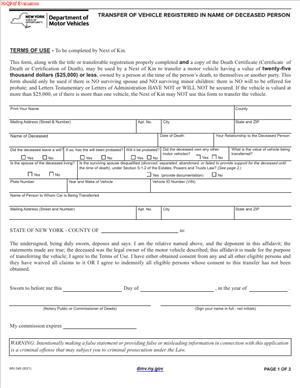
MV-349 – Transfer of Vehicle Registration in Name of Deceased Person
Fill out nowJurisdiction: Country: United States | Province or State: New York
The MV-349 – Transfer of Vehicle Registration in Name of Deceased Person is used when a registered vehicle owner has passed away and someone needs to transfer the registration into a new name. If you are settling an estate or handling a family member’s affairs, this document may be part of that process.
When a vehicle is still registered in the name of a deceased person, it cannot simply remain that way. Registration connects the vehicle to legal responsibility, insurance, and state records. Updating it ensures the records reflect the current owner or responsible party.
You might encounter this form while managing estate paperwork. It often comes up alongside title transfers, insurance updates, and probate matters. Understanding what the form does helps you complete it correctly and avoid delays.
This guide explains what the form is, who uses it, when it applies, and how to complete it step by step. The goal is to help you feel prepared before you begin filling it out.
What is MV-349 – Transfer of Vehicle Registration in Name of Deceased Person?
Clear definition
MV-349 – Transfer of Vehicle Registration in Name of Deceased Person is a New York motor vehicle form used to change the registration of a vehicle after the registered owner has died. It allows the registration to be placed in the name of a qualified person, such as an heir, surviving joint owner, or estate representative.
Registration is different from ownership. Ownership is tied to the vehicle title. Registration allows the vehicle to be legally driven on public roads. This form focuses on the registration record, not the title itself.
In practical terms, this document tells the state that the person listed on the current registration is deceased and that the registration needs to reflect a new responsible party.
Who typically uses this form?
You might use this form if you are the executor or administrator of an estate. That means you are managing the deceased person’s assets and responsibilities.
A surviving spouse may also use it, depending on how the vehicle was owned and registered. In some cases, an adult child or other heir completes the form if they are entitled to receive the vehicle.
If the vehicle was jointly registered, the surviving registrant may need this form to update the registration solely into their own name.
Insurance representatives or legal professionals may help prepare the paperwork, but the person signing the form is usually the one who will become the new registrant or who has authority over the estate.
Why might you need this form?
You need this form when a vehicle remains registered in the name of someone who has died and you want to legally operate, insure, sell, or transfer the vehicle.
Without updating the registration, the vehicle may not be legally driven. Insurance coverage may also become complicated if the named registrant is deceased.
If you plan to transfer the vehicle to yourself or another heir, this form may be part of that process. It ensures that the state’s motor vehicle records are accurate.
If you are preparing to sell the vehicle as part of settling an estate, correcting the registration is often one of the early steps in organizing the paperwork.
Typical real-life scenarios
- A parent passes away and leaves behind a car that was registered solely in their name. Their adult child is named executor and needs to transfer the registration so the vehicle can be used or sold. This form becomes part of that transition.
- A married couple owned a car, but the registration was only in one spouse’s name. After that spouse dies, the surviving spouse needs to update the registration to reflect their own name as the current registrant.
- An individual dies without a formal will, but a close family member is legally handling the estate. The vehicle must be registered to someone authorized before it can be transferred or sold.
- A family wants to keep the vehicle and give it to a beneficiary named in the will. Before the new beneficiary can register and drive the car, the existing registration tied to the deceased must be properly addressed.
- In each situation, the form helps close the gap between the deceased person’s registration record and the new person responsible for the vehicle.
When would you use MV-349 – Transfer of Vehicle Registration in Name of Deceased Person?
You would use MV-349 – Transfer of Vehicle Registration in Name of Deceased Person when the registered owner of a vehicle has died and the registration needs to be updated to reflect a new registrant. This often happens during estate administration.
The form is commonly used early in the estate process if the vehicle needs to remain in use. For example, a surviving family member may need the car for transportation while the estate is being settled.
You may also use it when preparing to transfer the vehicle permanently to an heir. In that case, the registration must align with the new owner’s name.
If the vehicle will be sold, the registration may need to be properly transferred or terminated as part of completing the transaction.
In estates where there was joint registration, the surviving joint registrant may use the form to remove the deceased person’s name from the registration record.
The form is generally relevant whenever the vehicle is still active in the state’s records and the person listed is no longer living.
Legal characteristics of MV-349 – Transfer of Vehicle Registration in Name of Deceased Person
This form functions as an official request to update motor vehicle registration records. It is part of an administrative process handled by the state’s motor vehicle agency.
For the form to be effective, it typically must be completed accurately, signed by the appropriate person, and submitted with any required supporting documents. These may include proof of death and documentation showing authority over the estate or entitlement to the vehicle.
Common reasons for rejection include incomplete information, missing signatures, or inconsistent details between the registration, title, and supporting documents. Even small errors in names, dates, or vehicle identification numbers can delay processing.
It is important to understand that this form addresses registration, not necessarily ownership. In many cases, a separate title transfer process must also be completed. The two processes are related but not identical.
High-level differences can exist depending on how the vehicle was owned. For example, vehicles owned jointly may be treated differently than those owned solely. Estate size and probate status may also affect which documents are required alongside this form.
This form does not resolve disputes between heirs. It does not determine who is legally entitled to the vehicle. It records the transfer of registration based on the information and documentation provided.
Is it legally binding?
Yes, in the sense that once accepted and processed, it updates the official registration record. That change has legal effect because registration determines who is recognized as responsible for the vehicle under state law.
By signing the form, you are generally confirming that the information provided is true and that you have the authority to request the transfer. False or inaccurate statements can create legal consequences.
However, the form itself does not create ownership rights. It reflects and records a transfer that is supported by other legal documents, such as a will, court appointment, or applicable estate rules.
In short, it becomes legally effective when properly completed, supported by required documentation, and accepted by the motor vehicle agency.
How to fill out MV-349 – Transfer of Vehicle Registration in Name of Deceased Person
Step 1 – Identify the vehicle
Begin by entering the full vehicle details exactly as they appear on the current registration and title. This usually includes the vehicle identification number, year, make, and plate number. Accuracy is critical because these details connect your request to the correct vehicle record.
Step 2 – Provide the deceased registrant’s information
Enter the full legal name of the deceased person as it appears on the registration. Include any additional identifying information requested on the form. The spelling must match existing records to avoid processing delays.
Step 3 – Enter the date of death
Provide the date of death in the format requested. This date is often supported by a death certificate or similar document submitted with the form. Ensure the date matches your supporting paperwork.
Step 4 – Identify the new registrant
Fill in the complete legal name of the person who will become the new registrant. Include their address and any other identifying information required. This information establishes who will be responsible for the vehicle going forward.
Step 5 – State your authority or relationship
Indicate your role in relation to the deceased person and the vehicle. For example, you may be an executor, administrator, surviving spouse, or heir. The form may require you to confirm that you are authorized to request the transfer.
Step 6 – Review insurance and registration details
Confirm that the vehicle’s insurance information is current and that any required insurance documentation is ready for submission. Registration cannot typically be maintained or issued without proper insurance coverage in place.
Step 7 – Sign and date the form
Sign the form in the space provided using your legal name. Enter the date of signing. Your signature confirms that the statements in the form are true to the best of your knowledge and that you have the authority to complete the transfer.
Step 8 – Double-check for completeness
Before submitting, review every section carefully. Make sure all required fields are filled in, all names are spelled correctly, and all supporting documents are attached. A thorough review at this stage can prevent rejection or delay.
Legal terms you might encounter in MV-349 – Transfer of Vehicle Registration in Name of Deceased Person
- Registrant: The registrant is the person whose name appears on the current vehicle registration. On this document, that person is deceased. You must enter their name exactly as it appears on the existing registration record to avoid processing delays.
- Decedent: The decedent is the individual who has passed away. This term may be used in instructions or related documents. It refers to the same person as the deceased registrant listed on the form.
- Executor: An executor is the person named in a will to handle the deceased person’s estate. If you are acting as executor, you may need to confirm your authority when signing this form. Your name must match the appointment documents exactly.
- Administrator: An administrator is appointed to manage an estate when there is no will or no executor is available. If you are the administrator, you sign in that capacity. The title you use on this form should match the official appointment.
- Estate: The estate includes all property owned by the deceased at the time of death. The vehicle listed on this document is part of that estate. The transfer recorded by this form reflects a change in registration tied to estate administration.
- Affidavit: An affidavit is a written statement made under oath. While this document itself may not be titled as an affidavit, some sections require you to certify that the information is true. Your signature confirms that statement.
- Title Certificate: The title certificate proves ownership of the vehicle. Registration and title are separate records. Completing this form changes the registration record, and you may also need to address the title if ownership is being transferred.
- Next of Kin: Next of kin refers to the closest living relative, such as a spouse or child. In some cases, a next of kin may be authorized to sign. The relationship you state on the form must be accurate and clear.
- Proof of Death: Proof of death usually means a death certificate. You may need to provide this document when submitting the form. The name and date of death must match what you enter on the form.
FAQs
Do I need to complete MV-349 – Transfer of Vehicle Registration in Name of Deceased Person if I am keeping the vehicle in the family?
Yes. Even if the vehicle stays within your family, the registration record must reflect the correct living registrant. This document updates the public record so it no longer shows the deceased person as the active registrant. If you skip this step, the registration remains in the deceased person’s name, which can create problems with insurance, renewals, or future transfers.
What name should I write for the deceased registrant?
You must write the name exactly as it appears on the current registration record. Do not shorten, rearrange, or correct spelling unless the official record already shows that version. If the registration shows a middle initial or suffix, include it. The goal is to match the existing record so the agency can locate the correct file.
Who is allowed to sign this document?
The signer must have legal authority connected to the deceased person’s estate. That could be an executor, an administrator, or another authorized individual. You need to clearly state your capacity next to your signature. If your authority is not clear from the form, you may be required to show documentation that confirms your role.
What date should I enter as the date of death?
Enter the exact date shown on the death certificate. Do not estimate. The date of death helps determine when the registration status changed and ensures the record reflects an accurate timeline. Double-check the month, day, and year before submitting.
Does this form transfer ownership of the vehicle?
Not by itself. This document updates the registration record to remove the deceased person’s name. Ownership is tied to the title certificate. If ownership is changing, you must also complete the required title transfer steps so both records match.
What happens to the license plates after I submit this form?
The plates are connected to the registration record. If the vehicle will continue to be registered, the plates may stay with it, depending on how the registration is updated. If the registration will not continue, you may need to handle the plates separately. The key point is that the registration record will be updated to reflect the new registrant or status.
What if the vehicle was jointly registered with the deceased person?
If the registration listed more than one person, you need to review how the names appear. If there was a surviving co-registrant, the process may be different from a sole registrant situation. Make sure you enter all names exactly as shown and clearly indicate which person is deceased.
How do I know if my MV-349 – Transfer of Vehicle Registration in Name of Deceased Person was accepted?
You will receive confirmation through updated registration documents or official notice that the record has been changed. Check that the new registration shows the correct living registrant and vehicle details. If you do not receive confirmation within a reasonable time, follow up to confirm the status.
Checklist: Before, During, and After MV-349 – Transfer of Vehicle Registration in Name of Deceased Person
Before
- Confirm the full legal name of the deceased registrant as shown on the current registration.
- Obtain a certified copy of the death certificate.
- Gather the current registration document and vehicle information.
- Verify your legal authority to act on behalf of the estate.
- Confirm whether the vehicle title also needs to be transferred.
- Check that the vehicle identification number (VIN) is correct and legible.
- Make sure insurance coverage is active if the vehicle will remain on the road.
During
- Print clearly in black or blue ink if completing by hand.
- Enter the deceased registrant’s name exactly as shown on the record.
- Write the accurate date of death from the death certificate.
- Provide complete information for the new registrant.
- State your relationship or legal capacity clearly next to your signature.
- Review every field before signing.
- Sign and date the form where indicated.
- Ensure all required supporting documents are attached.
After
- Make a full copy of the completed form and all attachments.
- Submit the form using the accepted filing method.
- Track when and how you submitted the documents.
- Monitor for confirmation or updated registration documents.
- Review the new registration for accuracy once issued.
- Store copies with estate records.
- Update your personal records to reflect the new registration status.
Common mistakes to avoid with MV-349 – Transfer of Vehicle Registration in Name of Deceased Person
- Mistake: Entering a nickname or shortened version of the deceased person’s name because it feels more natural, which happens when families use informal names; this can cause record mismatches and rejection, so do not forget to copy the name exactly as shown on the registration.
- Mistake: Guessing the date of death from memory because you do not have the certificate nearby; this can delay processing if the date does not match official records, so do not forget to verify the exact date before writing it down.
- Mistake: Signing without indicating your legal capacity, which often happens when you assume your role is obvious; this can lead to questions about your authority, so do not forget to state whether you are executor, administrator, or another authorized person.
- Mistake: Forgetting to address the vehicle title because you assume updating registration is enough; this creates inconsistent records, so do not forget to check whether ownership documents must also be updated.
- Mistake: Leaving required fields blank because they seem unimportant; incomplete forms may be rejected or delayed, so do not forget to review every line before submission.
- Mistake: Failing to keep copies of what you submitted because you expect everything to be processed smoothly; if documents are lost or questioned, you will have no proof, so do not forget to save complete copies for your records.
- Mistake: Submitting the form without required supporting documents due to misunderstanding the instructions; this can result in immediate rejection, so do not forget to confirm all attachments are included.
- Mistake: Not reviewing the updated registration after approval because you assume it must be correct; errors can still occur, so do not forget to check the new document carefully.
What to do after filling out MV-349 – Transfer of Vehicle Registration in Name of Deceased Person
Once you complete the form, pause before submitting it. A careful review now can prevent delays later. Compare every entry to the supporting documents in front of you. Names, dates, and numbers must match exactly.
- Step 1: Make a complete copy of the signed form for your records.
- Step 2: Make copies of all supporting documents, including proof of death and any papers showing your authority.
- Step 3: Confirm the correct submission method and location.
- Step 4: Submit the original signed form along with required attachments.
- Step 5: Request or keep proof of submission, such as a receipt or confirmation.
- Step 6: Mark your calendar to follow up if you do not receive confirmation within the expected timeframe.
- Step 7: Review the updated registration document once you receive it.
- Step 8: Verify that the new registrant’s name, address, and vehicle details are accurate.
- Step 9: If ownership is also changing, complete any related title transfer steps.
- Step 10: Store the updated registration and copies of all documents with the estate records.
After submission, stay organized. Keep all paperwork together in one folder, whether digital or paper. This helps if questions arise later about the vehicle’s status.
If the registration is approved, make sure the vehicle’s insurance and inspection records reflect the new registrant. Consistency across documents reduces the risk of future complications.
If the form is returned for corrections, address the issue promptly. Review the explanation carefully. Correct only what is necessary, but recheck the entire document before resubmitting.
Taking these final steps ensures the vehicle’s registration record accurately reflects the change after the registrant’s death. That clarity protects you, the estate, and anyone who will use or inherit the vehicle.
Disclaimer: This guide is provided for informational purposes only and is not intended as legal advice. You should consult a legal professional.