IL-1040-ES Estimated Income Tax Payments for Individuals 2026
Fill out nowJurisdiction: Country: United States | Province or State: Illinois
Revised date: 12/25
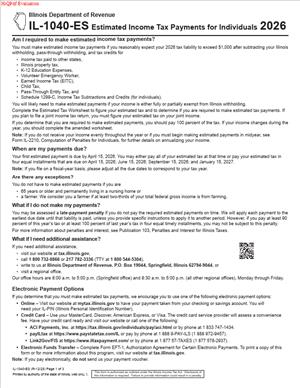
The IL-1040-ES Estimated Income Tax Payments for Individuals 2026 is the Illinois form used to calculate and submit estimated state income tax payments for the 2026 tax year. If you expect to owe Illinois income tax and you do not have enough tax withheld from wages or other payments, this form helps you pay in advance.
You are not filing your full tax return with this document. Instead, you are making scheduled payments toward what you expect to owe. These payments are typically made during the year, not just at tax time.
This form matters because Illinois requires many individuals to pay income tax as they earn income. If you wait until you file your annual return and have not paid enough, you may face penalties and interest.
If you are self-employed, earn freelance income, receive investment income, or have other untaxed income, this form may apply to you. Understanding how it works can help you avoid surprises when you file your 2026 Illinois income tax return.
What is IL-1040-ES Estimated Income Tax Payments for Individuals 2026?
Clear definition
The IL-1040-ES Estimated Income Tax Payments for Individuals 2026 is an estimated tax payment form issued by the Illinois Department of Revenue. It allows individuals to calculate how much Illinois income tax they expect to owe for the year and to make installment payments toward that amount.
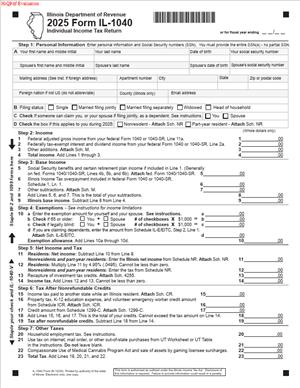
It is not the same as your annual IL-1040 individual income tax return. The annual return reports your actual income and tax after the year ends. The estimated payment form is used during the year to prepay part or all of your expected tax liability.
The document typically includes a worksheet to help you estimate your income, deductions, exemptions, and credits. Based on that estimate, you determine how much to send with each payment voucher or electronic submission.
Who typically uses this form?
You commonly use this form if you are self-employed. This includes sole proprietors, independent contractors, gig workers, and freelancers who do not have Illinois income tax withheld from their payments.
You may also use it if you receive income from investments, rental property, partnerships, or S corporations and not enough tax is withheld. Retirees with pension or other income that does not have Illinois withholding may also fall into this group.
Employees sometimes use this form if their withholding is too low. For example, if you have multiple jobs or a significant side income, your payroll withholding may not fully cover your Illinois tax.
Estates and trusts have separate forms. This specific document is for individuals who expect to file an Illinois individual income tax return for 2026.
Why might you need this form?
Illinois generally expects you to pay income tax as you earn or receive income. If you expect to owe a certain minimum amount of tax after subtracting withholding and credits, estimated payments may be required.
Without estimated payments, you may owe a large balance when you file your return. In some cases, you may also be charged a penalty for underpayment during the year.
This form helps you spread your tax payments across the year. That can make budgeting easier and reduce the risk of owing a lump sum in April.
It also gives you a structured way to think through your projected income. By working through the worksheet, you get a clearer picture of what your Illinois tax might look like for 2026.
Typical real-life scenarios
- You start freelancing full-time in 2026. No taxes are withheld from client payments. You estimate your annual profit and use the form to calculate quarterly Illinois payments.
- You keep your regular job but also sell products online. The extra income increases your total tax bill. Your paycheck withholding does not cover the additional Illinois tax, so you use estimated payments to make up the difference.
- You retire and begin receiving distributions from retirement accounts. Federal tax may be withheld, but Illinois withholding may not be enough. You estimate your state tax and use the form to avoid a large year-end balance.
- You own a rental property in Illinois. After expenses, you expect a net profit. Because tenants do not withhold taxes, you project your annual rental income and submit estimated payments using this document.
- You receive significant dividend and capital gain income during the year. Since no Illinois tax is automatically withheld, you calculate an estimated liability and make installment payments.
When would you use IL-1040-ES Estimated Income Tax Payments for Individuals 2026?
You would typically use IL-1040-ES Estimated Income Tax Payments for Individuals 2026 at the start of the 2026 tax year or as soon as you realize your withholding will not cover your expected Illinois tax. Many people review their situation early in the year to determine if estimated payments are necessary.
The form is often used before each quarterly due date. Estimated payments are commonly divided into four installments spread throughout the year. Before each payment, you may review your income so far and adjust your estimate if needed.
If your income changes midyear, you may return to the worksheet portion of the document to recalculate. For example, if your freelance income increases, you might increase your later payments. If income drops, you might reduce them.
New business owners often use this form in their first year of operation. Without employer withholding, estimated payments become the main way to pay Illinois income tax during the year.
You might also use this form after a major life change. Examples include leaving a job, starting contract work, selling property at a gain, or receiving a large one-time payment. In these cases, estimated payments help align your tax payments with your new income pattern.
Legal characteristics of IL-1040-ES Estimated Income Tax Payments for Individuals 2026
This form is an official state tax document. Its effectiveness depends on accurate completion and timely submission with payment. The amounts you report should be based on reasonable estimates of your expected income and tax.
For the document to function as intended, you must provide correct identifying information, such as your name and Social Security number. Errors in these details can cause processing delays or misapplied payments.
Timeliness is a key factor. Estimated payments are tied to specific due dates. Missing a due date or paying too little for a period can lead to interest or underpayment penalties, even if you pay the full amount later with your annual return.
Common problems include underestimating income, miscalculating tax, or failing to account for other Illinois adjustments and credits. Another issue is forgetting to adjust later payments after a significant income change.
State tax rules can vary. While many states require estimated payments, calculation methods and thresholds differ. This form applies specifically to Illinois income tax for individuals for the 2026 tax year.
It is important to understand what this document does not do. It does not replace your annual Illinois individual income tax return. You must still file your full return after the year ends. The estimated payment form only covers advance payments toward that future filing.
Is it legally binding?
The IL-1040-ES Estimated Income Tax Payments for Individuals 2026 is not a contract between you and another party. However, it is part of your compliance with Illinois tax law. When you submit payments using this form, you are fulfilling a statutory payment requirement.
The figures you provide are estimates, not final determinations of tax. They do not lock you into a final tax amount. Your actual liability is calculated when you file your annual return.
That said, submitting the form and payment creates a record of amounts paid toward your 2026 Illinois tax. Those payments are credited to your account and applied against your final tax liability.
If the estimates are significantly inaccurate or payments are insufficient, you may face financial consequences under state tax rules. The binding aspect relates to the obligation to pay required taxes, not to the estimate itself.
How to fill out IL-1040-ES Estimated Income Tax Payments for Individuals 2026
Step 1 – Gather your income information for 2026
Collect recent pay stubs, profit and loss statements, prior year tax returns, and records of expected income. Include wages, self-employment income, rental income, investment income, and any other taxable amounts. Having accurate projections makes your estimate more reliable.
Step 2 – Review your prior year’s Illinois tax return
Look at your most recent Illinois individual income tax return. Note your total income, Illinois base income, and total tax. This gives you a starting point and helps you compare expected changes for 2026.
Step 3 – Complete the estimated tax worksheet
Use the worksheet provided with the form to project your 2026 income. Enter your expected federal adjusted gross income and apply Illinois-specific additions and subtractions to determine your projected Illinois base income. Then calculate your estimated Illinois income tax for the year.
Step 4 – Subtract withholding and credits
Estimate how much Illinois income tax will be withheld from wages or other payments during 2026. Subtract that amount, along with any expected credits, from your projected total tax. The remaining balance is the amount you may need to cover through estimated payments.
Step 5 – Determine your installment amounts
Divide your expected remaining tax liability into the required number of installments for the year. The form generally provides guidance on how to calculate equal payments. If your income varies during the year, you may adjust later installments based on updated estimates.
Step 6 – Complete the payment voucher
Enter your name, address, and Social Security number carefully in the voucher section of the form. Double-check all identifying information. Indicate the correct tax year, which in this case is 2026, and the amount of the installment you are paying.
Step 7 – Submit the payment by the applicable due date
Send the voucher with your payment, or follow the electronic submission instructions provided with the document. Make sure the payment is made on or before the listed due date for that installment. Keep a copy or confirmation for your records.
Step 8 – Track your payments and update estimates if needed
Maintain a record of each payment you make throughout 2026. If your income changes significantly, revisit the worksheet and recalculate your remaining installments. This helps align your payments more closely with your actual tax situation before you file your annual return.
Legal terms you might encounter in IL-1040-ES Estimated Income Tax Payments for Individuals 2026
- Estimated tax: This is the amount of income tax you expect to owe for the year that is not covered by withholding. In this document, you calculate and pay it in advance. It is based on projected income, not final numbers.
- Installment payment: This refers to each scheduled payment you make during the year. Instead of paying one large amount at tax time, you divide your estimated tax into separate due dates. Each voucher corresponds to one installment.
- Taxable income: This is the portion of your income that is subject to Illinois income tax after adjustments. You use projected taxable income to calculate how much to pay. It is not the same as your gross income.
- Withholding: This is the tax already taken out of your paycheck or other payments. When completing the worksheet, you subtract expected withholding from your projected total tax. The remainder is what you may need to pay using estimated payments.
- Underpayment penalty: This is a charge that may apply if you do not pay enough tax during the year. If your installments are too low or late, the state may assess this penalty. Accurate estimates and timely payments help you avoid it.
- Adjusted gross income (AGI): This is your total income minus certain adjustments. Some safe harbor calculations use your prior year AGI to determine how much you must prepay to avoid penalties. You may need last year’s return to find this figure.
- Safe harbor rule: This is a guideline that allows you to avoid penalties if you pay at least a certain percentage of last year’s tax or current year’s tax. The worksheet helps you determine whether you meet this threshold. It offers protection even if your final tax ends up higher.
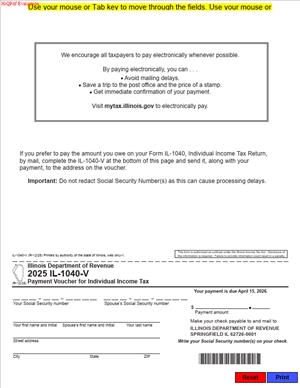
- Payment voucher: This is the portion of the packet you send with your payment if you are not paying electronically. It identifies your name, Social Security number, tax year, and installment period. It ensures your payment is credited correctly.
- Tax year: This is the calendar year for which you are making estimated payments. The form is specific to 2026. You must be sure you are using the correct year to avoid misapplied payments.
FAQs
Do I need to file IL-1040-ES Estimated Income Tax Payments for Individuals 2026 if I already have a job with withholding?
You may not need this document if your employer withholds enough Illinois tax to cover your full liability. Check your most recent pay stubs and compare the total expected withholding to your projected annual tax. If there is a shortfall, you may need to make estimated payments to cover the difference.
What information do I need in front of me before I start?
Have your most recent Illinois income tax return, current pay stubs, and records of any freelance or investment income. You will need your Social Security number and current address exactly as it appears on your tax records. Accurate prior-year tax totals help you apply any safe harbor calculation.
How do I know which installment amount to enter on each voucher?
Use the worksheet to divide your total estimated tax into equal payments unless your income varies significantly during the year. Each voucher corresponds to a specific due date. Enter only the amount due for that installment, not the full year’s total.
What happens if my income changes after I submit one payment?
You can adjust future installments. Recalculate your projected tax using updated income figures. Increase or decrease remaining payments so that your total prepaid tax better matches what you expect to owe.
Do I have to sign this document?
Payment vouchers generally do not require a signature, but you must ensure all identifying information is accurate. If you are submitting any accompanying correspondence, confirm whether a signature line is present. Always verify that your Social Security number is correct before sending payment.
Can I pay electronically instead of mailing a voucher?
Yes, you can submit estimated payments electronically through approved state systems. When paying electronically, you do not mail the paper voucher. Keep confirmation details for your records to prove the payment was processed.
What if I miss a due date?
Make the payment as soon as possible. Late payments may result in interest or a penalty. When completing your annual return, you may need to calculate whether an underpayment penalty applies.
How will I know my payment was credited to my account?
If you pay electronically, you should receive a confirmation number. If you mail a payment, check your bank statement to confirm the check cleared. When you later file your annual Illinois return, compare the credited estimated payments against your own records.
Checklist: Before, During, and After IL-1040-ES Estimated Income Tax Payments for Individuals 2026
Before
- Review your prior year Illinois tax return for total tax and AGI.
- Estimate all sources of 2026 income, including self-employment and investments.
- Gather current pay stubs to calculate expected withholding.
- Identify any credits you expect to claim.
- Confirm your current legal name and address on file.
- Decide whether you will pay by mail or electronically.
- Mark installment due dates on your calendar.
- Set aside funds in a separate account if possible.
During
- Complete the estimated tax worksheet carefully and line by line.
- Double-check your Social Security number before writing it on any voucher.
- Calculate each installment amount accurately.
- Confirm you are using the 2026 tax year vouchers.
- Write the correct installment period on the voucher.
- If mailing, make your check payable as instructed.
- If paying electronically, verify the correct tax year and payment type.
- Keep a copy or photo of each completed voucher.
After
- Store copies of worksheets and payment confirmations together.
- Monitor your bank account to confirm payments cleared.
- Update your records with the date and amount of each installment.
- Recalculate estimates if your income changes midyear.
- Keep track of total estimated payments for your annual return.
- Compare credited payments when filing your 2026 return.
- Retain records with your tax documents for future reference.
Common mistakes to avoid with IL-1040-ES Estimated Income Tax Payments for Individuals 2026
- Mistake: Using last year’s vouchers for the wrong tax year, which happens when forms look similar; this can cause misapplied payments or delays, so do not forget to confirm the year printed on each voucher.
- Mistake: Guessing income without reviewing actual records, which often leads to underpayment penalties; this results in extra charges, so do not forget to base estimates on real numbers.
- Mistake: Forgetting to subtract expected withholding, which happens when focusing only on freelance income; this may cause overpayment and cash flow strain, so do not forget to account for tax already withheld.
- Mistake: Entering an incorrect Social Security number, often due to rushing; this can prevent proper crediting of payments, so do not forget to verify all identifying details.
- Mistake: Missing installment due dates because they are not scheduled, which leads to penalties and interest; do not forget to calendar each payment in advance.
- Mistake: Failing to adjust later payments after a major income change, which happens when income increases or drops unexpectedly; this can create a large balance due, so do not forget to recalculate midyear.
- Mistake: Mailing a voucher after paying electronically, which happens when you are unsure the online payment went through; this may cause duplicate payments, so do not forget to confirm before sending anything by mail.
- Mistake: Not keeping proof of payment, which often occurs when relying on memory; this creates problems if there is a dispute, so do not forget to save confirmations and bank records.
What to do after filling out IL-1040-ES Estimated Income Tax Payments for Individuals 2026
Once you complete your worksheet and vouchers, focus on execution and recordkeeping. The form itself is only part of the process. What matters is that your payments are made correctly, on time, and properly tracked.
- Step 1: Decide how you will submit your payment, either electronically or by mailing the voucher with payment.
- Step 2: If mailing, write your check clearly and include any required identifying information in the memo line.
- Step 3: If paying electronically, carefully select the correct tax year and payment type before submitting.
- Step 4: Record the exact amount and date of each installment in a dedicated tax log.
- Step 5: Save a digital and paper copy of your completed worksheet.
- Step 6: Keep confirmation numbers or proof that your check cleared your bank.
- Step 7: Set reminders for the remaining installment due dates.
- Step 8: Review your income at least once midyear to see if your estimates need updating.
- Step 9: Increase or decrease future installments if your projections change.
- Step 10: When preparing your annual Illinois return, enter the total estimated payments exactly as recorded.
- Step 11: Compare your records with the state’s credited payment amounts.
- Step 12: Store all related documents with your 2026 tax records for future reference.
Treat estimated payments as an ongoing system, not a one-time task. Staying organized throughout the year reduces stress when you file your annual return and helps you avoid unexpected balances due.
Disclaimer: This guide is provided for informational purposes only and is not intended as legal advice. You should consult a legal professional.