2025 Form IL-990-T – Exempt Organization Income and Replacement Tax Return
Fill out nowJurisdiction: Country: United States | Province or State: Illinois
Revision Date: 12/2025
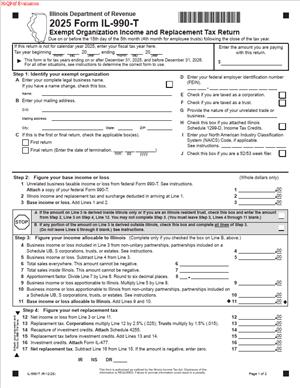
The 2025 Form IL-990-T – Exempt Organization Income and Replacement Tax Return is an Illinois tax filing used by certain tax-exempt organizations that have taxable income. Even though your organization may be federally tax-exempt, you may still owe Illinois income or replacement tax on specific types of income. This form reports income and calculates any tax due to the state.
If you are about to complete this document, you are likely dealing with unrelated business income or replacement tax obligations. The form connects your federal reporting with Illinois tax rules. It focuses on income earned in Illinois that is not fully exempt under state law.
This filing matters because failing to report taxable income can lead to penalties, interest, and compliance issues. Filing accurately helps keep your organization in good standing with the Illinois Department of Revenue.
Understanding what this form does, who files it, and how to complete it will make the process more manageable. The sections below walk you through the purpose, legal role, and step-by-step completion of the form.
What is the 2025 Form IL-990-T – Exempt Organization Income and Replacement Tax Return?
Clear definition
The 2025 Form IL-990-T – Exempt Organization Income and Replacement Tax Return is a state tax return used by exempt organizations to report Illinois unrelated business taxable income and calculate replacement tax. It applies to organizations that are generally exempt from income tax but earn certain taxable income within Illinois.
This form is separate from your federal Form 990-T. While the federal return reports unrelated business income to the Internal Revenue Service, the Illinois version focuses on how that income is treated under state law. The starting point is often federal taxable income, but Illinois adjustments may apply.
In simple terms, this document tells Illinois how much taxable income your exempt organization earned from activities that are not substantially related to its exempt purpose, and how much tax is owed on that income.
Who typically uses this form?
This form is commonly used by nonprofit corporations, charitable organizations, religious organizations, educational institutions, and other entities that have federal tax-exempt status but generate unrelated business income.
For example, a nonprofit hospital, university, or charitable foundation may operate a business activity that is not directly tied to its mission. If that activity produces taxable income, the organization may need to file this return in Illinois.
Trusts and other exempt entities may also use this form if they are subject to Illinois replacement tax and have unrelated business income attributable to Illinois.
The people completing the form are often executive directors, finance managers, treasurers, or outside accountants. If you are self-represented, you are likely responsible for gathering financial records and transferring the correct figures onto the form.
Why might you need this form?
You may need this form if your organization earned income from a trade or business that is not substantially related to its exempt purpose. Illinois taxes that income, even if the organization remains exempt for other activities.
You might also need to file if your organization is subject to the Illinois replacement tax. Replacement tax generally applies to certain entities, including corporations, and is calculated as a percentage of income.
Another reason to file is when your federal filing triggers a state obligation. If you file a federal Form 990-T reporting unrelated business income, that often signals the need to review Illinois filing requirements as well.
Even if no tax is ultimately due, filing may still be required in some cases to report the income and document the calculation.
Typical real-life scenarios
- A nonprofit organization operates a gift shop that is open to the public. The shop’s activities are not substantially related to the organization’s charitable mission. The income from the shop may be considered unrelated business income and reported on this return.
- A university rents out its facilities for private events during the off-season. If those rentals are treated as unrelated business activities under federal rules, the resulting income may flow into the Illinois filing.
- A charitable organization invests in a partnership that conducts a trade or business. If the partnership allocates unrelated business taxable income to the organization, that income may need to be reported on this form.
- A tax-exempt corporation earns advertising revenue from a publication. If that advertising is treated as unrelated business income, the organization may have a state tax reporting obligation tied to that revenue.
When would you use the 2025 Form IL-990-T – Exempt Organization Income and Replacement Tax Return?
You would use this form when preparing your annual Illinois tax filings, and your organization has unrelated business taxable income attributable to Illinois. The timing generally aligns with your organization’s tax year.
If your organization follows a calendar year, the filing typically covers income from January through December. If you operate on a fiscal year, the return reflects that specific accounting period.
You may also use this form when amending a previously filed return. If you discover errors in income reporting, deductions, or tax calculations, an amended filing may be required to correct the record.
In some situations, you might complete this form after receiving updated information from a partnership or other pass-through entity. If a Schedule K-1 shows Illinois-source unrelated business income, that may trigger a need to prepare or revise the filing.
Organizations that cease operations during the year may also use this form to report final taxable income. In that case, the return reflects activity up to the date of termination.
Legal characteristics of 2025 Form IL-990-T – Exempt Organization Income and Replacement Tax Return
This form is an official state tax return. It becomes effective when properly completed, signed, and submitted to the Illinois Department of Revenue. Accuracy and completeness are central to its acceptance.
For the return to be considered valid, it generally must include correct identifying information, a clear reporting period, accurate income figures, and the required signature. Missing signatures, math errors, or incomplete schedules commonly lead to processing delays or notices from the state.
The figures reported on this form usually tie back to federal filings. Differences between federal and Illinois numbers without explanation can raise questions. Illinois may require specific additions or subtractions to arrive at state taxable income.
This document does not grant or revoke tax-exempt status. It only reports and calculates tax on unrelated business income and replacement tax obligations. Filing it does not change your federal exemption.
State tax rules can differ from federal rules in certain respects. While Illinois often uses federal taxable income as a starting point, state-specific adjustments may apply. These differences can affect the final tax calculation.
Late filing or underpayment may result in penalties and interest. The form itself does not waive those amounts. It simply calculates the base tax and any additional charges reflected on the return.
Is it legally binding?
Yes, this return is legally binding once signed and submitted. When you sign the form, you are declaring that the information provided is true, correct, and complete to the best of your knowledge.
The signature creates accountability for the reported income, deductions, and tax calculations. If the information is materially incorrect, the organization may face assessments, penalties, or further review.
If a paid preparer completes the return, that preparer typically signs as well. The organization’s authorized officer still bears responsibility for reviewing the content before submission.
The legal effect of the filing is limited to tax reporting. It establishes the organization’s reported tax liability for the year. It does not create contracts, alter governance documents, or affect nonprofit status beyond tax compliance.
How to fill out 2025 Form IL-990-T – Exempt Organization Income and Replacement Tax Return
Step 1 – Gather your federal and financial records
Start by collecting your federal Form 990-T, financial statements, and any supporting schedules. You will need detailed information about unrelated business income, deductions, and credits. If your organization receives income from partnerships or other entities, gather all related statements showing Illinois-source amounts.
Step 2 – Enter organization identification information
At the top of the form, provide your organization’s legal name, mailing address, and federal employer identification number. Enter the correct tax year, whether calendar or fiscal. Make sure the information matches your federal filings and state registration records.
Step 3 – Report federal unrelated business taxable income
Locate the line that asks for your federal unrelated business taxable income. Transfer the appropriate figure from your federal return. This amount is often the starting point for calculating Illinois taxable income.
Check that the number reflects any federal adjustments already made. Using an incorrect federal figure can affect every later calculation on the form.
Step 4 – Apply Illinois additions and subtractions
Review the section for Illinois-specific modifications. These lines adjust your federal income to reflect differences under Illinois law. Enter any required additions to income and any permitted subtractions, based on the instructions for the tax year.
Carefully read each line description. Some adjustments apply only in specific circumstances, such as certain types of interest or depreciation differences.
Step 5 – Calculate Illinois net income
After applying additions and subtractions, compute your Illinois net income. Follow the line-by-line math shown on the form. Double-check each calculation to avoid simple arithmetic errors that can delay processing.
If the form includes a worksheet for allocation or apportionment, complete that section as directed. This may be required if income is earned both inside and outside Illinois.
Step 6 – Compute income and replacement tax
Once you determine Illinois net income, apply the applicable tax rates to calculate the income tax and any replacement tax due. The form will provide separate lines for each type of tax.
Enter the calculated amounts clearly. If the organization qualifies for credits, apply them in the designated section before determining the total tax owed.
Step 7 – Report payments and determine balance due or refund
Enter any estimated tax payments, withholding, or prior credits already made for the tax year. Subtract these payments from the total tax calculated.
If payments exceed the tax, the form will show an overpayment. If the tax exceeds payments, the difference is the balance due. Confirm the final figure matches your internal records.
Step 8 – Review, sign, and prepare for submission
Before signing, review every page of the 2025 Form IL-990-T – Exempt Organization Income and Replacement Tax Return for accuracy. Confirm that identification details, income figures, and calculations are consistent throughout the document.
An authorized officer must sign and date the return. If a preparer completed the form, ensure the preparer section is filled out as required. After signing, prepare the return for submission according to the filing method you are using, and retain a complete copy for your records.
Legal terms you might encounter in 2025 Form IL-990-T – Exempt Organization Income and Replacement Tax Return
- Unrelated Business Taxable Income (UBTI): This is income your exempt organization earns from a trade or business that is not substantially related to its exempt purpose. On this form, you start with the federal UBTI amount. You then adjust it for state purposes before calculating the Illinois tax.
- Replacement Tax: This is a separate tax imposed on certain entities, including corporations and some other organizations, in place of personal property tax. In this document, you calculate the replacement tax in addition to any income tax due. The rate and base are shown in specific lines in the tax computation section.
- Illinois Net Income: This is your taxable income after applying required state additions and subtractions to your federal UBTI. You compute it in the middle section of the form. This number becomes the base for calculating both income and replacement tax.
- Additions and Subtractions Modifications: These are adjustments required by Illinois law that increase or decrease your federal taxable income. You list them on specific lines and often attach a schedule explaining each item. They ensure your income is calculated according to state rules.
- Apportionment: If your organization operates in more than one state, you may need to divide income using an apportionment formula. The form refers you to an apportionment schedule if applicable. This determines how much of your total income is taxable in Illinois.
- Estimated Tax Payments: These are payments you made during the year toward your expected tax liability. You report them in the payments section. They reduce the balance you owe or increase your refund.
- Overpayment: This occurs when your total payments exceed your total tax. The form allows you to request a refund or apply the overpayment to next year’s estimated tax. You must clearly mark your choice.
- Authorized Officer: This is the individual legally allowed to sign the return on behalf of the organization. The signature line requires this person’s name and title. The signer confirms that the information provided is true and complete.
- Fiscal Year: This refers to the 12-month accounting period your organization uses, which may differ from the calendar year. You must indicate the beginning and ending dates at the top of the form. All reported income and expenses must match that exact period.
FAQs
What tax year should I enter on this form?
You must enter the exact beginning and ending dates of your organization’s tax year at the top of the document. If you operate on a calendar year, that will usually be January 1 through December 31. If you use a fiscal year, confirm the dates in your internal accounting records and match them exactly. The income and payments you report must fall within those dates.
Do I need to attach a copy of my federal return?
Yes. You generally need to attach a complete copy of your federal unrelated business income tax return, including all schedules. The state calculations begin with your federal figures, so the state agency uses that attachment to verify your starting income. Make sure the numbers on this form match the federal amounts you attach.
Who is allowed to sign the 2025 Form IL-990-T – Exempt Organization Income and Replacement Tax Return?
An authorized officer of your organization must sign it. This is typically a president, treasurer, chief financial officer, or another officer listed in your governing documents. The signer must include their title and the date. By signing, they confirm that the information in the 2025 Form IL-990-T – Exempt Organization Income and Replacement Tax Return is accurate and complete to the best of their knowledge.
What happens if my organization had no unrelated business income?
If you had no unrelated business taxable income for the year, you may not need to complete this document. However, you should confirm whether filing is still required due to prior activity or state instructions. If you do file showing zero income, make sure all identification fields are completed and clearly indicate zero in the income lines rather than leaving them blank.
How do I report estimated payments I already made?
You enter each estimated payment in the payments section of this document. Use your internal payment confirmations to ensure the amounts and dates match what was actually sent. Add all payments together and enter the total on the designated line so it properly offsets your calculated tax.
What if my organization’s name changed during the year?
Use the current legal name in the identification section and ensure it matches your registration records. If there was a name change, confirm that the state has that change on file. The name on this document should match the name associated with your identification number to avoid processing delays.
Can I correct a mistake after filing?
Yes. If you discover an error after submitting the return, you generally must file an amended return. Use the amended return checkbox if provided and clearly show the corrected figures. Attach an explanation of what changed and why, so the reviewing agency can process the correction accurately.
Will filing this form change my organization’s exempt status?
Filing this document reports taxable unrelated business income; it does not, by itself, change your exempt status. However, consistently high unrelated business activity could raise compliance questions. Keep clear records showing how your primary activities continue to support your exempt purpose while completing the 2025 Form IL-990-T – Exempt Organization Income and Replacement Tax Return.
Checklist: Before, During, and After 2025 Form IL-990-T – Exempt Organization Income and Replacement Tax Return
Before
- Confirm your organization had unrelated business taxable income for the tax year.
- Gather a complete copy of your federal unrelated business income tax return.
- Collect records of all estimated tax payments made during the year.
- Verify your organization’s legal name and identification number.
- Confirm your fiscal year start and end dates.
- Review prior year state returns for carryforwards or credits.
- Identify any Illinois-specific additions or subtractions that apply.
- Determine whether apportionment is required for multi-state activity.
During
- Enter your organization’s name and identification number exactly as registered.
- Transfer federal unrelated business taxable income accurately.
- Complete all required state additions and subtractions.
- Calculate Illinois net income carefully using the provided lines.
- Apply the correct income and replacement tax rates.
- Enter estimated payments and any credits in the proper section.
- Double-check all math, including subtotals and final balance.
- Ensure the authorized officer signs and dates the return.
After
- Make a complete copy of the signed return and all attachments.
- Submit the return using the approved filing method.
- If paying a balance due, confirm the payment amount matches the final line.
- If requesting a refund, monitor for confirmation or deposit.
- Store proof of filing and payment with your tax records.
- Update your accounting records to reflect the filed amounts.
- Calendar the next estimated tax due date, if required.
- Keep supporting documentation organized in case of review.
Common mistakes to avoid with 2025 Form IL-990-T – Exempt Organization Income and Replacement Tax Return
- Mistake: Leaving identification fields incomplete because you assume they are already on file, which happens when organizations rush through the top section; this can delay processing or cause misapplied payments, so do not forget to fully complete the name, address, and identification number lines.
- Mistake: Using numbers that do not match your federal return, often caused by manual retyping errors; this can trigger notices or adjustments, so do not forget to reconcile each transferred line with your attached federal copy.
- Mistake: Forgetting to include required schedules for additions and subtractions, which happens when filers focus only on the main page; this may result in recalculated tax or correspondence, so do not forget to attach detailed supporting schedules.
- Mistake: Miscalculating replacement tax because you overlook the separate rate, which often occurs when combining income and replacement tax into one figure; this can create underpayment, so do not forget to compute each tax component separately.
- Mistake: Failing to report all estimated payments, usually because payment confirmations are not centralized; this can make it appear you owe more than you do, so do not forget to total and verify every payment made during the year.
- Mistake: Submitting the return without an authorized signature, which happens when forms are prepared but not reviewed; this can invalidate the filing, so do not forget to obtain the proper officer’s signed and dated approval.
- Mistake: Ignoring apportionment when operating in multiple states, often due to misunderstanding state allocation rules; this can overstate or understate taxable income, so do not forget to determine whether an apportionment schedule is required.
- Mistake: Choosing the wrong option for an overpayment, which occurs when the refund and credit-forward boxes are overlooked; this can misapply funds to the wrong year, so do not forget to clearly mark your preference.
What to do after filling out 2025 Form IL-990-T – Exempt Organization Income and Replacement Tax Return
Once you complete the return, pause before sending it. A careful final review can prevent months of follow-up.
Start by comparing the final tax amount with your internal financial statements. Make sure the reported income matches your unrelated business activity records. Confirm that every attachment referenced in the form is included in your packet.
- Step 1: Make a full copy of the signed return, including all schedules and attachments.
- Step 2: Verify the payment amount, if any, and confirm the payment method you will use.
- Step 3: Submit the return using the accepted filing method for the tax year.
- Step 4: If mailing, use the correct mailing address and consider tracking delivery.
- Step 5: If filing electronically, save the electronic confirmation of submission.
- Step 6: Record the filing date and confirmation details in your compliance calendar.
- Step 7: Monitor your bank account to confirm that any payment clears or any refund is deposited.
- Step 8: Respond promptly to any notice or acknowledgment you receive.
- Step 9: Update your accounting system to reflect the final filed tax liability.
- Step 10: Retain all related records, including worksheets and correspondence, with your annual tax file.
You should also evaluate whether estimated tax payments will be required for the next year. If your unrelated business activity is ongoing, set reminders for future due dates. Keeping a compliance calendar helps you avoid penalties and interest.
Finally, brief your board or finance committee if appropriate. Share the total tax paid, any refund received, and any compliance issues identified. This keeps leadership informed and strengthens internal controls for future filings.
Disclaimer: This guide is provided for informational purposes only and is not intended as legal advice. You should consult a legal professional.