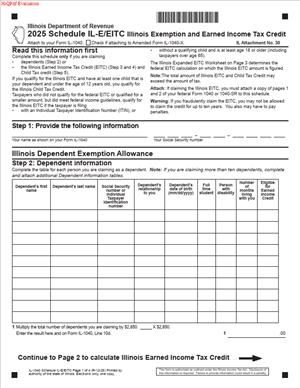
2025 Schedule IL-E or EITC Illinois Exemption and Earned Income Tax Credit
Fill out nowJurisdiction: Country: United States | Province or State: Illinois
The 2025 Schedule IL-E or EITC Illinois Exemption and Earned Income Tax Credit is an Illinois income tax schedule used to claim certain personal exemptions and the Illinois Earned Income Tax Credit. You attach it to your Illinois individual income tax return when you qualify for these benefits.
If you are filing your own taxes, this form directly affects how much Illinois income tax you owe or how much refund you may receive. It is not a standalone filing. It works together with your main Illinois return.
This schedule focuses on two main areas. First, it calculates exemptions for you, your spouse, and dependents. Second, it determines your Illinois Earned Income Tax Credit based on your federal Earned Income Credit.
Understanding this document before you complete it helps you avoid mistakes. Small errors in exemption counts or credit calculations can delay processing or change your refund amount.
What is the 2025 Schedule IL-E or EITC Illinois Exemption and Earned Income Tax Credit?
Clear definition
The 2025 Schedule IL-E or EITC Illinois Exemption and Earned Income Tax Credit is a state tax schedule used by Illinois residents who are claiming personal exemptions and the Illinois Earned Income Tax Credit on their annual state income tax return.
An exemption reduces the amount of income that is subject to Illinois income tax. The Earned Income Tax Credit, often called EITC, is a refundable credit based on earned income and your federal credit amount.
This schedule calculates those amounts and carries the totals to your Illinois individual income tax return. Without this form, you cannot properly claim these exemptions or the state EITC.
Who typically uses this form?
You typically use this schedule if you are filing an Illinois individual income tax return and qualify for one or more personal exemptions. This includes exemptions for yourself, your spouse if filing jointly, and any eligible dependents.
You also use it if you claimed the federal Earned Income Credit on your federal return. Illinois provides a state-level EITC that is calculated as a percentage of your federal credit.
Many working individuals and families with low to moderate income complete this form. It is common among taxpayers with children, part-year workers, and married couples filing jointly.
Why might you need this form?
You need this form to formally claim exemptions allowed under Illinois law. If you do not complete the schedule, those exemptions may not be applied to your return.
You also need it to calculate and claim the Illinois Earned Income Tax Credit. This credit can reduce your tax to zero and may result in a refund, depending on your situation.
The form ensures that your exemption amounts and EITC are calculated consistently with state rules. It connects your federal credit information to your Illinois tax return.
Typical real-life scenarios
- You are a full-time employee with two children and qualify for the federal Earned Income Credit. When preparing your Illinois return, you complete this schedule to claim exemptions for yourself and your dependents and to calculate your Illinois EITC.
- You are married and filing jointly. Both you and your spouse worked during the year, and your combined income qualifies for the federal credit. You use the schedule to reflect both personal exemptions and the correct state credit amount.
- You are a single parent who worked part-time while attending school. Your earned income is modest, and you received a federal EITC. You complete this form to determine your Illinois credit and adjust your tax owed.
- You are filing as a nonresident or part-year resident of Illinois, but had Illinois income. If you qualify for exemptions or the EITC under state rules, you may complete this schedule in connection with your Illinois return to calculate the allowable amounts.
When would you use the 2025 Schedule IL-E or EITC Illinois Exemption and Earned Income Tax Credit?
You use this schedule when you are preparing your Illinois individual income tax return and need to claim exemptions or the Illinois Earned Income Tax Credit. It is completed during the tax filing process for the 2025 tax year.
If you claimed a federal Earned Income Credit on your federal return, you generally complete this schedule to determine the Illinois credit. The state credit is tied to the federal amount, so you use figures directly from your federal return.
You also use it when your family situation affects your exemption count. Changes such as marriage, divorce, the birth of a child, or a dependent moving in or out of your household can change the number of exemptions you are entitled to claim.
Taxpayers filing as single, married filing jointly, or head of household may all use this schedule, depending on their circumstances. The need for the form depends on eligibility for exemptions and credits, not just your filing status.
If you are amending a prior Illinois return for 2025 and need to adjust exemptions or the EITC, you may complete this schedule again as part of the amended filing to show the corrected amounts.
Legal characteristics of the 2025 Schedule IL-E or EITC Illinois Exemption and Earned Income Tax Credit
This schedule is an official Illinois tax document. It becomes part of your state income tax return when you submit it. Its figures directly affect your calculated tax liability or refund.
For the schedule to be effective, it must be completed accurately and attached to the correct Illinois income tax return for the 2025 tax year. The numbers entered must match the information on your federal return, where required, especially for the Earned Income Credit.
Common issues that cause delays or adjustments include incorrect Social Security numbers for dependents, mismatched federal EITC amounts, math errors, and claiming exemptions for individuals who do not meet eligibility requirements. Inconsistencies between your federal and state returns may trigger a review.
Illinois rules for exemptions and credits may differ from federal rules in certain details. While the state EITC is based on the federal credit, eligibility and calculations follow state law. The percentage applied to your federal credit is determined under Illinois rules for the tax year.
This schedule does not replace your main Illinois tax return. It does not determine your entire tax situation. It only calculates specific exemptions and the Illinois Earned Income Tax Credit. It does not cover other credits, deductions, or taxes that may apply to you.
Is it legally binding?
Yes, as part of your signed Illinois income tax return, this schedule is legally binding. When you submit your return, you are declaring that the information provided is true and correct to the best of your knowledge.
The exemption counts, and the credit amounts you claim can be reviewed by the Illinois Department of Revenue. If errors are found, the department may adjust your return or request additional information. Inaccurate claims can lead to recalculated tax, reduced refunds, or additional amounts owed.
The schedule is binding in the sense that it forms part of your official tax filing. However, it does not create a contract between you and another private party. It is a tax reporting document used to determine your state tax obligations and credits.
How to fill out the 2025 Schedule IL-E or EITC Illinois Exemption and Earned Income Tax Credit
Step 1 – Review your federal return
Start with your completed federal income tax return for 2025. Locate your federal Earned Income Credit amount, if any. You will transfer specific figures from that return to this schedule, so having it available is essential.
Step 2 – Enter personal information
Provide your name and identifying number exactly as shown on your Illinois income tax return. If filing jointly, include your spouse’s information as required. Ensure these details match your main return to avoid processing issues.
Step 3 – Claim personal exemptions
Enter the number of exemptions you are claiming for yourself and, if applicable, your spouse. Then enter the number of qualifying dependents. Follow the instructions on the form to calculate the total exemption amount based on the allowed dollar value per exemption for 2025.
Step 4 – Calculate total exemption allowance
Multiply the number of exemptions by the exemption amount provided in the form instructions. Enter the total on the designated line. This amount will later be transferred to your Illinois income tax return to reduce your taxable income.
Step 5 – Enter your federal Earned Income Credit
Locate the exact federal Earned Income Credit amount from your federal return. Enter that figure on the line specified for the federal credit. Double-check the number for accuracy, as the Illinois credit is calculated from this amount.
Step 6 – Compute the Illinois Earned Income Tax Credit
Apply the percentage provided on the schedule to your federal Earned Income Credit. The form will instruct you to multiply your federal credit by the Illinois rate for 2025. Enter the calculated result as your Illinois EITC.
Step 7 – Transfer totals to your Illinois return
Move the final exemption amount and the Illinois Earned Income Tax Credit amount to the appropriate lines on your Illinois individual income tax return. Ensure the line numbers match the current year’s return instructions.
Step 8 – Review for accuracy
Recheck Social Security numbers, exemption counts, and all math calculations. Confirm that the federal credit amount matches your federal return and that all totals were transferred correctly. Once reviewed, include this schedule with your Illinois tax filing for submission.
Legal terms you might encounter in 2025 Schedule IL-E or EITC Illinois Exemption and Earned Income Tax Credit
- Adjusted Gross Income (AGI): This is your total income after certain federal adjustments. You calculate it on your federal return. On this form, your AGI affects whether you qualify for the Earned Income Tax Credit and how much you can claim.
- Base Income: This is the starting point for your Illinois income tax calculation. It is usually based on your federal income, with state-specific additions and subtractions. Your exemption allowance reduces your base income before tax is calculated.
- Exemption Allowance: This is the dollar amount you can subtract from your income for yourself, your spouse, and qualifying dependents. The number of exemptions you claim directly affects how much of your income is taxed. You calculate this total on this schedule and transfer it to your main state return.
- Dependent: A dependent is a person, often a child or qualifying relative, whom you support financially and claim on your tax return. You must meet specific tests to claim someone as a dependent. The number of dependents you list determines how many exemptions you can claim.
- Earned Income: This generally includes wages, salaries, tips, and self-employment income. It does not include passive income like interest or dividends. Your earned income determines your eligibility for the Earned Income Tax Credit.
- Federal Earned Income Credit (EIC): This is a refundable credit you claim on your federal tax return if you meet income and family size requirements. The Illinois credit is calculated as a percentage of your federal EIC. You must first determine your federal credit before completing the state calculation.
- Filing Status: This refers to how you file your tax return, such as single, married filing jointly, or head of household. Your filing status affects your exemption amounts and credit eligibility. It must match the status shown on your main Illinois return.
- Refundable Credit: A refundable credit can reduce your tax to zero and may result in a refund if the credit exceeds your tax liability. The Illinois Earned Income Tax Credit is refundable. That means you may receive money back even if you owe no state income tax.
- Tax Liability: This is the amount of tax you owe before credits are applied. Your exemption allowance reduces your taxable income, which lowers your tax liability. Then, refundable credits may further reduce or eliminate what you owe.
- Qualifying Child: A qualifying child is a dependent who meets age, relationship, residency, and support tests. The number of qualifying children affects the amount of the Earned Income Tax Credit you can claim. You must ensure the child meets all criteria before listing them.
FAQs
Do I have to file the 2025 Schedule IL-E or EITC Illinois Exemption and Earned Income Tax Credit if I am not claiming the Earned Income Tax Credit?
If you are claiming personal or dependent exemptions on your Illinois return, you generally complete this document to calculate the correct exemption allowance. Even if you are not eligible for the Earned Income Tax Credit, you may still need this form to show how you arrived at your total exemption amount. Review your main state return instructions to confirm whether the exemption section requires this schedule.
What information from my federal return do I need to complete this form?
You will need your adjusted gross income, your federal filing status, the number of dependents you claimed, and your federal Earned Income Credit amount if you received one. Keep your federal Form 1040 and any related schedules in front of you. This document mirrors several federal entries, so the numbers must match exactly.
What if my federal Earned Income Credit was reduced or denied?
If your federal credit was adjusted, you must use the final approved amount when calculating your state credit. Do not use the original amount you expected. If the federal credit was denied entirely, you cannot claim the related state credit, but you may still complete the exemption portion of the form.
Do both spouses need to sign anything on this document?
This schedule itself usually does not require a separate signature if it is attached to a jointly filed Illinois return. However, if you file jointly, both spouses must sign the main state return. Make sure the names and Social Security numbers match exactly across all attached forms.
Can I claim a dependent here if I did not claim them on my federal return?
In most cases, the dependents listed must match your federal return. If they do not match, your exemption and credit amounts may be questioned. Before entering a dependent on this form, confirm that the person qualifies under both federal and state rules and that your federal return reflects that claim.
What happens if I forget to attach this document to my Illinois return?
If this schedule is required and you do not include it, your exemption allowance or credit may not be processed. The tax authority may adjust your return or delay your refund. Always confirm that all required schedules are included before submitting your state filing.
How do I know if my Illinois Earned Income Tax Credit was accepted?
After filing, review your state tax notice or online account summary if available. Compare the credit amount shown on your processed return with what you calculated on the 2025 Schedule IL-E or EITC Illinois Exemption and Earned Income Tax Credit. If the numbers differ, read any correspondence carefully to see whether documentation or corrections are needed.
What should I do if I realize I made a mistake on this form after filing?
You will likely need to file an amended Illinois return to correct the exemption or credit amounts. Use the corrected figures from this document and clearly show the changes from the original filing. Keep copies of both the original and amended returns for your records.
Checklist: Before, During, and After 2025 Schedule IL-E or EITC Illinois Exemption and Earned Income Tax Credit
Before
- Gather your completed federal income tax return and all supporting schedules.
- Confirm your filing status for the tax year.
- Verify the number of dependents claimed on your federal return.
- Locate your federal Earned Income Credit amount, if any.
- Review income documents such as W-2s and 1099s for accuracy.
- Make sure names and Social Security numbers are correct.
- Check prior-year state returns for consistency in dependent claims.
During
- Enter your personal information exactly as it appears on your main Illinois return.
- Carefully count your personal and dependent exemptions.
- Multiply exemptions by the allowed dollar amount.
- Transfer your federal Earned Income Credit accurately.
- Apply the correct state percentage to compute the Illinois credit.
- Double-check all math calculations.
- Ensure your filing status matches across all documents.
- Review each line before moving to the next section.
After
- Transfer the final exemption and credit totals to your Illinois return.
- Confirm that all required schedules are attached.
- Make a complete copy of your return and this schedule.
- Submit your return using your chosen filing method.
- Watch for confirmation of receipt if filing electronically.
- Store digital and paper copies securely.
- Monitor for any correspondence from the state tax authority.
- Update your personal tax records with the final filed amounts.
Common mistakes to avoid with the 2025 Schedule IL-E or EITC Illinois Exemption and Earned Income Tax Credit
- Mistake: Claiming a different number of dependents than on your federal return, which often happens when families share custody, leading to processing delays or denied exemptions—do not forget to confirm that your dependent list matches your federal filing.
- Mistake: Using an estimated federal Earned Income Credit instead of the final approved amount, which can result in an overstated state credit and a later adjustment—do not forget to verify the exact figure from your completed federal return.
- Mistake: Entering incorrect Social Security numbers due to typing errors, which can cause rejection of the credit claim—do not forget to double-check each digit before submitting.
- Mistake: Forgetting to transfer the exemption allowance total to the correct line on your main Illinois return, which may increase your taxable income—do not forget to review the cross-reference lines carefully.
- Mistake: Miscalculating the exemption multiplication or state credit percentage, often due to rushing through math—do not forget to recheck calculations or use reliable computation tools.
- Mistake: Failing to attach this schedule when required, which can delay refunds—do not forget to confirm all required documents are included before filing.
- Mistake: Claiming the credit without qualifying earned income, which may trigger a review—do not forget to ensure your income meets eligibility requirements.
- Mistake: Ignoring state correspondence about adjustments, which can lead to unresolved balances—do not forget to open and respond promptly to any notices.
What to do after filling out the 2025 Schedule IL-E or EITC Illinois Exemption and Earned Income Tax Credit
Once you complete the schedule, your next focus is accuracy and proper filing. Small follow-up steps can prevent delays or corrections later.
- Step 1: Review every line of the schedule and compare it to your federal return to confirm matching income, dependents, and credit amounts.
- Step 2: Transfer the final exemption allowance and Earned Income Tax Credit amounts to the correct lines on your Illinois income tax return.
- Step 3: Check that your name and Social Security number appear exactly the same on every page.
- Step 4: Attach the schedule to your Illinois return if you are filing on paper, placing it in the order listed in the return instructions.
- Step 5: If filing electronically, confirm that the schedule is included in the electronic submission package before you transmit it.
- Step 6: Submit your return using your chosen method and note the date of submission.
- Step 7: Save a complete copy of the filed return, including this schedule, in both digital and paper format if possible.
- Step 8: Watch for confirmation that your return was accepted if you filed electronically, or allow processing time if you mailed it.
- Step 9: Review any notice you receive to ensure the exemption and credit amounts were processed as expected.
- Step 10: Keep all related tax documents, including proof of income and dependent eligibility, with your records in case questions arise later.
Staying organized after filing protects you. If you need to amend your return, respond to a notice, or apply for financial assistance that relies on your tax information, having a clear copy of this schedule makes the process easier and faster.
Disclaimer: This guide is provided for informational purposes only and is not intended as legal advice. You should consult a legal professional.