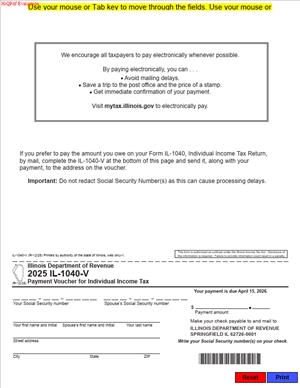
2025 IL-1040-V – Payment Voucher for Individual Income Tax
Fill out nowJurisdiction: Country: United States | Province or State: Illinois
The 2025 IL-1040-V – Payment Voucher for Individual Income Tax is a payment document used when you owe Illinois individual income tax and plan to pay by mail. It works as a cover sheet for your check or money order. It helps the Illinois Department of Revenue apply your payment to the correct tax year and account.
You use this form when you are not paying electronically. It connects your mailed payment to your 2025 Illinois individual income tax return. Without it, your payment could be delayed or misapplied.
This voucher is not your tax return. It does not calculate your tax. It simply identifies who you are, which tax year the payment is for, and how much you are paying.
If you are about to complete your Illinois tax filing and owe a balance, this form is part of the final step. Understanding how it works makes the submission process smoother and reduces the risk of processing issues.
What is 2025 IL-1040-V – Payment Voucher for Individual Income Tax?
Clear definition
The 2025 IL-1040-V – Payment Voucher for Individual Income Tax is a one-page payment voucher issued by the Illinois Department of Revenue. It accompanies a mailed payment for your 2025 Illinois Form IL-1040.
It identifies your name, address, Social Security number, and the amount you are paying. The voucher ensures that the payment is credited to the correct individual income tax account for the correct year.
This document does not stand alone. It is used together with your filed Illinois individual income tax return when you owe money. If you are due a refund, you generally do not use this voucher.
Who typically uses this form?
Individual taxpayers who file an Illinois Form IL-1040 and owe tax for the year 2025 commonly use this form. This includes full-year residents, part-year residents, and nonresidents who have Illinois income.
Self-employed individuals often use it if they owe additional tax at filing time. Employees who had too little withholding during the year may also use it.
Married couples who file jointly and owe a balance may submit one voucher with their joint payment. In that case, the voucher reflects the primary taxpayer’s identifying information as shown on the return.
Anyone choosing to pay by check or money order through the mail, instead of electronic payment, may need this voucher.
Why might you need this form?
You may need this form if your Illinois tax return shows a balance due. The voucher helps the state match your payment to your return quickly.
If you file your return electronically but choose to mail a paper check, the voucher is still used. It links the mailed payment to your electronically filed return.
You might also need it if you are paying close to the filing deadline and want a clear paper trail of your submission. The voucher provides a structured way to send your payment.
In short, this form matters when you owe Illinois income tax and are paying by mail for tax year 2025.
Typical real-life scenarios
- You complete your 2025 Illinois tax return and discover you owe $850. You decide to mail a check rather than pay online. You print and complete the voucher and send it with your payment.
- You file your Illinois return electronically in March 2026. The software shows a balance due. Instead of authorizing a direct debit, you choose to mail a check. You include the payment voucher so the state can connect your check to your e-filed return.
- You moved during the year and are unsure whether your address on file is current. When mailing your payment, you use the voucher to clearly state your updated address and identifying details.
- You are filing a joint return with your spouse. Your return shows a balance due. You send one check for the full amount and include a completed voucher listing the primary taxpayer’s Social Security number, so the payment is credited properly.
When would you use 2025 IL-1040-V – Payment Voucher for Individual Income Tax?
You would use 2025 IL-1040-V – Payment Voucher for Individual Income Tax when you owe Illinois individual income tax for 2025 and are paying by mail. It is typically submitted at the same time as your payment, often near the annual tax filing deadline.
If you file a paper IL-1040 return and include a check in the envelope, you attach or include the voucher with that check. It separates the payment information from the full return, which helps with processing.
If you file your return electronically but do not authorize an electronic withdrawal, you may mail your payment separately. In that case, the voucher becomes especially important. It connects your mailed check to your electronic filing.
Some taxpayers use this voucher when paying after receiving a notice that confirms a balance due for the 2025 tax year. In those cases, the voucher may still be used to identify the tax year and taxpayer, depending on the situation described in the notice.
You would not typically use this voucher if you are paying electronically, paying estimated taxes for a different period, or submitting a payment for a business tax account. This form is designed for individual income tax for a specific year.
Legal characteristics of 2025 IL-1040-V – Payment Voucher for Individual Income Tax
The 2025 IL-1040-V – Payment Voucher for Individual Income Tax is an official state-issued payment document. Its effectiveness depends on accurate and complete information. The name, Social Security number, tax year, and payment amount must match your tax account.
For the voucher to function properly, it must be legible. Errors in identifying information can delay processing. A mismatch between the voucher and the actual tax return may cause the payment to be applied incorrectly or held for review.
The payment itself must also meet general requirements. For example, a check or money order must be properly completed and payable in U.S. funds. If a payment is returned for insufficient funds, the voucher does not correct that issue.
This document does not calculate your liability. It does not change the amount of tax owed. It also does not serve as a substitute for filing your Illinois income tax return. You still need to submit your IL-1040 return separately, either by mail or electronically.
Different states use different voucher formats and procedures. This voucher applies only to the Illinois individual income tax for the 2025 tax year. It is not interchangeable with federal payment vouchers or those from other states.
Is it legally binding?
The voucher itself is not a contract. It is an administrative payment document. However, when you sign and submit your tax return and send payment with this voucher, you are making a formal tax payment to the state.
Your underlying tax obligation comes from Illinois tax law and your filed return, not from the voucher. The voucher simply facilitates the transfer and proper crediting of funds.
Once the payment is processed, it is generally treated as a payment toward your legal tax liability. If the amount sent does not match the amount owed, the difference may still be due, and additional notices may follow.
In this sense, the voucher plays a practical role in fulfilling your tax obligation, but it does not create new legal duties beyond those already established by your return and applicable tax rules.
How to fill out 2025 IL-1040-V – Payment Voucher for Individual Income Tax
Step 1 – Review your completed IL-1040 return
Before filling out the voucher, confirm the balance due on your 2025 Illinois Form IL-1040. Look at the final amount owed after credits, withholding, and estimated payments. The voucher should reflect the amount you are actually paying, which may be the full balance or a partial payment.
Step 2 – Enter your name and address
Write your full legal name as it appears on your Illinois tax return. If you are filing jointly, enter the primary taxpayer’s name first, consistent with the return. Provide your current mailing address, including apartment number if applicable.
Step 3 – Provide your Social Security number
Enter the Social Security number shown on your Illinois return. For joint filers, use the primary taxpayer’s Social Security number in the space provided. Double-check the number for accuracy to prevent misapplied payments.
Step 4 – Confirm the tax year
Make sure the voucher clearly reflects that the payment is for tax year 2025. Using the correct year is critical. Applying a payment to the wrong year can create confusion and may delay proper crediting.
Step 5 – Enter the payment amount
Fill in the exact amount you are submitting with the voucher. If you are paying the full balance due, this amount should match the balance on your return. If you are making a partial payment, enter only the amount enclosed.
Step 6 – Prepare your check or money order
Write a check or obtain a money order for the amount listed on the voucher. Ensure it is payable to the appropriate state agency as indicated in the form instructions. Write your Social Security number and the tax year on the memo line to help identify the payment.
Step 7 – Assemble your mailing package
Place the completed voucher and your check or money order together. Do not staple the check to the voucher unless the instructions specifically permit it. If you are mailing a paper return, include everything in the same envelope as directed in the form instructions.
Step 8 – Mail to the designated address
Use the mailing address listed in the official instructions for the voucher. The address may differ depending on whether you are enclosing a payment. Ensure proper postage and keep a copy of the voucher and your check for your records.
Once mailed, your submission is complete.
Legal terms you might encounter in 2025 IL-1040-V – Payment Voucher for Individual Income Tax
- Tax liability: This is the total amount of state income tax you owe for the year, after credits and payments. On this voucher, the payment amount you enter should match the remaining tax liability shown on your completed return. If you miscalculate your liability, your payment may be too high or too low.
- Remittance: A remittance is the money you send to satisfy a debt. In this context, it is your check or money order attached to the voucher. The voucher ensures your remittance is credited to the correct taxpayer and tax year.
- Social Security number (SSN): This is your unique taxpayer identifier. The number you enter on the voucher must match the SSN on your IL-1040 return. If it does not match, your payment can be misapplied or delayed.
- Tax year: The tax year refers to the calendar year for which you are filing your income tax return. The voucher is specific to the 2025 tax year. Entering the wrong year can result in the payment being credited incorrectly.
- Joint return: A joint return is filed by married taxpayers together. If you filed jointly, you typically list the primary taxpayer’s name and SSN first on the voucher. The order should match the return exactly.
- Payment processing: This is the administrative handling of your check and voucher by the tax agency. Accurate information ensures faster processing. Errors can lead to notices or additional correspondence.
- Overpayment: An overpayment occurs when you send more money than you owe. If this happens, the excess may be refunded or applied to another tax period, depending on your return and instructions.
- Underpayment: An underpayment means your payment is less than the tax due. This can trigger additional billing, penalties, or interest. You remain responsible for any unpaid balance.
- Money order: A money order is a prepaid payment method used instead of a personal check. If you use one, it must clearly show the correct amount and be payable as instructed on the voucher.
FAQs
Do I need to include 2025 IL-1040-V – Payment Voucher for Individual Income Tax if I already filed my return?
If you are mailing a paper check or money order for a balance due, you should include this document with your payment. It helps ensure your payment is credited to the correct account. If you pay electronically, you generally do not need to mail this voucher.
What happens if I send my payment without this form?
Your payment may still be processed, but it can take longer. Without the identifying details on this document, the agency may have difficulty matching the payment to your account. That can result in delay notices or temporary billing statements.
Where do I find the exact amount to enter on this voucher?
Look at the final balance due line on your completed Illinois individual income tax return. Enter that exact amount on this form. Do not estimate or round unless your return specifically instructs you to do so.
Whose Social Security number should I enter if we filed jointly?
Enter the primary taxpayer’s SSN as shown first on the tax return. The order must match the return exactly. If you switch the numbers, the payment could be applied to the wrong account.
Can I change the amount on this form if I realize I made a mistake on my return?
If you discover an error on your return before mailing your payment, correct the return first and then update the amount on this document. If the return has already been filed, you may need to file an amended return separately. Make sure the payment matches your most accurate calculation of tax owed.
What if I cannot pay the full amount shown on my return?
You can still submit a partial payment using this voucher. Enter the amount you are able to pay. Keep in mind that penalties and interest may continue on any unpaid balance until it is satisfied.
Do I staple the check to this form?
Follow the printed instructions on the voucher. Typically, you place the check or money order with the document without excessive stapling that could interfere with processing. Avoid damaging the barcode or printed information.
How do I confirm that my payment was received?
You can monitor your bank account to see when the check is cashed. That is often the first sign your payment was processed. You may also receive written confirmation or see the payment reflected in your state tax account records.
Checklist: Before, During, and After 2025 IL-1040-V – Payment Voucher for Individual Income Tax
Before
- Complete your IL-1040 return and confirm the final balance due.
- Double-check the tax year on your return.
- Verify the spelling of your name as it appears on the return.
- Confirm the correct Social Security number for the primary taxpayer.
- Decide whether you will pay by check or money order.
- Review the mailing address listed on the voucher instructions.
- Ensure your checkbook or money order reflects sufficient funds.
During
- Print your full legal name clearly on the voucher.
- Enter your current mailing address accurately.
- Write the primary taxpayer’s SSN exactly as shown on the return.
- Confirm the tax year is correct.
- Enter the exact payment amount from your return.
- Write your SSN and tax year on your check or money order if instructed.
- Make the check or money order payable as directed.
- Place the voucher and payment together in the envelope.
After
- Make a copy of the completed voucher for your records.
- Make a copy or photo of your check or money order.
- Mail the envelope to the correct address.
- Note the mailing date for your records.
- Monitor your bank account to confirm the check clears.
- Keep all related documents with your 2025 tax file.
- Respond promptly to any follow-up notice.
- Reconcile your records once the payment is processed.
Common mistakes to avoid with 2025 IL-1040-V – Payment Voucher for Individual Income Tax
- Mistake: Entering the wrong Social Security number because you rush or transpose digits, which can cause the payment to be applied to another account and delay credit, so do not forget to compare the number carefully against your filed return.
- Mistake: Writing an amount that does not match your actual balance due because you estimate or use an outdated draft of your return, which can result in underpayment notices or refunds of overpayment, so do not forget to verify the final filed version.
- Mistake: Using the wrong tax year on the voucher because you are preparing multiple returns at once, which may cause misapplication of funds, so do not forget to confirm that the year shown is 2025.
- Mistake: Making the check payable incorrectly due to habit or confusion, which can delay processing or require reissuance, so do not forget to follow the payee instructions exactly as printed.
- Mistake: Forgetting to include the voucher in the envelope because you focus only on the check, which can slow down payment matching, so do not forget to insert both documents together.
- Mistake: Mailing to an outdated or incorrect address because you rely on old instructions, which can significantly delay processing, so do not forget to verify the correct mailing address for the current year.
What to do after filling out 2025 IL-1040-V – Payment Voucher for Individual Income Tax
Once you complete the voucher and prepare your payment, your next steps matter just as much as filling it out correctly. Careful follow-through protects you from unnecessary notices and confusion.
- Step 1: Review the voucher one final time for accuracy, including your name, Social Security number, tax year, and payment amount.
- Step 2: Make a clear copy or take a photo of the completed voucher for your personal records.
- Step 3: Make a copy or image of your signed check or completed money order before mailing.
- Step 4: Place the original voucher and your payment in an envelope addressed exactly as instructed for balance-due payments.
- Step 5: Mail the envelope with enough postage and consider using a mailing method that provides proof of mailing if you want confirmation of the send date.
- Step 6: Record the date you mailed the payment in your personal tax file or calendar.
- Step 7: Monitor your bank account to confirm that your check is deposited or your money order is negotiated.
- Step 8: Once the payment clears, note the clearance date and amount in your tax records.
- Step 9: Keep all copies of the voucher, your return, and proof of payment together in your 2025 tax file for future reference.
- Step 10: If you receive any written notice about your balance after payment, compare the notice to your records and respond promptly if something does not match.
Staying organized after mailing your payment reduces stress. It also makes it easier to respond if questions arise later. Good recordkeeping now can save you significant time in the future.
Disclaimer: This guide is provided for informational purposes only and is not intended as legal advice. You should consult a legal professional.