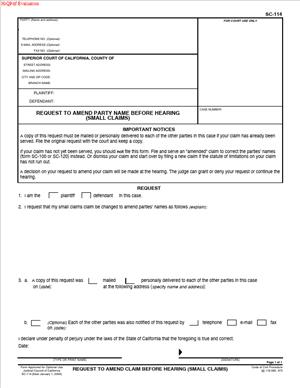
SC-114 – Request to Amend Party Name Before Hearing (Small Claims)
Fill out nowJurisdiction: Country: United States | Province or State: California
SC-114 – Request to Amend Party Name Before Hearing (Small Claims) is a court form used to correct or update a party’s name in a small claims case before the hearing takes place. It focuses on accuracy, not changing the substance of the claim.
You may be looking at this form because you noticed a name error after filing your case. This can feel stressful, especially when a hearing date is already set. This document exists to address that problem in a structured way.
The form matters because the court relies on the names listed to identify who is involved in the case. Correct names help ensure notices reach the right people and the hearing proceeds smoothly.
This document is not about rewriting your claim or adding new issues. It is about aligning the court record with the correct legal or commonly used name of a party.
If you are representing yourself, this form gives you a clear method to ask the court to recognize a name correction before you appear in front of a judge.
What is SC-114 – Request to Amend Party Name Before Hearing (Small Claims)?
Clear definition
SC-114 – Request to Amend Party Name Before Hearing (Small Claims) is a written request submitted to the small claims court to correct, clarify, or update the name of a plaintiff or defendant. The request is made before the scheduled hearing.
The form communicates the requested change to the court in an official format. It creates a record showing what name was originally used and what name is now being requested.
This document is procedural. It does not determine who wins or loses the case. It helps the court manage accurate case information.
Who typically uses this form/document?
People who filed a small claims case and later noticed a name issue commonly use this form. This includes both plaintiffs and defendants, depending on who identified the problem.
Self-represented individuals use this form when they realize a spelling mistake, an incomplete name, or an outdated business name appears in the case paperwork.
Small business owners sometimes use it when a business name was listed incorrectly or when a “doing business as” name needs clarification.
The form may also be used when a party’s name has changed due to events like marriage or correction of a clerical error.
Why you might need this form/document
You might need this form if the name on your original claim does not precisely match the party’s correct name. Even small differences can matter in court records.
You may also need it if you later learn that the person or business you sued uses a different legal name than the one you listed.
Using this form helps reduce confusion at the hearing. It signals to the court that you noticed the issue and are addressing it in advance.
The form allows the case to proceed without starting over, as long as the issue is limited to the party name.
Typical real-life scenarios
- You filed a claim against a business using the storefront name, then discovered the business operates under a slightly different registered name. The form allows you to request that correction before the hearing.
- You named an individual, but later realized you misspelled their last name on the claim. The error is minor, but you want the court record to be accurate.
- You sued someone using a nickname or shortened name because that is how you knew them. Later, you obtained documents showing their full legal name.
- You are the defendant,t and notice your name is incorrect on the claim. You want the court to recognize the correct version before appearing.
When would you use SC-114 – Request to Amend Party Name Before Hearing (Small Claims)?
This form is used after a small claims case has been filed but before the hearing occurs. Timing matters because the purpose is to correct the record ahead of the court date.
People often use it once they review their filed paperwork more closely or receive information clarifying the correct name of a party. This may happen during preparation for the hearing.
It is also commonly used after receiving documents, invoices, contracts, or communications that reveal a different name than originally listed.
The form is not limited to one side of the case. Either party may submit it if they are requesting a name amendment related to their role in the case.
Legal characteristics of SC-114 – Request to Amend Party Name Before Hearing (Small Claims)
This form is effective when it clearly identifies the existing case and explains the name change being requested. Accuracy and consistency are important for the court to process it smoothly.
Problems often arise when the requested change is unclear or appears to introduce a different party rather than correcting a name. Courts commonly look for continuity between the original and amended name.
At a high level, courts typically distinguish between correcting a name and substituting a new party. This form is generally associated with the first situation.
The document does not create new claims, increase damages, or alter the facts of the dispute. Its function is limited to the identification of parties.
Is it legally binding?
The form itself is a request, not a decision. It becomes effective only if the court accepts the amendment.
Once accepted, the corrected name becomes part of the official court record for that case. This affects how the case is referenced and how notices are addressed.
The form does not bind the parties to any settlement or outcome. It only addresses how a party is named in the proceedings.
How to fill out SC-114 – Request to Amend Party Name Before Hearing (Small Claims)
Step 1 – Identify the case information
Begin by entering the case name and case number exactly as they appear on your existing court paperwork. This connects your request to the correct file.
Ensure the courthouse information matches the location where your small claims case is pending. Consistency helps the clerk process the filing without delay.
Step 2 – State the current name on record
Write the party name as it currently appears in the court record. This shows the court what information is already on file.
Accuracy matters here. Even if the existing name is incorrect, copy it as written so the court can clearly see what is being changed.
Step 3 – Provide the requested amended name
Enter the corrected or complete name you are asking the court to use going forward. This may be a full legal name or a corrected business name.
Make sure the amended name is written clearly and legibly. The court will rely on this entry for future notices and references.
Step 4 – Explain the reason for the amendment
Briefly describe why the name change is needed. Common explanations include spelling errors, incomplete names, or updated business information.
This explanation helps the court understand that the request is about accuracy rather than changing the identity of the party.
Step 5 – Review the form for consistency
Check that all names, case numbers, and court details match your existing paperwork. Small inconsistencies can slow processing.
Confirm that the amended name appears the same way each time it is referenced on the form.
Step 6 – Sign and date the form
Sign the form where indicated to confirm that the information provided is accurate to the best of your knowledge.
The date shows when the request was made, which can matter for court processing before the hearing date.
Step 7 – Prepare the form for submission
Make a copy of the completed form for your records. Keeping a copy helps you track what was requested.
Follow the court’s standard process for submitting documents in your case, using the same case information already assigned.
Legal terms you might encounter in SC-114 – Request to Amend Party Name Before Hearing (Small Claims)
- Amended Party Name: This is the corrected or updated legal name you want the court to use going forward. In this document, you must write the full name exactly as it should appear in the court record. Even small differences matter because the court relies on this name for notices and judgments.
- Party of Record: This refers to any plaintiff or defendant officially listed in the case. The form asks you to identify which party’s name needs to be changed. You must match the role and position already assigned in the case.
- Case Number: This is the unique identifier the court assigned to your small claims case. You must copy it exactly as it appears on prior court paperwork. The court uses it to file your request in the correct case.
- Hearing Date: This is the scheduled court date for your small claims matter. The timing matters because this document is meant to be submitted before that date. The court needs enough time to review and update the record.
- Requesting Party: This is the person completing and signing the form. You may be requesting the change for yourself or for another party’s name, depending on your role in the case. Your authority comes from being a named party in the action.
- Clerical Error: This term describes a simple mistake, such as a misspelling or missing word. Many requests rely on explaining that the original name was entered incorrectly. The form gives you space to explain this clearly.
- Legal Name: This is the official name recognized for legal purposes, not a nickname or informal version. The court expects the amended name to reflect the legal identity of the person or entity. You should use the name that appears on formal records.
- Court Record: This is the official file maintained by the court for your case. Once the request is accepted, the amended name becomes part of that record. Future documents will rely on what appears there.
- Declaration: This is your signed statement that the information you provided is accurate. By signing, you confirm that the requested change is truthful and complete. The court treats this seriously.
FAQs
Can I use this document to fix a spelling error in a party’s name?
Yes. This document is commonly used to correct spelling mistakes, missing letters, or formatting issues. You should enter the incorrect version exactly as it appears now, and then clearly write the corrected version so the court can see the difference.
Do I need to attach proof of the correct name?
Sometimes you may choose to attach supporting paperwork, but this document itself focuses on your written explanation. If you include attachments, make sure the name on them matches the amended name you are requesting. The court looks for consistency.
Will changing a name affect the hearing date?
Filing this document does not automatically change the hearing date. The goal is to update the court record before the hearing occurs. You should still prepare as if the hearing will happen as scheduled unless the court tells you otherwise.
Who signs the form if the name being corrected is not mine?
The requesting party signs, not the person whose name is being corrected. You sign because you are asking the court to make the change in the case record. Your signature confirms the request, not ownership of the name.
Does this form change who is responsible in the case?
No. This document only corrects how a party’s name appears in the record. It does not add a new party or shift responsibility. The underlying claim remains the same.
How will I know if the court accepted the request?
After submission, the court may stamp or file the document and place it in the case file. In many situations, you will see the updated name on later notices or at the hearing. Keep a copy so you can confirm what you asked for.
Can I submit SC-114 – Request to Amend Party Name Before Hearing (Small Claims) on the day of the hearing?
You may try, but earlier is better. The court needs time to review and process the request. Submitting close to the hearing increases the risk that the record will not be updated in time.
Will the amended name appear on the judgment?
If the request is accepted before a decision is issued, the amended name should be used on the judgment. That is why accuracy matters now. The judgment relies on what is in the court record at the time it is entered.
Checklist: Before, During, and After SC-114 – Request to Amend Party Name Before Hearing (Small Claims)
Before
- Review all existing court papers to find the exact name currently on record.
- Confirm the correct legal name you want the court to use.
- Check the case number and hearing date for accuracy.
- Decide how you will explain the reason for the name change.
- Gather any documents that show the correct name, if available.
- Make sure you are listed as a party who can submit the request.
- Plan time to submit the form before the hearing date.
During
- Write the case information exactly as it appears on prior filings.
- Enter the current name without correcting it in that section.
- Enter the amended name in full, without abbreviations.
- Clearly explain why the name needs to be changed.
- Review the entire form for consistency and legibility.
- Sign and date the form where required.
- Make at least one copy for your records.
After
- Submit the form using the court’s accepted method.
- Watch for confirmation that the document was filed.
- Check future court notices for the updated name.
- Bring a copy of the filed form to the hearing.
- Update your own notes and evidence with the amended name.
- Follow up if the court record does not reflect the change.
- Keep all versions of the form with your case file.
Common mistakes to avoid with SC-114 – Request to Amend Party Name Before Hearing (Small Claims)
- Mistake: Correcting the name everywhere instead of showing the incorrect version first, which happens when people want to “fix” the record themselves, leading the court to miss what is changing, so you must not forget to show both versions clearly.
- Mistake: Using a nickname or shortened name because it feels familiar, which happens due to informal habits, resulting in a record that still does not match legal documents, so you must not forget to use the full legal name.
- Mistake: Leaving out the case number because you assume the clerk will add it, which happens when people rush, causing the request to be misfiled, so you must not forget to double-check this field.
- Mistake: Submitting the form too close to the hearing, which happens when the issue is noticed late, risking that the record will not be updated in time, so you must not forget to act early.
- Mistake: Forgetting to sign and date the form, which happens because the form looks informational, making it incomplete and unprocessed, so you must not forget the declaration section.
- Mistake: Explaining the reason vaguely, which happens when people think details are unnecessary, leading the court to question the request, so you must not forget to be specific.
- Mistake: Assuming the change affects liability, which happens due to confusion about party identity, causing unnecessary worry or arguments, so you must not forget that this only updates the name.
- Mistake: Failing to keep a copy, which happens after filing for relief, leaving you without proof of what was requested, so you must not forget to retain your records.
What to do after filling out SC-114 – Request to Amend Party Name Before Hearing (Small Claims)
Once the form is complete, your focus shifts to making sure the court actually receives and processes it. This is how you protect the accuracy of the case record and avoid confusion later.
Step 1: Make at least two copies of the completed and signed form.
- One copy is for your records. Another is to bring it with you to the hearing.
Step 2: Submit the original to the court using the accepted filing method.
- This may be in person, by mail, or electronically, depending on what the court allows.
Step 3: Confirm that the form was received and filed.
- Look for a file stamp, confirmation notice, or entry in the case record.
Step 4: Review any new court notices after filing.
- Check that the amended name appears correctly on later paperwork.
Step 5: Update your own documents and notes.
- Make sure your evidence labels, outlines, and statements use the amended name.
Step 6: Bring proof of filing to the hearing.
- Have your copy available in case the judge or clerk asks about the name change.
Step 7: Listen for the amended name during the hearing.
- If the incorrect name is used, you can refer to the filed request to clarify.
Step 8: Check the judgment or final paperwork.
- Confirm that the amended name appears correctly if a decision is issued.
Step 9: Keep the form with your permanent case file.
- It may be useful later if questions arise about party identity.
Step 10: Follow up if the record was not updated.
- If you see errors after filing, address them promptly using the court’s procedures.
Disclaimer: This guide is provided for informational purposes only and is not intended as legal advice. You should consult a legal professional.