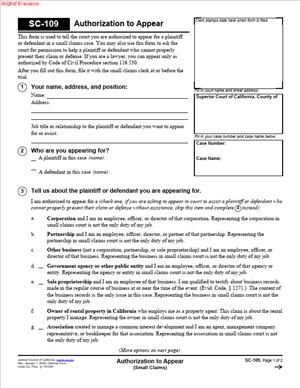
SC-109 – Authorization to Appear
Fill out nowJurisdiction: Country: United States | Province or State: California
The SC-109 – Authorization to Appear is a short court form used in small claims cases. It allows one person to appear in court on behalf of another. This matters when the named party cannot attend the hearing in person.
People often reach for this document right before a court date. You may be reviewing it while preparing paperwork or confirming who will speak at the hearing. Understanding its role helps avoid delays or confusion at the courthouse.
This form is narrow in purpose. It does not change the case itself. It only addresses who is allowed to appear and speak for a party in a small claims matter.
Timing matters. This document is typically completed close to the hearing date. Courts often expect it to be ready before the appearance, not after.
If you are self-represented, this form can feel unfamiliar. The sections are brief, but each line has a specific function. Knowing what the court expects makes the completion process smoother.
What is SC-109 – Authorization to Appear?
Clear definition
SC-109 – Authorization to Appear is a California small claims court document. It gives written permission for an authorized person to appear in court instead of the named party. The authorization is limited to the specific case listed on the form.
The document identifies the case, the party giving permission, and the person authorized to appear. It is designed for situations where personal attendance is not possible or practical.
This form does not transfer ownership of the claim. It does not change the amount requested or the defenses raised. It only addresses who may present the case at the hearing.
Who typically uses this form/document?
Individuals commonly use this form when they are a party to a small claims case but cannot attend the hearing. This may include plaintiffs or defendants.
Businesses also use this document. A business entity cannot appear in court on its own. A representative appears on its behalf, and this form records that authorization.
The authorized person is often an employee, partner, or other connected individual. The court uses the form to confirm that the appearance is permitted.
Why you might need this form/document
You might need this form if attending the hearing in person is not possible. Scheduling conflicts, distance, or other obligations can make attendance difficult.
In business cases, this form is often part of routine preparation. It clarifies who will speak for the business at the hearing.
The form helps the court manage appearances efficiently. It reduces uncertainty about whether the person at the podium has the authority to be there.
Without this document, the court may question the appearance. That can lead to delays or the need to reschedule.
Typical real-life scenarios
- A small business owner files a claim but is out of state on the hearing date. An employee who knows the transaction attends instead, using this authorization.
- A defendant in a small claims case has a work conflict on the hearing date. A spouse or associate appears to explain the situation and respond to the claim.
- A partnership is named in a case. One partner attends the hearing with written authorization from the partnership.
- A company is sued in small claims court. A designated representative brings this document to show they are authorized to speak for the company.
When would you use SC-109 – Authorization to Appear?
This form is used when a party to a small claims case will not appear personally at the hearing. The need arises before the scheduled court appearance.
It is commonly prepared after a hearing date is set. Once you know you cannot attend, the authorization becomes relevant.
Businesses often prepare this document as part of standard case preparation. The representative may change depending on availability, making the form necessary.
Individuals may use the form when personal attendance would cause hardship. The court uses the document to understand who will present the facts.
The form is tied to a specific case and hearing. It is not a general or ongoing authorization. Each case typically requires its own completed document.
Legal characteristics of SC-109 – Authorization to Appear
This document is effective when it is properly completed and presented in connection with the correct case. The court looks for a clear identification of the parties and the authorized person.
Incomplete information is a common issue. Missing names, unclear handwriting, or mismatched case details can cause problems at the hearing.
The form is specific to small claims proceedings. Other courts and case types often use different authorization rules or documents.
In California, small claims courts generally control who may appear and speak. This form reflects those procedural expectations but does not override court authority.
The document does not grant legal representation in the broader sense. It does not turn the authorized person into an attorney or legal advocate beyond the small claims appearance.
Is it legally binding?
The form is binding in the limited sense that it records permission for someone to appear. The court relies on it to determine whether the appearance is authorized.
Its effect depends on accurate completion and acceptance by the court. If the information is unclear, the court may not treat it as valid for that appearance.
The authorization applies only to the specific hearing and case listed. It does not create ongoing authority beyond that context.
How to fill out SC-109 – Authorization to Appear
Step 1 – Identify the case
Start by entering the case name and case number exactly as they appear on court notices. This links the authorization to the correct small claims matter.
Accuracy matters here. Even small differences can create confusion at the clerk’s desk or in the courtroom.
Step 2 – Identify the party giving authorization
Enter the name of the person or business that is a party to the case. This is the party who is allowing someone else to appear.
If the party is a business, use the full business name as shown in the case caption. Consistency helps the court confirm authority.
Step 3 – Identify the authorized person
Provide the full name of the person who will appear in court. This tells the judge and clerk who is expected at the hearing.
The authorized person should be someone connected to the party and familiar with the case. The form records who will speak if questions arise.
Step 4 – Describe the relationship or role
The form asks for the relationship between the party and the authorized person. This explains why that person is appearing.
Common entries include employee, partner, or other representative. The court uses this information to understand the connection.
Step 5 – Review the scope of the authorization
Read the authorization language on the form carefully. It explains what the authorized person may do at the hearing.
This section limits the authority to appear and speak in the small claims case. It does not expand beyond that role.
Step 6 – Sign and date the form
The party giving authorization signs and dates the document. This shows that the permission is current and intentional.
Unsigned or undated forms often raise questions at the hearing. The court looks for a clear, complete signature section.
Step 7 – Prepare the form for the hearing
Once completed, the form is typically brought to the hearing by the authorized person. The court may ask to see it before allowing the appearance.
Keeping a copy available can help if questions come up. The original document shows the authorization clearly.
Legal terms you might encounter in SC-109 – Authorization to Appear
- Authorization to Appear: This is the written permission that allows one person to attend a hearing on behalf of another. On this document, it defines who may speak or present information in court instead of the named party. The authorization is limited to what the form allows and what the court accepts.
- Party: A party is the person or business named in the case. On this form, the party is the one giving permission for someone else to appear. The party’s name must match the case record exactly.
- Authorized Representative: This is the person you name to appear for you. The form records their full name and role so the court knows who they are and why they are present. This person does not become a party to the case.
- Case Number: The case number is the court’s tracking number for your dispute. It appears at the top of the form and connects the authorization to the correct case file. A wrong number can cause the court to reject or ignore the authorization.
- Small Claims Court: This is the court handling the dispute. The form is designed specifically for small claims procedures, which are more informal but still require accurate paperwork. The rules about who may appear are stricter than in regular civil court.
- Declarant: The declarant is the person who signs the form to give permission. By signing, the declarant confirms the information is true and complete. The court relies on this signature to accept the authorization.
- Hearing Date: This is the scheduled court date for the case. The form is usually tied to a specific hearing, even if it does not list the date directly. Timing matters because an outdated authorization may not be honored.
- Scope of Authority: This describes what the authorized person is allowed to do. In practice, it limits the appearance to attending and participating as permitted in small claims. The court will not assume powers beyond what the form supports.
- Clerk: The clerk is the court staff member who receives and processes filings. When you submit this document, the clerk checks it for completeness. Acceptance by the clerk does not guarantee the judge will allow the appearance.
FAQs
Can I use SC-109 – Authorization to Appear if I cannot attend my hearing?
Yes, this form is used when you need someone else to appear instead of you. You must complete all identifying information so the court can link the authorization to your case. The court decides whether to accept the appearance at the hearing.
Does this document let the other person speak for me in court?
It allows the person you name to appear and participate as permitted in small claims. What they can say or do depends on court rules and the judge’s control of the hearing. You should make sure the person understands your position and facts.
Do the names on this form have to match the case exactly?
Yes, names should match the case record word for word. This includes spelling, middle initials, and business names. If the names do not match, the clerk or judge may question the authorization.
Is this form valid for more than one hearing?
It is typically connected to a specific hearing or stage of the case. If the case is continued or reset, you may need to submit a new document. Always check that the authorization still reflects the current hearing.
Can I change the authorized person after I file this form?
You can change it, but you usually need to complete a new document. The court needs a clear, current record of who is authorized to appear. Old versions may be disregarded.
Does filing this document change what appears on the public case record?
It adds a record that someone else is authorized to appear. It does not change the parties, the claim amount, or the judgment. The case still belongs to the original parties.
Does the authorized person need to bring anything to court?
They should bring a copy of this form and identification. Having a copy helps if the court staff or judge asks to see proof of authorization. They should also bring any documents needed for the hearing.
What happens if the judge does not accept the authorization?
The judge may require the party to appear personally or may continue the hearing. This can delay the case and may affect how your side is presented. Making sure the form is complete reduces this risk.
Checklist: Before, During, and After SC-109 – Authorization to Appear
Before
- Confirm you are a named party in the small claims case.
- Check the case number against your court notice.
- Decide who you want to authorize and confirm they are available.
- Verify the spelling of all names as they appear on the case.
- Review the hearing date and timing.
- Read the form instructions line by line.
- Prepare identification details for the authorized person.
During
- Fill in the case information carefully.
- Enter the full legal name of the party giving authorization.
- Enter the full legal name of the authorized representative.
- Review the scope of what the authorization covers.
- Check for blanks or incomplete sections.
- Sign and date the form using your usual signature.
- Make at least one copy before submitting.
After
- Submit the form according to court filing rules.
- Confirm the clerk accepted the filing.
- Provide a copy to the authorized person.
- Keep a copy with your case records.
- Remind the authorized person of the hearing details.
- Monitor the case for any changes or notices.
- Be ready to respond if the court requests clarification.
Common Mistakes to Avoid with SC-109 – Authorization to Appear
- Mistake: Listing a nickname instead of the legal name, which happens for convenience, can cause the court to question identity and reject the appearance, so do not forget to match the case record exactly.
- Mistake: Using the wrong case number because you copied it from memory, which can misfile the authorization and leave no valid permission on record, so do not forget to double-check the number.
- Mistake: Forgetting to sign and date the form, which happens when rushing, can make the document invalid, so do not forget the signature section.
- Mistake: Assuming the authorization lasts forever, which happens when hearings are continued, can leave you without coverage at the next date, so do not forget to update it if needed.
- Mistake: Naming someone who is unavailable on the hearing date, which happens due to schedule changes, can leave no one authorized to appear, so do not forget to confirm availability.
- Mistake: Filing too close to the hearing, which happens when deadlines are unclear, can result in the court not processing it in time, so do not forget to allow processing time.
- Mistake: Giving no copy to the authorized person, which happens from oversight, can slow check-in at court, so do not forget to share the filed form.
- Mistake: Leaving blanks on the form, which happens when sections seem optional, can cause rejection, so do not forget to complete every required field.
What to do after filling out SC-109 – Authorization to Appear
Once you complete the form, your job is not finished. How you handle the next steps affects whether the authorization is recognized at the hearing. Stay organized and proactive.
- Step 1: Make at least two copies of the completed form, one for your records and one for the authorized person.
- Step 2: Submit the original to the court using the accepted filing method for your case.
- Step 3: Check that the clerk stamps or otherwise confirms receipt.
- Step 4: Note the filing date and keep it with your case paperwork.
- Step 5: Give the authorized person a copy and review the case facts with them.
- Step 6: Confirm the hearing date, time, and location with the authorized person.
- Step 7: Monitor mail or electronic notices in case the court responds or requests changes.
- Step 8: Update your internal notes to reflect who is authorized and for which hearing.
- Step 9: Prepare a backup plan in case the court requires your personal appearance.
- Step 10: After the hearing, ask the authorized person what happened and record the outcome.
Disclaimer: This guide is provided for informational purposes only and is not intended as legal advice. You should consult a legal professional.