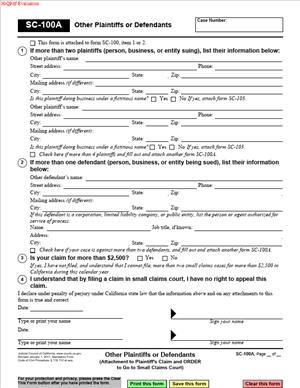
SC-100A – Other Plaintiffs or Defendants
Fill out nowJurisdiction: Country: United States | Province or State: California
SC-100A – Other Plaintiffs or Defendants is a companion form used in California small claims cases. It gives the court space to list additional people or businesses involved in the case.
You usually encounter this document when the main claim form does not have enough room. The goal is simple: make sure every party is properly named and included.
If you are about to fill out this form, you are likely already working on a small claims filing. This document does not start a case by itself. It adds information to an existing filing.
Accuracy matters here. Courts rely on this form to know who is part of the case and who must receive notice. Missing or unclear information can slow things down.
This form helps keep the case organized. It ensures that all plaintiffs or defendants are visible on the court record from the start.
What is SC-100A – Other Plaintiffs or Defendants?
Clear definition
SC-100A – Other Plaintiffs or Defendants is a California small claims form used to list additional plaintiffs or defendants beyond those named on the main claim form. It functions as an attachment, not a standalone filing.
The document expands the party list. It allows the court to see every person or entity involved in the dispute in one complete set of records.
This form does not explain the dispute itself. It only identifies parties and basic contact details so the case can move forward with proper notice.
Who typically uses this form/document?
This form is commonly used by people filing a small claims case with more than one plaintiff. It is also used when there is more than one defendant involved.
Self-represented individuals use it often because small claims forms limit space. When the lines run out, this document becomes necessary.
Businesses may also appear on this form. For example, a case might include multiple business partners or several related entities.
Court clerks expect to see this document when the main form cannot fully list all parties. It is a routine part of multi-party small claims filings.
Why you might need this form/document
You might need this form when your case involves several people on one side of the dispute. The main claim form usually allows space for only one plaintiff and one defendant.
If you leave parties off the filing, the court record may be incomplete. That can affect notice, scheduling, and how the case is handled.
This document helps ensure that everyone connected to the dispute is formally included. It supports clarity and procedural fairness.
Using this form can also prevent confusion later. It creates a clear record of who is involved from the beginning.
Typical real-life scenarios
- A group of roommates files a small claims case together against a former landlord over a security deposit. The main form lists one plaintiff, and this document lists the rest.
- A car accident involves multiple drivers and owners. The main form names one defendant, and this document adds the others who may be involved.
- Two business partners sue a vendor together. One partner appears on the main form, while the other is listed on this attachment.
- A consumer files a claim against a company and later realizes a related business entity is also involved. This document is used to include the additional defendant.
When would you use SC-100A – Other Plaintiffs or Defendants?
You would use SC-100A – Other Plaintiffs or Defendants when the number of plaintiffs or defendants exceeds the space provided on the main small claims form. This typically comes up before filing or at the time of submission.
It is often used at the beginning of a case. Courts generally prefer that all parties be identified early, rather than added later.
This form may also be used when a case involves groups, partnerships, or shared responsibility. Multiple names must appear clearly for the court to understand the structure of the case.
People filing on behalf of themselves often encounter this situation. Small claims cases frequently arise from shared contracts, joint purchases, or group living arrangements.
The form is also used when naming individuals and businesses together. Each party needs to be listed separately, with clear identifying information.
Legal characteristics of SC-100A – Other Plaintiffs or Defendants
SC-100A – Other Plaintiffs or Defendants work as part of a larger filing. Its effectiveness depends on being attached to the correct main claim form and filled out clearly.
The form is generally considered valid when it identifies parties in a way the court can understand and process. Names, addresses, and roles must be legible and complete.
Common problems arise when information is inconsistent. For example, names on this document that do not match the main filing can cause confusion.
Another frequent issue is overcrowding the form. Writing too small or adding unclear notes can make the information unusable.
While small claims procedures are similar across California, local practices may vary slightly. Courts may have different expectations for formatting or attachments, though the purpose of the form remains the same.
This document does not resolve disputes. It does not explain facts, assign responsibility, or determine outcomes. It only identifies who is involved.
Is it legally binding?
This form itself is not a contract or agreement. It does not create obligations between the parties.
Its legal effect comes from being part of a court filing. When accepted, it becomes part of the official case record.
The information provided is relied upon for notice and participation. In that sense, accuracy matters, but the document does not decide rights or liabilities.
How to fill out SC-100A – Other Plaintiffs or Defendants
Step 1 – Review the main claim form
Start by looking at the primary small claims form you are filing. Identify where it references additional plaintiffs or defendants.
This step helps you confirm that this document is being used as an attachment and not on its own.
Step 2 – Match the case information
Transfer the case title and basic identifying information exactly as it appears on the main form. Consistency helps the court link the documents.
Even small differences in names or spelling can create confusion at filing.
Step 3 – Identify each additional party
Use one entry for each additional plaintiff or defendant. Keep the information clear and separated.
This usually includes full names and contact details. The goal is easy identification.
Step 4 – Indicate the party role
Clearly note whether each listed person or entity is a plaintiff or a defendant. This distinction matters for how the case proceeds.
Avoid mixing roles in a single entry. Each party should be clearly categorized.
Step 5 – Write legibly and completely
Courts rely on readable forms. Print clearly or type if permitted.
Incomplete entries can lead to delays or requests for clarification.
Step 6 – Attach the form properly
Place this document behind the main claim form when submitting. It should read as a continuation, not a separate filing.
This helps the clerk process the documents together as one case record.
Step 7 – Review before submission
Read through the completed form and compare it to the main filing. Check for matching names and roles.
Once everything aligns, the form is ready to be submitted as part of the small claims filing.
Legal terms you might encounter in SC-100A – Other Plaintiffs or Defendants
- Plaintiff: A plaintiff is the person or entity bringing the claim. In this document, a plaintiff listed is an additional party beyond the space provided on the main claim form. Each plaintiff must be clearly named so the court knows who is asking for relief.
- Defendant: A defendant is the person or entity being sued. This document allows you to list extra defendants so the court record reflects everyone you believe is responsible. Accuracy matters because service and judgment depend on the exact names entered.
- Party: A party is anyone directly involved in the case as a plaintiff or defendant. This form expands the list of parties without changing the substance of the claim. Every party listed becomes part of the official case record.
- Case Number: The case number is the unique identifier assigned by the court. You copy it from the main claim form so this attachment is matched to the correct case. A mismatch can cause filing delays or rejection.
- Attachment: An attachment is a document added to the main filing. This form functions as an attachment and does not stand alone. It must be submitted together with the primary claim form.
- Service of Process: Service of process is the formal delivery of court papers to parties. Adding names here affects who must be served. If a party is listed, they generally need proper service to be bound by the case.
- Capacity: Capacity describes how a party is involved, such as an individual or a business representative. The way you list a name can signal capacity. This helps the court understand who is responsible.
- Caption: The caption is the top section of court forms that identifies the case and parties. This document continues the caption by adding more names. The information must mirror the main form exactly.
- Court Record: The court record is the official file maintained by the court. Once accepted, this document becomes part of that record. Future judges and clerks rely on it for accuracy.
FAQs
Do I have to use SC-100A – Other Plaintiffs or Defendants if I only have one plaintiff and one defendant?
No. If all parties fit on the main claim form, this form is not needed. You use it only when you run out of space to list everyone involved.
Where do I find the case number to put on this form?
You copy the case number from the main claim form you already prepared or filed. It usually appears near the top of that document. The number must match exactly so the clerk can attach this document to the correct file.
What names should I enter for additional parties?
Use the full legal names of each person or entity. Match spelling and formatting to how they appear on the main claim form. Consistent names help avoid confusion during service and hearings.
Can I add both extra plaintiffs and extra defendants to the same document?
Yes. This document allows you to list additional parties on either side of the case. Make sure each person is clearly identified as a plaintiff or a defendant so the court understands their role.
Does adding someone on this form automatically notify them about the case?
No. Listing a party updates the court record, but it does not complete the delivery of papers. You still need to make sure the required documents are properly served on any added party.
Will the public be able to see the names I add here?
Yes. Once filed, the information becomes part of the public court record. Anyone reviewing the case file can see the listed parties.
What happens if I make a mistake on this document?
Clerks may reject the filing or ask for correction. Errors can also lead to service problems later. Review carefully before submitting to avoid delays.
Do I need to sign this document?
This document usually does not require a separate signature because it supplements the signed main claim form. Check that it is properly attached and submitted together so it is accepted.
Is SC-100A required for every additional party?
Yes, if the main claim form does not have enough space. Listing extra parties anywhere else, such as in the narrative section, is usually not accepted as a substitute.
Can I remove a party later if I listed them by mistake?
In many cases, yes, but it usually requires filing an amended claim or requesting permission from the court. Removing a party after filing can delay the case, so it is better to confirm all names before submission.
What if I do not know the full address of an additional defendant?
You should provide the most complete address you reasonably can. An incomplete address may make service difficult, which can prevent the case from moving forward until corrected.
Checklist: Before, During, and After SC-100A – Other Plaintiffs or Defendants
Before
- Confirm the main claim form is complete.
- Check how many extra parties need to be listed.
- Gather full legal names for each additional party.
- Verify spelling against official records you have.
- Locate the case number from the main form.
- Decide which parties are plaintiffs and which are defendants.
- Make sure you have the correct court location information.
During
- Write the case number exactly as shown on the main form.
- Enter each additional party on a separate line.
- Clearly mark each party as plaintiff or defendant.
- Use consistent name formatting throughout.
- Write legibly if completing by hand.
- Review each entry as you go for accuracy.
- Keep the document aligned with the main claim form.
After
- Attach this document to the main claim form.
- Make copies for your personal records.
- Prepare copies for service if required.
- Submit all documents together to the court.
- Confirm the clerk accepts the filing.
- Store a stamped copy in a safe place.
- Update your case notes with the added parties.
Common mistakes to avoid with SC-100A – Other Plaintiffs or Defendants
- Mistake: Using nicknames instead of full legal names, which happens when you rely on memory, can cause service problems, and you should not forget to verify names before filing.
- Mistake: Entering the wrong case number because you copied from an old document, which can lead to rejection, and you should not forget to cross-check with the main form.
- Mistake: Listing a party without indicating plaintiff or defendant, which happens when rushing, can confuse the court, and you should not forget to clearly label roles.
- Mistake: Submitting the document by itself, which happens when you treat it as independent, can delay processing, and you should not forget that it must be attached.
- Mistake: Inconsistent spelling across forms, which happens with multiple drafts, can complicate the record, and you should not forget to match every name exactly.
- Mistake: Forgetting to make copies, which happens during last-minute filing, can leave you without proof, and you should not forget to keep a complete set.
What to do after filling out SC-100A – Other Plaintiffs or Defendants
Once you finish completing the document, your focus shifts to proper handling and follow-through. This form works only when it is integrated into the rest of your filing. Treat it as part of a single package, not a separate task.
- Step 1: Review the main claim form and this document side by side to confirm all party names and the case number match.
- Step 2: Attach this document securely to the main claim form in the correct order.
- Step 3: Make at least two copies of everything for your own records.
- Step 4: Prepare additional copies for any parties who must receive service.
- Step 5: Submit the full set to the court using the same method as the main claim form.
- Step 6: Ask the clerk to confirm acceptance and stamping if filing in person.
- Step 7: Note the filing date in your personal case log.
- Step 8: Organize your copies in a folder with other case materials.
- Step 9: Check that all listed parties are included in your service plan.
- Step 10: Update any internal notes or calendars to reflect the full list of parties.
Disclaimer: This guide is provided for informational purposes only and is not intended as legal advice. You should consult a legal professional.