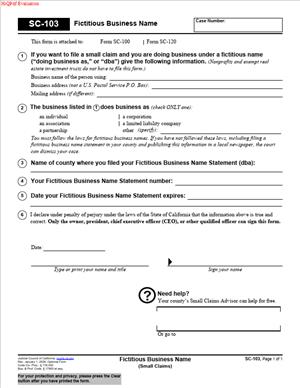
SC-103 – Fictitious Business Name
Fill out nowJurisdiction: Country: United States | Province or State: California
SC-103 – Fictitious Business Name is a court form used in California small claims cases when a business operates under a name different from its legal owner. You may encounter it when you are involved in a small claims filing, and a business name does not clearly identify a real person or entity.
This document matters because courts need to know who is actually responsible for a business name. A fictitious name alone does not tell the court who can be held accountable. The form connects the name used in everyday business with the underlying owner.
If you are representing yourself, this form helps you understand how a business is identified in the case record. It clarifies whether the name on the claim is a person, a partnership, or another type of entity.
The form is short, but accuracy matters. Small mistakes can cause delays or confusion about who is involved in the case. Knowing what the form is for before you start makes completion easier.
This guide explains what the form does, when it comes up, and how to complete it step by step. It focuses on practical understanding, not legal strategy.
What is SC-103 – Fictitious Business Name?
Clear definition
SC-103 – Fictitious Business Name is a California Small Claims Court form that identifies the real owner behind a business name that is not the owner’s legal name. It links the name used publicly to the person or entity that controls it.
The form is used within a small claims case. It does not create a business name. It simply discloses ownership information for court purposes.
A fictitious business name is sometimes called a “doing business as” name. The court uses this form to avoid uncertainty about who is involved in the dispute.
Who typically uses this form/document?
This form is commonly used by people involved in small claims cases that include a business. That can include individuals, sole proprietors, or business operators appearing without a lawyer.
You might also see it used by someone bringing a claim against a business whose public name does not match the owner’s legal name. The form helps the court connect the claim to a real party.
In some cases, a business owner completes the form to clarify their role. In others, another party completes it to identify who is responsible for the business.
Why you might need this form/document
You may need this form when a business name alone does not tell the court who owns or controls it. Courts rely on clear identification to manage notices, hearings, and judgments.
Without this information, a case can become confusing. The court may not know who must appear or who would be affected by a decision.
The form helps avoid mix-ups between similar business names. It also helps distinguish between a business name and a separate legal entity.
Typical real-life scenarios
- You file a small claims case against a local business. The business advertises under a name that does not include a person’s name. The form is used to identify the individual or entity behind that name.
- You are a sole proprietor and are sued under your business name. The form is used to show that the business name belongs to you personally.
- You operate a side business under a creative name. When the case is filed, the form links that name to you so the court knows who is appearing.
- You are responding to a claim and notice that the business name listed is unclear. The form clarifies ownership so the case record is accurate.
When would you use SC-103 – Fictitious Business Name?
SC-103 – Fictitious Business Name is used during a California small claims case when a fictitious business name is involved. It often comes up at the filing stage or early in the case process.
You may encounter it when reviewing case paperwork and realizing that the business name listed does not clearly identify a person or legal entity. The form fills that gap.
It can also arise when a party wants to correct or clarify the name used in the case. The goal is to ensure the court record reflects who is actually involved.
People acting as claimants, defendants, or business owners may interact with this form. The role depends on how the business name appears in the case.
Legal characteristics of SC-103 – Fictitious Business Name
SC-103 – Fictitious Business Name form is effective when it clearly connects a business name to its owner. Courts look for complete and consistent information that matches the rest of the case file.
Common problems include incomplete names, mismatched addresses, or unclear ownership descriptions. These issues can cause delays or require correction.
Practices can vary by location within California. Some courts review the form closely before accepting it, while others focus on whether the information is understandable.
This form does not determine who wins or loses a case. It does not resolve disputes about liability or damages. Its role is informational.
Is it legally binding?
The form itself is not a contract or agreement. It does not create legal obligations between parties.
However, the information provided is part of a court record. Accuracy matters because the court relies on it to identify the parties involved.
If the form is signed, the signature generally indicates that the information is being presented as true to the best of the signer’s knowledge. That is why careful completion is important.
How to fill out SC-103 – Fictitious Business Name
Step 1 – Review the case caption
Start by looking at the top of the form. You will see space for the court name and case information. This should match the small claims case exactly as it appears on other documents.
Confirm that the business name is written the same way it appears in the claim. Consistency helps the court connect the form to the correct case.
Step 2 – Identify the fictitious business name
The form will ask for the fictitious business name. This is the name the business uses publicly, not a personal name unless the business uses one.
Write the name clearly and completely. Avoid abbreviations unless the business actually uses them.
Step 3 – Provide the owner’s legal name
Next, the form asks for the real name of the person or entity that owns the business. This is the legal owner, not an employee or manager unless they are also the owner.
Use the full legal name. This helps the court distinguish between individuals with similar names.
Step 4 – Add the owner’s address
The form includes space for an address connected to the owner. This is typically a physical or mailing address associated with the business or owner.
Make sure the address is readable and complete. This information is used for court communication.
Step 5 – Describe the relationship to the business
You will be asked to indicate how the named person or entity relates to the business. This explains whether the owner is an individual, a partnership, or another type of organization.
Use the description that best fits the situation as presented on the form. The goal is clarity, not technical detail.
Step 6 – Review for consistency
Before signing, read through the entire form. Compare it to other case documents to ensure names and addresses match.
Small differences can cause confusion. Taking a moment to check consistency can prevent delays.
Step 7 – Sign and date the form
The final step is signing and dating the form, as indicated. This confirms that the information has been completed.
Once signed, the form is ready to be included with the rest of the small claims paperwork.
Legal terms you might encounter in SC-103 – Fictitious Business Name
- Fictitious Business Name: This is a name a business uses that is different from the owner’s legal name. In this document, you list the exact name as it appears in your filings and records. Small differences matter because the court relies on this spelling to identify the business.
- Legal Name: This is the individual or entity name that legally owns the business. The form asks for this so the court can connect the business name to a real person or organization. The legal name should match government-issued or formation records.
- Owner: The owner is the person or entity that controls the business using the fictitious name. In this document, you identify who is responsible for the business. This helps the court know who can sign and be held accountable.
- Address of Record: This is the mailing address associated with the owner or business. The court may use it for notices or to verify identity. You should use an address that stays accurate during the case.
- Declaration: A declaration is a written statement you sign to confirm that the information is true. By signing, you are telling the court that the details about the business name and owner are accurate. This gives the document weight in the case.
- Signature: The signature shows who completed and approved the document. It must be from someone with authority over the business. The court treats the signature as confirmation that the information is complete and correct.
- Date Signed: This is the day the document is completed. The date helps place the information in time for the case record. An incorrect or missing date can cause confusion about when the information was valid.
- Relationship to Business: This explains how the signer is connected to the business, such as owner or authorized representative. The form uses this to confirm the signer’s authority. Vague descriptions can raise questions about whether the signer is allowed to submit it.
- Case Caption: The case caption identifies the court case this document belongs to. It usually includes the parties’ names and case number. This ensures the document is filed in the correct case file.
FAQs
Do I need to file SC-103 – Fictitious Business Name if I already listed my business name somewhere else?
You still need to complete this form if the court requires it for your case. This document creates a clear link in the case record between the business name and the real owner. Other filings do not automatically update or replace what this document records.
What exact name should I enter for the business?
Use the full fictitious business name exactly as you use it publicly. This includes punctuation, spacing, and spelling. The name on this document should match what appears on your other case papers to avoid confusion.
Who is allowed to sign this form?
The signer must be the owner or someone with authority to act for the owner. This matters because the court relies on the signature to confirm responsibility. If the signer lacks authority, the information may be questioned.
What address should I use if the business has more than one location?
Use the address that best represents the owner or main business contact. The address should be one where mail can reliably be received. Consistency with other court filings helps keep the record clear.
What happens if I make a small spelling mistake?
Even small errors can create delays or questions about identity. The court uses exact names to match records. Review the document carefully before filing to catch these issues early.
Does filing this form change ownership of the business?
No, this document only records information about the business name and owner. It does not transfer ownership or create a new business. It simply clarifies who is behind the name for the case.
Will this information become part of the public court record?
Yes, once filed, the details are part of the case file. That means the business name and owner connection are visible in the record. Be accurate and intentional about what you include.
What should I do if the business name changes after I file?
If details change, you may need to update the court with a new filing. This document reflects the information as of the date you signed it. Keeping the record current helps avoid confusion later.
Checklist: Before, During, and After SC-103 – Fictitious Business Name
Before
- Confirm the exact fictitious business name you use publicly.
- Verify the owner’s full legal name from official records.
- Gather the correct address you want associated with the business.
- Review other case documents for name consistency.
- Check who has the authority to sign for the business.
- Locate the case caption and case number.
- Set aside time to review the form carefully.
During
- Enter the business name exactly as it appears elsewhere.
- Write the owner’s legal name without abbreviations.
- Provide a complete and current address.
- Clearly describe the signer’s relationship to the business.
- Review every field for accuracy before signing.
- Sign using the authorized person’s name.
- Add the correct date next to the signature.
After
- Make a copy for your personal records.
- Attach the document to the correct case file.
- Submit it using the required court method.
- Confirm the court accepted the filing.
- Update your internal notes with the filing date.
- Keep the copy with other case documents.
- Monitor for any court notices referencing it.
Common mistakes to avoid with SC-103 – Fictitious Business Name
- Mistake: Using a nickname or shortened business name because it seems close enough, which happens from habit, but can cause the court to question identity, so do not forget to match the exact name everywhere.
- Mistake: Listing the wrong owner due to outdated records, which leads to confusion about responsibility, so always confirm current ownership before filing.
- Mistake: Having an unauthorized person sign because it feels convenient, which can invalidate the document, so do not forget to confirm the signing authority.
- Mistake: Entering an old or temporary address, which can cause missed notices, so remember to use an address that stays valid.
- Mistake: Skipping the date or using the wrong date, which makes the timing unclear, so always double-check the signing date.
- Mistake: Filing it under the wrong case number, which misplaces the document, so do not forget to verify the case caption.
- Mistake: Assuming other filings already cover this information, which can leave gaps in the record, so remember each form serves its own purpose.
- Mistake: Not keeping a copy after filing, which makes later reference difficult, so always save a personal copy.
What to do after filling out SC-103 – Fictitious Business Name
Once the document is complete, your next actions help make sure it actually works for your case. This form only matters if it is properly submitted and tracked. Treat it as part of your case record, not a standalone paper.
- Step 1: Make at least one clear copy for yourself before submitting anything.
- Step 2: Attach or group the form with the correct small claims case paperwork.
- Step 3: Submit the document using the method required for your court case.
- Step 4: Note the date you submitted it in your personal case notes.
- Step 5: Watch for confirmation that the court accepted the filing.
- Step 6: Store your copy with other important case documents in one place.
- Step 7: Review future court notices to ensure the business name appears correctly.
- Step 8: Update any internal records or notes that track your filings.
- Step 9: If you spot an error after filing, prepare to correct it promptly.
- Step 10: Keep the information consistent in all later court papers.
Disclaimer: This guide is provided for informational purposes only and is not intended as legal advice. You should consult a legal professional.