SC-104A – Proof of Mailing (Substituted Service)
Fill out nowJurisdiction: Country: United States | Province or State: California
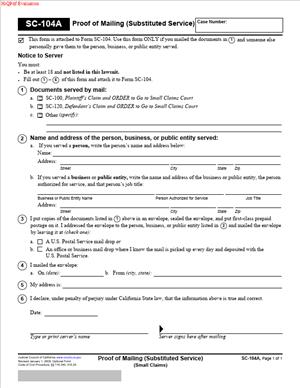
SC-104A – Proof of Mailing (Substituted Service) is a court form used to document that certain papers were mailed after substituted service occurred. It is part of the small claims process in California. The form records details about the mailing, not the underlying dispute.
You usually encounter this document when you are serving small claims papers, and personal delivery did not happen directly to the named individual. The form focuses on what was mailed, where it was mailed, and when it was mailed. It creates a written record for the court file.
This form matters because courts rely on written proof to confirm that notice steps were completed. Mailing is a follow-up step to substituted service. The form shows that the mailing actually happened.
If you are representing yourself, this document helps you understand what information the court expects about the mailing. Each section is practical and fact-based. Accuracy and clarity are central to its purpose.
The form does not decide your case. It does not argue facts or explain your position. It exists to document a procedural step in the case timeline.
What is SC-104A – Proof of Mailing (Substituted Service)?
Clear definition
SC-104A – Proof of Mailing (Substituted Service) is a written statement filed with the court. It describes the mailing of court documents after substituted service. Substituted service generally means the papers were left with someone else at a location connected to the person being served.
The document identifies the papers mailed, the address used, and the date of mailing. It also identifies who performed the mailing. The form becomes part of the official court record.
This form is specific to small claims matters. It is designed to be straightforward and factual. The court uses it to confirm that the required notice steps were completed.
Who typically uses this form/document?
People involved in small claims cases commonly use this form. This includes plaintiffs, defendants, or other parties responsible for service tasks. Often, it is completed by the person who handled the mailing.
Self-represented individuals frequently encounter this document. Small claims procedures are designed for people without lawyers. The form reflects this by using direct questions and limited space.
In some situations, a non-party adult completes the mailing and the form. The focus remains on the act of mailing, not on who benefits from it.
Why you might need this form/document
You might need this form when personal service did not occur directly. Substituted service is sometimes used when the named person was not personally handed the papers. Mailing is commonly a required follow-up step.
The court expects a record showing that the mailing took place. This form provides that record. Without it, the court file may appear incomplete.
The form helps avoid confusion later. It shows dates, addresses, and document names in one place. This clarity can matter if questions arise about notice.
Typical real-life scenarios
- A plaintiff attempts to serve a defendant at home. Another adult at the residence accepts the papers. Later, the plaintiff mails copies of the same papers to that address. The mailing details are recorded on this form.
- A small business is involved in a small claims case. Papers are left with an employee at the business location. Copies are then mailed to the business address. The person who mailed them completes the form.
- A defendant needs to prove that substituted service was followed by mailing. The defendant or another adult handles the mailing and fills out the form to document it.
- A case involves multiple documents, such as a claim and a hearing notice. All were mailed together after the substituted service. The form lists each document and the mailing date.
When would you use SC-104A – Proof of Mailing (Substituted Service)?
Use this form after the substituted service has already been completed. It is not used before service, and it does not replace the required step of delivering, leaving, or otherwise serving the papers. The timing is important because the mailing step comes after the substituted service has taken place.
This form is used when the court process requires proof that notice was mailed following substituted service. In small claims matters, this often happens early in the case, before the hearing date. The form helps create a clear record showing when the papers were mailed, where they were sent, and how the mailing relates to the earlier service step.
The person who mailed the papers, or the person responsible for completing the mailing, should usually complete the form soon after the mailing is done. Completing it promptly helps ensure that the date, address, and other details are accurate. The completed form is then submitted to the court and becomes part of the case file.
The form may also be useful if the service is later questioned. A written record of the mailing can help show what was done and when. However, the form focuses only on the mailing requirement. It does not prove personal delivery or the substituted service itself, which must be shown separately if required.
Legal characteristics of SC-104A – Proof of Mailing (Substituted Service)
This form functions as a factual declaration about mailing. Its effectiveness depends on accurate, complete information. Courts generally look for clear identification of the documents mailed, the address used, and the mailing date.
Problems often arise when information is missing or unclear. Common issues include incomplete addresses, vague descriptions of documents, or inconsistent dates. These issues can create delays or requests for clarification.
While the form is used in California small claims cases, procedures can vary across jurisdictions. The overall concept of documenting mailing is common, but specific form requirements differ. This document is tailored to California’s small claims process.
The form does not confirm that the recipient actually received the mail. It documents that the mailing occurred. It also does not prove personal service or substituted service by itself.
Is it legally binding?
The form is a signed statement submitted to the court. It carries weight as a factual representation of what occurred. The signer affirms that the information is true to the best of their knowledge.
Its binding nature relates to accuracy, not outcome. The form does not bind the court to a decision in the case. It binds the signer to the truthfulness of the statements made.
If information is incorrect, the issue typically concerns the service process rather than the merits of the case. The form’s role remains procedural and informational.
How to fill out SC-104A – Proof of Mailing (Substituted Service)
Step 1 – Case and party information
Begin by identifying the case connected to the mailing. This usually includes the case number and the names of the parties involved. The information should match what appears on other court documents.
This section helps the court place the form in the correct file. Consistency matters because small claims courts handle many cases with similar names.
Step 2 – Documents that were mailed
List the specific documents that were mailed. Use the full names of the papers, such as the claim or notice. This shows exactly what was included in the mailing.
Clarity here helps avoid later questions. The court can see that the mailed documents correspond to the case.
Step 3 – Mailing address
Provide the address where the documents were mailed. This is typically the same location where substituted service occurred. Include all relevant details, such as unit numbers.
The address connects the mailing to the earlier service step. Accuracy supports a clear record.
Step 4 – Date of mailing
State the date the documents were placed in the mail. This establishes timing within the case process. The date is a key reference point for the court.
Using a specific calendar date avoids confusion. It shows when the mailing action was completed.
Step 5 – The person who mailed the documents
Identify who performed the mailing. This is often the person completing the form. The court uses this information to understand who has firsthand knowledge of the mailing.
The role is factual rather than argumentative. It simply records who handled the task.
Step 6 – Signature and affirmation
Sign the form where indicated. The signature confirms that the information provided is accurate based on your knowledge. It completes the document for filing.
Once signed, the form is ready to be included with other case materials. It serves as the written proof of mailing for the substituted service step.
Legal terms you might encounter in SC-104A – Proof of Mailing (Substituted Service)
- Substituted service: This means the court allowed papers to be left with an adult at the other party’s home or business instead of being handed directly to them. This form records the follow-up mailing that makes the service complete. Without the mailing, substituted service is usually not finished.
- Proof of mailing: This is a written statement showing that documents were mailed. This document, it confirms that copies of the court papers were sent by mail after substituted service. The court relies on this proof to track notice.
- Declarant: The declarant is the person who mailed the documents and signed the form. It must be someone who is legally allowed to mail the papers, usually not a party to the case. Their role is to state facts, not opinions.
- Mailing address: This is the address where the documents were sent. It must match the address used for substituted service. Errors here can cause the court to question whether notice was proper.
- Date of mailing: This is the calendar date the documents were placed in the mail. Timing matters because deadlines often run from this date. The form uses this date to confirm compliance.
- Documents mailed: This section lists exactly what was sent. The list should match the papers served earlier. Missing or extra items can create confusion about what the other party received.
- Case number: This is the unique number assigned to your small claims case. The court uses it to file and track the document. A wrong number can cause misfiling or rejection.
- Party served: This refers to the person or business that received substituted service and the follow-up mailing. The name should match the case caption. Consistency helps avoid disputes about identity.
- Perjury: By signing, the declarant states the information is true under penalty of perjury. This gives the document legal weight. False statements can have serious consequences.
FAQs
Do I need to file SC-104A – Proof of Mailing (Substituted Service) if I already filed a proof of service?
Yes, if the service was done by substituted service, this document is separate and records the mailing step. The earlier proof shows the papers were left with another adult. This form shows the required mailing that completes the process.
Who is allowed to sign this form?
The signer is the person who actually mailed the documents. They usually must be over 18 and not a party to the case. If you mailed the papers yourself, check whether that is allowed in your situation before signing.
What if I mailed the documents a day later than planned?
You must enter the actual date of mailing, not the intended date. Deadlines often count from that real date. Writing a different date can create conflicts in the court record.
Do I need to attach copies of what I mailed?
This document usually does not require attachments. It records what was mailed by listing the documents. Keep copies for your own records in case the court or the other party asks.
What happens if the address on this document is slightly different from the address on the earlier service form?
Differences can raise questions about whether notice was proper. You should check that the address matches the substituted service address. If it does not, you may need to correct the issue before filing.
Can I fix a mistake after I already filed this document?
Often, you can file a corrected version if the court allows it. The corrected document should clearly show accurate information. Act quickly so the case schedule is not affected.
Does filing this document change my hearing date?
This document itself does not set or move hearing dates. It simply proves notice. However, problems with mailing can delay the case if the service is challenged.
How many times do I need to use SC-104A – Proof of Mailing (Substituted Service) in one case?
You usually file it once for each party served by substituted service. If you served multiple parties this way, each mailing may require its own completed document.
Checklist: Before, During, and After SC-104A – Proof of Mailing (Substituted Service)
Before
- Confirm substituted service was already completed correctly.
- Identify exactly which documents were required to be mailed.
- Verify the correct mailing address from your service records.
- Choose a qualified person to mail the documents.
- Gather the case number and party names as they appear on court papers.
- Decide on the mailing date and method.
- Make copies of all documents for your records.
During
- Mail the documents to the correct address.
- Record the exact date the documents were mailed.
- Complete the case caption carefully.
- List each document mailed without abbreviations.
- Enter the full mailing address clearly.
- Have the correct person sign as the declarant.
- Review the form for accuracy before filing.
After
- Make copies of the completed form.
- File the original with the court as required.
- Confirm the filing was accepted.
- Store copies with your case file.
- Note the mailing date for deadline tracking.
- Be ready to explain the mailing if asked.
- Update any personal case checklist or timeline.
Common mistakes to avoid with SC-104A – Proof of Mailing (Substituted Service)
- Mistake: Listing the wrong mailing address because you copied it from memory, which can lead the court to doubt notice, so always double-check against the substituted service record.
- Mistake: Using an estimated mailing date instead of the real one, which happens when people fill out the form later and forget, and can affect deadlines if not corrected.
- Mistake: Having a party to the case sign as the declarant, often due to a misunderstanding, which can invalidate the proof, so confirm signer eligibility.
- Mistake: Forgetting to list all documents mailed, which creates gaps in the record and can lead to disputes about what was received.
- Mistake: Writing a case number incorrectly because of rushed filing, which may cause rejection or misfiling, so compare it to the court’s notice.
- Mistake: Filing late without tracking deadlines, which can delay the case, so always calendar key dates.
- Mistake: Assuming this form replaces other service proofs, which can leave the record incomplete, so ensure all required documents are filed.
- Mistake: Not keeping copies after filing, which makes it harder to respond to questions, so always retain a full set.
What to do after filling out SC-104A – Proof of Mailing (Substituted Service)
After you complete the form, your focus shifts to filing, tracking, and recordkeeping. This document becomes part of the court’s service history. Treat it as an official record that may be reviewed later.
- Step 1: Make at least two copies of the signed form for your personal records.
- Step 2: Check the court’s preferred filing method, such as in person or by mail.
- Step 3: File the original form with the correct court location for your case.
- Step 4: Confirm the clerk accepted the filing and stamped your copy if applicable.
- Step 5: Note the filing date and mailing date in your case timeline.
- Step 6: Place the filed copy with other service documents in one folder.
- Step 7: Review upcoming deadlines that run from the mailing date.
- Step 8: Be prepared to explain the mailing details if the judge asks.
- Step 9: Update any internal notes or summaries you use to track the case.
- Step 10: Monitor court notices to ensure no service issues are raised.
Disclaimer: This guide is provided for informational purposes only and is not intended as legal advice. You should consult a legal professional.