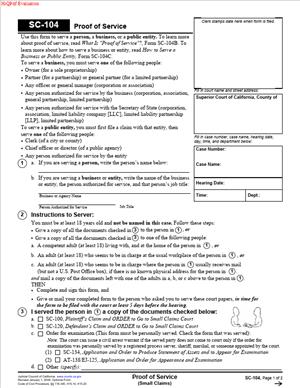
SC-104 – Proof of Service (Small Claims)
Fill out nowJurisdiction: Country: United States | Province or State: California
SC-104 – Proof of Service is a court form used to show that required papers were delivered to another person in a small claims case. It records who received the documents, how they were delivered, and when delivery happened. The court relies on this record to track notice.
You usually encounter SC-104 – Proof of Service right before or after filing other small claims paperwork. It does not start a case. It documents a step that already occurred. The timing often feels urgent because filings move quickly.
If you are representing yourself, this form often raises practical questions. You may wonder who completes it, what details matter, and how precise the information must be. Understanding the form reduces delays and confusion.
This document matters because courts generally expect proof that all parties received notice. Without a completed proof of service, filings may sit unprocessed. Hearings may be postponed. The form acts as a bridge between delivering papers and moving the case forward.
The language on SC-104 – Proof of Service is structured and factual. It is not about arguments or explanations. It focuses on dates, names, addresses, and methods of delivery.
What is SC-104 – Proof of Service?
Clear definition
SC-104 – Proof of Service is a written statement filed with the court to confirm that specific court documents were served on another party. Service means delivering copies in an accepted way. The form captures the details of that delivery.
The document is standardized. It prompts for information that the court commonly checks. This includes the server’s identity, the recipient’s identity, and the method used. The form becomes part of the case record.
The form itself does not deliver documents. It only reports that the delivery already happened. Accuracy matters because the court relies on the report as a factual record.
Who typically uses this form/document?
People involved in California small claims cases commonly use this form. This includes individuals bringing a claim and individuals responding to one. Businesses involved in small claims also rely on it.
The person who completes the form is usually the person who performed the service. That person may be a friend, colleague, or professional server. The server is often not a party to the case.
Court clerks handle the form after submission. Judges may review it if service is questioned. The recipient of the served documents usually does not fill them out.
Why you might need this form/document
You might need this form when the court requires confirmation that papers reached the other side. Many filings depend on proper notice. The form shows that the notice occurred.
The form helps prevent disputes about whether someone knew about the case. It creates a written trail tied to specific dates. This matters when deadlines are calculated.
Using SC-104 – Proof of Service can also reduce administrative delays. When service is clearly documented, the clerk can process filings without follow-up questions.
Typical real-life scenarios
- A person files a small claims case and arranges for someone else to deliver the claim to the defendant. After delivery, the server completes SC-104 – Proof of Service to document what happened. The form is then filed with the court.
- A defendant receives notice of a small claims case and later serves a response or other allowed filing. The delivery of that response is documented using the same form. The court uses it to confirm that the other party was informed.
- A business is involved in a dispute, and documents are delivered to an agent or office address. The proof of service records the name of the person who accepted the papers and their role. This helps clarify receipt.
- A hearing is scheduled, and the court reviews the file beforehand. The proof of service shows that notice was given within expected timeframes. This allows the hearing to proceed without administrative interruption.
When would you use SC-104 – Proof of Service?
You use SC-104 – Proof of Service after papers have been delivered in a small claims case. The delivery occurs first. The form follows as documentation.
The form is commonly used when initiating a case. It is also used later when additional filings require notice. Each instance of service usually has its own proof.
Timing often aligns with filing deadlines. The form is prepared close to the date of service, so details remain accurate. Courts typically expect prompt submission after service occurs.
Different roles interact with the form at different times. A claimant may encounter it early. A defendant may encounter it when responding. A server encounters it immediately after completing delivery.
Legal characteristics of SC-104 – Proof of Service
SC-104 – Proof of Service functions as a factual declaration about service. Its effectiveness depends on completeness and accuracy. Courts generally look for clear identification of documents served, parties involved, and the method used.
Common problems arise from missing information. Dates left blank, unclear addresses, or mismatched names can create questions. Using a method not listed on the form may also raise issues.
The form reflects general service rules used in California small claims cases. While service concepts exist in many jurisdictions, details vary. Methods and timing commonly differ outside California.
This document does not prove that the recipient read or understood the papers. It only records that delivery occurred in a recognized way. It also does not validate the content of the served documents.
Is it legally binding?
The form carries legal significance as a signed statement of facts. The person who signs is declaring that the information is true. Courts rely on that declaration when managing the case.
It is not a contract between parties. It does not create obligations by itself. Its binding effect relates to the accuracy of the reported service.
If information is incorrect, the court may question the service. That can affect scheduling or acceptance of filings. The form’s role is procedural rather than decisional.
How to fill out SC-104 – Proof of Service
Step 1 – Identify the case
At the top of the form, you enter the case name and case number. This ties the proof of service to the correct court file. The information usually matches earlier filings exactly.
Step 2 – List the documents served
The form asks you to identify which documents were delivered. This section focuses on titles rather than explanations. Each document is named so the court knows what was included.
Step 3 – Identify the person served
You provide the full name of the person who received the documents. If delivery is involved by a business or organization, the individual accepting the service is listed. Addresses are included as written at the time of delivery.
Step 4 – Describe the method of service
This step records how the documents were delivered. The form includes standard methods used in small claims cases. The server marks the method that matches what occurred.
Step 5 – Enter the date and location of service
You record the exact date when the delivery happened. The city and state are also listed. This information helps the court evaluate timing requirements.
Step 6 – Identify the server
The person who delivered the documents provides their name and contact information. This identifies who is making the declaration. The server’s role is clearly separated from the parties.
Step 7 – Confirm eligibility to serve
The form includes statements about the server’s eligibility. This typically addresses age and involvement in the case. The server acknowledges these statements by completing the section.
Step 8 – Sign and date the form
The server signs the form and dates the signature. This transforms the form into a formal declaration. Unsigned forms are commonly treated as incomplete.
Step 9 – Prepare the form for submission
Once completed, the form is ready to be filed with the court handling the small claims case. The filing becomes part of the official record and is associated with the related documents.
Legal terms you might encounter in SC-104 – Proof of Service
- Proof of Service: This is the written record showing that documents were delivered to the right person in the right way. In this form, you are not arguing your case. You are documenting how and when the service happened.
- Service: Service means delivering legal papers to another party. On this form, service is described by method, date, and location so the court can verify notice was given.
- Server: The server is the person who delivered the documents. This form records the server’s name and role because the court needs to know who actually completed service.
- Party Served: This is the individual or business that received the documents. You must list the name exactly as it appears in the case so the court can match records.
- Method of Service: This explains how the documents were delivered, such as personal delivery or mail. The method matters because different rules apply to each option listed on the form.
- Date of Service: This is the calendar date when delivery happened. The court uses this date to confirm that timing requirements were met.
- Place of Service: This is the location where the service occurred. On the form, it helps confirm that delivery happened in a real, identifiable place.
- Declaration: The form acts as a declaration by the server. By signing, the server confirms the information is true and complete.
- Signature: The signature finalizes the declaration. Without it, the court may treat the form as incomplete or unreliable.
FAQs
Who fills out this document?
The person who actually delivered the papers fills it out. That could be a friend, a process server, or another adult who is not a party to the case. You do not complete it yourself unless you were allowed to serve and did so.
Where do I find the case information to enter?
You copy the case name and number from the court paperwork you are serving. The information must match exactly so the court can connect this form to the correct file.
What documents should be listed as served?
List every document that was handed or mailed to the other party. If it is not listed, the court may assume it was not served, even if it was included in the packet.
How specific does the service location need to be?
Be as specific as possible. Write a street address, business name, or a clear description of the place so the court can tell where service occurred.
What if the name of the person served is spelled wrong?
Correct it before filing. The name on this form should match the party’s legal name in the case record, or the court may question whether the right person was served.
Can I fix this form after it is filed?
Yes, but corrections usually require a new or amended proof. The updated version replaces the old record, so the accuracy of the first time saves delay.
Does SC-104 – Proof of Service change the court record?
It updates the case file to show that notice was given. It does not change claims, amounts, or hearing dates. It only documents delivery.
How do I know the court accepted this document?
After filing, the clerk usually stamps or records it. Keep a copy showing acceptance so you can prove service if questions come up later.
Checklist: Before, During, and After SC-104 – Proof of Service
Before
- Confirm you are not the party who must be served.
- Gather all documents that need delivery.
- Verify the exact legal name of the person or business served.
- Check the case number and court name for accuracy.
- Choose the correct method of service.
- Make copies of everything for your records.
During
- Deliver every listed document together.
- Note the exact date of delivery.
- Write down the full address or location immediately.
- Confirm the identity of the person served.
- Avoid guessing details later.
- Keep documents in the same order as listed.
After
- Complete the form while the details are fresh.
- Review every field for completeness.
- Sign and date as the server.
- Make copies of the completed form.
- Submit it according to court procedures.
- Store a stamped copy in your case file.
Common mistakes to avoid with SC-104 – Proof of Service
- Mistake: Listing documents that were not actually delivered, which happens when copying from a checklist, leading to questions about credibility, so do not forget to match the list to what was served.
- Mistake: Using the wrong service date because it was filled out later, causing timing issues, so do not forget to record the date immediately.
- Mistake: Misspelling the party’s name, often from rushing, which can cast doubt on service, so do not forget to match the court record exactly.
- Mistake: Leaving the location vague, which happens when details are assumed, making verification difficult, so do not forget to include a full address or description.
- Mistake: Forgetting to sign the form, which occurs during last-minute filing, making it invalid, so do not forget the signature.
- Mistake: Filing without keeping a copy, which happens when relying on memory, leaving you without proof later, so do not forget to save stamped copies.
- Mistake: Selecting the wrong method of service, which comes from misunderstanding options, leading to rejection, so do not forget to check the correct box.
- Mistake: Letting the wrong person complete the form, which happens when roles are unclear, risking rejection, so do not forget that only the server signs.
What to do after filling out SC-104 – Proof of Service
Once the form is complete, treat it as part of your official case record. Accuracy and follow-through matter as much as filling it out.
- Step 1: Review the entire form line by line for missing information.
- Step 2: Make at least two copies of the signed form.
- Step 3: Submit the original to the court using the accepted filing method.
- Step 4: Ask for confirmation that the filing was received and recorded.
- Step 5: Place a stamped or confirmed copy in your personal case folder.
- Step 6: Update your case notes to reflect the service date and method.
- Step 7: Check the docket later to confirm the proof appears in the record.
- Step 8: Bring a copy with you to any hearing in case service is questioned.
- Step 9: Replace older drafts with the final version to avoid confusion.
Disclaimer: This guide is provided for informational purposes only and is not intended as legal advice. You should consult a legal professional.