You can challenge some California traffic tickets without going to the first trial in person. This is called a trial by written declaration. You give the court a signed account and any useful proof. The citing officer may send a written account too. A judge reads the submissions and sends a decision. A traffic ticket by written declaration is a formal court case, not a letter asking the officer to cancel a ticket.
The details matter. The court must receive the right request by the due date. You may need to deposit the full fine, called bail, before the written trial. If the decision goes against you, a new in-person trial may still be available. This guide explains the process in California as of September 2026. Check the notice from the court handling your ticket because local filing methods and current forms can change.
What a trial by written declaration does
Under California Vehicle Code section 40902, a person charged with an eligible infraction can contest it in writing. The rule covers infraction violations of the Vehicle Code and local ordinances adopted under it. It is not a way to handle every parking ticket, criminal charge, or court matter. Check the charge on your citation and ask the court if its classification is unclear.
For a traffic ticket by written declaration, you submit your statement under penalty of perjury. That means you confirm it is true. The court asks the citing officer for a statement. A judge or commissioner reviews the written accounts and evidence, then issues a decision. You normally do not question the officer face to face at this first stage.
This choice can help if the key facts are visible in a photo, diagram, timestamp, or short witness account. It can also help if you cannot easily travel to court. It does not make the evidence less important. A short, clear account supported by a relevant record is more useful than pages of unrelated material.
Is a traffic ticket by written declaration right for your case?
Read both your citation and the court’s later notice. Find the charged code section, the court name, and the appearance or response date. If the court requires an appearance or the charge is not an eligible infraction, ask the clerk about your options before using the written process. The statewide rule sets minimum procedures, while the court handling the ticket gives the practical submission directions.
Think about how you can prove your account. A photo may show that a sign was blocked from a driver’s view. A dated repair record might explain when equipment was fixed, although an equipment correction may have a different process. A passenger who saw a traffic signal can provide a signed statement. The example does not prove the legal result by itself; the court weighs all evidence and the charged rule.

Start with the due date and the correct court
The ticket’s date is the first deadline to check. Do not assume a request is timely because you mailed it that day. Some courts require receipt by the stated date, and online submission rules differ. For example, San Mateo County tells drivers to submit its online request on or before the due date. Use your own court’s notice or traffic page for the accepted methods and timing.
California Rule of Court 4.210 also describes a written request for a trial by written declaration made by the appearance date. In that process, the clerk extends the date and provides forms and instructions. The TR-205 election must then reach the clerk by the original or extended date. If you need more time, ask the court before the due date and obtain the new date in writing. Do not assume that merely asking stops the clock.
Keep a copy of the citation, court notice, any extension, your completed request, and proof that the court received it. If you submit online, save the confirmation. If you mail it, allow delivery time and keep the tracking record. A traffic ticket by written declaration depends on the court receiving a valid request, not just on your intention to contest the ticket.
Check the form version before you begin
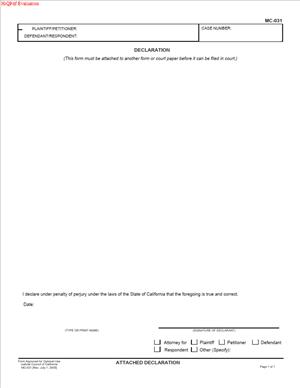
California Courts identifies TR-205, Request for Trial by Written Declaration, as the main request. TR-200, Instructions to Defendant, explains the process. The California Courts guide says you can use MC-031, Attached Declaration, if you need more space. The Traffic Advisory Committee proposed changes to the written-trial forms in 2026, so check the Judicial Branch’s current forms page and your local court before submitting an older copy. A proposal is not itself a new effective rule.
RunSensible Forms has a page for MC-031, Attached Declaration. Use it only when it fits the court’s instructions, and your statement needs more room. For the controlling TR-205 request, obtain the current version directly from California Courts or the court handling the case.
Build evidence for a traffic ticket by written declaration
Start with the exact charge. Your traffic ticket by written declaration should address what happened and why the evidence matters to that charge. Separate what you saw from what you later learned. Do not guess a speed, distance, color, or time if you do not know it. A traffic ticket by written declaration is signed under penalty of perjury, so accuracy matters more than dramatic language.
Useful material may include:
- A photograph showing the road, sign, marking, or signal from a relevant view.
- A simple diagram showing the direction of travel and where people or signs were located.
- A dated document that directly supports a disputed fact.
- A witness’s signed declaration describing what that person personally saw.
California Courts specifically list photos, diagrams, and witness statements as possible evidence. It says witness statements may use MC-031 or include a signed statement under penalty of perjury. Explain what each image or document shows in your statement. Do not assume the judge will infer why a photo matters.
How to write the statement
Use a simple order: identify the ticket, state your position, describe the events in time order, point to each exhibit, and ask for a finding of not guilty if that is your position. Stick to facts you can explain. A traffic ticket by written declaration may include your own observations and supporting records, but it should not become a general complaint about enforcement.
For example, a driver cited for passing a stop sign might write: “I approached the intersection on Pine Street at about 4 p.m. I saw the stop sign at the corner and stopped before the marked line. Photo A shows the line from my direction of travel. My passenger’s signed statement describes where the car stopped.” Use an example only as a model of clear writing. Never copy facts that are not true of your case.
If a detail is uncertain, say so. “I do not recall the precise minute” is better than inventing a time. If a photo was taken later, state when. If a witness did not see the full event, do not have them claim that they did. Give each attachment a simple label and refer to that label once in the statement.
Check witness and image details
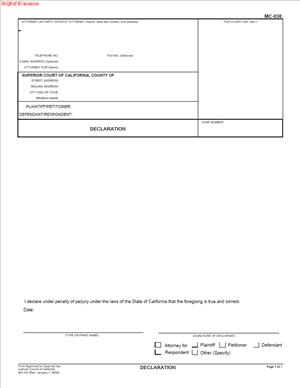
A witness should describe personal observations, not repeat your version of the event. Include the date, location, what the witness could see, and a signature under the court’s required declaration language. A witness may use MC-031 if the court accepts it for the added statement. A generic MC-030, Declaration exists in the directory, but follow the traffic court’s specific directions before choosing it.
For a traffic ticket by written declaration, make copies of photographs that remain readable after printing or scanning. State where you stood when you took them and whether conditions had changed. A later photo can still show the layout, but it may not prove what a signal displayed at the time of the ticket. If you submit a video or large file, ask the court which format it accepts. San Mateo County, for example, sets file-format and size rules for its online process; those limits are local, not a statewide rule.
Complete and submit the request
For a traffic ticket by written declaration, get the current TR-205 and read TR-200 first. Match your name, citation number, court, and charged violation to the notice. Use the form’s statement area or an allowed attachment. Review every page before signing. Ask the clerk if the court has local instructions that add steps to the statewide forms.
Before you submit a traffic ticket by written declaration, check this list:
- Eligibility: The ticket and court instructions allow this kind of written trial.
- Date: The court will receive your request and any required material by its due date.
- Identity: Your name, case number, and citation number agree across the papers.
- Statement: You address the charged event and sign where required.
- Evidence: Every attachment is readable, relevant, and identified in the statement.
- Payment: You have confirmed the court’s bail instructions or asked about an available alternative.
- Record: You keep a complete copy and proof of submission.
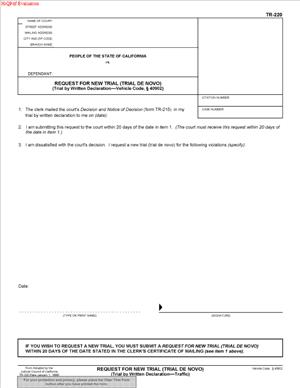
Do not replace TR-205 with an informal letter unless the court expressly directs you to use another accepted method. Do not use the page for TR-220 to start the first written trial. TR-220 is for asking for a new trial after a decision on a written declaration.

California Small Claims Trial: Evidence, Witnesses, and Hearing Checklist
What happens to the bail deposit?
California courts say you usually pay the full fine as bail when submitting the written-trial papers. If you are found not guilty, the court returns the deposit. If you are found guilty, the court applies it to the amount owed and tells you if there is a balance. Do not assume a civil filing-fee waiver form waives traffic bail. Ask the court about your options if you cannot pay the required deposit.
The payment method for a traffic ticket by written declaration, and any exception, depends on the current court procedure. Read its instructions before sending money. Keep a receipt and record the case number linked to the payment. If the court later sends a refund or a balance notice, compare it with your own record before taking the next step.
What the judge reviews and how you get the result
In a traffic ticket by written declaration, the court requests a written declaration from the citing officer. The judge considers your statement, the officer’s statement, and any accepted witness statements, photos, or diagrams. The court then sends the outcome by mail. The time it takes can vary by court. Keep your address current with the court and check your case status if a decision does not arrive when expected.
The court’s written result is generally TR-215, Decision and Notice of Decision. Read all of it. It may state the finding, fine or refund information, and the date the court mailed the decision. Save the envelope if it helps establish the mailing date. That date matters if you want to request a new trial after losing a traffic ticket by written declaration.
If you are found not guilty, follow the court’s instructions for any refund. If you are found guilty, read how the bail was applied and whether you owe more. If the amount creates a hardship, California Courts describes an ability-to-pay process that can sometimes lower a fine or allow more time, a payment plan, or community service. This is a separate issue from proving whether the citation was valid.
Can traffic school still be an option?
Ask the court about traffic school if you may qualify after a traffic ticket by written declaration. The court notice should say whether it is available. Eligibility can depend on the charge, your license, the vehicle, and past attendance. Do not assume that contesting a ticket automatically preserves or ends traffic-school eligibility. If that choice matters to you, ask before filing and again when reading the decision.
Traffic school addresses the effect of a qualifying point on your driving record. It is not the same as a not-guilty finding. The court sets any completion deadline and fees. If you have a commercial license, ask about the different rules that may apply.
If you lose, consider a new trial promptly
Losing the first traffic ticket by written declaration does not always end the case. California’s process allows a request for a trial de novo, meaning a new trial from the beginning. Use TR-220, Request for New Trial (Trial de Novo). This is not an ordinary appeal asking a higher court to review the written decision. At the new trial, you can present your account and evidence in person under the court’s directions.
San Mateo County’s court says TR-220 must be filed within 20 calendar days from the date the court mailed TR-215. Check the statewide rule, your decision, and your own court’s directions immediately rather than relying on the day you opened the letter. The court will notify you of the new trial date if it accepts a timely request.
RunSensible Forms has a page for TR-220, Request for New Trial. Compare any copy with the current Judicial Branch form before filing. TR-220 is a request for a new hearing; it does not replace your preparation for that hearing.
Prepare differently for the new trial
After a traffic ticket by written declaration leads to a new trial, read the hearing notice and confirm where and how you must appear. Bring the citation, TR-215, your prior declaration, originals or clear copies of exhibits, and any available witnesses. Be ready to explain your evidence aloud and ask relevant questions about the officer’s account. San Mateo County specifically tells drivers to bring evidence and witnesses and prepare to question the officer at the new trial.
Do not assume the judge at the new trial has memorized your written packet. Make a brief list of the facts you must prove. Mark the document or photograph that supports each one. If you need an accommodation for a disability or language help, contact the court ahead of the hearing about its process.
If you instead lose a later court trial and believe the judge made a legal mistake, an appeal is a different process. California Courts explains that an appeal is not a new trial and does not let you add fresh witnesses or evidence. Check its rules and deadlines before taking that step.
Mistakes that can weaken a written case
A traffic ticket by written declaration can fail for procedural reasons even when you have useful evidence. Avoid these problems:
- Missing the receipt deadline. Check when your court must receive the request, not just when you plan to send it.
- Using the wrong process. A parking matter, fix-it ticket, or charge requiring an appearance may need different steps.
- Submitting a form from an older packet. Check the current Judicial Branch and local court versions.
- Writing broad claims without facts. Describe the actual event and connect each exhibit to a point in dispute.
- Sending unclear photos. Identify the view, date, and fact each photo helps show.
- Relying on another person’s account as your own. Have a witness give a separate signed statement.
- Forgetting the bail instructions. Ask the court how to handle payment or hardship before the filing deadline.
- Ignoring the mailed decision. Open it promptly, note the mailing date, and act quickly if seeking a new trial.
Before filing a traffic ticket by written declaration, ask someone you trust to read the packet for missing dates, illegible images, and conflicting case numbers. They can help proofread, but the person who gives a sworn account must review and sign their own statement.
Conclusion
To fight a traffic ticket by written declaration, first confirm that the charge qualifies. Get the current TR-205 and the local court’s instructions. Send a truthful statement with a few strong, explained exhibits, meet the court’s due date, and follow its bail directions. Read the mailed decision as soon as it arrives. If you lose, check the TR-220 new-trial deadline right away.
This is general information, not legal advice for your particular ticket. RunSensible Forms is not a court, government agency, law firm, or official filing service. The court decides what it accepts and how it rules.
Frequently Asked Questions
Can I contest any California ticket this way?
No. A traffic ticket by written declaration generally concerns eligible Vehicle Code infractions or local ordinances adopted under that code. A misdemeanor or a matter with another required procedure may not qualify. Check the exact charge and ask the court when unsure.
Do I have to use TR-205?
California courts identify TR-205 as its written-trial request. A local court may also offer an accepted online process. Follow the instructions for the court named on your citation, and make sure any required statement and evidence are submitted by its deadline.
What if I cannot afford the bail deposit?
The California Courts guide says payment of the full fine as bail is usually part of a traffic ticket by written declaration. Ask your court about available procedures before the due date. Do not assume an ordinary civil court fee waiver covers this deposit.
Can my passenger write a statement?
Yes, a person who saw relevant events can provide a signed witness declaration. California courts point to MC-031 or a signed statement with its required penalty-of-perjury language. The witness should describe what they actually observed.
What happens if the officer does not submit a declaration?
The court asks the officer for a written statement, but do not assume silence guarantees any specific outcome. The judge and court process control the decision. Wait for TR-215, the official decision, and ask the clerk if the case status is unclear.
How long do I have to ask for a new trial?
San Mateo County says the TR-220 request is due within 20 calendar days from the mailing date of TR-215. Check the decision and the rules for your court promptly. Do not calculate from the day you happened to read the mail.
Is TR-220 the same as an appeal?
No. TR-220 asks for a fresh trial after the decision on a traffic ticket by written declaration. An appeal asks a higher court to review a trial decision for a legal error, generally on the existing record.
Resources
- California Courts, Trial by Written Declaration: https://selfhelp.courts.ca.gov/traffic/trial-declaration
- California Courts, TR-205 Request for Trial by Written Declaration: https://selfhelp.courts.ca.gov/jcc-form/TR-205
- California Courts, TR-200 Instructions to Defendant: https://selfhelp.courts.ca.gov/jcc-form/TR-200
- California Rule of Court 4.210: https://courts.ca.gov/cms/rules/index/four/rule4_210
- California Courts, TR-220 Request for New Trial: https://selfhelp.courts.ca.gov/jcc-form/TR-220
- California Courts, Traffic School: https://selfhelp.courts.ca.gov/traffic/traffic-school
- California Courts, If You Cannot Afford a Traffic Ticket: https://selfhelp.courts.ca.gov/traffic/ask-lower-fine
- San Mateo County Superior Court, Trial by Written Declaration: https://sanmateo.courts.ca.gov/divisions/traffic/trial-written-declaration
Disclaimer: The content provided on this blog is for informational purposes only and does not constitute legal, financial, or professional advice.
Contents