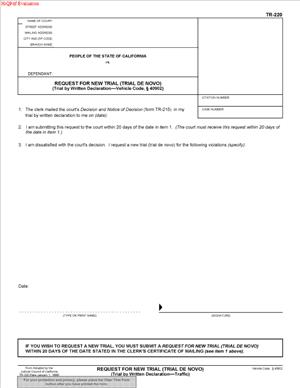
TR-220 – Request for New Trial (Trial De Novo)
Fill out nowJurisdiction: Country: United States | Province or State: California
If you lost a traffic case in California and believe the decision was wrong, TR-220 – Request for New Trial (Trial De Novo) is the form used to ask the court for a new hearing. This document starts the process of having your case heard again from the beginning.
This form is most often used after a trial by written declaration. That means the judge decided your case based only on written statements and evidence, without anyone appearing in court. If you disagree with that result, this filing gives you a chance to present your case in person.
TR-220 – Request for New Trial (Trial De Novo) is not an appeal in the traditional sense. You are not asking a higher court to review the first decision. Instead, you are asking the same trial court to hold a completely new trial.
If you are about to fill out this form, it helps to understand what it does, when it applies, and what happens next. The sections below walk through the purpose of the document and how to complete it clearly and accurately.
What is TR-220 – Request for New Trial (Trial De Novo)?
Clear definition
TR-220 – Request for New Trial (Trial De Novo) is a California court form used to request a new trial after a decision in a traffic case that was decided by written declaration. A trial de novo means “new trial.” The court treats the matter as if the first decision did not happen.
When you file this document, you are asking the court to schedule a new hearing where you can appear in person. The judge will consider testimony and evidence again. The prior written decision does not control the outcome of the new trial.
This form is specific to certain traffic infraction cases. It is part of the traffic court process and is designed for self-represented individuals as well as those with legal representation.
Who typically uses this form?
Most people who use this form are drivers who received a traffic ticket and chose to contest it through a trial by written declaration. After receiving the court’s decision in the mail, they may decide to request a new in-person trial.
You may also see this form used by vehicle owners who were cited in connection with a traffic violation. In some cases, commercial drivers or people concerned about points on their driving record use this process to seek another opportunity to present their case.
Attorneys sometimes file this form on behalf of clients. However, it is commonly completed by individuals who are representing themselves and want to continue challenging the citation.
Why might you need this form?
You might need this form if the court found you guilty after reviewing your written declaration and the officer’s written statement. If you believe important facts were misunderstood or not fully explained in writing, a new trial allows you to speak directly to the judge.
Some people feel that written submissions did not fully capture their explanation. Others want the opportunity to question the citing officer in court. A trial de novo gives you the chance to present live testimony and clarify details.
You may also use this form if you believe you have stronger evidence to present in person. For example, you may want to show photographs, diagrams, or other materials and explain them directly to the court.
Typical real-life scenarios
- You contest a speeding ticket through a trial by written declaration. The court later mails a notice stating that you were found guilty. You disagree with the result and want to appear in court to explain your version of events. Filing this form starts that process.
- You submit a written statement explaining that a stop sign was obscured by trees. The officer submits a conflicting statement. The judge rules against you based only on the written documents. You decide that an in-person hearing may give you a better chance to describe the location clearly.
- You are concerned about the impact of a traffic conviction on your driving record or insurance. After losing the written trial, you want to present additional facts in open court. A trial de novo allows the court to reconsider the case from the beginning.
- You believe there was a misunderstanding in your written explanation. Perhaps your statement was brief or lacked supporting detail. You want to testify directly and answer questions from the judge. This form is the procedural step that requests a new hearing.
When would you use TR-220 – Request for New Trial (Trial De Novo)?
You would use this form after you have already completed a trial by written declaration and received the court’s decision. It is not used before the written trial. It is also not used for cases that were already decided after an in-person court appearance.
Timing matters. Courts generally set a specific period after the decision is mailed during which you can request a new trial. The form must be filed within that time frame for the request to be considered.
This form is typically used by defendants in traffic infraction cases. It may apply to violations such as speeding, stop sign violations, red light violations, or similar traffic offenses handled in traffic court.
If your case involved a misdemeanor or a more serious charge, a different process may apply. The trial de novo process connected to this form is commonly tied to traffic infractions decided by written declaration.
You would not use this form simply because you disagree with a judge’s decision after a full in-person trial. In that situation, the appropriate process is often an appeal, which follows different rules and deadlines.
Legal characteristics of TR-220 – Request for New Trial (Trial De Novo)
This form is a procedural request. It does not argue your case or explain why the original decision was wrong. Its main function is to notify the court that you are exercising your right to a new trial after a written decision.
For the request to be effective, it generally must be filed within the required time period and properly completed. Missing required information, using the wrong case number, or filing after the deadline can lead to rejection or loss of the opportunity for a new trial.
The court typically reviews whether the request was timely and properly submitted. If accepted, the court schedules a new trial date. The case then proceeds as if no written decision had been made.
In California, this process is specific to traffic cases decided by written declaration. Other states may use different forms or may not offer the same type of new trial process. Even within California, procedures can vary slightly by court location, such as how hearings are scheduled or how notices are sent.
This form does not cancel your citation automatically. It does not erase points from your driving record by itself. It simply opens the door to a new hearing where the judge will decide the case again.
If bail was required for the written trial, the handling of that payment after a new trial request can vary based on the outcome of the new hearing. The form itself does not resolve those financial issues.
Is it legally binding?
The form becomes legally significant once it is properly filed with the court. By signing and submitting it, you are formally invoking your right to a new trial under the applicable traffic court rules.
It is binding in the sense that it starts a new court proceeding. The court may schedule a hearing based on your request, and you are expected to appear if a new trial date is set. Failure to appear can lead to additional consequences.
However, the form does not bind the judge to any particular outcome. The court is not required to change the original result. The new trial is a fresh review of the evidence and testimony.
The legal effect of this document depends on proper completion, timely filing, and acceptance by the court. If those conditions are not met, the original written decision typically remains in place.
How to fill out TR-220 – Request for New Trial (Trial De Novo)
Step 1 – Identify the court and case information
At the top of the form, enter the name of the court that handled your traffic case. This is usually the same court listed on your citation and on the notice of decision from your written trial. Include the court’s address if the form asks for it.
Next, provide your case number exactly as it appears on court documents. Double-check the number for accuracy. An incorrect case number can delay processing or cause confusion about which case you are referring to.
Step 2 – Provide your personal information
Fill in your full legal name as it appears on the citation or court paperwork. Include your current mailing address so the court can send you notices about the new trial date.
If the form asks for a phone number or other contact details, provide accurate and up-to-date information. This helps ensure you receive any scheduling updates or instructions related to your case.
Make sure the information is legible. If you are completing the form by hand, write clearly in dark ink. If you are typing, review for spelling errors before printing or submitting electronically, if permitted.
Step 3 – Confirm the request for a new trial
In the main section of the form, you will indicate that you are requesting a new trial after a decision in a trial by written declaration. This section is typically short and direct.
You are not required to explain your reasons for requesting the new trial on this form. The purpose here is simply to notify the court that you want the case heard again in person.
Read the wording carefully before signing. By completing this section, you are confirming that you are making this request within the allowed process for traffic cases.
Step 4 – Review any statements about bail or payment
Some versions of the form may include information about bail that was posted for the written trial. Review any references to payment amounts and confirm that the details match your records.
If the form includes a space to acknowledge bail or payment status, complete it as instructed. This section connects the new trial request to the financial aspect of your case.
Do not assume that filing the request changes payment obligations automatically. The outcome of the new trial will generally determine what happens next.
Step 5 – Sign and date the form
Locate the signature line near the end of the document. Sign your full legal name. If you are represented by an attorney, that person may sign on your behalf where appropriate.
Enter the date you are signing the form. The date can be important because courts often measure filing deadlines from the mailing date of the written decision.
Before submitting, review the entire document one more time. Confirm that all sections are complete, the case number is correct, and your contact information is accurate. Once signed and dated, the form is ready for filing with the court that handled your traffic case.
Legal terms you might encounter in TR-220 – Request for New Trial (Trial De Novo)
- Trial de novo: This means a “new trial” from the beginning. When you request this, the court does not simply review what happened before. Instead, the case starts over as if the earlier decision never happened.
- Judgment: A judgment is the court’s official decision in your case. On this form, you are challenging a prior judgment and asking the court to replace it with a new hearing and decision.
- Notice of Entry of Judgment: This is the formal notice that tells you the court has entered a judgment. The date you received or were served with this notice often controls your deadline to file this document.
- Filing deadline: This refers to the time limit for submitting your request. If you file late, the court may reject your request automatically. You must check the date of mailing or service carefully and count days accurately.
- Defendant: The person accused of committing an offense. If you were cited for a traffic violation, you are typically the defendant and the person who would file this request.
- Plaintiff: The party who started the case. In traffic matters, this is often the government entity that issued the citation. You are asking for a new hearing against that party.
- Bail: Money deposited with the court to guarantee your appearance or to cover fines. The form may refer to bail and whether it has been posted, forfeited, or applied to a fine.
- Declaration: A written statement made under penalty of perjury. Although this form is mainly a request, your signature acts as a declaration that the information you provide is true and correct.
- Proof of service: Documentation showing that the other party was properly notified. While this request is filed with the court, some procedures may require that the opposing party also receive notice.
- Clerk: The court official who processes filings. The clerk stamps your document as “filed” and enters it into the court record, which officially triggers the next stage of the case.
FAQs
What deadline applies when filing TR-220 – Request for New Trial (Trial De Novo)?
You must look at the date the court mailed or personally served the notice of judgment. The deadline is calculated from that specific date, not from the day you read it. Count calendar days carefully and confirm whether the last day falls on a weekend or a court holiday, which may affect when the clerk will accept your filing.
What happens to the original judgment after I submit this form?
Once this document is properly filed and accepted, the prior judgment is set aside for purposes of moving forward. The case returns to an active status, and the court schedules a new trial. The earlier decision no longer controls the outcome, but it remains part of the case history.
Do I need to explain why I disagree with the earlier decision?
No detailed explanation is required for this document. You are not arguing the facts yet. You are simply requesting a new trial. Your opportunity to present evidence and explain your position comes at the new hearing, not on this form.
What if I miss the filing deadline?
If you file late, the clerk may refuse to accept the request, or the court may deny it automatically. The prior judgment will remain in effect. You should confirm the exact deadline before submitting anything and keep proof of when you filed.
Do I need to attach any additional documents?
In most cases, you do not attach evidence or written arguments to this request. However, you should review any instructions that came with the judgment notice. If the court requires a copy of the notice or other paperwork, attach clear copies and keep the originals for yourself.
Will my bail be returned if I file this request?
Filing this document does not automatically return bail. Bail may remain on deposit while the case is pending again. You should check the section that refers to bail status and confirm with the clerk how it will be handled until the new trial is completed.
How do I know the court accepted my filing?
After submission, the clerk will stamp the document as filed and enter it into the court system. You should request a file-stamped copy for your records. If you file by mail, watch for confirmation or check the case record to confirm it was received and processed.
Can I change or withdraw my request after filing?
Once filed, this request moves your case forward to a new trial. If you later decide not to proceed, you may need to notify the court formally. Until the court confirms any change, you are expected to appear at scheduled hearings.
Checklist: Before, During, and After TR-220 – Request for New Trial (Trial De Novo)
Before
- Read the notice of entry of judgment and confirm the mailing or service date.
- Calculate the exact filing deadline using calendar days.
- Locate your case number and confirm it matches the judgment notice.
- Verify the correct court name and branch location.
- Confirm your current mailing address and contact information.
- Check the status of any bail you posted.
- Review any court instructions about filing methods.
- Make a plan to file in person or by mail with enough time before the deadline.
During
- Print clearly or type your full legal name as it appears on court records.
- Enter the correct case number without missing digits.
- Confirm the court’s full name and location.
- Mark or complete the section requesting a new trial.
- Review any bail-related statements for accuracy.
- Read the entire form once before signing.
- Sign and date the document in the correct space.
- Make at least two copies before submitting the original.
After
- File the original with the court clerk before the deadline.
- Obtain a file-stamped copy for your records.
- Confirm the court has scheduled a new trial date.
- Update your calendar with all hearing dates.
- Keep proof of filing in a safe place.
- Monitor mail for any court notices.
- Prepare your evidence and witness list for the new trial.
- Verify the status of your bail with the court if needed.
Common mistakes to avoid with TR-220 – Request for New Trial (Trial De Novo)
- Mistake: Missing the filing deadline because you miscounted the days, which happens when you start counting from the wrong date; this can cause automatic denial, so do not forget to calculate from the mailing or service date shown on the notice.
- Mistake: Writing the wrong case number because you rely on memory instead of checking paperwork; this may delay processing or attach your request to the wrong file, so do not forget to copy the number exactly as shown.
- Mistake: Forgetting to sign the form because you focus only on the request section; an unsigned document can be rejected, so do not forget that your signature is required.
- Mistake: Assuming bail is automatically refunded after filing, which happens due to confusion about procedure; this may lead to financial surprises, so do not forget to confirm bail status with the clerk.
- Mistake: Filing at the wrong court location because you overlooked the branch listed on your judgment; this can delay your case, so do not forget to match the court name and address exactly.
- Mistake: Waiting until the last day to file, which often happens due to procrastination; unexpected delays can cause late filing, so do not forget to allow extra time for mailing or in-person lines.
- Mistake: Attaching unnecessary arguments or evidence because you think you must explain everything immediately; this can confuse the record, so do not forget that the new trial is where you present your case.
- Mistake: Failing to keep a file-stamped copy because you assume the court will keep track; this may leave you without proof of timely filing, so do not forget to request and store a stamped copy.
What to do after filling out TR-220 – Request for New Trial (Trial De Novo)
Once you complete the form, focus on proper filing and preparation. The new trial will not happen automatically without your follow-through.
- Step 1: Make at least two copies of the completed form before submitting the original. One copy is for your records. The other may be used for reference at the clerk’s office.
- Step 2: File the original with the correct court clerk. Submit it in person or by mail, depending on what the court allows. If mailing, use a method that gives you proof of delivery.
- Step 3: Request a file-stamped copy. This stamped version proves you filed on time. Keep it in a safe place with all other case documents.
- Step 4: Confirm that the court has processed your request. You can do this by reviewing your case status or contacting the clerk to verify acceptance.
- Step 5: Watch for a notice of hearing. The court will schedule a new trial date. Read the notice carefully and note the courtroom, date, and time.
- Step 6: Update your calendar immediately. Set reminders well before the trial date so you have time to prepare.
- Step 7: Organize your evidence. Gather documents, photographs, diagrams, or other materials you plan to present. Make copies for the court and the opposing party if required.
- Step 8: Identify any witnesses you may call. Contact them early to confirm availability and understand the court’s process for ensuring their attendance if necessary.
- Step 9: Review the rules of procedure for the new trial. The case starts fresh, so be ready to present your side clearly and concisely.
- Step 10: Keep all correspondence from the court. Store notices, receipts, and copies together in a dedicated folder so you can quickly access them on the day of trial.
By staying organized and proactive, you put yourself in the best position to handle the new trial confidently and efficiently.
Disclaimer: This guide is provided for informational purposes only and is not intended as legal advice. You should consult a legal professional.