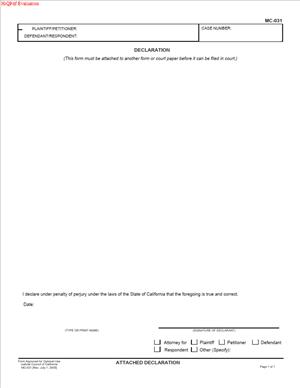
MC-031 – Attached Declaration
Fill out nowJurisdiction: Country: United States | Province or State: California
The MC-031 – Attached Declaration is a court form used in California civil cases when you need more space to explain facts. It allows you to provide a written statement under penalty of perjury and attach it to another court form or filing.
You use this form when the main document does not give you enough room to fully describe what happened, what you are requesting, or why you are responding in a certain way. It becomes part of your official court submission.
If you are representing yourself, this form gives you a structured way to tell your side of the story. It helps the judge understand the details behind your request or response.
Because it is filed with the court, the information you include matters. The content must be clear, factual, and organized so it supports the document it is attached to.
What is MC-031 – Attached Declaration?
Clear definition
MC-031 – Attached Declaration is a California Superior Court form used to provide additional written statements in a civil case. It serves as an attachment to another pleading, motion, or request that needs more explanation.
A declaration is a written statement of facts that you sign under penalty of perjury. This means you are stating that the information is true to the best of your knowledge. The court treats it as sworn testimony, even though it is not given in person.
The form itself is simple. It provides space to identify the case, the party making the declaration, and the factual statements you want the court to consider.
Who typically uses this form?
Self-represented individuals often use this form when they need more room than a standard court form provides. Many Judicial Council forms include a checkbox that says “Attachment MC-031,” signaling that extra pages are allowed.
Attorneys also use this document when filing motions or responses that require detailed factual support. For example, a lawyer might attach a declaration from a client explaining events in chronological order.
Parties in civil cases, including plaintiffs and defendants, may use this form. It is not limited to one side of a case.
Witnesses can also provide declarations using this format if their written statement is being submitted in support of a motion or other filing.
Why might you need this form?
Court forms often provide only a few lines to explain complex facts. If your situation cannot be fully described in that space, this form allows you to continue your explanation.
You might need it to describe a timeline of events, explain communications between parties, or clarify financial details. It helps you present specific facts instead of brief summaries.
You may also use it to respond to claims made by the other party. A clear, organized declaration can address each point directly and provide context that the judge may not otherwise see.
In many cases, the strength of your filing depends on the factual detail you provide. This document creates space for that detail.
Typical real-life scenarios
- You file a motion asking the court to dismiss a case, but the form only provides a few lines to explain your reasons. You attach a declaration describing the background of the dispute and key dates.
- You are responding to a motion filed by the other party. They included statements you believe are inaccurate. You attach your own declaration explaining what actually occurred.
- You are requesting a change to a court order in a civil matter. The request form is brief, so you attach a declaration describing new facts or changed circumstances.
- You are submitting evidence about damages in a contract dispute. The declaration outlines how the amount was calculated and references supporting documents.
- In each of these situations, the declaration supports the main filing. It does not replace it.
When would you use MC-031 – Attached Declaration?
You would use this form when another California civil court document requires or allows additional factual explanation. It is typically attached to motions, applications, oppositions, or responses.
For example, if you are filing a request for a court order and the form includes a section labeled “Facts in support,” but the space is limited, you may check the box indicating an attachment and include this declaration.
If you are opposing a motion, you may attach a declaration to explain your version of events. This is common when the court must decide based on written submissions rather than live testimony.
Parties sometimes use declarations to introduce exhibits. In that case, the declaration explains what each attached document is and why it matters.
In general, you use this form when the court needs more factual detail to understand your position.
Legal characteristics of MC-031 – Attached Declaration
This document is part of a court filing in the California Superior Court system. It becomes part of the official case record once filed.
For a declaration to be effective, it must clearly identify the case, including the case number and party names. It must state facts rather than arguments whenever possible. Facts are specific statements about what happened, when, and who was involved.
The declaration must be signed and dated. It includes language stating that the information is true under penalty of perjury under the laws of the State of California. Without a signature, the court may disregard it.
Common problems include missing case information, failing to sign the document, or including statements that are vague or unrelated to the issue before the court. Disorganized writing can also reduce its usefulness.
This form does not create a contract or agreement between parties. It does not, by itself, request a court order. It supports another document that makes a request.
While declarations are widely accepted in civil proceedings, the specific weight a judge gives to a declaration may vary depending on the type of hearing and the rules that apply to that motion.
Is it legally binding?
A declaration signed under penalty of perjury carries legal significance. By signing, you are affirming that the statements are true. Providing false information can have serious consequences.
The declaration itself does not bind the other party. It does not automatically grant you the outcome you seek. Its effect depends on how it supports the main filing and how the court evaluates it.
It becomes part of the case record once properly filed. The court may rely on it when making decisions, especially in matters decided on written submissions.
Its legal force comes from the sworn nature of the statement and its role within a formal court proceeding.
How to fill out MC-031 – Attached Declaration
Step 1 – Complete the case caption
At the top of the form, fill in your name, address, and contact information in the space provided. Enter the court name, including “Superior Court of California,” along with the county where the case is filed. Write the names of the plaintiff and defendant exactly as they appear in the case. Add the case number in the designated box.
Step 2 – Identify yourself as the declarant
Begin the body of the declaration by stating your name and your role in the case. For example, you may identify yourself as the plaintiff, defendant, or another party. This helps the court understand who is providing the information.
Step 3 – State your facts clearly and in order
Write your statements in numbered paragraphs. Each paragraph should focus on one fact or a closely related set of facts. Use specific dates, locations, and descriptions when possible. Keep the content focused on the issue connected to the main filing.
Step 4 – Refer to attachments if needed
If you are including documents as exhibits, refer to them clearly in the declaration. Describe each document briefly and explain its connection to your statements. Label the attachments in a consistent way so they can be easily identified.
Step 5 – Avoid argument and repetition
Keep the declaration factual rather than argumentative. Focus on what you personally saw, heard, or experienced. Avoid repeating information that is already fully stated in the main form unless additional detail is necessary.
Step 6 – Review for completeness and accuracy
Read the entire declaration carefully. Confirm that the case number, party names, and all details are correct. Make sure your statements are clear and directly related to the purpose of the filing.
Step 7 – Sign and date under penalty of perjury
At the end of the form, sign your name and write the date. By signing, you are declaring under penalty of perjury under California law that the information is true and correct. Once signed, attach the completed declaration to the primary document and include it with your court submission.
Legal terms you might encounter in MC-031 – Attached Declaration
- Declarant: The person who writes and signs the declaration. This is you, if you are the one providing the facts. Your name must match the name shown in the case caption so the court can clearly identify who is making the statements.
- Penalty of Perjury: A statement at the end of the declaration where you confirm that everything you wrote is true. By signing under penalty of perjury, you are legally stating that your information is accurate to the best of your knowledge. False statements can lead to serious consequences, including court sanctions.
- Case Caption: The heading at the top of the first page. It includes the court name, case title (names of the parties), and case number. Every attached page must clearly connect to this caption so the clerk knows which case your declaration belongs to.
- Attachment: Extra pages added to another court form. This document is not filed alone in most situations. It supports a motion, response, or other pleading by giving more detailed facts.
- Exhibit: A document you refer to and attach as evidence. If you mention an email, contract, photo, or receipt in your declaration, you may label it as “Exhibit A,” “Exhibit B,” and so on. Each exhibit should be clearly marked and referenced in your written statements.
- Personal Knowledge: Facts you directly saw, heard, or experienced. Your declaration should focus on personal knowledge rather than guesses or secondhand information. Courts give more weight to statements based on what you personally know.
- Chronological Order: Arranging events by date, from earliest to most recent. Writing your declaration in chronological order helps the judge understand what happened and when. It also reduces confusion and repetition.
- Service: The formal process of delivering court documents to the other party. After completing your declaration, it usually must be served along with the main motion or pleading it supports. Proper service ensures fairness and keeps the case moving.
- Filing: Submitting your completed forms to the court clerk so they become part of the official case record. Filing may be done electronically or in person, depending on the court’s procedures. A document is not considered by the judge unless it is properly filed.
FAQs
Do I have to use MC-031 – Attached Declaration every time I need more space?
No. You use this form when a court document does not provide enough room for your full explanation. If the original form clearly says “Attach declaration if more space is needed,” this document is the correct way to add information. If there is already a designated attachment page built into the main form, use that instead. Always check the instructions on the primary form before adding extra pages.
What information must match the main form I am attaching this to?
The case caption must match exactly. That includes the court name, case number, and party names. Your name must also appear the same way across all documents. If the main motion lists a hearing date or department, confirm that your attached pages refer to the same event so there is no confusion in the record.
Can I include new requests in this document?
This document is meant to explain facts, not to create new requests. Any formal request for orders should appear in the main motion or pleading. Use this form to support those requests with details. If you add a brand-new request only in your declaration, the court may ignore it because it was not properly noticed.
Do I need to attach proof or exhibits to support what I say?
If you refer to documents, you should attach copies as labeled exhibits. For example, if you state that you sent a letter on a certain date, attach that letter and label it clearly. Mention the exhibit by letter in the paragraph where you discuss it. Keep your exhibits organized and in the same order you reference them.
What happens if I forget to sign under penalty of perjury?
An unsigned declaration is usually treated as incomplete. The court may reject it or disregard the statements entirely. Before filing, confirm that you signed and dated the last page. Without that signature, the document does not carry legal weight.
Can someone else write and sign the declaration for me?
Only the person with personal knowledge of the facts should sign. If someone else witnessed events, that person should prepare and sign their own declaration. Each declarant signs separately under penalty of perjury. Do not sign for someone else.
Is there a limit to how long this document can be?
There is no fixed page limit for MC-031 – Attached Declaration, but you should be concise. Judges review many filings, so clarity matters. Focus on relevant facts. Remove repetition and unnecessary commentary so your main points stand out.
Will this document become part of the public record?
In most civil cases, yes. Once filed, it becomes part of the court file. That means the information you include may be accessible to others. Review your statements carefully and avoid including sensitive personal details unless they are directly relevant and necessary.
Checklist: Before, During, and After MC-031 – Attached Declaration
Before
- Confirm the main form actually requires or allows an attached declaration.
- Gather all dates, documents, and notes related to your statement.
- Review the case caption for accuracy.
- Outline your key points in chronological order.
- Identify any exhibits you plan to reference.
- Make sure you are the correct person to provide these facts.
- Check the hearing date connected to your filing.
During
- Copy the exact case caption onto the first page.
- Clearly state your name and role in the case.
- Number each paragraph for easy reference.
- Stick to facts based on personal knowledge.
- Refer to exhibits by letter and attach them in order.
- Use clear, direct sentences.
- Avoid emotional or argumentative language.
- Leave space for your signature and date.
After
- Review the entire document for spelling and factual accuracy.
- Confirm all referenced exhibits are attached and labeled.
- Sign and date under penalty of perjury.
- Make required copies for yourself and other parties.
- Attach the declaration to the main motion or pleading.
- File the complete packet with the court.
- Serve all required parties properly.
- Keep proof of filing and service in your records.
Common mistakes to avoid with MC-031 – Attached Declaration
- Mistake: Leaving out the case number because you assume it is obvious, which happens when copying quickly from memory, leading to filing delays or rejection; do not forget to match the caption exactly as it appears in the case.
- Mistake: Writing arguments instead of facts because you want to persuade the judge, which can weaken your credibility and reduce clarity; do not forget that this document is for factual statements, not legal debate.
- Mistake: Referring to exhibits but failing to attach them, often due to last-minute printing or scanning issues, which can cause the court to disregard those references; do not forget to physically include and label each exhibit.
- Mistake: Including information based on what someone else told you, which happens when summarizing events quickly and can reduce reliability; do not forget to limit statements to your own personal knowledge.
- Mistake: Forgetting to sign under penalty of perjury because you focused on the content and overlooked the final line, resulting in an invalid declaration; do not forget to sign and date the document.
- Mistake: Adding new requests for court orders inside the declaration, which happens when trying to explain your position fully, but can cause procedural problems; do not forget that formal requests belong in the main motion.
- Mistake: Submitting the declaration without attaching it to the correct motion, often due to assembling documents out of order, which can create confusion in the clerk’s office; do not forget to staple or electronically combine it with the primary filing.
What to do after filling out MC-031 – Attached Declaration
Once you finish writing and signing your declaration, shift your focus to proper submission and recordkeeping. The content matters, but procedure matters just as much. If you skip a step, the court may not consider what you wrote.
Start by assembling your full filing packet. Your declaration should be attached directly behind the motion, response, or other pleading it supports. Keep the pages in logical order. Make sure exhibit tabs or labels are visible and consistent with your references in the text.
- Step 1: Review the complete packet, including the main form and all attachments, to confirm names, dates, and case numbers match.
- Step 2: Make the required number of copies. Typically, you need one for the court, one for yourself, and one for each other party.
- Step 3: Check whether filing is electronic or in person for your case type.
- Step 4: Submit the packet to the court clerk through the required method.
- Step 5: Obtain confirmation of filing, such as a stamped copy or electronic receipt.
- Step 6: Arrange for proper service on all other parties.
- Step 7: Complete and file any required proof of service form.
- Step 8: Store a complete, organized copy of everything you filed.
- Step 9: Calendar any hearing date associated with the filing.
- Step 10: Prepare to reference your declaration at the hearing if needed.
After filing, confirm that your document appears on the case docket or register of actions. If something is missing, address it quickly. Keep your stamped copy in a safe place. Bring it to any related hearing.
Before the hearing date, read your declaration again. Be ready to answer questions about the facts you stated. The judge may rely heavily on what you wrote, especially if the other side submits a competing declaration.
Finally, update your personal case file. Keep all drafts, final versions, exhibits, and proof of service together. Staying organized helps you respond efficiently to future filings and keeps your presentation consistent throughout the case.
Disclaimer: This guide is provided for informational purposes only and is not intended as legal advice. You should consult a legal professional.