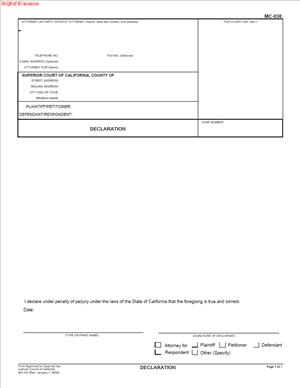
MC-030 – Declaration
Fill out nowJurisdiction: Country: United States | Province or State: California
The MC-030 – Declaration is a court form used in California civil cases to present written statements under penalty of perjury. It allows you to explain facts to the court in your own words. Instead of speaking in court, you provide a signed written statement.
If you are representing yourself, this form often becomes your main way to tell the judge what happened. It can support a motion, respond to another party’s filing, or provide additional information the court requested. It is commonly attached to other documents in a court filing.
The MC-030 – Declaration matters because judges rely on written evidence when making decisions. A clear and complete declaration can shape how the court understands your situation. If it is unclear or incomplete, the judge may give it less weight.
This form is not a complaint or a motion by itself. It does not start a case. Instead, it supports another filing by adding sworn facts. Understanding how it works helps you present your information in a structured and credible way.
What is MC-030 – Declaration?
Clear definition
This form is a Judicial Council form used in California civil proceedings to provide a written statement of facts. It is signed under penalty of perjury. That means you are legally affirming that everything you wrote is true and correct.
A declaration serves as written testimony. Instead of appearing in court to speak, you put your statements in writing. The court reads it as part of the official record.
This form is often used when you need more space than what another form provides. Many court forms include a section that says “Attachment MC-030.” That signals you may use this document to continue your explanation.
Who typically uses this form?
Self-represented individuals frequently use this form to explain their side of a dispute. If you do not have a lawyer, this document may be your primary way to describe events, provide context, and respond to claims.
Attorneys also use this form to submit statements from their clients or other witnesses. In that setting, the person with knowledge of the facts signs the declaration.
Parties in civil cases, family law matters, and certain other court proceedings may use this document. It is designed for use in the Superior Court of California and fits into many types of civil filings.
Why might you need this form?
You may need this form when the court requires factual support for a request. Courts typically decide motions based on written papers. A declaration provides the factual foundation for those papers.
If you are responding to a motion, you might use this form to explain your version of events. If you are asking for relief, you might use it to describe why your request is reasonable and supported by facts.
You may also use this form when another court document does not provide enough space. Rather than squeezing important information into a small box, you can attach a declaration and present your facts in a clear order.
Typical real-life scenarios
- You file a motion asking the court to change a hearing date. You attach a declaration explaining your scheduling conflict and why the change will not prejudice the other side. The judge reviews your written explanation when deciding whether to grant the request.
- You respond to a motion filed by the opposing party. In your declaration, you describe communications, attach copies of messages, and explain what actually occurred. Your written statement becomes part of the court’s review.
- You are involved in a civil dispute about property damage. You submit a declaration describing the condition of the property before and after the incident. You reference photographs and attach them as exhibits.
- You request a fee waiver or other procedural relief. The declaration provides additional background about your financial situation or circumstances that are not fully captured in the main form.
- In each scenario, the declaration adds detailed facts that support another filing. It strengthens your presentation by organizing your statements in a structured format.
When would you use MC-030 – Declaration?
You use this form when the court needs sworn facts in writing. This often happens in motion practice. Courts commonly decide motions based on written submissions rather than live testimony.
If you are filing a request that depends on what happened in the past, a declaration allows you to describe those events. For example, you may need to explain timelines, conversations, or actions taken by you or another party.
If you are opposing a request, you can use this form to dispute factual claims. You present your version of events in numbered paragraphs. The judge compares both sides’ declarations when making a decision.
This form is also used when a judge asks for additional information. The court may issue an order requiring a written explanation by a certain date. In that situation, a declaration provides a formal way to respond.
Witnesses may also submit declarations. If someone has personal knowledge of relevant facts, they can sign a declaration describing what they saw or heard. That written statement becomes part of the case file.
In general, you use this document when your case depends on facts that must be clearly presented and formally affirmed as true.
Legal characteristics of MC-030 – Declaration
A declaration is effective when it meets certain basic requirements. It must be signed. It must include a statement that it is made under penalty of perjury. It must be dated. The person signing must have personal knowledge of the facts described.
Personal knowledge means you directly experienced or observed what you are describing. Courts typically give little weight to statements based on rumor or secondhand information.
Clarity and organization matter. Courts expect declarations to be written in numbered paragraphs. Each paragraph usually contains one fact or a closely related set of facts. This format makes it easier for the judge to reference specific statements.
Common problems include vague statements, unsupported conclusions, or arguments disguised as facts. A declaration is meant to present facts, not legal arguments. The legal arguments usually belong in a separate memorandum or section of a motion.
Another frequent issue is failing to sign under penalty of perjury. Without that language and signature, the court may treat the document as incomplete or defective. Proper formatting, case information, and caption details also affect whether the filing is accepted.
The MC-030 – Declaration does not replace live testimony at trial. In many situations, declarations are used for pretrial motions. At trial, witnesses may need to appear in person unless the court allows otherwise.
Procedural details can vary depending on the type of case. For example, deadlines for filing and serving declarations may differ between civil, family, and other court departments. While the basic function of the declaration remains consistent, filing rules may change depending on the context.
Is it legally binding?
A declaration is legally significant because it is made under penalty of perjury. When you sign, you are affirming that the contents are true. Providing false information can have serious consequences.
However, the declaration itself is not a contract. It does not create an agreement between parties. Its purpose is to present sworn facts to the court.
Its binding nature relates to your obligation to tell the truth. The court may rely on your statements when making decisions. If the court later determines that statements were knowingly false, that can affect credibility and potentially lead to penalties.
In short, the declaration carries legal weight because of the oath-like affirmation it contains. It becomes part of the official court record once properly filed and accepted.
How to fill out MC-030 – Declaration
Step 1 – Complete the caption section
At the top of the form, fill in the court name, branch name, and court address as shown on other documents in your case. Enter the case name exactly as it appears on prior filings. Include the case number without changes. This information links your declaration to the correct court file.
Step 2 – Identify the declarant
In the opening sentence, state your name. The standard language begins with “I, [name], declare.” Use your full legal name. Make clear who is making the statement. If you are filing on your own behalf, you are the declarant. If someone else is providing the statement, that person’s name goes here.
Step 3 – State your connection to the case
Briefly explain your role. You might state that you are the plaintiff, defendant, or another party. If you are a witness, describe how you are connected to the events. This gives context for why you have knowledge of the facts.
Step 4 – Present facts in numbered paragraphs
Write your statements in separate numbered paragraphs. Keep each paragraph focused on one main fact or event. Present information in chronological order when possible. Use clear dates, locations, and names. Avoid speculation and opinions. Focus on what you directly know.
Step 5 – Reference and attach exhibits if needed
If you are referring to documents, photographs, or other evidence, identify them clearly in your declaration. Label each attachment as an exhibit. Mention each exhibit in the paragraph where it is discussed. Attach the exhibits behind the declaration in an organized order.
Step 6 – Include the penalty of perjury statement
Near the end of the form, confirm that the declaration is made under penalty of perjury under the laws of the State of California. The form typically includes this language. Do not alter it. This statement is what gives the document its sworn status.
Step 7 – Date and sign the declaration
Enter the date you are signing the document. Sign your name on the signature line. Print or type your name below your signature if space is provided. Your signature finalizes the declaration and confirms that you stand behind the truth of what you wrote.
Legal terms you might encounter in MC-030 – Declaration
- Declarant: The person who writes and signs the declaration. You are the declarant if you are the one providing the facts. Your name must appear exactly as it does in the case caption, and you must sign the document yourself.
- Penalty of Perjury: A statement at the end of the document where you declare that everything you wrote is true. By signing under penalty of perjury, you are making a sworn statement without going to court in person. False statements can lead to serious legal consequences.
- Caption: The top section of the first page that lists the court name, case title, case number, and parties. This must match the court’s records exactly. Any mismatch can cause filing delays or rejection.
- Case Number: The unique number assigned to your court case. You must enter it correctly on every page. If you leave it out or enter it incorrectly, the clerk may not know where to file your document.
- Exhibit: A document you attach to support what you are saying. Examples include emails, contracts, photos, receipts, or medical records. Each exhibit should be labeled clearly so the judge can identify it easily.
- Personal Knowledge: Facts you know because you saw, heard, or experienced them yourself. Courts give more weight to statements based on personal knowledge. Avoid repeating rumors or secondhand information.
- Proof of Service: A separate document showing that you delivered a copy of your declaration to the other party. Courts require proof that all sides received the same information. Without it, your filing may not be considered.
- Responsive Declaration: A declaration filed in response to another party’s motion or declaration. It addresses specific claims made by the other side. You must clearly state which statements you are responding to.
- Material Facts: Important facts that could affect the judge’s decision. Focus on facts that relate directly to the issue before the court. Irrelevant details can weaken your presentation.
- Judicial Officer: The judge or commissioner assigned to your case. Your declaration is written for this person to review. Keep your tone respectful and factual.
FAQs
Do I need to notarize MC-030 – Declaration?
No. This form does not require notarization because you sign it under penalty of perjury. Your signature, along with the required statement about penalty of perjury, replaces the need for a notary.
What if I make a mistake after I sign this document?
If you notice a mistake before filing, correct it neatly and initial the change if the court accepts handwritten corrections. If the error is significant or you already filed it, prepare a new declaration with the correct information and file it as soon as possible so the court has an accurate record.
Can I attach documents to support what I am saying?
Yes. You can attach exhibits that support your statements. Refer to each attachment clearly in the body of your declaration, label them (for example, Exhibit A, Exhibit B), and make sure the labels match what you mention in the numbered paragraphs.
What date should I use when signing?
Use the actual date you sign the declaration. Do not backdate or future-date it. The court relies on that date to understand when your statement was made.
Do I have to file this form with the court clerk?
Yes. After completing MC-030 – Declaration, you must file it with the court handling your case unless you are submitting it directly during a hearing as instructed. Filing places it in the official court record.
Does the other party get a copy?
Yes. You must have someone over 18 who is not part of the case serve a copy on the other party or their attorney. The person who serves it must complete a proof of service form.
What if I need more space than one page?
You can continue on additional pages. Make sure each page includes the case number and is numbered clearly. Keep your paragraphs numbered in order from start to finish.
Can I use this document to tell my entire story about the case?
You should focus only on facts that relate directly to the issue the court is deciding. The MC-030 – Declaration is not the place for arguments, insults, or unrelated background details. Stay specific and organized so the judge can easily follow your points.
Checklist: Before, During, and After MC-030 – Declaration
Before
- Confirm the exact case name and case number from prior court documents.
- Review the motion or issue you are responding to.
- Gather all documents you may want to attach as exhibits.
- Outline the key facts you want to present in logical order.
- Make sure the facts are based on your personal knowledge.
- Check any deadlines for filing and service.
- Verify the correct court location and department.
- Ensure your contact information is current and accurate.
During
- Complete the caption exactly as it appears in court records.
- State your full legal name clearly as the declarant.
- Write in numbered paragraphs.
- Stick to one fact or event per paragraph.
- Refer to exhibits by clear labels.
- Use clear, simple language.
- Include the penalty of perjury statement.
- Date the document with the day you sign.
- Sign your name clearly and legibly.
After
- Make at least two copies: one for you and one for the other party.
- Attach copies of all exhibits to each set.
- Arrange for proper service by a qualified adult.
- Complete and file the proof of service.
- File the original declaration with the court clerk.
- Confirm filing acceptance through a receipt or file stamp.
- Keep your stamped copy in a safe place.
- Bring a copy to your hearing if one is scheduled.
Common mistakes to avoid with MC-030 – Declaration
- Mistake: Writing long emotional narratives instead of clear facts, often because you want the judge to understand your frustration, which can make your declaration harder to follow and reduce its impact; do not forget to focus on specific, relevant events.
- Mistake: Forgetting to include the case number in the caption, usually due to copying from memory, which can delay filing or misplace your document; do not forget to verify it from official paperwork.
- Mistake: Failing to sign under penalty of perjury, often because you assume typing your name is enough, which can cause rejection by the clerk; do not forget your handwritten signature and date.
- Mistake: Referring to exhibits without attaching them, which happens when documents are prepared separately and can weaken your credibility; do not forget to label and attach every referenced exhibit.
- Mistake: Including hearsay or secondhand statements, often because you think all information helps, which may reduce the weight of your declaration; do not forget to stick to personal knowledge whenever possible.
- Mistake: Missing the service requirement, often due to focusing only on filing, which can prevent the judge from considering your declaration; do not forget to complete and file proof of service.
- Mistake: Submitting the document after the deadline, often because you underestimate preparation time, which can result in the court ignoring your filing; do not forget to check deadlines early.
- Mistake: Using informal language, text abbreviations, or slang, often from copying email style, which can appear unprofessional; do not forget that this is a formal court document.
What to do after filling out MC-030 – Declaration
Once you finish writing and signing your declaration, shift your focus to proper filing and delivery. Courts care just as much about procedure as they do about content. A well-written declaration can lose impact if it is not filed or served correctly.
Start by reviewing the entire document from top to bottom. Confirm that every page includes the case number. Check that your paragraphs are numbered in order and that each exhibit mentioned is attached and labeled clearly. Make sure the date next to your signature matches the day you actually signed.
- Step 1: Make the required copies of the signed declaration and all exhibits.
- Step 2: Arrange for service by someone over 18 who is not involved in the case.
- Step 3: Have the server complete a proof of service form accurately.
- Step 4: File the original declaration and proof of service with the court clerk.
- Step 5: Confirm that the clerk stamps your copy as “Filed.”
- Step 6: Verify the hearing date, time, and department if one is scheduled.
- Step 7: Organize your filed copy and exhibits in a folder for easy access.
- Step 8: Prepare to reference specific paragraph numbers during the hearing.
- Step 9: Monitor mail or electronic notifications for any response from the other party.
- Step 10: Update your personal records to reflect the filing date and what was submitted.
If you file in person, ask the clerk to stamp your copies before you leave. If you file electronically, download and save the confirmation receipt. Keep both digital and paper versions if possible. Organized records help you stay confident and prepared.
Before your hearing, reread your declaration carefully. The judge may ask you questions based on what you wrote. Be ready to explain or clarify specific paragraphs. Stick to the facts you included. Do not expand into new issues unless the court allows it.
If circumstances change after you file, you may need to submit an additional declaration to update the court. Keep track of deadlines and procedural rules so your new information is considered.
Treat your declaration as part of your official court record. Store it securely with other case documents. Clear organization now will save you time and stress later in the process.
Disclaimer: This guide is provided for informational purposes only and is not intended as legal advice. You should consult a legal professional.