A California small claims trial gives each side a limited time to explain a money dispute. The judge needs facts, documents, and a clear request. A large folder does not win by itself. Your goal is to show what happened, why the other side is responsible, and how you calculated the amount.
This guide provides general legal information, not legal advice. Rules, forms, and local practices can change. Check the current California Courts Self-Help Guide and your county court before acting.
Start With the Claims the Judge Must Decide
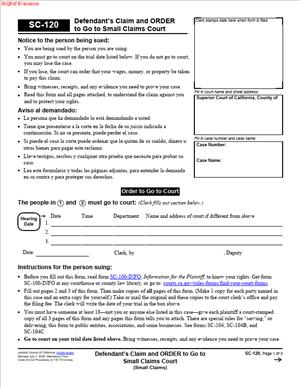
Read every filed claim before building your evidence. The plaintiff’s SC-100 states why the defendant allegedly owes money. A defendant may file SC-120 to bring a related claim against the plaintiff. The judge may hear both claims at the same California small claims trial.
Make a one-page issue list. For each claim, write:
- What event or agreement created the dispute
- What each side promised to do
- What action or failure caused the loss
- The amount requested
- How that amount was calculated
- The evidence supporting each point
- The other side’s likely answer
Do not prepare only for your own story. Read the other side’s papers and attached records. Mark facts you agree with, facts you dispute, and facts you cannot confirm.
California small claims trial issue map
An issue map connects each fact to proof. For example, a contractor claim may require proof of the agreement, payment, promised work, incomplete work, notice of the problem, repair cost, and amount still unpaid or requested back.
Keep legal conclusions out of the map unless you can explain the supporting facts. “They breached the contract” is a conclusion. “The written estimate promised completion by May 10, but the dated photos show the work stopped on April 28” is a fact-based point.
Confirm Service and the Hearing Details
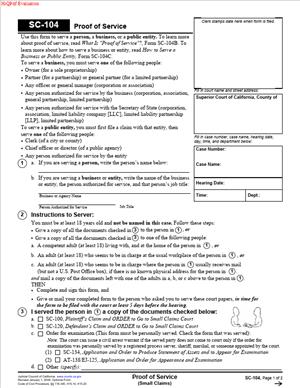
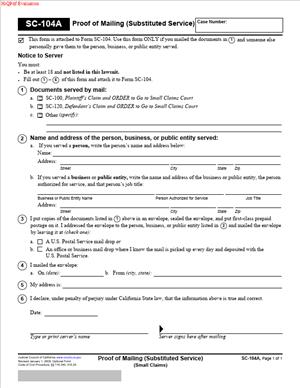
A strong case cannot fix missing service. Review the filed proof of service before the California small claims trial. SC-104 records how certain small claims papers were served. SC-104A may document the mailing step after substituted service. SC-112A can prove service by mail for documents that may be served that way.
Check these items early:
- Correct legal name of every party
- Correct case number
- Documents listed as served
- Person who completed service
- Service method and address
- Service date
- Filed proof of service
- Hearing date, time, department, and access method
Do not assume every document can be served by mail. Different papers can require different methods. The party to the case may not be allowed to serve some papers. Use the current instructions for the exact form.
Contact the clerk or small claims advisor if the record appears incomplete. Court staff can explain procedure but cannot advise you how to win.
Build a Clean Evidence Packet
Evidence is information used to prove or disprove a fact. Common evidence includes contracts, receipts, invoices, photographs, messages, emails, estimates, account records, and witness testimony.
Start with originals or reliable source copies. Keep an untouched master set. Use working copies for notes. Do not edit screenshots in a way that hides context. Keep full message threads when the surrounding conversation matters.
For a California small claims trial, sort the evidence in date order or by issue. Use simple exhibit labels such as “Exhibit 1” and a short description. Follow any local rule about exchanging or submitting exhibits before the hearing.
California small claims trial exhibit checklist
For each proposed exhibit, ask:
- What fact does this prove?
- Who created or received it?
- Is the date visible?
- Is the full document included?
- Can the judge read it quickly?
- Does it contain private data that should be redacted under court rules?
- Do I have enough copies or the required electronic version?
Remove duplicates. A judge does not need six copies of the same invoice in one packet. If a long record contains only two useful pages, include the needed context and flag the key pages.
Create an exhibit index. List the exhibit number, description, date, and the point it supports. This index is for organization; follow the court’s rules about what is formally admitted.
Prove the Amount, Not Just the Wrong
Small claims cases usually seek money. You must connect the other side’s conduct to a specific loss. A reasonable story without a supported calculation may leave the judge unsure what amount to award.
Prepare a damage worksheet for the California small claims trial. List each amount separately, then identify its source.
Examples include:
- Deposit paid, supported by a receipt or bank record
- Unpaid invoice, supported by the agreement and work record
- Repair cost, supported by an invoice or estimate
- Property value, supported by purchase records or other reliable proof
- Payments already received, shown as deductions
- Court costs requested where allowed
Do not add unrelated stress, time, or inconvenience as a dollar amount unless the law allows that type of recovery. Do not round numbers without an explanation. Check your math twice.
Bring a one-page total that matches the amount requested in the filed claim. If the requested amount changed, confirm what procedure the court requires before the hearing.
Decide Which Witnesses Are Truly Needed
A witness can describe facts they personally saw, heard, or did. Choose witnesses because they prove a needed point, not because they agree with you.
For each witness, write the fact they can establish. Ask whether the same fact is already clear from a reliable document. Too many witnesses can repeat the same point and use limited hearing time.
Talk with a willing witness before the California small claims trial. Confirm the hearing date and the person’s availability. Explain that they should tell the truth in their own words. Do not coach a witness to memorize a script.
Using a subpoena for a California small claims trial
SC-107 is the Small Claims Subpoena for Personal Appearance and Production of Documents and Things. It may be used to require a witness to attend, produce identified records, or both. A subpoena is a court command, not an informal request.
Describe requested records narrowly. “All records about me” may be unclear or excessive. A focused description identifies the record type, date range, account or transaction, and why it matters.
Issuing and serving a subpoena can involve deadlines, witness fees, privacy rules, and special procedures for consumer or employee records. Read the current instructions and get help from the small claims advisor when records contain private information.
Prepare for the Other Side’s Evidence
Write the strongest fair version of the other side’s case. Then identify your answer and the proof supporting it. This makes the California small claims trial less surprising.
Common disputes include:
- Whether an agreement existed
- What the agreement required
- Whether work was completed
- Whether goods were damaged before delivery
- Whether notice of a problem was given
- Whether a payment was already made
- Whether the claimed amount is too high
- Whether the wrong person or business was named
Do not hide a bad fact. Prepare a short, truthful explanation. If you made a mistake, explain what happened and why it does or does not change the requested result.
How to File a California Small Claims Case for Property Damage or Unpaid Rent
If the defendant filed SC-120, the plaintiff must prepare to answer that claim too. Treat it as a separate claim with its own issue map, evidence, witnesses, and amount calculation.
Write a Short Hearing Outline
A California small claims trial is usually less formal than a regular civil trial, but it still needs structure. Prepare an outline rather than a speech.
Use this order:
- Identify who you are and what you want the judge to decide.
- State the agreement or event in one or two sentences.
- Explain what went wrong in date order.
- Point to the key exhibits.
- Introduce any needed witness.
- Explain the amount requested or disputed.
- Answer the other side’s main point.
- End with the exact result you request.
Practice aloud. Aim for a clear opening of about one minute. Then practice the longer explanation without reading every document.
California small claims trial presentation tips
- Speak to the judge, not to the other party.
- Do not interrupt.
- Answer the question asked.
- If you do not know, say so.
- Use dates and amounts instead of vague words.
- Ask permission before handing up a document.
- Keep notes short enough to find information quickly.
- Stay calm when the other side disagrees.
The judge may ask questions in a different order than your outline. Follow the judge’s lead.
Plan for Remote or In-Person Court
Confirm whether the California small claims trial is in person, remote, or hybrid. Read every notice from the court. Local technology and exhibit rules can differ.
For an in-person hearing:
- Plan travel, parking, and security time.
- Bring organized copies in a sturdy folder.
- Dress neatly and turn off your phone.
- Arrive early enough to find the department.
For a remote hearing:
- Test the device, camera, microphone, and internet.
- Use the name shown in the case when joining.
- Sit in a quiet, well-lit space.
- Keep exhibits open and easy to locate.
- Know how the court wants electronic evidence submitted.
- Have a phone backup and the clerk’s contact information.
Do not record a hearing unless the court expressly permits it. Court rules can restrict photography, audio, and video.
Request a Postponement Only When Necessary
SC-150 asks the court to postpone a small claims trial. Filing the request does not change the date by itself. The original date remains in effect unless the court grants a new one.
If you need more time, act promptly. State the specific reason and follow service requirements for the request. Keep proof that the other parties received it. If you do not receive a court decision, be prepared to attend on the original date.
A postponement can help when a necessary witness is unavailable, service is incomplete, or an important event prevents attendance. It is not a substitute for ordinary preparation.
Add the decision to your California small claims trial calendar. If granted, update witnesses, exhibits, travel, and service tasks with the new date.
What to Expect During and After the Hearing
The judge may call the case, confirm who is present, review service, hear each side, examine documents, question witnesses, and take the matter under submission. The exact order can vary.
Bring patience. Other cases may be heard first. Settlement may still be possible, but do not feel pressured to accept an agreement you do not understand. Put any settlement in clear terms.
At the end of the California small claims trial, the judge may announce a decision or send it later. SC-130, Notice of Entry of Judgment, reports the result and explains important next steps. Read every page and note any deadline immediately.
Do not assume winning means instant payment. California has separate post-judgment procedures. Do not begin enforcement until legally allowed. A party may also have limited options to challenge or appeal depending on their role and what happened.
Common Trial-Preparation Mistakes
Avoid these common problems:
- Bringing a large, unsorted folder
- Failing to prove the amount requested
- Using cropped screenshots without context
- Depending on a witness who never confirmed attendance
- Waiting too long to request records
- Ignoring a defendant’s SC-120 claim
- Assuming service is complete without checking the filed proof
- Reading a long speech instead of answering the judge
- Interrupting the other side
- Missing local rules for remote hearings or exhibits
- Treating a postponement request as already granted
- Leaving court without understanding the next notice
A final California small claims trial review should cover claims, service, evidence, witnesses, damages, presentation, logistics, and follow-up.
Conclusion
The best California small claims trial preparation is simple and connected. Start with the filed claims. Match each disputed fact to reliable evidence. Prove the amount with clear math. Arrange only the witnesses you need. Confirm service, hearing details, and local exhibit rules. Then practice a short explanation that helps the judge follow the case.
You do not need to sound like a lawyer. You need to be accurate, organized, respectful, and ready to answer questions.
Frequently Asked Questions
What evidence should I bring to a California small claims trial?
Bring evidence that proves each required fact and the amount. This may include agreements, messages, photographs, receipts, invoices, estimates, statements, and witness testimony.
How many copies of my exhibits do I need?
Check your court’s current instructions. Some courts require paper copies for the judge and other side. Others have electronic submission rules, especially for remote hearings.
Can I bring a written statement from a witness?
The judge decides what evidence to consider and how much weight it receives. Live testimony allows questions. Ask the small claims advisor about local practice and whether a subpoena is needed.
How do I make a witness attend?
SC-107 may be used to command attendance or production of identified records. Follow current issuance, service, fee, timing, and privacy requirements.
What if the defendant filed a claim against me?
Read SC-120 carefully. Prepare a separate response to each allegation, supported by evidence and a clear amount calculation where relevant.
Can I change my court date?
You may ask with SC-150, but the judge decides. Filing the request does not cancel the current date. Attend as scheduled unless the court grants a change.
Will the judge decide the case immediately?
Sometimes. The judge may also mail the decision later. Read the Notice of Entry of Judgment and calendar every stated deadline.
Resources
-
-
- California Courts, Small Claims: https://selfhelp.courts.ca.gov/small-claims-california
- California Courts, Go to your small claims trial: https://selfhelp.courts.ca.gov/small-claims/trial
-
Disclaimer: The content provided on this blog is for informational purposes only and does not constitute legal, financial, or professional advice.
Contents