Court hearing preparation requires parties to manage several procedural requirements before the hearing date. These requirements include receiving and reviewing the hearing notice, requesting a continuance when more time is needed, applying for a fee waiver when court costs create a financial barrier, and using subpoenas to compel testimony or document production.
A notice of hearing establishes the date, time, location, and obligations tied to the scheduled proceeding. A continuance request asks the court to reschedule that proceeding. A fee waiver allows eligible parties to proceed without paying certain court costs. A subpoena requires a non-party witness or record holder to appear, testify, or produce documents, subject to court enforcement.
The applicable rules depend on the jurisdiction, court level, and case type. In California civil harassment cases, parties commonly use Judicial Council forms such as CH-109, Notice of Court Hearing, and CH-115, Request to Continue Court Hearing, under California Code of Civil Procedure § 527.6. In the New York City Civil Court, fee waiver applications may require CIV-GP-15, Affirmation in Support of an Application to Waive Court Costs, Fees, and Expenses, and CIV-GP-16-i when state payment of stenographic transcript costs is requested. These procedures operate under CPLR Article 11-B and Judiciary Law § 35.
Federal and state courts use different procedural frameworks. In federal civil cases, notices, continuances, and subpoenas are governed by the Federal Rules of Civil Procedure, including Rules 45, 6, and 77. In Texas civil cases, subpoenas are governed by Texas Rule of Civil Procedure 176, while fee waiver procedures are addressed under Texas Government Code § 573.001. These frameworks differ in terminology, forms, filing deadlines, service requirements, and eligibility standards.
Selecting the correct procedural pathway is a requirement. A party must use the form set and procedure required by the specific court handling the case. Submitting a continuance request on the wrong local form may result in rejection, delay, or loss of procedural rights. Parties should confirm the governing rules, required forms, filing method, service requirements, and hearing deadlines before submitting any document to the court.
Selecting the wrong court form can delay a hearing before the merits are reached. Use the RunSensible Forms Library to access court-ready templates and filing tools, or Fnd the Right Law Forms Online to locate current forms for the correct jurisdiction.
What Court Hearing Preparation Can Accomplish
Court hearings rely on four prehearing tools:
- Notice of hearing: schedules the proceeding, sets appearance requirements, and starts service and response deadlines.
- Continuance request: asks the court to postpone the hearing and extend related interim orders when authorized.
- Fee waiver application: asks the court to excuse covered court costs for a party who cannot afford them.
- Subpoena: requires a person or entity to appear, testify, produce documents, or produce records.
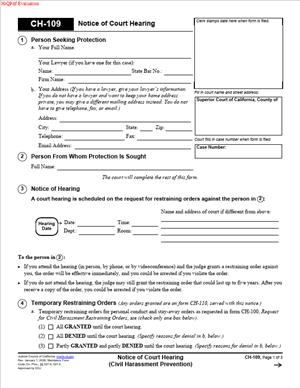
A notice of hearing imposes the first procedural obligation. In California civil harassment cases, CH-109, Notice of Court Hearing, gives the respondent the hearing date, time, department, and related orders. Any temporary orders included with the notice become enforceable only after proper service. Without personal service of the notice and required documents, the court may lack a basis to proceed against a nonappearing party. If the respondent does not attend after proper service, the court may still issue orders based on the evidence presented.
A continuance request does not change the hearing date by itself. In California civil harassment cases, CH-115, Request to Continue Court Hearing, allows either party to seek more time to complete service, prepare for the hearing, or address another valid scheduling issue. The original hearing date remains in effect until the judge signs a continuance order. If a temporary restraining order is already in place, the order may remain effective until the continued hearing date. If the continuance is denied, the hearing proceeds as scheduled.
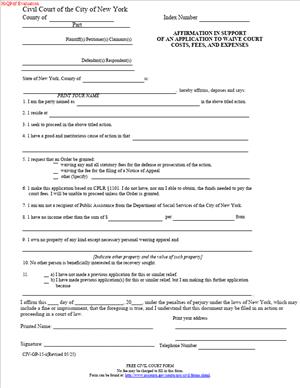
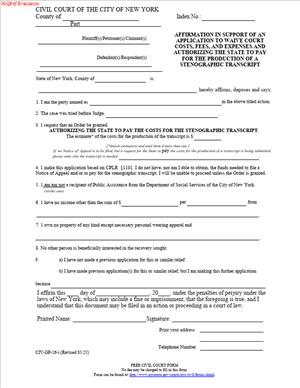
A fee waiver application does not remove costs automatically. In New York, CIV-GP-15 supports a request to waive filing fees and related costs under CPLR 1101. CIV-GP-16 may be used for transcript or appeal-related costs. The court reviews the applicant’s financial condition and the costs requested. If granted, the waiver allows the party to proceed without paying the covered costs. If denied, the party must pay the required fees or risk delay, rejection, or dismissal.
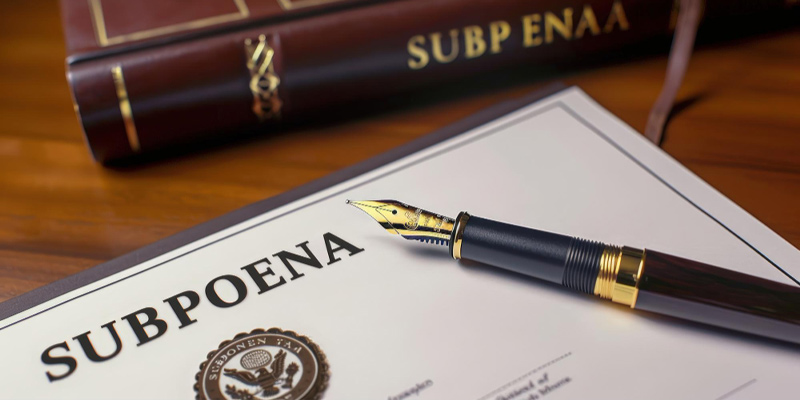
A subpoena creates a direct obligation for a non-party. In California criminal and juvenile cases, CR-125 may be used to order attendance or production. Once properly issued and served, the subpoena legally binds the recipient. Noncompliance with a valid subpoena may result in contempt, sanctions, a warrant, or other authorized penalties. A defective subpoena may be unenforceable even when the requested testimony or documents are relevant.
These tools allow the court to manage attendance, scheduling, costs, and evidence before the hearing. Used correctly, they support a procedurally valid hearing. Errors in service, form selection, court approval, or subpoena issuance can delay the case or affect enforcement.
Common Stages: The Court Hearing Preparation Process
Court hearing preparation begins with the filing that opens the case and continues through notice, interim requests, hearing attendance, and post-hearing compliance. Each stage affects the validity of later filings, service, orders, and enforcement.
Step 1 — Initiating the Case or Proceeding
The process begins when a party files the pleading, petition, or application that opens the matter. In California civil harassment cases, this is typically CH-100, Request for Civil Harassment Restraining Orders. In the New York Civil Court, it may be a summons and complaint, petition, application, or responsive pleading. This filing opens the case, assigns a docket or index number, and establishes the framework for later hearing preparation.
Accuracy at initiation controls later filings. Party names, addresses, case captions, identifying details, court selection, and case type must be correct before notice and service proceed. Errors at this stage can affect every later form, filing, service attempt, and order. Any material error should be corrected before the notice of hearing is served.
Step 2 — Scheduling and Noticing the Hearing
After the court reviews the initiating papers, it schedules the hearing and issues the required notice. In California civil harassment cases, CH-109, Notice of Court Hearing, identifies the hearing date, time, courtroom or department, required appearances, and any temporary restraining order. The petitioner must review the notice for accuracy, make required copies, and arrange service on the respondent through a qualified adult server.
Service gives the notice legal effect. In California civil harassment cases, personal service generally must be completed within the time stated in the court’s order, often at least five days before the hearing under Code of Civil Procedure § 527.6(m). Any temporary restraining order included with the notice becomes enforceable only after proper service. Failure to complete timely service may result in a continuance, denial, or dismissal of the requested relief.
Step 3 — Addressing Interim Issues Before the Hearing
Before the hearing, parties must resolve procedural barriers that may affect attendance, cost, or evidence:
- a continuance request if the hearing date is unworkable or more preparation time is needed;
- a fee waiver application if court costs prevent filing or participation;
- a subpoena if third-party testimony, documents, or records are needed.
These requests should be handled as soon as the issue is identified. In California civil harassment cases, CH-115, Request to Continue Court Hearing, may be used when a party needs more time to complete service, prepare, or address another scheduling issue. In the New York Civil Court, CIV-GP-15 may support a request to waive court costs, while CIV-GP-16-i may apply when transcript costs are at issue. Each request has its own filing deadline, service requirement, and review process.
Step 4 — Obtaining Administrative or Judicial Review
Continuance requests and fee waiver applications require court action. Filing the request does not change the hearing date or remove payment obligations. The assigned judicial officer may decide the request on the papers without a separate oral hearing. The court may grant, partially grant, or deny the request in a written order.
Until the court issues an order, the original hearing date and fee obligations remain in effect. A party should not assume that a continuance has been granted, that a fee has been waived, or that an interim order has been extended. If temporary orders are already in place, the continuance request should address whether they remain effective until the new hearing date.
Step 5 — Compelling Evidence and Testimony
A party that needs third-party testimony or documents must prepare and serve a subpoena before the hearing. California CR-125/JV-525 may be used in criminal, juvenile, and related proceedings. The subpoena must identify the witness or record holder, state the required appearance or production, specify the hearing date, time, and location, and describe requested documents with enough precision to permit compliance.
Service must be completed with enough lead time for the recipient to respond. Witness fees may be required at the time of service. Proof of service, delivery records, and any subpoena compliance documents should be retained and brought to the hearing. A subpoena that is incomplete, improperly issued, or improperly served may be unenforceable.
Step 6 — Attending the Hearing
All preparation culminates in the scheduled hearing or the continued hearing if the court granted a continuance. Parties must appear at the date, time, and location stated in the notice or later court order. They should bring proof of service, fee waiver orders, subpoena records, exhibits, witness information, and any written orders issued before the hearing.
At the hearing, the court receives testimony, reviews evidence, addresses subpoenaed materials, and issues its determination. The result may be a restraining order, judgment, dispositional order, dismissal, denial, or other relief authorized by the court. A party that fails to appear after proper notice may have orders entered without its input.
Step 7 — Post-Hearing Follow-Through
After the hearing, parties must preserve the court’s orders and complete any required service, filing, or enforcement steps. A restraining order, judgment, or dispositional order should be copied, stored, and reviewed for scope, duration, compliance obligations, renewal deadlines, and enforcement procedures. Where required, the order must also be served on the opposing party or transmitted for law enforcement entry.
Compliance must be monitored after the order is issued. Violations may support contempt proceedings, enforcement applications, modification requests, emergency relief, or other remedies allowed by the governing court rules. Missed service steps, unclear order terms, or failure to track expiration dates can affect enforcement and future relief.
The Documents and Forms That Drive the Process
Court hearing preparation depends on the correct form at each procedural stage. Each document performs a specific function: one opens the matter, one sets the hearing, one asks the court to change timing, one seeks relief from costs, one compels evidence, and one confirms service. These documents work as a sequence. A defect in one form can affect the next filing, the hearing date, or the enforceability of resulting orders.
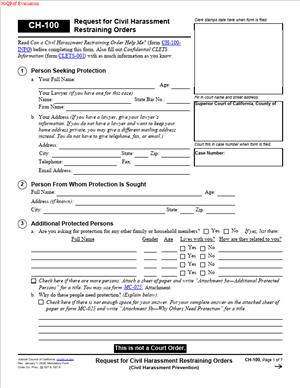
CH-100 — Request for Civil Harassment Restraining Orders
In California civil harassment proceedings, CH-100 is the primary application that starts the case. It identifies the parties, describes the alleged conduct, states the requested protection, and gives the court the factual basis for reviewing temporary and long-term relief. The court uses this filing to decide whether to issue temporary orders and whether to schedule a hearing.
CH-100 also triggers the next document in the process: CH-109, Notice of Court Hearing. The petitioner should review the party names, case caption, addresses, court location, and requested relief before the notice is issued and served. Any error in the foundational filing should be corrected before service, because the notice, proof of service, and final order rely on the same identifying information.
CH-109 — Notice of Court Hearing
CH-109 is issued by the court after it reviews the CH-100. The petitioner does not file CH-109 as an independent request. The form gives the respondent the hearing date, time, department, required appearances, and any temporary restraining order issued before the hearing.
CH-109 activates the service obligation and starts the procedural clock. Once issued, the petitioner must make the required copies and arrange personal service through a qualified adult server. Any temporary order attached to or included with CH-109 becomes enforceable only after proper service. Without valid service, the court may lack a basis to proceed against a nonappearing respondent.
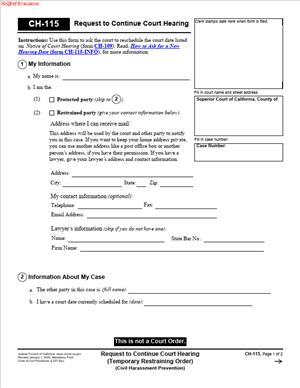
CH-115 — Request to Continue Court Hearing
CH-115 is used in California civil harassment cases when a party asks the court to move the hearing date. It may be needed when service has not been completed, a party needs more preparation time, or another scheduling issue prevents the hearing from proceeding as scheduled.
CH-115 is not self-executing. Filing the request does not change the hearing date. The original hearing remains active unless the judge signs an order granting the continuance. If a temporary restraining order is already in place, the request should address whether that order should remain effective until the continued hearing date.
CIV-GP-15 — Fee Waiver Application
In the New York Civil Court, CIV-GP-15 supports an application to waive court costs for a party who cannot afford them. The form requires financial information, including income, assets, household composition, necessary expenses, and the specific fees the applicant asks the court to waive.
CIV-GP-15 does not waive fees automatically. It supports a request for judicial approval. The judge reviews the financial disclosures and issues an order granting, partially granting, or denying the application. Until the court grants the waiver, the fee obligation remains in effect.
The applicant should complete the form accurately and attach supporting documents when required. Common supporting records may include:
- pay stubs or proof of benefits;
- bank statements;
- rent, utility, or medical bills;
- proof of household obligations; and
- documents showing the fee or court cost requested.
A granted fee waiver should be presented whenever the covered cost would otherwise be due. The order may need to be shown to the clerk, Marshal’s office, transcript office, or other administrative office. The waiver does not always transfer automatically between court departments or later procedural steps.
How to Draft and Submit a Court Service and Filing Affidavit
CIV-GP-16-i — Transcript Cost Application
CIV-GP-16-i is a companion fee waiver document used when a party seeks state payment of stenographic transcript costs. It may be necessary when a transcript is needed for an appeal, post-trial motion, or other court-authorized step, and the party cannot afford the reporting expense.
Like CIV-GP-15, CIV-GP-16-i requires judicial approval. The court evaluates the applicant’s financial condition and the need for the transcript in the pending proceeding. A party should not assume that a general fee waiver covers transcript costs unless the order expressly includes them.
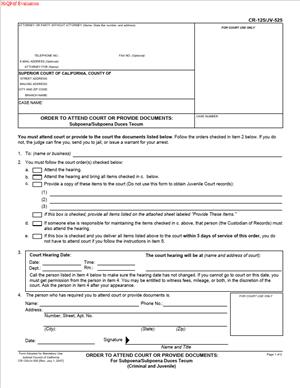
CR-125/JV-525 — Order to Attend Court or Provide Documents
CR-125/JV-525 is used in California criminal, juvenile, and related proceedings to require a person or entity to attend court, testify, produce documents, or produce records. The form identifies the issuing party, the recipient, the court, the case, and the required action.
A subpoena supplements the hearing record by compelling third-party evidence that may not be available voluntarily. It does not replace the notice of hearing or excuse a party from presenting its own evidence. The form must describe the requested records with enough precision to allow compliance. Broad requests for “all records” without date limits, subject matter, or record type may invite objections, motions to quash, or delay.
Subpoenas directed to institutional record holders may require additional compliance steps. Health records may require a HIPAA-compliant authorization, court order, notice to the subject of the records, or an opportunity to object. Educational records may require student consent or a court order under FERPA. A subpoena alone may not be enough when another privacy framework controls disclosure.
CH-200 or Other Proof of Service
Proof of service confirms that the required notice or delivery occurred. In California civil harassment cases, CH-200 or a similar proof of personal service form documents service of CH-109 and related papers. The server must usually be at least 18 years old and not a party to the case.
Proof of service is not a formality. It gives the court a record showing when, how, and by whom the documents were served. If the respondent later claims a lack of notice, the filed proof of service allows the court to evaluate whether it may proceed. If proof of service is missing, incomplete, or inconsistent, the court may continue the hearing, deny relief, or require corrected service.
Proof of service also matters for subpoenas and continuance requests. A subpoena may be unenforceable if service was defective or if required witness fees were not tendered. A continuance request may be delayed or denied if the other party was not notified. At each stage, proof of service connects the document to court authority and enforcement.
How the Forms Work Together
The forms operate as a coordinated sequence. CH-100 establishes the factual and legal basis for the case. CH-109 gives notice of the hearing and triggers service deadlines. CH-115 modifies the schedule only if the court grants it. CIV-GP-15 and CIV-GP-16-i address financial barriers only after judicial approval. CR-125/JV-525 secures third-party testimony or records for the hearing. Proof of service confirms that the required notice and delivery steps were completed.
Because these forms depend on one another, parties should treat each document as part of the same procedural record. The party names, case number, hearing date, court location, service details, and requested relief should remain consistent across all filings. Inconsistent information can create service problems, delay the hearing, weaken enforcement, or require corrective filings before the court can proceed.
Each hearing document must match the court, case type, and procedural request. The RunSensible Forms Library provides court-ready templates and updated legal documents, while Find the Right Law Forms Online helps users identify jurisdiction-specific forms before drafting or filing.
Aftermath: Enforcement, Compliance, and Ongoing Obligations
After the hearing, the focus shifts from preparation to compliance, enforcement, and preservation of the record. Any order issued by the court is binding unless it is stayed, modified, reversed, or expires under its own terms. A party’s disagreement with the order does not excuse noncompliance.
A restraining or protective order must be served before it can be enforced against the restrained person. In California civil harassment matters, an order issued after CH-109 or CH-115 proceedings becomes enforceable after proper service and, where applicable, entry into CLETS. Once enforceable, violations may lead to arrest, criminal prosecution, contempt, or other authorized penalties. The protected party should keep a certified copy of the order and review the prohibited conduct, distance restrictions, contact limits, expiration date, and any exceptions.
A fee waiver order affects only the court costs covered by the order. It does not eliminate a judgment, damages award, sanction, restitution obligation, or private debt. The order should be presented whenever a covered cost arises, including filing, service, transcript, or clerk-related costs. If the party’s financial circumstances materially change, the court may require updated financial information or a supplemental application.
A subpoena remains enforceable only if it was validly issued and served. If a witness or record holder fails to comply, the issuing party must usually show proof of service before the court will consider contempt, sanctions, a warrant, or another enforcement remedy. Defective service, missing witness fees, vague document requests, or failure to comply with privacy rules may prevent enforcement.
Post-hearing orders may also require later action. A party may need to request renewal before a restraining order expires, seek modification if circumstances change, or file an appeal or motion within the applicable deadline. Missed deadlines can limit or eliminate review. Parties should confirm the exact deadline under the governing court rules rather than relying on general time periods.
Recordkeeping is a compliance requirement, not an administrative preference. A complete case file should include:
- filed documents with clerk stamps;
- signed court orders and certified copies;
- proofs of service for notices, subpoenas, and post-hearing orders;
- fee waiver orders and related receipts;
- subpoena delivery records and responses;
- written communications with the court, clerk, law enforcement, or process server; and
- notes documenting violations, attempted compliance, or enforcement steps.
Organized records support enforcement, renewal, modification, appeal, and defense against later claims of noncompliance. In restraining order matters, the protected party should store copies securely and keep an accessible copy for emergency use. In fee waiver matters, the party should retain the order for the duration of the case. In subpoena practice, proof of service and compliance records provide the foundation for any enforcement request.
Common Mistakes and Best Practices
Procedural precision is required in court hearing preparation. Courts apply filing, service, notice, deadline, and disclosure rules to protect the validity of the proceeding. Errors can delay hearings, cause rejected filings, weaken enforcement, or result in loss of rights.
Common Mistakes
Common procedural mistakes include:
- Using the wrong form or jurisdiction’s form: California Judicial Council forms are not interchangeable with New York Civil Court forms. CIV-GP-15 has no procedural effect in a California superior court, and CH-115 does not operate as a New York Civil Court continuance request.
- Filing in the wrong court or case type: A form must match the jurisdiction, court level, and proceeding. Errors in court selection, case type, party names, or case number can cause rejection or require corrective filings.
- Serving documents incorrectly: Service errors include using an ineligible server, failing to use personal service when required, serving the wrong address, omitting required attachments, or failing to complete proof of service.
- Filing continuance requests too late: A continuance is not automatic. Courts may deny last-minute requests that do not show good cause, especially when the issue could have been raised earlier.
- Submitting fee waiver applications after the fee deadline: A late fee waiver may not prevent rejection, delay, or dismissal. The application should be filed before the cost becomes due whenever possible.
- Using vague subpoena language: A subpoena duces tecum should identify the subject, date range, record type, and record holder. Broad requests for “all records” may be treated as overbroad or unenforceable.
- Omitting financial information from fee waiver forms: Courts rely on the application to evaluate financial need. Missing income, assets, benefits, household information, or expenses may result in denial or sanctions.

Best Practices
Best practices include:
- Use current, jurisdiction-specific forms: Obtain forms from the court or official court source. Confirm the court, case type, party names, case number, hearing date, and required attachments before filing.
- Check every form for consistency: Names, addresses, case numbers, hearing dates, court locations, and requested relief should match across filings, notices, subpoenas, and proofs of service.
- Arrange service through an eligible server: Use a server that satisfies the applicable rule. Confirm whether personal service is required and whether any attachments must be served with the main document.
- Preserve proof of service: Complete proof of service accurately, file it when required, and keep a copy in the case file. Missing proof can delay the hearing or prevent enforcement.
- File continuance and fee waiver requests promptly: Submit these requests as soon as the need arises. Until the court grants relief, the original hearing date and payment obligations remain in effect.
- Limit subpoena requests with precision: Identify the records by subject, date range, record type, and record holder. For protected records, comply with any required notice, authorization, court order, or privacy rule.
- Support fee waiver applications with records: Attach pay records, benefit letters, bank statements, bills, or other documents required by the court. The supporting documents should match the financial information stated in the form.
- Maintain a complete case file: Keep stamped filings, signed orders, receipts, proofs of service, subpoena records, fee waiver orders, and written communications with the court or clerk. Organized records support enforcement, renewal, modification, appeal, and responses to later claims of noncompliance.
Many procedural errors begin with outdated forms, missing attachments, or documents prepared for the wrong jurisdiction. Use the RunSensible Forms Library for court-ready templates and filing tools, and Find the Right Law Forms Online to locate current or compliant forms for the applicable court.
Final Thoughts
Court hearing preparation depends on four procedural tools: notices, continuance requests, fee waivers, and subpoenas. Each tool serves a different function. A notice sets the hearing and triggers service obligations. A continuance request asks the court to modify the schedule. A fee waiver application addresses court costs. A subpoena compels testimony, documents, or records needed for the hearing.
The required forms are jurisdiction-specific. California forms such as CH-109, CH-115, and CR-125/JV-525 are not interchangeable with New York forms such as CIV-GP-15 and CIV-GP-16-i. Each form must match the court, case type, procedural request, and governing rule. A correct form still has no effect unless it is completed accurately, issued when required, served properly, and supported by the necessary proof.
Procedural discipline affects the result. Properly served notices allow the court to proceed and enforce temporary orders. Timely continuance requests preserve the opportunity to be heard when more time is justified. Complete fee waiver applications help prevent court costs from blocking access to the case. Precise subpoenas make third-party evidence available without unnecessary delay or objection.
The obligation to manage the case continues after the hearing. Orders must be preserved, served when required, and monitored for compliance. Fee waiver orders must be presented when covered costs arise. Subpoena compliance must be documented and enforced through the court when necessary. The hearing is not the end of the process; it is the point at which preparation turns into compliance, enforcement, and ongoing case management.
Court hearing preparation requires forms that are accurate, current, and appropriate for the jurisdiction. The RunSensible Forms Library provides court-ready templates, filing tools, and updated legal documents, while Find the Right Law Forms Online helps users locate the correct forms for their court and case type.
FAQs
1. What is the legal difference between a notice of hearing and a subpoena?
A notice of hearing (such as California’s CH-109) is a court-issued document that informs parties of the scheduled date, time, and location of a proceeding. It binds the named parties to appear and may include temporary orders. A subpoena (such as California’s CR-125/JV-525) is a court order directed at a third party — a witness or record-holder who is not a party to the case — compelling attendance, document production, or both. A notice of hearing notifies; a subpoena commands. The consequences of non-compliance also differ: a party who ignores a hearing notice may have orders entered against them; a third party who ignores a valid subpoena may be held in contempt of court.
2. When must a continuance request be filed in a California civil harassment case?
There is no fixed statutory deadline by which a CH-115 continuance request must be filed, but the practical standard is clear: as soon as the need is identified. Courts assess whether the requesting party acted promptly upon learning of the conflict and whether the request demonstrates good cause. A request filed days before the hearing — particularly where the conflict was known weeks earlier — is routinely denied. Filing immediately upon identifying a legitimate scheduling conflict, medical emergency, or service deficiency is the most reliable approach. Until the court issues a signed order granting the continuance, the original hearing date remains binding.
3. Who is eligible to apply for a fee waiver in the Civil Court of New York City?
Eligibility for a CIV-GP-15 fee waiver is based on financial need, not categorical entitlement. The court evaluates the applicant’s income relative to necessary living expenses, household size and composition, assets and available funds, and the importance of the specific litigation step requiring the waived fee. Recipients of public benefits such as SNAP, SSI, SSDI, or public assistance are generally treated as presumptively eligible, but the court may still deny or limit relief based on the totality of the financial picture. Self-represented litigants, tenants, consumers, workers, veterans, and small business owners with limited cash flow are among the most common applicants.
4. What documents should be attached to a CIV-GP-15 or CIV-GP-16-i application?
Supporting documentation strengthens the application and reduces the likelihood of denial or delayed processing. Applicants should attach recent pay stubs (typically four to eight weeks), current benefit award letters for any public assistance received, the most recent filed tax return if available, bank statements from the past two to three months, and proof of recurring necessary expenses such as rent, utilities, and medical costs. For CIV-GP-16-i, additional documentation explaining why a stenographic transcript is necessary for the pending litigation step — typically an appeal or post-trial motion — is advisable. Attachments should be labeled as exhibits and referenced within the body of the affirmation.
5. What are the service requirements for a California civil harassment hearing notice?
Under California Code of Civil Procedure §527.6(m), the respondent must be personally served with the notice of hearing and all supporting documents. Personal service requires delivery by an adult who is not a party to the case. Service by mail alone is generally insufficient unless the court specifically authorizes an alternative method. The timing requirement is set by the court’s order, but courts typically require service to be completed at least five days before the hearing. Proof of personal service must be filed with the court before the hearing. Defective or incomplete service can result in the postponement of the hearing.
6. What happens if a subpoenaed party does not comply with a CR-125/JV-525?
If a properly issued and served subpoena is ignored, the issuing party may bring the matter to the court’s attention by presenting the proof of service and establishing that the order was validly delivered. The court may issue a bench warrant requiring the non-complying witness to appear and explain the failure, impose monetary sanctions, or take other enforcement action under California Code of Civil Procedure §1991. The enforceability of a non-complied subpoena depends entirely on the completeness and accuracy of the proof of service. Without valid proof of service, the court cannot take action against the non-complying party.
7. Can a fee waiver be revoked, and what triggers revocation?
Yes. California courts may revoke a fee waiver order if the applicant’s financial circumstances improve materially or if the court discovers that the original affirmation contained false or misleading information. In New York Civil Court proceedings governed by CIV-GP-15, the order is issued for a specific case and may be revisited if circumstances change significantly. Applicants who experience a material improvement in income or assets — such as obtaining employment, receiving an inheritance, or resolving a debt — should proactively inform the court rather than waiting for the court to discover the change. Revocation after a finding of misrepresentation may also expose the applicant to sanctions for providing false statements under oath.
8. How does a continuance granted on CH-115 affect an existing temporary restraining order?
When the court grants a continuance in a California civil harassment proceeding, the existing TRO does not automatically expire or continue. The signed continuance order must address the status of any pending TRO explicitly. In practice, courts typically extend TROs to the new hearing date as part of the continuance order, but this extension must be confirmed in the written order rather than assumed. If the continuance order does not address the TRO’s status, the applicant should seek clarification from the court clerk or judicial officer immediately. An expired TRO pending a continued hearing creates an enforcement gap that can have serious safety consequences.
Resources
- California Code of Civil Procedure §527.6 – California Legislative Information https://leginfo.legislature.ca.gov/faces/codes_displaySection.xhtml?sectionNum=527.6.&lawCode=CCP
- New York CPLR Article 11-B (Poor Person Proceedings) – New York State Legislature https://www.nysenate.gov/legislation/laws/CVP/A11-B
- New York Judiciary Law §35 (Legal Services for Poor Persons) – New York State Legislature https://www.nysenate.gov/legislation/laws/JUD/35
- CH-109 Notice of Court Hearing (Civil Harassment Prevention) – RunSensible Forms https://forms.runsensible.com/Forms/usa/california/cdj/ch-djca/ch-109-notice-of-court-hearing-civil-harassment-prevention/
- CH-115 Request to Continue Court Hearing – RunSensible Forms https://forms.runsensible.com/Forms/usa/california/cdj/ch-djca/ch-115-request-to-continue-court-hearing/
- CIV-GP-15 Affirmation in Support of Application to Waive Court Costs – RunSensible Forms https://forms.runsensible.com/Forms/usa/new-york/civil-court-of-new-york-city/civ-gp-15-affirmation-in-support-of-an-application-to-waive-court-costs-fees-and-expenses/
- CIV-GP-16-i Affirmation in Support of Application to Waive Costs and Authorize Transcript Payment – RunSensible Forms https://forms.runsensible.com/Forms/usa/new-york/civil-court-of-new-york-city/civ-gp-16-i-affirmation-in-support-of-an-application-to-waive-court-costs-fees-and-expenses-and-authorizing-the-state-to-pay-the-costs-for-the-production-of-a-stenographic-transcript/
- CR-125/JV-525 Order to Attend Court or Provide Documents (Subpoena) – RunSensible Forms https://forms.runsensible.com/Forms/usa/california/cdj/cr-125-and-jv-525-order-to-attend-court-or-provide-documents-subpoena-or-subpoena-duces-tecum-criminal-and-juvenile
- California Judicial Council Civil Harassment Forms (CH Series) – California Courts https://www.courts.ca.gov/selfhelp/civilharassment.htm
- Federal Rules of Civil Procedure Rule 45 (Subpoenas) – Cornell Legal Information Institute https://www.law.cornell.edu/rules/frcp/rule_45
- New York Civil Court – Official Court Forms and Filing Instructions https://nycourts.gov/courts/nyc/civil/forms.shtml
Disclaimer: The content provided on this blog is for informational purposes only and does not constitute legal, financial, or professional advice.
Contents