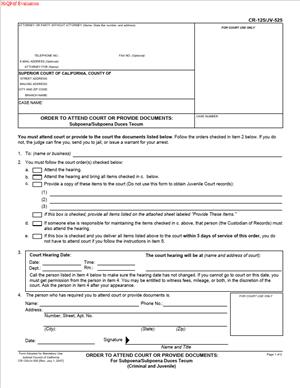
CR-125 and JV-525 – Order to Attend Court or Provide Documents – Subpoena or Subpoena Duces Tecum (Criminal and Juvenile)
Fill out nowJurisdiction: Country: United States | Province or State: California
If you are preparing for a criminal or juvenile court case in California, you may need a witness or documents to support your side. CR-125 and JV-525 – Order to Attend Court or Provide Documents – Subpoena or Subpoena Duces Tecum (Criminal and Juvenile) is the form used to require someone to come to court or bring specific records.
This document is more than a request. It is a court order. When properly issued and served, it directs a person or organization to appear at a hearing or produce documents relevant to a case.
You might be a defendant, a parent in a juvenile matter, or another party involved in a criminal or juvenile proceeding. If you are representing yourself, understanding how this form works is essential. Mistakes can delay your case or prevent important evidence from being considered.
This guide explains what the form does, when it is used, and how to complete it. The focus is practical. You will see what information belongs in each section and what to watch for during preparation.
What is CR-125 and JV-525 – Order to Attend Court or Provide Documents – Subpoena or Subpoena Duces Tecum (Criminal and Juvenile)?
Clear definition
CR-125 and JV-525 – Order to Attend Court or Provide Documents – Subpoena or Subpoena Duces Tecum (Criminal and Juvenile) is a California court form used in criminal and juvenile cases to require a person to attend court, provide documents, or both.
A “subpoena” orders someone to appear and testify. A “subpoena duces tecum” orders someone to bring specified documents, records, or other evidence. This form covers both purposes. It can be tailored to require attendance, production of documents, or both at the same time.
The form becomes effective when it is properly completed, issued, and served according to court procedures. Once validly served, the recipient is legally required to comply unless the court modifies or cancels the order.
Who typically uses this form?
This form is commonly used by parties in criminal cases, including defendants who represent themselves. It may also be used in juvenile delinquency or dependency matters by parents, guardians, minors through counsel, or other authorized parties.
In many cases, attorneys prepare and issue subpoenas. However, self-represented individuals may also use this form when court rules allow it. Court clerks or judicial officers may be involved in issuing or approving the document, depending on the situation.
The recipient of the form can be an individual witness, a business, a school, a hospital, a law enforcement agency, or any person or entity that has relevant information or records.
Why might you need this form?
You may need this form if someone has information that supports your case but is not willing to appear voluntarily. A subpoena creates a formal obligation to attend and testify.
You may also need records that are not in your possession. For example, medical files, phone records, surveillance footage, or school records may be held by third parties. A subpoena duces tecum allows you to formally request those documents for use in court.
In criminal and juvenile matters, evidence can affect outcomes such as guilt, innocence, sentencing, placement decisions, or custody arrangements. Without a valid court order, some organizations will not release confidential records.
Typical real-life scenarios
- A defendant in a criminal case believes that a store’s security camera recorded an incident. The store refuses to release the footage without a court order. The defendant uses this form to require the store to produce the video in court.
- In a juvenile delinquency case, a parent wants a teacher to testify about a minor’s behavior and performance at school. The teacher is willing but needs formal documentation from the court. A subpoena ensures the teacher is authorized to attend.
- A party may need medical records to show the extent of injuries or to challenge claims made by another side. Health care providers often require a subpoena before releasing records related to a case.
- In a case involving alleged probation violations, a self-represented person may need employment records to show compliance with court conditions. If the employer will not provide them voluntarily, a subpoena duces tecum can be used to request them.
- In some situations, law enforcement reports or internal records are relevant. Accessing these materials often requires formal court authorization, which this form helps initiate.
When would you use CR-125 and JV-525 – Order to Attend Court or Provide Documents – Subpoena or Subpoena Duces Tecum (Criminal and Juvenile)?
You would use this form when you need evidence or testimony for a criminal or juvenile hearing and cannot obtain it informally. It is typically used before trial, during pretrial motions, or before a contested juvenile hearing.
Timing matters. The subpoena must allow enough time for the recipient to receive it and respond. Courts often expect reasonable notice. If documents are requested, the recipient needs time to gather them.
This form may be used for trial, evidentiary hearings, sentencing hearings, or other court proceedings where testimony or documents are relevant. It can also be used for hearings related to detention, disposition, or review in juvenile court.
Self-represented individuals often use this form when they have identified specific evidence that supports their position but do not have direct access to it. The form provides a structured way to bring that evidence before the court.
You would not use this form for civil cases. It is specifically designed for criminal and juvenile matters in California courts.
Legal characteristics of CR-125 and JV-525 – Order to Attend Court or Provide Documents – Subpoena or Subpoena Duces Tecum (Criminal and Juvenile)
This document carries the authority of the court once properly issued and served. It directs a named person or organization to take specific action. The action must be clearly described, including the date, time, and location of appearance or the exact documents required.
For the subpoena to be effective, it must accurately identify the court, the case number, and the parties involved. It must clearly state what is required. Vague or overly broad document requests can lead to objections or court challenges.
Service is a critical part of validity. The subpoena must generally be delivered in a legally recognized manner. If service is improper, the recipient may not be obligated to comply.
Problems often arise when the requested documents are not described with enough detail. For example, asking for “all records” without limits can be challenged as too broad. Clear date ranges and specific categories reduce disputes.
Another common issue is privacy. Certain records, such as medical or school files, may involve confidentiality rules. Additional notices or procedures may apply before those records can be released.
This form does not automatically guarantee that you will receive the documents before the hearing. The court may need to resolve objections or motions related to the subpoena. The form also does not decide whether the evidence will be admitted at trial. It only compels production or attendance.
Procedures can vary slightly between courts or case types. Criminal and juvenile matters may have different timelines or internal review processes. The core function of the form remains the same: to compel attendance or production.
Is it legally binding?
Yes, when properly issued and served, this subpoena is legally binding. The recipient is required to comply with its terms unless the court modifies or quashes it.
Failure to comply with a valid subpoena can result in legal consequences. Courts have the authority to enforce their orders. However, recipients may have the right to object or seek court protection if the request is improper or burdensome.
The binding effect depends on proper completion, issuance, and service. If any of these steps are missing or defective, enforcement may not be possible. That is why accuracy and clarity are essential throughout the process.
How to fill out CR-125 and JV-525 – Order to Attend Court or Provide Documents – Subpoena or Subpoena Duces Tecum (Criminal and Juvenile)
Step 1 – Identify the court and case information
At the top of the form, enter the full name of the court handling your criminal or juvenile case. Include the street address, city, and branch name if required. Then fill in the case name and case number exactly as they appear on other court documents. Accuracy here ensures the subpoena is linked to the correct proceeding.
Step 2 – Provide your information
Enter your name, address, and contact information in the section that identifies the party requesting the subpoena. If you are self-represented, indicate that clearly in the space provided. This allows the court and other parties to know who is issuing the request.
Step 3 – Identify the person or entity being subpoenaed
Write the full legal name of the person or organization you are ordering to attend or produce documents. Include a complete address for service. If you are subpoenaing a business or agency, use the correct legal name to avoid confusion or improper service.
Step 4 – Specify attendance requirements
If you are requiring someone to appear in court, fill in the date, time, and department of the hearing. Make sure this information matches the scheduled court proceeding. The form must clearly state where and when the person is expected to appear.
Step 5 – Describe the documents to be produced
If you are requesting documents, describe them in clear, specific terms. Include relevant date ranges and types of records. Avoid broad phrases. The description should allow the recipient to identify exactly what must be produced without guessing.
Step 6 – Indicate whether personal appearance is required
The form allows you to clarify whether the person must appear in addition to providing documents. Complete this section carefully. If only documents are required, the form should reflect that clearly to prevent misunderstandings.
Step 7 – Review for completeness and accuracy
Before submitting or issuing the form, read every section. Confirm that names are spelled correctly, dates are accurate, and document descriptions are precise. Errors can cause delays or make the subpoena difficult to enforce.
Step 8 – Follow issuance and service procedures
After completing the form, follow the required process for having it issued and properly served. This may involve a clerk, judicial officer, or other authorized person, depending on the case. Proper service ensures the recipient receives official notice and that the order can be enforced if necessary.
Legal terms you might encounter in CR-125 and JV-525 – Order to Attend Court or Provide Documents – Subpoena or Subpoena Duces Tecum (Criminal and Juvenile)
- Subpoena: A court order that requires a person to appear in court to testify. In this form, it directs the named individual to attend a specific hearing on a specific date and time. It is not a request. It is a command backed by the authority of the court.
- Subpoena Duces Tecum: A court order that requires someone to produce documents, records, or other tangible evidence. On this form, you will describe exactly what must be provided. The description must be clear enough so the person knows what to bring or send.
- Custodian of Records: The person responsible for maintaining records for an organization, such as a school, hospital, or police department. If you are requesting official records, you may list the custodian instead of a specific employee. This ensures the correct person handles the document request.
- Personal Service: The formal delivery of the subpoena directly to the named individual. This is usually done by someone who is not a party to the case and is over 18. Proper service is required for the order to be enforceable.
- Proof of Service: A written statement confirming that the subpoena was delivered correctly. The person who serves the documents completes and signs this proof. You must keep or file this proof to show the court that the order was properly delivered.
- Witness Fees: Payment that may be required when you subpoena a non-party witness. This can include a daily fee and mileage. If required, these fees are typically provided at the time of service.
- Production Date: The date by which documents must be produced. This may be the same as the hearing date or earlier if documents are requested separately from testimony. The date must be clearly stated to avoid confusion.
- Time and Place of Appearance: The exact courtroom, address, date, and time when the person must appear. This information must match the court’s official hearing notice. Any mistake can make the subpoena ineffective.
- Juvenile Proceedings: Court cases involving minors, such as delinquency or dependency matters. When this form is used in a juvenile case, confidentiality rules may apply. You must ensure the subpoena respects privacy protections tied to these proceedings.
FAQs
Do I need the judge to sign this form before it becomes valid?
In many cases, a subpoena issued by a party or attorney does not require a judge’s signature, but it must be properly issued under court authority. Check the signature section carefully. If the form includes a space for a clerk or judge to sign, you must obtain that signature before serving it. An unsigned subpoena is not enforceable.
How do I know if I should check the box for personal appearance or only document production?
Look at what you need from the person. If you want them to testify in court, you must require a personal appearance. If you only need records, you can request document production without requiring them to attend. Make sure the boxes you check match your actual intent, because the person served will rely strictly on what this document says.
What happens if I list the wrong case number on this form?
The case number ties the subpoena to the correct court file. If it is wrong, the clerk may reject it, or the recipient may challenge it. Before serving, compare the case number on this form to the official court paperwork. The numbers must match exactly, including letters.
Do I have to attach a list of documents if I run out of space?
Yes. If the space on the form is not enough, you can attach a separate page that clearly lists each category of documents. Label the attachment and reference it in the main form. Be specific about dates, types of records, and subjects so the recipient knows exactly what to gather.
How much detail should I include when describing the documents I want?
Be precise but reasonable. Identify date ranges, file types, and subject matter. For example, instead of asking for “all records,” specify “incident reports dated January 1 to March 31 for the named individual.” Vague requests can lead to objections or incomplete responses.
What if the person ignores CR-125 and JV-525 – Order to Attend Court or Provide Documents – Subpoena or Subpoena Duces Tecum (Criminal and Juvenile)?
If the subpoena was properly issued and served, failure to comply can lead to court enforcement actions. The court may require the person to explain their absence or nonproduction. You will need your proof of service to show the order was delivered correctly.
Can I change the hearing date after I have already served this document?
You cannot simply edit the original after service. If the court reschedules the hearing, you generally must notify the witness and may need to reissue or amend the subpoena. Make sure the updated date and time are clearly communicated and properly served if required.
Will the documents produced become part of the public court record?
That depends on how they are used in the case. In juvenile matters, records are often confidential. If documents are filed with the court or introduced as evidence, they may become part of the case file, subject to applicable privacy rules. Review the caption and case type to understand how the records will be handled.
Checklist: Before, During, and After CR-125 and JV-525 – Order to Attend Court or Provide Documents – Subpoena or Subpoena Duces Tecum (Criminal and Juvenile)
Before
- Confirm the correct court name, branch, and address.
- Verify the exact case number and case title.
- Decide whether you need testimony, documents, or both.
- Clearly identify the full legal name of the person or entity.
- Draft a detailed and specific description of the requested records.
- Check the hearing date, time, and courtroom.
- Determine whether witness fees are required.
- Arrange for an eligible adult to serve the subpoena.
During
- Complete every required field on the form.
- Double-check spelling of names and addresses.
- Attach additional pages if the document requests exceed the space.
- Obtain any required clerk or judicial signature.
- Make copies for your records before service.
- Have the server personally deliver the subpoena.
- Provide witness fees at the time of service if required.
- Ensure the server completes the proof of service form.
After
- File the proof of service with the court if required.
- Keep a stamped copy in your case file.
- Calendar the appearance or production date.
- Follow up if documents are to be mailed before the hearing.
- Prepare to review the produced documents promptly.
- Bring copies of the subpoena and proof of service to court.
- Be ready to explain your document request if challenged.
- Update your case strategy based on the response received.
Common mistakes to avoid with CR-125 and JV-525 – Order to Attend Court or Provide Documents – Subpoena or Subpoena Duces Tecum (Criminal and Juvenile)
- Mistake: Leaving the document request vague because you are unsure what exists, which happens when you guess at record titles; this can lead to objections or incomplete production, so do not forget to define clear categories and date ranges.
- Mistake: Serving the subpoena yourself, which happens when self-represented parties try to save time; this can invalidate service and delay your case, so do not forget that service must be completed by a qualified adult who is not a party.
- Mistake: Forgetting to include witness fees when required, which happens due to a lack of awareness about fee rules; this can make the subpoena unenforceable, so do not forget to confirm fee obligations before service.
- Mistake: Using an incorrect hearing date or courtroom, which often happens after a schedule change; this can result in a witness appearing at the wrong time or not at all, so do not forget to verify the latest court notice.
- Mistake: Failing to obtain a required signature from the clerk or judge, which happens when you assume the form is automatically valid; this can cause rejection or noncompliance, so do not forget to complete all issuance steps.
- Mistake: Not filing or keeping proof of service, which happens when paperwork feels secondary; this can prevent enforcement if the person fails to comply, so do not forget to secure and store signed proof.
What to do after filling out CR-125 and JV-525 – Order to Attend Court or Provide Documents – Subpoena or Subpoena Duces Tecum (Criminal and Juvenile)
Once you complete the form, pause and review it carefully. Small errors can cause big delays. Confirm names, dates, and document descriptions match your case paperwork exactly.
- Step 1: Make at least two copies of the completed subpoena, plus any attachments.
- Step 2: Obtain any required clerk or judicial signature so the subpoena is officially issued.
- Step 3: Arrange for personal service by a qualified adult who is not involved in the case.
- Step 4: Provide witness fees at the time of service if they apply.
- Step 5: Have the server complete and sign a proof of service form immediately after delivery.
- Step 6: File the proof of service with the court if required, or keep it ready for the hearing.
- Step 7: Calendar the appearance or production date and set reminders a week before and a day before.
- Step 8: If documents are to be mailed before the hearing, monitor for receipt and organize them by date and category.
- Step 9: Bring copies of the subpoena and proof of service to court in case compliance is questioned.
- Step 10: Update your case file to reflect whether the witness appeared or the documents were produced.
If the person complies, review the documents promptly. Highlight key information. Prepare follow-up questions if the witness will testify.
If the person does not comply, gather your paperwork. You may need to inform the court that the order was ignored. Your proof of service and a clear record of what was requested will be essential.
Keep everything organized. A well-documented process strengthens your position and helps the court address any issues quickly.
Disclaimer: This guide is provided for informational purposes only and is not intended as legal advice. You should consult a legal professional.