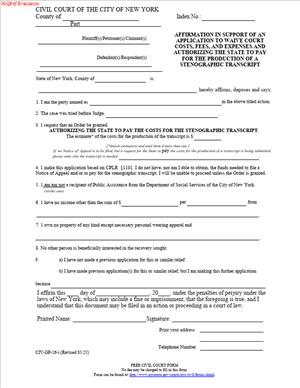
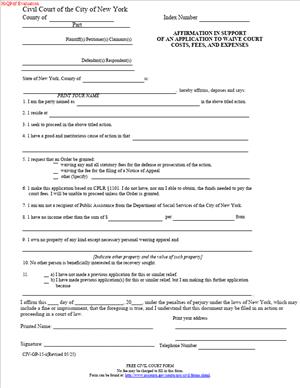
CIV-GP-16-i – Affirmation in Support of an Application to Waive Court Costs, Fees, and Expenses and Authorizing the State to Pay the Costs for the Production of a Stenographic Transcript
Fill out nowJurisdiction: Country: United States | Province or State: New York
CIV-GP-16-i – Affirmation in Support of an Application to Waive Court Costs, Fees, and Expenses and Authorizing the State to Pay the Costs for the Production of a Stenographic Transcript is a court filing used in certain New York civil cases. It explains your financial situation and asks the court to consider waiving specific court-related costs.
This document matters when money is a barrier to continuing or completing a court case. It focuses on court fees and the cost of preparing a written transcript from recorded court proceedings.
You complete this form when you want the court to review your finances in a formal, sworn way. The information you provide helps the court decide whether costs may be waived or paid by the state.
This form is often completed by people representing themselves. It is written in plain language, but it still carries legal weight because it is an affirmation made under penalty of perjury.
Understanding what this document does and what it does not do helps you approach it calmly and accurately. The goal is clarity, not persuasion.
What is CIV-GP-16-i – Affirmation in Support of an Application to Waive Court Costs, Fees, and Expenses and Authorizing the State to Pay the Costs for the Production of a Stenographic Transcript?
Clear definition
CIV-GP-16-i – Affirmation in Support of an Application to Waive Court Costs, Fees, and Expenses and Authorizing the State to Pay the Costs for the Production of a Stenographic Transcript is a written statement submitted to the Civil Court of the City of New York. In it, you affirm facts about your income, expenses, assets, and household.
An affirmation is similar to an affidavit, but it is not notarized. Instead, you sign it with a statement that the information is true under penalty of perjury.
The purpose of this document is to support a request for relief from certain court-related costs. Those costs can include filing fees and the expense of producing a stenographic transcript.
The form connects your financial details to a specific request. It allows the court to assess whether paying those costs would be a hardship.
Who typically uses this form/document?
This form is commonly used by individuals involved in civil cases in the New York City Civil Court. Many users are self-represented litigants.
People with limited income often encounter this document when fees create a barrier to moving forward. That can include plaintiffs, defendants, petitioners, or respondents, depending on the case.
The form is also used by people who need a transcript of prior court proceedings but cannot afford the transcription cost. Transcripts are often required for appeals or certain motions.
Attorneys may prepare similar submissions for clients, but this particular form is designed to be accessible to non-lawyers. Its structure guides you through the information the court typically reviews.
Why you might need this form/document
Court costs can add up quickly, especially in longer cases. Filing fees, motion fees, and transcript costs can exceed what some people can reasonably pay.
This document creates a formal record of your financial circumstances. Without that record, the court has no basis to consider waiving or shifting costs.
You might need this form when a transcript is required to challenge or review a court decision. Transcripts are prepared by court reporters and are not free by default.
The form also matters because timing can affect your case. Delays caused by unpaid fees or missing transcripts can slow or pause court activity.
Typical real-life scenarios
- A tenant involved in a housing dispute may need a transcript to appeal a decision. The cost of that transcript can be several hundred dollars, creating a financial obstacle.
- A person bringing a civil claim may reach a point where a motion filing fee is required. Limited income may make paying that fee difficult without assistance.
- Someone defending a civil lawsuit may need copies of prior proceedings to respond properly. The stenographic transcript becomes essential to understanding what occurred in court.
- A litigant with public assistance income may already meet certain financial thresholds. This form allows the court to see that income in context, rather than assuming the ability to pay.
When would you use CIV-GP-16-i – Affirmation in Support of an Application to Waive Court Costs, Fees, and Expenses and Authorizing the State to Pay the Costs for the Production of a Stenographic Transcript?
This document may be used at different stages of an active civil case in the New York City Civil Court. It is not limited to the start of a case.
You may use it whenever a court fee is required, and you are unable to pay. This may occur when filing papers, during motion practice, or after a hearing.
The document is also commonly used to ask the state to cover the cost of preparing a stenographic transcript. That type of request often arises when a transcript is needed for further court action, such as review or appeal.
Different parties may need this relief at different points in the case. A plaintiff may encounter filing fees early in the process, while a defendant may later need a transcript to seek review or pursue an appeal.
Legal characteristics of CIV-GP-16-i – Affirmation in Support of an Application to Waive Court Costs, Fees, and Expenses and Authorizing the State to Pay the Costs for the Production of a Stenographic Transcript
This form is effective when it is completed fully and signed. The affirmation language gives it legal significance.
Accuracy is critical. Courts commonly review these forms closely, and missing or unclear information can cause delays or denial.
Common problems include leaving sections blank, providing estimates without explanation, or listing income without frequency. Inconsistencies between sections can also raise questions.
Practices can vary slightly between courts or judges within New York City. The overall purpose remains the same, but how information is weighed may differ.
This document does not automatically waive fees. It does not guarantee approval, payment, or favorable treatment in your case.
Is it legally binding?
The affirmation is legally binding in the sense that you are swearing the information is true. You sign under penalty of perjury.
That means intentionally false statements can have consequences. The court relies on your honesty when reviewing your financial situation.
The form does not bind the court to a specific outcome. It binds you to the truthfulness of what you submit.
How to fill out CIV-GP-16-i – Affirmation in Support of an Application to Waive Court Costs, Fees, and Expenses and Authorizing the State to Pay the Costs for the Production of a Stenographic Transcript
Step 1 – Review the caption and case information
The top of the form includes the court name and space for case details. This connects your affirmation to a specific case.
You will see areas for party names and index or docket numbers. These details help the court file your submission correctly.
Accuracy here prevents confusion or misfiling. It also ensures the request is reviewed by the correct judge or clerk.
Step 2 – Identify yourself clearly
The form asks you to state who you are in relation to the case. This may be plaintiff, defendant, petitioner, or respondent.
You affirm that you are the person making the statements in the document. This establishes responsibility for the information provided.
Clear identification helps the court understand whose finances are being described. It also avoids assumptions about shared or separate income.
Step 3 – State your request in general terms
Early in the form, you indicate that you are seeking a waiver of court costs and fees. This frames the rest of the information.
The request may also include authorization for the state to pay transcript production costs. That part links directly to stenographic services.
This section is brief but important. It tells the reader why the financial details that follow are being provided.
Step 4 – Describe your income sources
You are asked to list income from all sources. This can include wages, benefits, or other regular payments.
The form typically asks for amounts and frequency. This helps the court understand the monthly or weekly financial flow.
If income varies, the form allows explanation. Context matters when numbers change from month to month.
Step 5 – Explain public assistance or benefits
There is often a section for public assistance, disability benefits, or similar programs. These details provide additional context.
Courts commonly recognize that certain benefits are limited and fixed. Listing them separately helps clarify your financial picture.
This section also distinguishes earned income from assistance-based income. That distinction can affect how hardship is assessed.
Step 6 – List household information
The form may ask about people who live with you and depend on your income. This includes children or other dependents.
Household size affects how far income must stretch. More dependents often mean higher necessary expenses.
Providing this information helps the court understand obligations beyond your individual needs.
Step 7 – Outline regular expenses
You are asked to list ongoing expenses such as rent, utilities, transportation, or medical costs. These are typically monthly figures.
This section shows how income is used. It helps explain why available funds may be limited.
Specificity matters here. General descriptions can make it harder for the court to assess financial strain.
Step 8 – Identify assets or property
Some versions of the form ask about assets like bank accounts or property. This gives a fuller financial snapshot.
Assets are considered differently from income. Listing them accurately avoids later questions or requests for clarification.
If assets are limited or inaccessible, that context can be included within the space provided.
Step 9 – Address the stenographic transcript request
If the form includes transcript costs, there is space to explain the need for a stenographic transcript. This connects cost to purpose.
You may identify the proceeding and date involved. That helps the court understand scope and relevance.
This section focuses on the expense itself, not the merits of the case. Keeping that distinction clear helps the review process.
Step 10 – Read the affirmation carefully
Before signing, you are presented with affirmation language. This states that the information is true to the best of your knowledge.
Reading this section closely reinforces the seriousness of the submission. It also clarifies the meaning of your signature.
Understanding this language helps avoid unintentional misstatements.
Step 11 – Sign and date the form
Your signature finalizes the affirmation. The date shows when the information was current.
Unsigned forms are commonly rejected or returned. Dating the form helps the court track timing.
Once signed, the document represents your sworn statement at that point in time.
Legal terms you might encounter in CIV-GP-16-i – Affirmation in Support of an Application to Waive Court Costs, Fees, and Expenses and Authorizing the State to Pay the Costs for the Production of a Stenographic Transcript
- Affirmation: An affirmation is a written statement you sign to confirm that what you say is true. In this form, you affirm facts about your finances without a notary. Your signature carries legal weight because it is made under penalty of perjury.
- Application: An application is a formal request you submit to the court. Here, the application asks the court to consider waiving costs and fees. The affirmation supports that request with financial details.
- Court costs: Court costs are charges required to move a case forward. On this form, costs can include filing fees and other administrative expenses. You identify these costs so the court can decide whether they should be waived.
- Fees: Fees are specific amounts set by the court for certain actions. Examples include motion fees or appeal-related charges. This form groups fees with costs because both affect your ability to proceed.
- Expenses: Expenses refer to additional required payments tied to court activity. In this document, expenses often relate to transcript preparation. You explain why paying these would be a hardship.
- Stenographic transcript: A stenographic transcript is a written record of what was said in court. It is prepared by a court reporter from shorthand or recordings. This form asks the court to authorize payment for producing that transcript.
- State payment authorization: This term refers to permission for the state to cover specific costs. On this form, you are asking the court to allow the state to pay the transcript expense. Authorization is not automatic and depends on review.
- Financial hardship: Financial hardship means that paying the costs would be difficult or impossible given your situation. The form does not define hardship in one sentence. Instead, you show it through income, expenses, and obligations.
- Penalty of perjury: This phrase means you promise the information is true. If you knowingly provide false information, there can be consequences. The phrase appears near the signature line to emphasize accuracy.
FAQs
Do I have to use CIV-GP-16-i – Affirmation in Support of an Application to Waive Court Costs, Fees, and Expenses and Authorizing the State to Pay the Costs for the Production of a Stenographic Transcript to ask for a fee waiver?
You use this form when you are asked to explain your finances in writing to support a waiver request. It records income, expenses, and household details in a sworn format. The court relies on what you enter to decide whether to review your request.
What date should I put on this form?
Use the date you actually sign the document. That date tells the court when the information was current. If your finances change later, the form still reflects your situation on the signing date.
Who is allowed to sign this document?
You sign it yourself if you are the party asking for the waiver. The signer must be the person whose finances are described. Do not sign for someone else unless the form clearly allows it.
Do I need to attach proof of income or bills?
This form usually does not require attachments to be accepted. However, the court may ask for proof later. Keep documents handy so you can respond quickly if requested.
What if my income changes after I file this form?
This document captures a snapshot of your finances at the time you sign it. If your situation changes significantly, you may need to update the court. Keep track of changes so you can explain them if asked.
Will the information on this form become public?
The form becomes part of the court file. It records financial details you provide. Be accurate and complete, but only include what the form asks for.
How will I know if the court approved my request?
Approval is not automatic. The court may issue an order, stamp, or notation in the case record. Check your case status and any papers you receive after filing.
Does this form cover all future fees in my case?
This form addresses the costs and transcript request described in it. It does not automatically cover every future expense. You may need to submit another request if new costs arise.
Checklist: Before, During, and After CIV-GP-16-i – Affirmation in Support of an Application to Waive Court Costs, Fees, and Expenses and Authorizing the State to Pay the Costs for the Production of a Stenographic Transcript
Before
- Confirm your case name and index or docket number.
- Gather recent income information from all sources.
- List your regular monthly expenses realistically.
- Count the number of people in your household.
- Identify whether you are requesting transcript costs.
- Review prior court dates tied to the transcript.
- Set aside time to complete the form without rushing.
During
- Print clearly or type so every entry is readable.
- Use exact amounts when you know them.
- Explain variable income briefly in the space provided.
- Complete every section, even if the answer is zero.
- Match names exactly as they appear on the case.
- Read the affirmation language before signing.
- Sign and date only after reviewing the full form.
After
- Make a copy for your personal records.
- Note the date you submitted the form.
- Check whether the filing is in person or by mail.
- Watch for confirmation or a court response.
- Keep proof of submission if available.
- Monitor deadlines that depend on fee decisions.
- Update your case file with the outcome.
Common mistakes to avoid with CIV-GP-16-i – Affirmation in Support of an Application to Waive Court Costs, Fees, and Expenses and Authorizing the State to Pay the Costs for the Production of a Stenographic Transcript
- Mistake: Leaving income sections blank because you have no wages, which happens when people forget benefits count, leads to delays, and you should not forget to write “$0” or list assistance.
- Mistake: Estimating expenses without explanation, which happens when people rush, can cause questions from the court, and you should not forget to note if amounts vary.
- Mistake: Signing without reading the affirmation, which happens from habit, risks incorrect statements, and you should not forget the penalty of perjury language.
- Mistake: Using a nickname instead of your legal name, which happens casually, can disconnect the form from the case, and you should not forget to match the caption exactly.
- Mistake: Forgetting to date the form, which happens easily, can result in rejection, and you should not forget the date next to your signature.
- Mistake: Requesting transcript costs without identifying the proceeding, which happens when details are unclear, may limit review, and you should not forget the hearing date.
- Mistake: Assuming approval without checking the record, which happens due to silence, can stall your case, and you should not forget to confirm acceptance.
What to do after filling out CIV-GP-16-i – Affirmation in Support of an Application to Waive Court Costs, Fees, and Expenses and Authorizing the State to Pay the Costs for the Production of a Stenographic Transcript
Once the form is complete, your focus shifts to submission and follow-up. Treat this document like any other court filing. Organization and tracking matter.
Start by making at least one full copy for yourself. Keep it with your case papers. This helps if questions come up later about what you stated and when.
Pay attention to how the court accepts filings in your case. Some courts accept filings at the clerk’s window. Others require mailing. The method affects timing and confirmation.
If you submit in person, ask whether the clerk will stamp your copy. A stamped copy shows the date received. If you mail it, note the mailing date in your records.
After submission, monitor your case. The court may issue an order approving or denying the request. That decision may appear in writing or as a docket entry.
If your request involves a stenographic transcript, wait for instructions. Approval usually comes before the transcript is produced. Do not assume work will start without authorization.
Keep your financial information current. If you later submit other papers that mention income or expenses, make sure they are consistent with this form or explain changes.
Use the outcome to plan next steps. Approval may allow your case to move forward without payment. A denial may require you to decide how to proceed.
- Step 1: Make copies of the completed and signed form for your records.
- Step 2: Submit the original using the method required for your case.
- Step 3: Record the submission date and method in your case notes.
- Step 4: Check the case file for acknowledgment or entry.
- Step 5: Watch for written orders or notices from the court.
- Step 6: Follow any instructions related to transcript production.
- Step 7: Keep all related papers together in one file.
- Step 8: Update your personal case timeline with the court’s decision.
- Step 9: Prepare to respond if the court asks for clarification.
- Step 10: Adjust your next filings based on whether costs were waived.
Disclaimer: This guide is provided for informational purposes only and is not intended as legal advice. You should consult a legal professional.