CH-109 – Notice of Court Hearing (Civil Harassment Prevention)
Fill out nowJurisdiction: Country: United States | Province or State: California
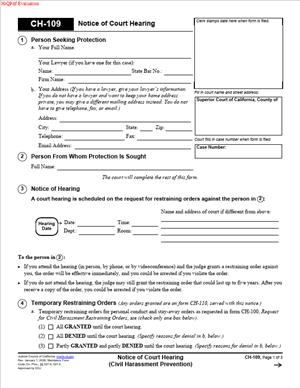
The CH-109 – Notice of Court Hearing (Civil Harassment Prevention) is a court-issued document used in California civil harassment cases. It tells the parties when and where the court hearing will take place.
If you are asking the court for protection from harassment, this form is part of the process. It connects your request to a scheduled hearing date. Without it, the other party would not know when to appear in court.
If you are the person responding to a civil harassment request, this form gives you critical information. It tells you when you can present your side of the story.
Understanding this document matters because it sets the timeline for your case. Missing the hearing listed on this form can affect the outcome.
This guide explains what the form is, when it is used, and how to complete it clearly and accurately.
What is CH-109 – Notice of Court Hearing (Civil Harassment Prevention)?
Clear definition
CH-109 – Notice of Court Hearing (Civil Harassment Prevention) is an official California court form. It provides notice that a hearing has been scheduled in a civil harassment case.
The form lists the date, time, and location of the court hearing. It also identifies the parties involved and may include temporary orders made by the court.
This document is typically prepared by the court after a request for civil harassment restraining orders is filed. It becomes part of the official court record.
Who typically uses this form?
This form is commonly used by a person seeking protection from harassment. That person is often called the petitioner or requesting party.
It is also relevant to the person accused of harassment, often called the respondent or restrained person. They receive a copy so they know when to appear in court.
Court clerks handle the scheduling and issuance of this form. Law enforcement officers may become involved if temporary orders are included and must be enforced.
Self-represented individuals frequently deal with this document. Many people in civil harassment cases do not have attorneys.
Why might you need this form?
You may need this form if you filed paperwork asking the court for protection from harassment. After you submit your request, the court schedules a hearing and issues this notice.
You may also need this form if someone has filed a civil harassment request against you. It tells you when you can respond in person before a judge.
This form ensures both sides receive formal notice of the hearing. Proper notice is an important part of court procedure.
Without this document, there is no official confirmation of the hearing date. That can delay the case or create confusion.
Typical real-life scenarios
- You had repeated unwanted contact from a neighbor. After filing for a civil harassment restraining order, the court sets a hearing date. This form tells both of you when to appear.
- A former friend has been sending threatening messages. You file a request for protection. The court reviews your papers and issues this notice with a scheduled hearing.
- Someone accuses you of harassment and files in court. You are served with paperwork that includes this notice. It explains when you must go to court to respond.
- You requested temporary orders for immediate protection. The court grants short-term orders and schedules a full hearing. This form reflects both the temporary orders and the hearing date.
When would you use CH-109 – Notice of Court Hearing (Civil Harassment Prevention)?
You encounter this form after a civil harassment case has started. It is not the first document filed, but it becomes central once the court sets a hearing.
If you are the person seeking protection, you use this form to arrange service on the other party. The respondent must receive notice of the hearing within a specific time frame set by the court.
If you are the respondent, you use the information in this document to prepare for court. It provides the timeline for filing any response and gathering evidence.
This form may also be relevant if temporary restraining orders were requested. The hearing listed on the notice is where the judge decides whether to make those orders longer-lasting.
In many cases, the hearing must take place within a short period after filing. This document confirms that schedule. It creates structure for the next steps in the process.
Legal characteristics of CH-109 – Notice of Court Hearing (Civil Harassment Prevention)
This form is an official court notice. Its effectiveness depends on accurate court information, proper issuance by the clerk, and correct service on the other party.
The document generally includes the court’s name and address, the case number, and the names of the parties. Missing or incorrect details can cause confusion or delays.
A common issue arises when the respondent is not properly served. If the service does not meet court requirements, the hearing may be postponed.
Another problem occurs when the case number or party names do not match other filed documents. Consistency across all filings helps prevent administrative errors.
This form may also include temporary orders. Those orders are enforceable once properly served. However, the notice itself does not decide the final outcome of the case.
Procedural rules can vary between states. In California, specific timelines apply to scheduling and service in civil harassment matters. Other jurisdictions may use different forms or procedures.
The document does not replace the original request for restraining orders. It works alongside other filings in the case.
Is it legally binding?
The notice itself is a binding court document in the sense that it officially schedules a hearing. The date and time listed are set by the court.
If temporary orders are included, those orders may become enforceable once the respondent is properly served. Law enforcement can act based on valid temporary orders.
However, the notice does not automatically create a long-term restraining order. The judge decides that at the hearing.
Its legal impact depends on proper service and accurate court issuance. Without those elements, the hearing may not proceed as planned.
How to fill out CH-109 – Notice of Court Hearing (Civil Harassment Prevention)
Step 1 – Review the Caption Information
Start by reviewing the top section of the form. This area includes the court name, court address, and case number. Ensure the names of the petitioner and respondent match the original filing exactly.
If you are completing information before submission to the clerk, check spelling and formatting carefully. The case number must be accurate to link the notice to the correct file.
Step 2 – Confirm the Hearing Details
The court typically fills in the hearing date, time, and department. Once those details are entered, review them closely.
Make sure the location is clear. Some courts have multiple buildings or courtrooms. The document should clearly state where the hearing will take place.
If you receive the completed form from the clerk, read this section immediately. The timeline for service and preparation depends on the hearing date.
Step 3 – Check for Temporary Orders
Look for any section indicating that temporary restraining orders were granted or denied. These details may appear within the same document or reference another attached order.
If temporary orders are granted, note their scope and expiration date. They often remain in effect until the hearing.
Understanding this section helps you know what conduct is restricted before the court makes a final decision.
Step 4 – Review Service Instructions
The form usually includes information about serving the respondent. Read this part carefully.
It may state how many days before the hearing the respondent must receive the paperwork. This timeline affects when the service must be completed.
Ensure that a person who is legally permitted to serve documents handles delivery. The person requesting protection typically cannot serve the papers personally.
Step 5 – Verify Party Information
Check that the addresses and identifying details for both parties are correct. Accurate information helps ensure proper notice.
If address confidentiality applies, confirm that any protected information is handled according to court procedures.
Errors in this section can delay service or create confusion about who is involved in the case.
Step 6 – Make Copies for Records and Service
Once the form is complete and signed or stamped by the clerk, make the required copies. You generally need one for yourself, one for the other party, and one for proof of service.
Keep your copy in a safe place. Bring it to the hearing along with any supporting documents.
Having complete and organized copies supports a smoother court appearance.
Step 7 – File and Track Completion
If you are responsible for submitting the form to the clerk for issuance, confirm that it is officially filed. The clerk may stamp or endorse the document.
After service is completed, ensure that proof of service is filed with the court. The hearing listed on the CH-109 – Notice of Court Hearing (Civil Harassment Prevention) will usually move forward only if proper notice has been given.
Track deadlines carefully based on the hearing date. The information in this document sets the pace for the rest of your preparation.
Legal terms you might encounter in CH-109 – Notice of Court Hearing (Civil Harassment Prevention)
- Petitioner: This is the person asking the court for protection. On this form, the petitioner’s name appears in the caption at the top and identifies who requested the civil harassment restraining orders. You should make sure this name matches exactly what appears on the original request filed with the court.
- Respondent: This is the person the restraining order is against. The respondent must be properly notified of the hearing listed in this document. The name must be spelled correctly because law enforcement and the court rely on this exact information.
- Notice of Hearing: This section tells you the date, time, and location of the court hearing. It officially informs both sides when to appear. If you miss this hearing, the judge may still make orders without you.
- Temporary Restraining Order (TRO): A TRO is a short-term order that may already be in place before the hearing. This document will indicate whether a TRO was granted, denied, or partially granted. You need to read this carefully to understand what rules apply before the court date.
- Proof of Service: This refers to written confirmation that the respondent was properly given copies of the filed documents. The court requires proof that service was completed correctly and on time. Without valid proof of service, the hearing may be postponed.
- Personal Service: This means someone other than you personally handed the documents to the respondent. The court usually requires personal service in civil harassment cases. Service by mail alone is often not enough unless the court specifically allows it.
- Clerk of the Court: The clerk is the court official who processes filings and issues hearing dates. The clerk signs or stamps this document to make it official. If the form is not signed or stamped, it may not be valid.
- Hearing Date: This is the scheduled court appearance listed on the form. It is critical because deadlines for service are tied to this date. If the date changes, you must follow updated instructions from the court.
- Orders Requested: This refers to the protections the petitioner asked the judge to grant. While this form does not list all details of those requests, it connects to the original request document where those orders are described.
- Court Department or Division: This identifies the specific courtroom or judicial officer assigned to your case. Showing up at the wrong department can delay your hearing or cause you to miss it entirely.
FAQs
What exactly does CH-109 – Notice of Court Hearing (Civil Harassment Prevention) tell me?
This document gives you the official date, time, and location of the court hearing for the civil harassment restraining order case. It also shows whether temporary orders were granted and provides instructions about serving the respondent. You should carefully review each section so you know what must happen before the hearing.
Do I need to file this form myself?
In most situations, the court prepares and issues this document after you file your request for restraining orders. You typically do not complete the hearing details yourself. Instead, you review it for accuracy and use it to complete service on the respondent.
What if the hearing date on this form does not work for me?
You cannot simply ignore the scheduled date. If you cannot attend, you must ask the court about the process for requesting a new date. Until the court officially changes it, the hearing remains scheduled and binding.
How do I know if temporary restraining orders are in effect?
Look at the section that indicates whether a Temporary Restraining Order was granted, denied, or granted in part. If granted, the terms are usually attached in a separate order document. You must follow those terms immediately, and the respondent must be served with them.
What happens if the respondent is not served before the hearing?
If the service is not completed by the deadline, the judge may continue or postpone the hearing. The court needs proof that the respondent received the papers. Without valid proof of service filed with the court, the judge may not move forward.
Can I change information after the CH-109 – Notice of Court Hearing (Civil Harassment Prevention) is issued?
You cannot change the hearing details on your own. If there is an error in a name, address, or other identifying detail, you should contact the court clerk to ask about correction procedures. Any official changes must come from the court.
What should I check before serving the respondent?
Confirm that the names are spelled correctly, the hearing date and time are clear, and all referenced attachments are included. Make sure you have complete copies of every document the respondent must receive. Missing pages can invalidate the service.
Does this document become part of the public court record?
Yes, once filed and issued, it becomes part of the court file. The hearing date and case information are recorded in the court system. Accurate information is important because law enforcement and court staff rely on the official record.
Checklist: Before, During, and After CH-109 – Notice of Court Hearing (Civil Harassment Prevention)
Before
- Confirm the hearing date, time, department, and courthouse address.
- Review whether a Temporary Restraining Order was granted.
- Make complete copies of all filed documents, including attachments.
- Arrange for a qualified adult to personally serve the respondent.
- Check the deadline for completing the service before the hearing.
- Ensure all names and case numbers match exactly across documents.
- Prepare blank Proof of Service forms for the server to complete.
- Organize your paperwork in the order listed in the case caption.
During
- Have the server personally deliver all required documents to the respondent.
- Confirm the server completes the Proof of Service accurately and fully.
- Double-check that the date and time of service are recorded.
- File the completed Proof of Service with the court promptly.
- Keep a stamped copy of the Proof of Service for your records.
- Prepare your evidence and outline for the upcoming hearing.
- Review the temporary orders so you comply with all restrictions.
- Monitor for any notice from the court about schedule changes.
After
- Attend the hearing on the scheduled date and time.
- Bring extra copies of all filed documents and evidence.
- Present your case clearly and answer the judge’s questions directly.
- Obtain a filed copy of any orders issued at the hearing.
- Serve the final restraining order if the judge grants it.
- Keep certified copies in a safe place.
- Provide copies to relevant parties if required by court order.
- Update personal records to reflect any new court orders.
Common mistakes to avoid with CH-109 – Notice of Court Hearing (Civil Harassment Prevention)
- Mistake: Assuming the hearing date is flexible, which happens because people think it is tentative, leading to missed court appearances and possible denial of orders; do not forget that the listed date is mandatory unless the court officially changes it.
- Mistake: Failing to complete personal service properly, often due to confusion about who can serve papers, which can delay the case or force a continuance; do not forget that you cannot serve the papers yourself.
- Mistake: Overlooking attached temporary orders, which happens when people focus only on the hearing date, resulting in accidental violations; do not forget to read every attached page carefully.
- Mistake: Filing an incomplete Proof of Service, usually because the server skips details, which can cause the judge to refuse to proceed; do not forget to review the proof for accuracy before filing.
- Mistake: Bringing no extra copies to the hearing, which happens due to last-minute preparation, causing stress and possible delays; do not forget to organize and duplicate all documents in advance.
- Mistake: Ignoring small name or spelling errors, which seem minor but can create enforcement problems later; do not forget to verify that all identifying information matches across every form.
- Mistake: Waiting until the last minute to arrange service, which happens due to a misunderstanding of deadlines, risking incomplete service before the hearing; do not forget to schedule service well before the cutoff date.
- Mistake: Not checking the assigned courtroom department, which occurs when people assume any courtroom is fine, leading to missed appearances; do not forget to confirm the exact department listed on the form.
What to do after filling out CH-109 – Notice of Court Hearing (Civil Harassment Prevention)
Once this document is issued by the court, your focus shifts from paperwork to action. You must make sure the respondent is properly served and that the court receives proof of that service before the hearing.
- Step 1: Review the issued document immediately after receiving it from the clerk.
- Step 2: Confirm that the hearing date, time, and department are clearly listed.
- Step 3: Check whether temporary restraining orders were granted and read them carefully.
- Step 4: Make at least three complete sets of copies—one for service, one for you, and one spare.
- Step 5: Arrange for a qualified adult server to personally deliver the documents to the respondent.
- Step 6: Ensure the server completes the Proof of Service form fully and accurately.
- Step 7: File the completed Proof of Service with the court before the deadline tied to the hearing date.
- Step 8: Confirm the court has accepted and processed the Proof of Service.
- Step 9: Prepare your hearing materials, including evidence, witness information, and a clear outline of what you want the judge to order.
- Step 10: Attend the hearing on time and bring all originals and copies with you.
After the hearing, carefully review any final orders the judge signs. Make multiple copies of the signed order. Keep one with you, store one in a safe place, and provide copies as necessary for enforcement. If the court grants a restraining order, follow all listed terms strictly. Keep track of expiration dates and renewal deadlines if applicable.
Staying organized is your best tool. Maintain a folder with stamped copies, service proofs, and all court communications. This record protects you and helps avoid confusion later.
Disclaimer: This guide is provided for informational purposes only and is not intended as legal advice. You should consult a legal professional.