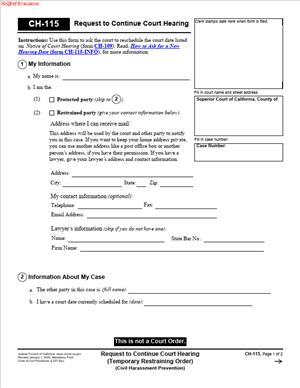
CH-115 – Request to Continue Court Hearing (Temporary Restraining Order) (Civil Harassment Prevention)
Fill out nowJurisdiction: Country: United States | Province or State: California
The CH-115 – Request to Continue Court Hearing is a court form used in California civil harassment cases. You use it to ask the court to move a scheduled hearing to a later date.
This form matters because court hearings have strict deadlines. If you cannot attend on the scheduled date, you need a formal way to inform the court and request more time. CH-115 – Request to Continue Court Hearing is the document designed for that purpose.
You may be the person asking for protection or the person responding to a request for protection. Either side can use this form, depending on the situation. The key is that a hearing has already been set, and you need to change that date.
Filing this form does not automatically change your hearing. It asks the judge to approve a new date. Until the court grants the request, the original hearing date usually remains in place.
Understanding how this document works helps you avoid missing court. Missing a hearing can lead to serious consequences, including orders being made without your input.
What is CH-115 – Request to Continue Court Hearing?
Clear definition
CH-115 – Request to Continue Court Hearing is a formal written request to the court asking that a scheduled civil harassment hearing be postponed. “Continue” in this context means to move the hearing to a later date.
This form is part of the civil harassment court process in California. It is used after a hearing date has already been assigned. You complete it and file it with the court to explain why you need more time.
The document typically includes information about the current hearing date, the reason you are asking for a new date, and whether the other party has been notified. The judge reviews this information before deciding whether to grant the request.
Who typically uses this form?
People involved in civil harassment cases most often use this form. That includes the person who requested a restraining order and the person who is responding to it.
A petitioner may use the form if they cannot attend the hearing due to an emergency, illness, or scheduling conflict. A respondent may use it if they need more time to prepare a response, gather evidence, or arrange for witnesses.
Self-represented individuals commonly rely on this form. Many people in civil harassment cases do not have lawyers, so the form is designed to be completed without legal representation.
Attorneys may also use this form on behalf of their clients. In that case, the attorney completes and signs it as the party’s representative.
Why might you need this form?
You might need this form if you cannot attend the hearing on the scheduled date. Courts expect attendance, and failing to appear can affect your rights.
You may also need more time to prepare your case. For example, you might need to collect documents, secure witness statements, or respond to allegations made against you.
Sometimes the other party was not properly served in time. In those situations, the hearing may need to be continued so that service requirements are met.
Unexpected events can also make a continuance necessary. Medical issues, family emergencies, or work conflicts often lead people to request a new hearing date.
Typical real-life scenarios
- You filed a civil harassment restraining order and received a hearing date two weeks away. A medical emergency arises, and you are scheduled for treatment on the same day. You use the form to request a later date so you can attend and present your case.
- You were served with papers only a few days before the hearing. You need time to prepare a written response and gather messages that support your side. You submit the form to ask the court for additional time.
- You live out of town and need time to arrange travel to the courthouse. The scheduled date conflicts with previously arranged travel plans that cannot be changed. You request a continuance to ensure you can be physically present.
- The person who filed the case did not complete service correctly, and you believe you did not receive proper notice. The court may require the hearing to be rescheduled so service rules can be satisfied.
When would you use CH-115 – Request to Continue Court Hearing?
You use this form after a hearing has been set in a civil harassment case. The hearing date is usually listed on earlier court documents.
Timing is important. The request is generally made before the scheduled hearing date. Courts often expect you to act promptly once you know you cannot attend.
Petitioners may use the form if they need more time to prepare evidence or ensure the other party has been served. Respondents may use it if they need time to prepare a defense or secure witnesses.
In many cases, a temporary restraining order may already be in effect. If the hearing is continued, the court may address whether temporary orders remain in place until the new hearing date.
You would not use this form to change the outcome of a hearing. It is only used to request a new date. Substantive arguments about the case are handled through other filings and at the hearing itself.
Legal characteristics of CH-115 – Request to Continue Court Hearing
This form is a procedural request. It does not decide the case. It asks the court to exercise its authority to reschedule a hearing.
For the request to be effective, it must be properly completed and filed with the court handling your case. The case number and party names must match the court’s records. Incomplete or incorrect information can delay processing.
Courts generally require a clear reason for the requested continuance. Vague statements may not provide enough information for the judge to evaluate the request. Specific facts are usually more helpful than general claims.
Service requirements may apply. In many situations, the other party must receive notice of your request. Failing to follow service procedures can cause delays or the denial of the request.
Different courts within California may have local procedures that affect how continuance requests are handled. While the core purpose of the form is consistent statewide, filing timelines and review processes can vary.
This form does not cancel a hearing by itself. Only a judge can grant a continuance. Until the court approves the request and issues a new date, you remain responsible for the original hearing.
The form also does not extend deadlines automatically for related filings unless the court orders otherwise. Its purpose is limited to requesting a change in the hearing date.
Is it legally binding?
The form itself is not legally binding in the way a court order is. It is a request for judicial action. Its legal effect depends on whether the judge grants or denies it.
If the court signs and approves the continuance, the new hearing date becomes official. At that point, the updated date and any related instructions are binding on the parties.
If the court denies the request, the original hearing date remains in effect. Failing to appear after a denial can lead to orders being made without your participation.
Any statements you make on the form are made to the court. Providing accurate information is important because the judge relies on those statements when deciding whether to grant the request.
How to fill out CH-115 – Request to Continue Court Hearing
Step 1 – Identify the court and case information
At the top of the form, enter the name of the court and its address exactly as shown on your other case documents. Fill in the case number carefully. Include the names of the petitioner and respondent as they appear in the case. This ensures the request is filed in the correct manner.
Step 2 – Identify who is making the request
Indicate whether you are the petitioner or the respondent. Provide your name and contact information in the spaces provided. If you have an attorney, the attorney’s information is typically listed instead of yours.
Step 3 – State the current hearing date
Enter the date, time, and department of the currently scheduled hearing. Copy this information directly from the notice of hearing or other court paperwork. Accuracy is important so the court knows which hearing you want to continue.
Step 4 – Explain why you are requesting a continuance
In the section provided, describe the reason you need a new hearing date. Be clear and specific. Include relevant details such as scheduling conflicts, medical issues, or the need for additional time to prepare. Keep your explanation focused on why you cannot proceed on the current date.
Step 5 – Address service and notice to the other party
Complete the portion of the form that addresses whether the other party has been notified of your request. Provide the required details about how and when notice was given, if applicable. This information helps the court determine whether proper procedures have been followed.
Step 6 – Review and sign the form
Read the entire form before signing. Confirm that all information is accurate and complete. Sign and date the form in the designated area. Your signature confirms that the information you provided is true to the best of your knowledge.
Step 7 – File the form with the court
Submit the completed CH-115 – Request to Continue Court Hearing to the court clerk in the county where your case is pending. Filing methods may include in-person submission, mail, or electronic filing, depending on the court’s procedures. After filing, monitor your case for the court’s decision on your request.
Legal terms you might encounter in CH-115 – Request to Continue Court Hearing
- Continuance: A continuance is a request to postpone a scheduled court hearing to a later date. In this form, you are asking the judge to move the current hearing to another day. The court must approve the request before the date officially changes.
- Hearing Date: This is the specific date and time currently set for your court appearance. You must copy this information exactly as it appears on your notice or prior court order. Any mistake here can cause confusion about which hearing you are asking to reschedule.
- Temporary Restraining Order (TRO): A TRO is a short-term court order that provides immediate protection until a full hearing is held. If a TRO is in place, the judge will decide whether it remains effective until the new hearing date. Your form may ask you to address this issue directly.
- Protected Person: The protected person is the individual seeking protection under a civil harassment restraining order. This term appears in the case caption and other court documents. You must use the same name exactly as it appears in the court’s records.
- Restrained Person: The restrained person is the individual against whom protection is requested. As with the protected person, the name must match the existing court documents. Incorrect spelling or name changes can delay processing.
- Declaration: A declaration is a written statement of facts that you sign under penalty of perjury. If you need more space to explain why you are requesting a continuance, you may attach a declaration. The judge relies on this explanation to decide whether to grant your request.
- Service of Process: Service of process means formally delivering court papers to the other party. When you request a continuance, the other side usually must be notified. The form may require information about how and when notice was or will be given.
- Good Cause: Good cause is a legally acceptable reason to request a postponement. Examples include medical emergencies, inability to serve the other party in time, or unexpected conflicts. You must clearly explain your good cause in plain facts, not general statements.
- Order on Request to Continue Hearing: This is the judge’s written decision in response to your request. The court will either grant or deny the continuance. The hearing date does not change unless the judge signs an order approving it.
FAQs
Do I need the judge’s approval for CH-115 – Request to Continue Court Hearing?
Yes. Filing this document does not automatically change your hearing date. The judge must review your request and sign an order granting the continuance. Until you receive a signed order with a new date, you should assume the original hearing date still applies.
What reason is strong enough to request a continuance?
You need to show good cause. That means a clear, specific reason you cannot attend or are not ready for the current hearing date. Common examples include a medical emergency, a lack of proper service, or not having enough time to prepare evidence. Simply saying you are busy is usually not enough.
Do I have to notify the other party after filing this form?
In most situations, yes. The court expects the other party to receive notice of your request. This may involve personal service or another approved method. You should check what type of service is required and make sure proof of service is completed accurately.
What happens to a temporary restraining order if the hearing is postponed?
If a temporary restraining order is in effect, the judge will decide whether it stays in place until the new hearing date. This decision will be written in the court’s order. Do not assume the order expires or continues without reading the signed decision carefully.
How do I know if my request was approved?
You must review the signed court order. The clerk may provide a filed copy, or you may need to check the court file. The order will clearly state whether the hearing is continued and list the new date, time, and department.
What if I cannot serve the other party before the current hearing date?
You can explain this clearly in your request and describe your attempts to complete the service. The judge may grant a continuance to allow more time for proper service. Be specific about dates and efforts so the court understands your situation.
Can I attach extra pages to explain my situation?
Yes. If there is not enough space on this document to explain your reasons, you can attach a declaration. Make sure your name, case number, and page numbering appear on each attachment so it is properly connected to your case file.
What if my name or the other party’s name is slightly different on this form?
The names must match the court’s existing records exactly. Even small spelling differences can cause filing issues. Before submitting this document, compare the names to your previous court papers and correct any discrepancies.
Checklist: Before, During, and After CH-115 – Request to Continue Court Hearing
Before
- Confirm your current hearing date, time, and department from the latest court notice.
- Review whether a temporary restraining order is active.
- Gather documents that support your reason for requesting a continuance.
- Check whether you have properly served the other party.
- Make sure all names and the case number match prior filings exactly.
- Prepare a clear explanation of your good cause.
- Determine what type of service will be required after filing.
- Make copies of all documents you plan to submit.
During
- Fill in the court name and location exactly as listed on prior paperwork.
- Enter the case number without errors.
- State the current hearing date clearly.
- Provide detailed facts explaining why you need more time.
- Attach a declaration if additional explanation is necessary.
- Review the form for completeness and accuracy.
- Sign and date the form where required.
- Submit the form to the court clerk by the required method.
After
- Obtain a filed copy of your request.
- Calendar the original hearing date until you receive a signed order changing it.
- Check for the judge’s decision in writing.
- Serve the signed order on the other party if required.
- Keep proof of service for your records.
- Update your calendar with any new hearing date.
- Continue preparing your case for the rescheduled hearing.
- Store copies of all filed and served documents in a safe place.
Common mistakes to avoid with CH-115 – Request to Continue Court Hearing
- Mistake: Assuming the hearing is automatically postponed after filing, which happens because people think submitting the form is enough; this can lead to missing the original court date and serious consequences, so do not forget that only a signed court order changes the date.
- Mistake: Giving vague reasons like “I need more time,” which happens when you feel overwhelmed; the judge may deny the request for lack of detail, so do not forget to include specific facts and dates.
- Mistake: Forgetting to address an existing temporary restraining order, which happens when focusing only on the hearing date; this can create confusion about whether protections remain in place, so do not forget to review and mention the TRO status.
- Mistake: Failing to serve the other party properly, which happens due to misunderstanding service rules; this can delay your case or invalidate your request, so do not forget to complete and document correct service.
- Mistake: Listing incorrect names or case numbers, which happens from copying errors; the clerk may reject your filing, so do not forget to double-check all identifying information.
- Mistake: Waiting until the last minute to file, which happens when hoping the issue resolves itself; late requests may be denied, so do not forget to act as soon as you know you need a continuance.
- Mistake: Not checking the court’s response, which happens when assuming approval; you could miss important instructions or dates, so do not forget to confirm whether the order was granted or denied.
- Mistake: Failing to keep copies of filed and served documents, which happens during rushed preparation; this can make it hard to prove compliance later, so do not forget to organize and store your paperwork.
What to do after filling out CH-115 – Request to Continue Court Hearing
Once you complete the form, pause and review every entry. Confirm the case number, names, and hearing date are accurate. Make sure your explanation is clear and specific. If you attached a declaration, check that it is signed and dated.
- Step 1: Make at least two copies of the completed form and any attachments—one for you and one for the other party.
- Step 2: File the original with the court clerk using the accepted filing method.
- Step 3: Obtain a stamped or filed copy showing the date of submission.
After filing, do not assume your hearing date has changed. The judge must review your request and issue a written order. Monitor your case status carefully.
- Step 4: Check whether the judge signed an order granting or denying the continuance.
- Step 5: If granted, write down the new hearing date, time, and department immediately.
- Step 6: Serve the signed order on the other party if required and complete proof of service.
Keep your records organized. Place the filed request, the signed order, and proof of service together in your case folder. You may need to show these documents at the next hearing.
- Step 7: Update your calendar and set reminders for the new date.
- Step 8: Continue preparing your evidence, witnesses, and documents for the rescheduled hearing.
- Step 9: If the request is denied, prepare to attend the original hearing date and time.
- Step 10: Bring copies of all relevant documents with you to court, including your request and the judge’s order.
Staying organized and proactive protects your position. A continuance gives you time, but it does not replace preparation. Use the additional time wisely to strengthen your case.
Disclaimer: This guide is provided for informational purposes only and is not intended as legal advice. You should consult a legal professional.