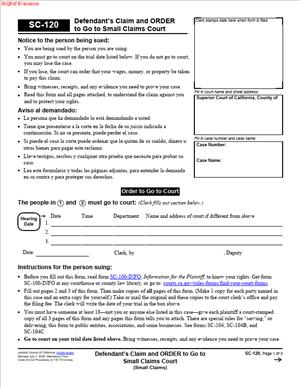
SC-120 – Defendant’s Claim and ORDER to Go to Small Claims Court
Fill out nowJurisdiction: Country: United States | Province or State: California
SC-120 – Defendant’s Claim and ORDER to Go to Small Claims Court is a court form used in California small claims cases. It allows a defendant to make a claim against the plaintiff in the same case. It also serves as the court’s order setting a hearing date.
This document matters because it changes your role in the case. You are no longer only responding to someone else’s claim. You are also asking the court to decide a claim you have against the other party.
People often encounter this form when they are already involved in a small claims case. You may have been sued first. After reviewing the situation, you may believe the other party owes you money instead.
Filling out this form carefully is important. The information you provide helps the court understand what your claim is about. It also tells the other party what issues will be discussed at the hearing.
If you are about to complete SC-120 – Defendant’s Claim and ORDER to Go to Small Claims Court, this guide walks through what the form is, when it is used, and how each part fits together. The goal is to help you understand what you are being asked to write before you write it.
What is SC-120 – Defendant’s Claim and ORDER to Go to Small Claims Court?
Clear definition
SC-120 – Defendant’s Claim and ORDER to Go to Small Claims Court is a California small claims court form. It allows a defendant to file a claim against the plaintiff within the same small claims case.
The form serves two functions. First, it states the defendant’s claim and the amount requested. Second, it includes an order from the court that schedules the hearing and provides basic instructions about appearing.
This is not a general response or denial. It is a way to bring your own claim into the case so both sides’ claims can be heard together.
Who typically uses this form/document?
This form is typically used by someone who has been named as a defendant in a small claims case. That person believes the plaintiff caused harm or owes money related to the same situation.
Individuals use this form most often. Small businesses, landlords, tenants, contractors, and customers also commonly use it when they are defendants in small claims court.
The form is not used by the original plaintiff to start a case. It is used only after a case already exists and you are responding with your own claim.
Why you might need this form/document
You might need this form if the issue is not one-sided. You may believe the plaintiff’s claim ignores important facts. You may also believe the plaintiff is actually the one who caused financial loss.
Using this form allows both claims to be considered together. That can save time and reduce the need for separate cases about the same dispute.
It also creates a clear record of your claim. The court and the other party can see exactly what you are asking for and why.
Typical real-life scenarios
- A tenant is sued by a landlord for unpaid rent. The tenant believes the landlord failed to return a security deposit and caused damage to personal property. The tenant files this form to raise that claim in the same case.
- A customer sues a contractor for poor work. The contractor believes the customer refused to pay for completed services. The contractor uses this form to claim the unpaid balance.
- A driver is sued after a minor accident. The driver believes the other driver caused the collision and damaged their vehicle. The driver files a defendant’s claim so both sides’ damages are addressed.
- A former roommate sues for shared bills. The defendant believes they paid more than their share and covered expenses for the plaintiff. The defendant uses this form to seek reimbursement.
When would you use SC-120 – Defendant’s Claim and ORDER to Go to Small Claims Court?
You would use SC-120 – Defendant’s Claim and ORDER to Go to Small Claims Court after you have been named as a defendant in a small claims case. The case must already be filed with the court.
This form is used when your claim arises from the same transaction or situation. The dispute is usually connected to the same event, agreement, or relationship described in the plaintiff’s claim.
People often use this form when they realize their position is not just defensive. You are not only saying the plaintiff is wrong. You are saying you are owed money instead.
The timing matters because small claims cases move quickly. This form is part of the process that brings both sides’ claims before the judge at the same hearing.
Legal characteristics of SC-120 – Defendant’s Claim and ORDER to Go to Small Claims Court
This form has specific legal characteristics because it is issued by the court system. It must be completed fully and filed properly to be accepted as part of the case.
The form becomes effective when it is filed with the court and processed. The order portion reflects the court’s authority to schedule the hearing and require attendance.
Common problems arise when information is missing or unclear. Incomplete party names, incorrect case numbers, or vague claim descriptions can cause delays or confusion.
High-level differences can exist based on local court practices. While the form is statewide, filing methods, timelines, and hearing logistics may vary by county.
This document does not decide the case by itself. It does not guarantee payment or dismiss the plaintiff’s claim. It simply places your claim before the court for consideration.
Is it legally binding?
The order portion of the form is legally binding once issued by the court. It sets the hearing date and requires the parties to appear or follow the court’s instructions.
The claim itself is not a binding decision. It is a request for the court to decide the issue at the hearing. The binding outcome comes later, after the judge makes a decision.
How to fill out SC-120 – Defendant’s Claim and ORDER to Go to Small Claims Court
Step 1 – Case caption and court information
At the top of the form, you identify the court where the case is filed. This includes the court name and location. You also enter the case number exactly as it appears on the plaintiff’s paperwork. This information connects your claim to the correct case.
Step 2 – Party names and contact details
This section asks for the names, addresses, and contact information of the parties. You list yourself as the defendant making the claim. You also list the plaintiff you are making the claim against. Accuracy matters so notices reach the correct people.
Step 3 – Statement of the defendant’s claim
Here you describe what your claim is about. You explain, in plain terms, why you believe the plaintiff owes you money. The space is limited, so the description is usually brief and focused on key facts.
Step 4 – Amount of the claim
You state the dollar amount you are asking the court to award. This amount reflects your claimed loss. It is written as a specific number rather than a range or estimate.
Step 5 – Basis for the claim
This part asks for the reason behind your claim. You may reference an agreement, property damage, unpaid work, or another clear basis. The goal is to show how the amount requested connects to what happened.
Step 6 – Verification and signature
You review the completed form and sign it. Your signature confirms that the information is true and correct to the best of your knowledge. You also include the date you sign the document.
Step 7 – Court order section
The court completes this portion after filing. It lists the hearing date, time, and location. This section also outlines expectations about appearing and presenting your case.
Step 8 – Review for completeness
Before submission, you read through every section. You check that names match across documents, amounts are consistent, and handwriting or text is readable. A complete form helps avoid processing issues.
Step 9 – Submission to the court
You submit the form according to the court’s filing process. Once filed, the document becomes part of the case record and triggers the order to appear at the hearing.
Legal terms you might encounter in SC-120 – Defendant’s Claim and ORDER to Go to Small Claims Court
- Defendant’s Claim: This is the part of the document where you, as the defendant, state that you are making your own claim against the plaintiff. It turns the case into one where both sides may be asking for money or other relief. What you write here defines what the court will consider from your side.
- Plaintiff: The plaintiff is the person or entity that originally started the small claims case against you. Their name must appear exactly as it does in the court’s records. Any mismatch can cause confusion or delays.
- Defendant: You are the defendant if you were originally sued. When you file this document, you stay the defendant but also become a claimant for your own issue. Your legal name and contact details matter because court notices rely on them.
- Small Claims Court: This is the court that handles lower-dollar disputes using simpler procedures. The form is designed specifically for this court, which is why it limits how much you can claim and how information is presented. The judge will expect concise, factual statements.
- Claim Amount: This is the dollar amount you are asking the court to award to you. The amount must fit within small claims limits and should match the explanation you give. Inconsistencies can weaken your position.
- Cause of Action: This term refers to the legal reason you believe you are owed money or relief. On the form, it appears as a brief explanation of what happened. You do not need complex legal language, but you must clearly connect the facts to your claim.
- Hearing Date: This is the scheduled date when both sides must appear in court. The order section of the document often confirms or sets this date. Missing it can result in losing by default.
- Service of Process: This means officially delivering court papers to the other party. Even though the court issues the order, you may still need to ensure proper service. Proof that the service occurred is often required.
- Verification: This is your signed statement that the information you provided is true and correct. By signing, you are making the statements under penalty of perjury. The court treats this seriously.
FAQs
Can I file SC-120 – Defendant’s Claim and ORDER to Go to Small Claims Court if I already responded verbally in court?
Yes, you can still use this document if you want your claim formally recorded. Verbal statements at a hearing do not replace a written claim. This form creates an official record that the judge can rely on.
Where do I find the case number to enter on this form?
Look at any court notice or paperwork you already received in the case. The number is usually at the top of the page. You must copy it exactly so the court files your claim in the correct case.
What happens if I leave the claim amount blank or write “to be determined”?
The court may reject the filing or ignore your claim. This document is meant to state a specific amount. You should calculate the amount before filing and enter a clear number.
Do I need to attach evidence when I file this document?
You usually do not attach evidence to this form itself. Instead, you keep your documents and bring them to the hearing. The form is for stating your claim, not proving it yet.
Who is allowed to sign this form if the defendant is a business?
A person authorized to act for the business must sign. The signer’s role should match what the court expects, such as an owner or authorized representative. The name on the signature line should be readable.
Will filing this form change the hearing date?
It can, but not always. The order section tells you whether the court set a new date or kept the existing one. You must read that section carefully and plan based on what it says.
How will I know if the court accepted this document?
You will usually receive a stamped copy or a notice from the court. That stamp or notice is your confirmation. Keep it with your records.
Does this document become part of the public court record?
Yes. The information you write becomes part of the case file. That is why accuracy and clarity matter when completing this document.
Checklist: Before, During, and After SC-120 – Defendant’s Claim and ORDER to Go to Small Claims Court
Before
- Gather all court papers related to the case.
- Confirm the exact names of all parties as listed by the court.
- Calculate the total amount you are claiming.
- Write a short, clear summary of why you are making the claim.
- Check the hearing date and any deadlines you received.
- Make sure you know who will sign the document.
- Prepare a copy for your records.
During
- Fill in the case number exactly as shown on court documents.
- Print names clearly to avoid misreading.
- Enter the claim amount as a specific dollar figure.
- Keep explanations factual and brief.
- Review the order section for dates and instructions.
- Sign and date the verification section.
- Check that every required field is completed.
After
- Make copies of the completed document.
- Submit the form using the court’s accepted method.
- Confirm that the court stamped or logged your filing.
- Arrange for proper service if required.
- Note the hearing date on your calendar.
- Organize the evidence you plan to bring to court.
- Store all documents together in one place.
Common mistakes to avoid with SC-120 – Defendant’s Claim and ORDER to Go to Small Claims Court
- Mistake: Using nicknames or shortened names, which happens when people rush, leading to mismatched records and missed notices, so do not forget to copy names exactly as listed.
- Mistake: Writing an unclear or emotional explanation, which happens under stress, causing the judge to miss your point, so do not forget to stick to facts.
- Mistake: Claiming an amount without checking limits, which happens when people estimate, leading to rejection or reduction, so do not forget to verify the amount.
- Mistake: Forgetting to sign the verification, which happens during last-minute filing, making the document invalid, so do not forget to check the signature line.
- Mistake: Ignoring the order section, which happens when people focus only on their claim, causing missed dates, so do not forget to read the entire page.
- Mistake: Failing to keep copies, which happens after filing, leaving you without proof, so do not forget to make and save copies.
- Mistake: Assuming the court will serve the other party automatically, which happens due to confusion, risking improper service, so do not forget to confirm service requirements.
- Mistake: Submitting incomplete contact information, which happens when fields seem optional, leading to missed communications, so do not forget to fill in all contact sections.
What to do after filling out SC-120 – Defendant’s Claim and ORDER to Go to Small Claims Court
Once the form is complete, your next steps focus on making the filing effective and staying organized. This is where many self-represented people lose momentum. Treat this as a process, not a single task.
- Step 1: Make at least two copies of the completed form. One is for your records, and one may be needed for service or reference.
- Step 2: Submit the original to the court using the method the court accepts, such as in person or by mail.
- Step 3: Ask for or wait for confirmation that the court accepted the filing, such as a stamp or notice.
- Step 4: Read the order section again after filing to confirm the hearing date and time.
- Step 5: Mark the hearing date on your calendar and set reminders.
- Step 6: Check whether you are responsible for serving the other party and complete that step if required.
- Step 7: Gather and organize evidence that supports your claim, keeping it separate from the filed form.
- Step 8: Update any personal notes or case summaries you keep so they match what you filed.
- Step 9: Monitor mail or court messages in case the court issues further instructions.
- Step 10: Bring your copies and evidence with you on the hearing date.
Disclaimer: This guide is provided for informational purposes only and is not intended as legal advice. You should consult a legal professional.