California divorce disclosure explained: gather your records, meet the deadlines, and learn what to share or file.
California divorce disclosure means giving your spouse a clear picture of your finances. It covers income, bills, property, and debts. The process matters even when you expect to agree on the divorce.
The paperwork serves different purposes. Some documents go to your spouse. Others tell the court that you completed that exchange. Sending every bank statement to the clerk can create needless privacy problems.
This guide explains the usual process in a California divorce started by a petition and response. Joint petitions, summary dissolutions, defaults, and court-approved exceptions need separate checks. For the wider process, read our California divorce guide.
This is general legal information, checked September 8, 2026. RunSensible Forms helps people prepare legal forms. It is not a law firm, government agency, or court filing service.
What California Divorce Disclosure Covers
Disclosure is an exchange of facts. It helps both sides understand the finances before they make decisions about property or support. California law calls for full, accurate information early in the case, with updates when key facts change. Family Code section 2100 explains these duties.
There are two main stages:
- Preliminary disclosure: the first required financial exchange.
- Final disclosure: the later exchange before resolving property or support issues, or going to trial, unless properly waived or excused.
Your California divorce disclosure should list what you own and owe, including items you believe belong only to you. Listing an asset does not mean agreeing to divide it. Disclosure and ownership are different questions.
On these forms, community property means property treated as shared by the spouses. Separate property means property treated as belonging to one spouse. The parties may disagree about these labels.
For example, you might own a retirement account opened before marriage. List the account and gather the records. Do not leave it out because you believe it is separate property. The legal treatment may need more work.
Put the Correct Deadlines on Your Calendar
California Divorce Disclosure Deadlines for Each Spouse
In the usual petition-and-response case, the first deadlines run from filing:
- The petitioner, who starts the case, serves first disclosures with the petition or within 60 days after filing it.
- The respondent, who answers the case, serves first disclosures with the response or within 60 days after filing it.
The parties may extend these periods by written agreement, or the court may extend them. A verbal promise is not the written agreement described in the law. Family Code section 2104(f) sets these rules.
Keep the filing date, planned exchange date, and actual exchange date in separate calendar entries. Save any written extension with your records.
California divorce disclosure does not replace the deadline to respond to the divorce itself. If you received a summons and petition, review those papers promptly.
Plan for the Final Exchange Too
Unless a valid waiver or court exception applies, final disclosure has a different timing rule. Exchange it before or when entering a property or support agreement, other than temporary support. If the case goes to trial, the deadline is no later than 45 days before the first assigned trial date. Family Code section 2105(a) states the rule.
Do not assume every deadline moves when a trial is continued. Check the first assigned date and any court order.
Gather Records Before You Complete the Forms
A useful California divorce disclosure file starts with source records. These are the documents behind the numbers on your forms.
Use folders for income, taxes, property, debts, and documents already shared. Give each file a clear name. Include the institution, document type, and statement date.

Income and Tax Records
Gather these materials where they apply:
- Pay stubs for the last two months.
- Proof of other income, such as benefits, pension payments, or rent received.
- All tax returns you filed during the two years before serving first disclosures.
- Records explaining a recent change in pay or work hours.
- Business records needed to explain self-employment income.
The tax-return rule concerns returns filed during the preceding two years. That may differ from simply choosing the last two tax years. Family Code section 2104(a) supplies the rule.
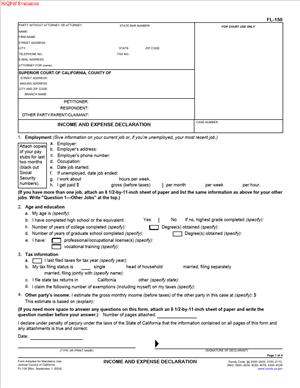
For self-employment, FL-150 asks for a profit-and-loss statement for the last two years or Schedule C from the latest federal return. It also calls for proof of other income. Follow its instructions about removing Social Security numbers. See the official Income and Expense Declaration.
Keep records for each business together. A transfer from a business account to a personal account may need explanation. Do not treat every deposit as wages without checking its source.
Property and Debt Records
Collect current records for bank accounts, investments, loans, and credit cards. Add deeds and mortgage statements for real estate. Gather vehicle titles and loan details.
For retirement benefits, look for both the latest benefit statement and the plan summary. For a business, locate ownership records and relevant tax schedules. The official Property Declaration instructions identify documents used to support these categories.
Record the date shown on each statement. A balance without a date can be hard to compare with another document.
California divorce disclosure can involve assets held by someone else, including your spouse. If you know an account exists but lack its records, note the gap. Ask for the missing facts. Do not invent a balance or treat missing records as proof that an asset has no value.
Build a List of Missing Documents
Use a short working list with four details: the item, the missing record, who can provide it, and your follow-up date.
For example: “Retirement plan; latest benefit statement missing; request from plan administrator; follow up next Tuesday.”
This list is an organizing tool. It does not replace an attachment or extend a court deadline. Ask for help promptly if records will not arrive in time.
Understand How the Forms Work Together
California divorce disclosure uses a package of documents. No single form tells the whole financial story.
FL-140, Declaration of Disclosure, identifies the exchange and its attachments. The package includes an income and expense declaration and an asset-and-debt schedule or property declarations. It can also require written information beyond the standard forms. See the official FL-140.
The Income and Expense Declaration, FL-150, addresses income and living costs. The Schedule of Assets and Debts, FL-142, organizes property and liabilities.
FL-160, Property Declaration, can serve as the property schedule instead. When using it, follow its separate instructions for community property and separate property. Its required columns also depend on why you are using it.
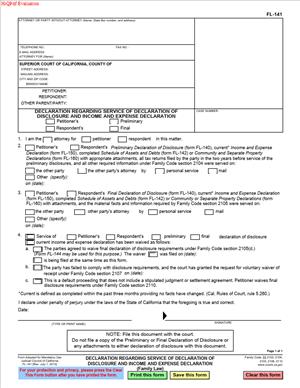
FL-141 reports that you served the required disclosure papers. FL-144 can record an agreement to waive final disclosure when the legal conditions are met.
Before downloading or signing, compare your copy with the current Judicial Council version. A page explaining a form may stay online after the form changes.
Know What to Serve and What to File
To serve documents means to deliver them in a way the law allows. To file means to submit them to the court.
California divorce disclosure involves both actions, but usually with different documents.
California divorce disclosure: what to serve and file.
| Document | Usual treatment in the disclosure process |
|---|---|
| FL-140, Declaration of Disclosure | Serve it with the required package. Do not routinely file it. |
| FL-142, Schedule of Assets and Debts | Serve it as part of the package. The form says it should not be filed. |
| FL-160, Property Declaration | Serve it if used for disclosure. It may separately need filing for another purpose. |
| FL-150, Income and Expense Declaration | Serve it. A support request, court order, or applicable procedure may also require filing. |
| Tax returns and financial attachments | Exchange as required. Do not automatically attach the private package to FL-141. |
| FL-141, declaration about service | File it to report the finished exchange or applicable waiver. |
| FL-144, final-disclosure waiver | File it when the parties validly use this waiver. |
The distinction comes from the FL-140 instructions, FL-160 instructions, and FL-141 in Riverside’s court packet.
Some local packets combine disclosure with other filing steps. Check the purpose of each submission. If a packet conflicts with a form’s warning, ask the court’s self-help center to clarify before uploading private records.
For example, FL-160 may be filed with a request for default or a proposed judgment. Its instructions still say to keep the listed private financial records out of that filing.
Exchange the Full Package and Keep Proof
First, check that each document listed in your package is actually included. Open each electronic file. Make sure every page is present and readable.
The California divorce disclosure exchange has its own service rules. Do not assume the rules for serving the initial summons work the same way. For example, Santa Clara’s court guidance permits a party to mail the disclosures and complete FL-141 themselves. Confirm the right recipient and method for your case. See Santa Clara’s disclosure instructions.
If your spouse has a lawyer, check where the papers must go. Do not assume an informal email or text attachment satisfies service requirements.
Keep a complete copy of what you sent. Note the date, method, recipient, and address used. Save any delivery record.
Then complete the declaration confirming service, FL-141. Its statement must match what happened. Do not report an exchange you only plan to complete later.
File the required declaration and keep the court’s filing confirmation. Store it beside your copy of the exchanged package. That makes it easier to answer a later question about compliance.
Check the Numbers Before You Sign
Review California divorce disclosure as a set. A figure can look reasonable alone but conflict with another page.

How to Modify Child Custody in California: Forms, Evidence, and Court Steps
Separate Income from Account Transfers
Suppose your bank statement shows a deposit from your own savings account. That movement of money needs different treatment from a paycheck. Find the record that explains it.
Keep a note of your calculation method. If income varies, label the period used. Follow the form’s directions for last month’s income and monthly averages.
Avoid using take-home pay where a form asks for gross pay, meaning pay before deductions. Keep payroll deductions and household expenses in their proper places.
Show Values and Debts Clearly
Imagine a car with an estimated value of $18,000 and a $7,000 loan. Those are two separate figures. Where the form asks for both, show both. The difference is $11,000, but entering only that difference hides useful detail.
For each key estimate, note the source and date. Keep the listing, statement, appraisal, or other record you used. An estimate should be clear enough for someone else to question or check.
Review Your Attachments as Carefully as Your Answers
Check names, case numbers, dates, totals, and page references. Look for duplicate expenses. Confirm that attachments belong to the correct account and person.
California divorce disclosure forms are signed under penalty of perjury. You formally state that your answers are true, and a deliberate lie can have legal consequences. Read the declaration above each signature. If an answer is uncertain, ask how to explain what you do not know instead of presenting a guess as fact.
Update the Information When Important Facts Change
California divorce disclosure is an ongoing duty. A change in work, an asset sale, or newly found financial facts may require an update. The duties can continue while property has not yet been divided. Family Code section 2102 sets out these rules.
Keep the earlier version. Create a dated correction or update and show what changed. That record helps both sides understand which figures are current.
Do not assume that sending a new bank statement fixes every affected form. Check whether the change also affects income, expenses, an asset value, or a debt balance.
For example, a job loss may make an earlier income statement misleading. Gather the final pay record and evidence of any replacement income. Ask what updated documents must be served or filed before a support hearing.
For support proceedings, “current” generally means prepared within the past three months, with no facts changed. The note on FL-141 refers to California Rule of Court 5.260. A recent signature alone does not make outdated facts current.
Know When Final Disclosure Can Be Waived
A California divorce disclosure waiver concerns the final exchange. It does not let spouses privately agree to skip preliminary disclosure.
The parties must already have exchanged first disclosures and current income and expense declarations. They must also have supplied the required updates. The waiver must be knowing and voluntary. It confirms compliance with disclosure duties rather than removing those duties. Family Code section 2105(d) lists the conditions.
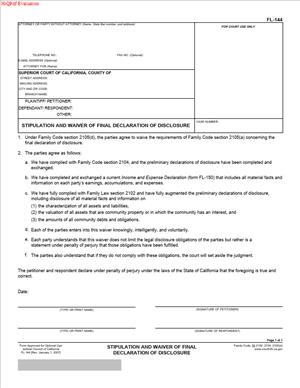
The Stipulation and Waiver of Final Declaration of Disclosure, FL-144, provides a way to record that agreement.
Read each statement before signing. If a pension value is missing or a business interest remains unexplained, ask whether you can truthfully make those statements. Do not sign simply because the other person wants to finish quickly.
Default cases have distinct rules. A default without a settlement agreement is not the same as a default with an agreement. There is also a narrow exception involving court-ordered publication or posting and a defaulting respondent. Get the correct instructions for that path. See Family Code section 2110 and FL-140.
Respond to Missing or Incomplete Disclosure
If your spouse has not provided the needed facts, keep a clear record. List each missing item and request it in writing.
Complete your own California divorce disclosure duties. Do not assume the other person’s delay excuses yours.
Section 2107 provides a process for a complying party to request disclosure or more detail. If that request fails, court remedies may include an order compelling a response or limiting evidence. Financial sanctions may also apply, subject to the statute’s exceptions. Family Code section 2107 explains these options.
Get procedural help before filing a motion. Bring your exchanged documents, proof of service, written requests, and any reply. Those records show what remains unresolved.
Conclusion: Make the Exchange Clear and Complete
Good California divorce disclosure starts with complete records and ends with an accurate record of what you shared.
Before moving ahead, check five points:
- Your deadline is based on the right event.
- Every known asset, debt, and income source has been considered.
- The required attachments are included.
- You have separated the exchange package from court filings.
- Key changes have been disclosed, and any waiver is valid.
Use the current forms, read their instructions, and ask for help with uncertain answers. A careful California divorce disclosure package supports informed decisions and makes gaps easier to address.
Frequently Asked Questions
Do We Need Disclosures If We Agree on Everything?
Generally, yes. Agreement alone does not remove first California divorce disclosure duties. Final disclosure may be waived only when the required conditions are met. Special procedures and court-approved exceptions need their own review.
Must I List Property I Owned Before Marriage?
Yes. Disclosure generally includes assets and debts whether or not you claim they are separate or shared. Listing the property does not decide who owns it or how it should be divided.
Do I File My Tax Returns with FL-141?
Do not automatically attach tax returns or the private disclosure package to FL-141. That form reports service. A separate court order or proceeding may require financial records, so check the purpose of the filing.
Can I Skip My Disclosures Until My Spouse Sends Theirs?
Do not assume you can. Your California divorce disclosure deadline applies to your required exchange. Keep proof that you complied and seek help with the procedure for requesting missing facts.
Does FL-144 Waive the First Financial Exchange?
No. FL-144 addresses final disclosure. Its statements include confirmation that first disclosures have already been completed and exchanged. It is not permission to hide information or leave required updates unfinished. See official FL-144.
What If I Find a Mistake After Sending the Forms?
Address it promptly. Find the wrong entry, gather the correct record, and prepare the needed amendment or update. Preliminary disclosures can be amended, and proof of service of the amendment must be filed. Check section 2104(d).
Resources
These primary sources support the article. Form revision dates are the dates printed on the versions reviewed, not a claim that every county-hosted copy will always remain current.
- California Family Code section 2100 — full disclosure and updates: https://leginfo.legislature.ca.gov/faces/codes_displaySection.xhtml?lawCode=FAM§ionNum=2100.
- California Family Code section 2102 — continuing financial duties: https://leginfo.legislature.ca.gov/faces/codes_displaySection.xhtml?lawCode=FAM§ionNum=2102.
- California Family Code section 2104 — preliminary disclosures and deadlines: https://leginfo.legislature.ca.gov/faces/codes_displaySection.xhtml?lawCode=FAM§ionNum=2104.
- California Family Code section 2105 — final disclosures and waiver conditions: https://leginfo.legislature.ca.gov/faces/codes_displaySection.xhtml?lawCode=FAM§ionNum=2105.
- California Family Code section 2107 — noncompliance and remedies: https://leginfo.legislature.ca.gov/faces/codes_displaySection.xhtml?lawCode=FAM§ionNum=2107.
- California Family Code section 2110 — default-related disclosure rules: https://leginfo.legislature.ca.gov/faces/codes_displaySection.xhtml?lawCode=FAM§ionNum=2110.
- Judicial Council FL-140, Declaration of Disclosure — revision July 1, 2013, hosted by Amador Superior Court: https://amador.courts.ca.gov/system/files/forms-and-filings/fl140.pdf
- Riverside Superior Court financial-disclosure packet — includes FL-142 revised July 1, 2025, FL-150 revised September 1, 2024, and FL-141 revised July 1, 2013: https://riverside.courts.ca.gov/system/files?file=financialdisclosure.pdf&rev=05-20-2023-10:07:27pm. The packet cover conflicts with the included FL-142 and FL-141 filing warnings. The article follows the statutes and form instructions; readers should seek local clarification.
- Judicial Council FL-150, Income and Expense Declaration — revision September 1, 2024; contents checked against the court-hosted version in Riverside’s packet: https://courts.ca.gov/sites/default/files/courts/default/2024-11/fl150.pdf
- Judicial Council FL-160, Property Declaration — revision July 1, 2016, hosted by Amador Superior Court: https://amador.courts.ca.gov/system/files/forms-and-filings/fl160.pdf
- Judicial Council FL-144, Stipulation and Waiver of Final Declaration of Disclosure — revision January 1, 2007, hosted by Amador Superior Court: https://amador.courts.ca.gov/system/files/forms-and-filings/fl144.pdf
- Santa Clara Superior Court, Mandatory Financial Disclosures — revised March 30, 2026: https://santaclara.courts.ca.gov/system/files/self-help/mandatory-financial-disclosures_rem.pdf. Used for its local mailing guidance, not as a universal filing checklist.
Disclaimer: The content provided on this blog is for informational purposes only and does not constitute legal, financial, or professional advice.
Contents