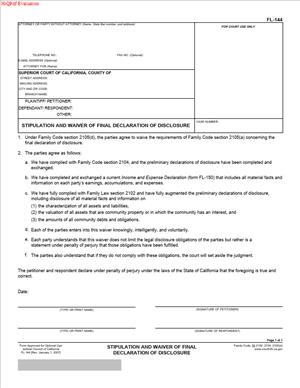
FL-144 – Stipulation and Waiver of Final Declaration of Disclosure
Fill out nowJurisdiction: Country: United States | Province or State: California
FL-144 – Stipulation and Waiver of Final Declaration of Disclosure is a court form used in California family law cases. You use it when both sides agree to give up the requirement to exchange a final financial disclosure before finishing your case.
This document comes up most often in divorce, legal separation, and nullity proceedings. It is part of the financial disclosure process required by the Superior Court of California – Department of Justice – Family Law.
When you file for divorce in California, each side must share detailed financial information. There is an initial disclosure and, in many cases, a final disclosure. This form relates only to the final disclosure stage.
If you are about to sign or file this form, it is important to understand what rights you are giving up, what must already be done, and how it affects the timeline of your case.
What is FL-144 – Stipulation and Waiver of Final Declaration of Disclosure?
Clear definition
FL-144 – Stipulation and Waiver of Final Declaration of Disclosure is a written agreement between both parties in a family law case. By signing it, you both confirm that you want to waive, or give up, the requirement to exchange a final declaration of disclosure.
In California, a declaration of disclosure is a set of financial documents. It typically includes information about income, expenses, assets, debts, and property. The “final” declaration is an updated version exchanged closer to settlement or trial.
This form does not replace the initial disclosure. It only addresses the final round of financial exchange. Both parties must confirm that the initial disclosures were completed before waiving the final step.
The document is filed with the court. It tells the judge that both sides agree to move forward without completing the final disclosure requirement.
Who typically uses this form?
You will usually see this form used by spouses or domestic partners who are resolving their case by agreement. It is common in uncontested divorces or negotiated settlements.
Both the petitioner and the respondent must agree. One side cannot use this form alone. It requires joint participation and signatures.
Self-represented individuals often encounter this form when they are preparing a marital settlement agreement. Attorneys also use it when their clients want to streamline the process after exchanging sufficient financial information.
It is less common in highly contested cases. When there are disputes about hidden assets or complex finances, parties may prefer to complete full final disclosures.
Why might you need this form?
You may need this form if you and the other party have already exchanged enough financial information to feel comfortable settling your case. The final declaration of disclosure is designed to update financial data before judgment. If nothing significant has changed, both sides may decide it is unnecessary.
Using this form can help avoid additional paperwork. It can also reduce delays if you are close to submitting a final judgment package.
The court generally requires confirmation that both parties understand what they are waiving. This form serves as that confirmation.
It also creates a written record. If questions arise later about whether disclosures were completed, the filed form shows that both sides knowingly agreed to waive the final exchange.
Typical real-life scenarios
- You and your spouse may have separated over a year ago and already exchanged detailed financial documents early in the case. Your incomes and assets have not changed. You reach a full settlement and want to finalize your divorce without repeating the same disclosures. In that situation, this form often becomes part of the final paperwork.
- In another case, both parties may have modest finances. There is one home, a few bank accounts, and no business interests. After exchanging initial disclosures and negotiating a settlement, both feel that updated financial forms would not add meaningful information. They sign this form to move forward.
- Sometimes, couples use mediation to resolve property and support issues. During mediation, they share pay stubs, tax returns, and account statements. When they prepare their written agreement, they decide that another formal disclosure package is unnecessary and use this document to reflect that agreement.
- There are also situations where the case has been pending for some time, but both parties have remained transparent about financial changes. They may have informally updated each other about job changes or new debts. Once they are ready to finalize, they use this form to avoid a technical delay related to final disclosures.
When would you use FL-144 – Stipulation and Waiver of Final Declaration of Disclosure?
You typically use this form near the end of your case. It comes after initial disclosures have been exchanged and before a judgment is entered.
In many California divorce cases, the law requires each party to serve a preliminary declaration of disclosure. Later, before trial or settlement, a final declaration may also be required. This form is used when both sides agree to skip that final step.
If you are preparing a stipulated judgment, meaning both sides agree on all terms, this form may be included in your judgment packet. It helps confirm that the disclosure requirements have been addressed.
The petitioner and respondent both play a role here. Each must confirm that they have complied with initial disclosure requirements. Each must also state that they understand the right to receive a final declaration from the other side.
You might also use this form if your financial circumstances have remained stable since the initial disclosures. If there have been no significant changes in income, assets, or debts, both parties may decide that updated forms are not necessary for a fair settlement.
This form is generally not used at the beginning of a case. It is tied to the final stages, when you are preparing for judgment or closing out your matter.
Legal characteristics of FL-144 – Stipulation and Waiver of Final Declaration of Disclosure
This document is a mutual waiver. That means both sides give up the same right. It becomes effective when properly completed, signed by both parties, and filed with the court as part of the case record.
For it to be valid, initial declarations of disclosure must already have been properly served. The form includes statements confirming this. If those earlier steps were not completed, signing this waiver does not fix that problem.
Accuracy matters. The case caption, party names, and case number must match the court’s records. Incomplete or inconsistent information can cause processing delays or rejection of your judgment package.
Signatures are essential. Both parties must sign the form. If one signature is missing, the court will not treat it as a valid mutual waiver.
This form does not disclose any financial information itself. It does not list assets or debts. Instead, it states that you are choosing not to require an updated financial exchange.
It also does not resolve property division, support, or custody issues. Those terms must appear in a separate agreement or court order. This form only addresses the procedural requirement of final financial disclosure.
Court practices can vary slightly by county. Some courts review disclosure documents closely before entering judgment. Others focus mainly on whether required forms are filed. Even so, the core legal requirement that both sides knowingly waive the final disclosure remains consistent across California family courts.
Common problems include signing the form too early, before initial disclosures are complete, or misunderstanding what is being waived. Another issue can arise if one party later claims they did not fully understand the financial situation at the time of signing. Clear communication and accurate prior disclosures are central to avoiding disputes.
Is it legally binding?
When properly completed and filed, this form is generally legally binding as to the waiver of the final declaration of disclosure. By signing, you are formally stating that you understand your right to receive a final disclosure and that you are choosing to give up that right.
The binding effect depends on voluntary and informed consent. Each party must sign freely. If a court later finds that a signature was obtained through fraud, mistake, or serious misrepresentation, the validity of the waiver may be questioned.
It is important to understand that the binding nature of this form is limited to the disclosure requirement. It does not prevent a court from reviewing a settlement agreement for fairness where required by law. It also does not automatically shield a judgment from future challenge if there was intentional concealment of assets.
In general, once accepted as part of a final judgment package, the waiver becomes part of the official court record. At that point, it carries the same weight as other filed agreements in the case.
How to fill out FL-144 – Stipulation and Waiver of Final Declaration of Disclosure
Step 1 – Complete the court caption
At the top of the form, fill in the name of the court, the county, and the court address as shown on other documents in your case. Enter the full names of the petitioner and respondent exactly as they appear in prior filings. Add the case number assigned by the court. This information must match the existing case record.
Step 2 – Review the statements about initial disclosure
Read the section that confirms each party has completed and served their preliminary declaration of disclosure. Make sure this is accurate based on what has already happened in your case. The form relies on this confirmation to support the waiver of the final disclosure.
Step 3 – Confirm understanding of the waiver
Locate the section where both parties acknowledge their right to receive a final declaration of disclosure. This part states that you understand what a final disclosure includes and that you are choosing to waive it. Read each statement carefully before proceeding.
Step 4 – Verify there are no outstanding disclosure disputes
Ensure that there are no unresolved issues about missing financial information. The form assumes that both sides are satisfied with the information already exchanged. If there are open questions or incomplete data, those concerns need to be addressed before signing.
Step 5 – Sign and date the form
Each party must sign and date the form in the designated signature area. Use the same name format that appears in the caption. The dates next to each signature should reflect when the form is actually signed.
Step 6 – Prepare the form for filing
Make a copy of the completed and signed document for your records. The original is typically included in your judgment package or filed with other required documents. Ensure that all pages are included and that signatures are clear and legible.
Step 7 – Include the form in your final submission
Place the completed FL-144 – Stipulation and Waiver of Final Declaration of Disclosure with the rest of your final paperwork, such as your proposed judgment or settlement agreement. Check that the case number appears on every page if required by local practice. Once submitted, it becomes part of the court file and supports entry of judgment without a final declaration of disclosure.
Legal terms you might encounter in FL-144 – Stipulation and Waiver of Final Declaration of Disclosure
- Stipulation: A stipulation is a written agreement between you and the other party. In this document, it means you both agree to give up the requirement to exchange final financial disclosure forms. You are telling the court that this decision is mutual and voluntary.
- Waiver: A waiver is the act of giving up a legal right. Here, you are giving up the right to receive the other party’s final declaration of disclosure. You are also confirming that you understand what you are giving up before you sign.
- Final Declaration of Disclosure: This is a set of financial documents normally exchanged before a case is finalized. It updates income, expenses, assets, and debts. By signing this form, you confirm that you are choosing not to require this final exchange.
- Preliminary Declaration of Disclosure: This is the first required financial disclosure in a family law case. This form assumes that both sides have already completed and exchanged these initial disclosures. You are confirming that the step is done before waiving the final one.
- Income and Expense Declaration: This document lists your current earnings and monthly expenses. It is often part of financial disclosures. When you waive the final declaration, you are agreeing not to require an updated version of this information before judgment.
- Schedule of Assets and Debts: This form details what you own and what you owe. It is central to property division. By signing this waiver, you state that you are satisfied with the information already exchanged about assets and debts.
- Community Property: Community property generally includes assets and debts acquired during the marriage or domestic partnership. Financial disclosures are meant to identify and value this property. Waiving final disclosure means you are proceeding based on the information already provided about it.
- Separate Property: Separate property usually includes assets owned before the marriage or received as a gift or inheritance. Accurate disclosure helps confirm what is separate versus community. When you sign, you confirm you are comfortable moving forward without further updated disclosures about these classifications.
- Judgment: The judgment is the final court order that resolves your case. This form is typically filed before the judgment is entered. It allows the court to finalize your case without requiring proof of a final financial exchange.
- Service: Service means formally delivering legal documents to the other party. Financial disclosures must usually be served, though not filed. This waiver confirms that proper service of preliminary disclosures already occurred.
FAQs
Do both of us have to sign this document?
Yes. This document is only valid if both parties sign it. If one person refuses to sign, you cannot waive the final declaration of disclosure. In that situation, the final financial disclosures would still need to be prepared and served before the case can move forward to judgment.
What am I confirming when I sign FL-144 – Stipulation and Waiver of Final Declaration of Disclosure?
You are confirming that you have already exchanged your preliminary financial disclosures and that you understand your right to receive a final update. By signing FL-144 – Stipulation and Waiver of Final Declaration of Disclosure, you are stating that you choose not to require that final exchange. You are also confirming there are no outstanding disputes about financial information.
Does this document get filed with the court or just exchanged?
Unlike the financial disclosures themselves, this document is filed with the court. The underlying financial forms are generally served on the other party but not filed. This form becomes part of the official court record and allows the judge to proceed without proof of a final disclosure exchange.
What happens if we sign this and later discover an undisclosed asset?
Signing this document does not excuse intentional nondisclosure. Each party still has an ongoing duty to fully and accurately disclose assets and debts. If something significant was hidden or omitted, that issue can still create legal consequences even after judgment.
Can we sign this if our financial situation has changed recently?
You can, but you should think carefully. This document means you are choosing not to require updated financial information before finalizing your case. If income, debts, or assets have changed and those changes matter to support or property division, you may want updated disclosures before signing.
Is there an effective date on this form?
The effective date is generally the date both parties sign. There is no separate “start date” field for changing your rights later. What matters is that both signatures are completed before you submit it with your final paperwork, so the court can accept it.
Do we need to attach our financial forms to this document?
No. You do not attach the preliminary or final financial disclosure forms to this document. You are only confirming that the required preliminary disclosures were exchanged. The court relies on your signed statement rather than reviewing the underlying financial paperwork.
What if our names are spelled differently here than on earlier filings?
The names on this document should match the case caption exactly as it appears in prior filings. If there is a mismatch, the clerk may reject the filing. Before submitting, compare the case number, party names, and roles to your earlier documents to avoid delays.
Checklist: Before, During, and After FL-144 – Stipulation and Waiver of Final Declaration of Disclosure
Before
- Confirm that both parties completed and served their preliminary declarations of disclosure.
- Review your most recent income, asset, and debt information for accuracy.
- Compare current financial facts to what was previously disclosed.
- Resolve any disputes about missing or unclear financial information.
- Make sure you understand what rights you are giving up.
- Locate your correct case number and court caption.
- Ensure both parties are willing to sign voluntarily.
- Check that your settlement terms are complete and consistent with disclosed information.
During
- Enter the full court name and case number exactly as shown on prior filings.
- List party names exactly as they appear in the case caption.
- Carefully read each statement before signing.
- Confirm that no final disclosure has been exchanged if you are waiving it.
- Verify there are no pending requests for additional financial documents.
- Sign and date the form clearly.
- Have the other party sign and date the form.
- Review the completed form for blank fields or errors.
After
- Make at least two copies of the signed form.
- Include the original in your final judgment submission packet.
- Submit the form using the court’s accepted filing method.
- Check that the clerk accepts the filing without rejection.
- Keep a stamped copy for your personal records.
- Store it with your settlement agreement and judgment paperwork.
- Monitor your case status to confirm the judgment is processed.
- Update your financial and personal records once the case is finalized.
Common mistakes to avoid with FL-144 – Stipulation and Waiver of Final Declaration of Disclosure
- Mistake: Signing without completing preliminary disclosures first, often because you want to finish quickly, which can delay judgment or cause rejection, so do not forget to confirm both sides served initial disclosures.
- Mistake: Assuming this form replaces full financial honesty, which happens when parties misunderstand its purpose, leading to serious consequences if assets were hidden, so do not forget your ongoing duty to disclose.
- Mistake: Filing the financial disclosure documents themselves with the court, because the process feels unclear, which can create privacy issues or clerk rejection, so do not forget that this form is filed but disclosures are usually only served.
- Mistake: Using inconsistent names or the wrong case number, often from copying older drafts, which can result in filing delays, so do not forget to match the caption exactly.
- Mistake: Leaving a signature or date blank, usually due to rushing, which makes the form invalid, so do not forget that both parties must sign and date.
- Mistake: Waiving final disclosure despite major recent financial changes, often to speed up settlement, which can create unfair outcomes, so do not forget to reassess whether updated information is necessary.
- Mistake: Submitting the form without including it in the final judgment packet, because you assume it stands alone, which may stall court approval, so do not forget to coordinate it with your other final documents.
- Mistake: Not keeping a filed copy, which happens when you rely on memory, causing stress if questions arise later, so do not forget to store a stamped copy with your records.
What to do after filling out FL-144 – Stipulation and Waiver of Final Declaration of Disclosure
Once you complete and sign the form, your focus shifts to proper filing and follow-through. This step is about making sure the court can finalize your case without delay. Small administrative errors can slow things down, so be methodical.
Start by reviewing the entire document again. Check signatures, dates, spelling of names, and the case number. Make sure nothing is blank.
- Step 1: Make at least two complete copies of the signed form for your records.
- Step 2: Place the original signed form into your final judgment packet.
- Step 3: Confirm that your settlement agreement or proposed judgment matches the financial understanding reflected in your disclosures.
- Step 4: Submit the full packet using the court’s required filing method.
- Step 5: Pay any required filing fees if applicable.
- Step 6: Obtain confirmation that the clerk accepted the filing.
- Step 7: Calendar a reminder to check the status of your judgment.
- Step 8: Keep your filed copy in a safe place with all family law paperwork.
- Step 9: Update your personal financial records to reflect the finalized property division.
- Step 10: Monitor mail or electronic notices for the entered judgment.
After filing, stay organized. If the court rejects your submission for any reason, act quickly to correct the issue. Delays often happen because of small technical errors, not major legal problems.
Once the judgment is entered, review it carefully. Make sure it reflects your agreement and expectations. Store the judgment and this form together. You may need them later for refinancing, retirement account transfers, or enforcement issues.
Good recordkeeping now saves time and stress later. Treat this step as the final quality check before your case officially closes.
Disclaimer: This guide is provided for informational purposes only and is not intended as legal advice. You should consult a legal professional.