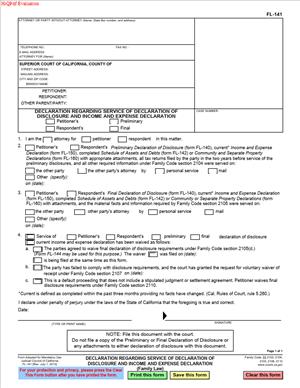
FL-141 – Declaration Regarding Service of Declaration of Disclosure and Income and Expense Declaration
Fill out nowJurisdiction: Country: United States | Province or State: California
The FL-141 – Declaration Regarding Service of Declaration of Disclosure and Income and Expense Declaration is a court form used in California family law cases. It tells the court that you have properly shared the required financial documents with the other party.
If you are going through a divorce, legal separation, or nullity case, financial disclosure is part of the process. This form does not list your finances. Instead, it confirms that you delivered the required disclosure documents to the other side.
You file this form with the court after serving your financial disclosures. It acts as proof that you completed that step. Without it, the court may not move your case forward.
This document is about transparency. It shows that both sides are exchanging financial information, which helps ensure fairness in decisions about property, support, and related issues.
What is FL-141 – Declaration Regarding Service of Declaration of Disclosure and Income and Expense Declaration?
Clear definition
FL-141 – Declaration Regarding Service of Declaration of Disclosure and Income and Expense Declaration is a declaration filed with the Superior Court of California in family law cases. It confirms that you served your Declaration of Disclosure and, when required, your Income and Expense Declaration on the other party.
In simple terms, it is a statement under penalty of perjury. You are telling the court that you delivered certain financial forms to your spouse or domestic partner, or to their attorney.
The form does not include your financial details. Those are contained in separate documents. FL-141 only addresses service, meaning the act of formally delivering those documents.
Who typically uses this form?
This form is commonly used by petitioners and respondents in divorce or legal separation cases. If you started the case, you may file it after serving your preliminary disclosure documents. If you are responding, you may also use it after serving your own disclosures.
Self-represented individuals often complete this form on their own. Attorneys also prepare and file it on behalf of their clients.
Both parties in a case usually complete and file their own FL-141. Each side must confirm service of its own disclosures.
Why might you need this form?
California family law requires each party to exchange financial information early in the case. This includes assets, debts, income, and expenses.
After you serve these financial documents, the court expects proof that service occurred. FL-141 provides that proof.
In many cases, the court will not enter a final judgment until both sides have filed their declarations regarding service. If this form is missing, your case may stall.
This form also creates a record. If there is later disagreement about whether disclosures were exchanged, the filed declaration shows when service was completed.
Typical real-life scenarios
- You file for divorce and complete your preliminary Declaration of Disclosure. You arrange for someone to mail it to your spouse. After it is mailed, you complete FL-141 to confirm that service took place.
- You respond to a divorce petition and prepare your own Income and Expense Declaration. You have it personally served on the petitioner. You then file this form to inform the court that you completed that step.
- You and your spouse are working toward a settlement. Before submitting your agreement to the court, you each file your declarations regarding service to show that full financial disclosure occurred.
- Your case has been pending for several months. The court requires confirmation that both sides exchanged financial documents before scheduling further hearings. Filing this form satisfies that requirement.
When would you use FL-141 – Declaration Regarding Service of Declaration of Disclosure and Income and Expense Declaration?
You use this form after you serve your required financial disclosure documents in a family law case. It is not filed at the very beginning of the case. It comes after you have prepared and delivered the necessary financial forms.
In many divorce cases, each party must serve a preliminary Declaration of Disclosure. This often happens early in the process. Once you complete service, you prepare and file FL-141 to notify the court.
You may also use this form when serving a final Declaration of Disclosure. In some cases, parties exchange updated financial information before trial or settlement. After serving those final disclosures, you again use this form to confirm service.
Both petitioners and respondents use it. The key factor is whether you have served the required financial disclosure documents. The form is tied to that event, not to a specific role in the case.
If your case involves issues such as property division or spousal support, financial transparency is central. This form supports that process by documenting that disclosure occurred.
Legal characteristics of FL-141 – Declaration Regarding Service of Declaration of Disclosure and Income and Expense Declaration
This form is a declaration made under penalty of perjury. That means you are legally stating that the information you provide about the service is true.
For the form to be effective, it must accurately identify the case. This includes the correct court name, case number, and party names. Errors in these details may cause delays or rejection.
The declaration must reflect proper service. In family law cases, financial disclosures are usually not filed with the court. Instead, they are served on the other party. The form confirms that the service took place in a legally recognized way, such as by mail or personal delivery.
Common problems include failing to complete all required sections, listing the wrong documents as served, or not signing the declaration. An unsigned form is typically not accepted.
The form does not replace the requirement to actually serve the disclosure documents. Filing FL-141 without having served the required forms does not satisfy disclosure obligations.
It also does not resolve disputes about whether the disclosures were complete or accurate. It only states that they were served.
While this form is specific to California family law, procedures can vary slightly between counties in how filings are processed. The core purpose remains the same statewide.
Is it legally binding?
Yes, in the sense that it is a sworn declaration. When you sign it, you are making a statement under penalty of perjury. False statements can carry serious consequences.
The binding effect relates to the truth of the declaration. You are legally responsible for the accuracy of what you state about the service.
However, the form itself is not a contract. It does not create new financial obligations or agreements between the parties. It documents compliance with an existing legal requirement.
Its legal importance lies in moving the case forward. Courts often require proof of service of disclosures before granting certain relief or entering judgment. Filing this declaration helps demonstrate that you have met that procedural requirement.
How to fill out FL-141 – Declaration Regarding Service of Declaration of Disclosure and Income and Expense Declaration
Step 1 – Complete the court and case information
At the top of the form, fill in the name of the court, the court’s address, and the branch name if required. Enter the full names of the petitioner and respondent exactly as they appear in your case. Write the correct case number. This information must match your other filed documents.
Step 2 – Identify yourself and your role in the case
Indicate whether you are the petitioner or the respondent. Provide your name and contact information in the space designated for the party without an attorney if you are self-represented. If you have an attorney, their information is typically listed in the attorney section.
Step 3 – Select the type of disclosure served
The form includes options to indicate what you served. Mark whether you served a preliminary Declaration of Disclosure, a final Declaration of Disclosure, or both. If the Income and Expense Declaration was included, reflect that as required by the form.
Ensure that your selections match the documents you actually delivered. The declaration must accurately describe what was served.
Step 4 – Provide the date and method of service
Enter the date on which the disclosure documents were served. Indicate the method used, such as personal service or service by mail, if the form requires that detail.
The date should match the proof of service associated with your disclosure documents. Consistency across documents helps avoid questions about timing.
Step 5 – Confirm compliance with disclosure requirements
The form includes language stating that you have complied with the applicable disclosure requirements. Read this section carefully before signing.
By completing this section, you are confirming that you served the required documents in accordance with the rules governing financial disclosure in family law cases.
Step 6 – Sign under penalty of perjury
At the end of the form, print your name, enter the date, and sign where indicated. Your signature affirms that the information in the declaration is true and correct.
Review the entire document before signing. Make sure names, dates, and selections are accurate. Once signed, file the completed form with the court clerk in your case.
Legal terms you might encounter in FL-141 – Declaration Regarding Service of Declaration of Disclosure and Income and Expense Declaration
- Declaration: A written statement you sign under penalty of perjury. On this form, you are declaring that you properly served specific financial disclosure documents on the other party. The court relies on your declaration instead of requiring live testimony about service.
- Service: The formal act of delivering legal documents to another party. In this context, service refers to delivering your financial disclosures, not necessarily filing them with the court. This form records how and when that delivery happened.
- Preliminary Declaration of Disclosure: The first required exchange of financial information in a family law case. It typically includes a schedule of assets and debts and an income and expense declaration. This document confirms that you served those preliminary disclosures.
- Final Declaration of Disclosure: The updated and complete exchange of financial information before a case is resolved. Not every case requires a final declaration, but if you complete one, you must document service. This form allows you to confirm that step.
- Income and Expense Declaration: A detailed form that lists your income, monthly expenses, and financial obligations. When you serve this on the other party, you must record that service here. The court uses this information to evaluate support and financial issues.
- Proof of Service: Evidence that documents were delivered properly. While the financial disclosures themselves are not filed with the court, this document serves as proof that service occurred. It becomes part of the court file.
- Penalty of Perjury: A legal statement that you swear the information is true and correct. If you knowingly provide false information, you can face serious consequences. Your signature gives this document legal weight.
- Party: Each person involved in the case, typically labeled as petitioner and respondent. You must clearly identify which party you are and which party received the disclosures. Accuracy here prevents confusion in the court record.
- Case Number: The unique identifier assigned to your court case. This number must match exactly what appears on other filed documents. It connects this document to your specific case file.
FAQs
Do I file my financial disclosure forms with the court along with FL-141 – Declaration Regarding Service of Declaration of Disclosure and Income and Expense Declaration?
No. You generally do not file your actual financial disclosure forms with the court. You serve them on the other party. This form is what you file to tell the court that you completed that service. Make sure you keep copies of the financial documents you served in your own records.
What date do I put as the date of service?
You enter the exact date the other party was served with your disclosure documents. This is the date the documents were mailed, personally delivered, or otherwise legally served. Do not use the date you filled out this document unless that is also the date the service actually occurred.
Who is allowed to serve the disclosure documents?
In most cases, someone over 18 who is not a party to the case must serve the documents. You usually cannot serve the other party yourself. The person who completed the service provides the information needed for you to complete this document accurately.
What if I made a mistake in the service method or date?
If you entered the wrong date or selected the wrong method of service, correct it before filing. If the document has already been filed, you may need to complete a new form with the correct information. The court record should reflect exactly how and when service happened.
Do both parties need to complete this document?
Yes. Each party that is required to serve financial disclosures must file its own declaration confirming service. You are only reporting your own service. The other party must file their own document confirming they served you.
What happens if I do not file this document?
If you do not file this document, the court may treat your disclosures as incomplete. That can delay hearings, settlement, or judgment. The court may refuse to finalize your case until proper service is documented.
What should I double-check before signing under penalty of perjury?
Confirm that the names of both parties match the case caption exactly. Verify the case number, the date of service, and the type of disclosures served. Make sure the method of service listed matches what actually occurred. Once you sign, you are legally stating that all information is accurate.
Does filing this form change the public record?
This document becomes part of the public court file. It shows that disclosures were served but does not include your private financial details. The actual financial forms you served are not placed in the public file, which helps protect your sensitive information.
Checklist: Before, During, and After FL-141 – Declaration Regarding Service of Declaration of Disclosure and Income and Expense Declaration
Before
- Confirm you completed your required financial disclosure forms in full.
- Make copies of all disclosure documents for service.
- Arrange for a qualified adult who is not a party to serve the documents.
- Verify the other party’s correct mailing or service address.
- Check your case number and court name from a filed document.
- Review whether you are serving preliminary or final disclosures.
- Ensure all attachments to your financial forms are included.
During
- Confirm the server uses the correct method of service.
- Record the exact date service is completed.
- Identify clearly which disclosure forms were served.
- Enter party names exactly as they appear on court documents.
- Mark the correct boxes for preliminary or final disclosures.
- Review every line for accuracy before signing.
- Sign and date the form under penalty of perjury.
After
- Make at least two copies of the signed document.
- File the original with the court clerk.
- Confirm the clerk accepts and processes the filing.
- Keep a stamped copy for your personal records.
- Organize your financial disclosures and proof of service together.
- Calendar any next deadlines in your case.
- Check the court docket to confirm the filing appears.
Common mistakes to avoid with FL-141 – Declaration Regarding Service of Declaration of Disclosure and Income and Expense Declaration
- Mistake: Filing your financial disclosure documents with the court instead of just serving them, which happens because people assume all forms must be filed, leading to rejected filings or privacy concerns; do not forget that only this declaration is typically filed.
- Mistake: Serving the documents yourself, which happens when self-represented parties try to save time, resulting in improper service that can delay your case; do not forget that a non-party adult must usually complete service.
- Mistake: Entering the wrong date of service, often because you use the signing date instead of the actual delivery date, which can create inconsistencies in the court record; do not forget to confirm the exact day service occurred.
- Mistake: Checking the wrong box for preliminary versus final disclosures, which happens when you are unsure which stage you are in, causing confusion about compliance; do not forget to verify which disclosure requirement you are satisfying.
- Mistake: Using a nickname or misspelled name in the caption, which happens when copying from memory, leading to clerical issues or delays; do not forget to match the names exactly as they appear in the case.
- Mistake: Forgetting to sign under penalty of perjury, which happens during rushed filings, resulting in an incomplete document, the clerk may reject; do not forget that your signature gives the form legal effect.
- Mistake: Failing to keep copies, which happens when focusing only on filing, making it hard to prove what was submitted later; do not forget to store stamped copies safely.
- Mistake: Filing before service is actually completed, which happens when trying to move the case forward quickly, creating a false record of compliance; do not forget that service must occur before you declare it.
What to do after filling out FL-141 – Declaration Regarding Service of Declaration of Disclosure and Income and Expense Declaration
Once you complete the form, slow down and review it carefully. Small errors can cause delays. Confirm that every required box is checked and that the date of service is accurate.
- Step 1: Make at least two copies of the signed form.
- Step 2: Organize the original and copies in the correct order.
- Step 3: Submit the original to the court clerk for filing.
- You may file in person or through any available filing method allowed in your case. When filing in person, ask the clerk to stamp your copies. If filing electronically, download and save the confirmation receipt.
- Step 4: Confirm the filing was accepted and not rejected.
- Step 5: Save a stamped or confirmed copy in your case folder.
- Step 6: Store copies of the financial disclosures you served in a secure place.
- Keep your disclosure documents and this filed declaration together. If a question arises later about whether you complied with disclosure rules, you will have clear records.
- Step 7: Update your personal case timeline to reflect the date of service and filing.
- Step 8: Review upcoming court dates or deadlines that depend on completed disclosures.
- If your case requires a final declaration of disclosure later, mark a reminder so you do not miss that step. Proper documentation now makes settlement discussions and court hearings smoother.
- Step 9: Bring a copy of the filed declaration to any hearing if financial issues are discussed.
- Step 10: Maintain organized records until your case is fully resolved and any judgment is entered.
Staying organized shows the court that you are taking your responsibilities seriously. It also reduces stress because you know your paperwork is complete and properly documented.
Disclaimer: This guide is provided for informational purposes only and is not intended as legal advice. You should consult a legal professional.