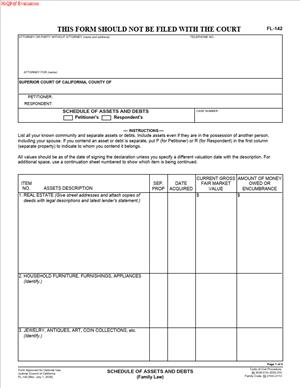
FL-142 – Schedule of Assets and Debts
Fill out nowJurisdiction: Country: United States | Province or State: California
If you are going through a divorce or legal separation in California, you may need to complete FL-142 – Schedule of Assets and Debts. This form lists what you own and what you owe. It gives the court and the other party a clear picture of your financial situation.
FL-142 – Schedule of Assets and Debts is part of the financial disclosure process in family law cases. It focuses on property and debts, not income or expenses. You use it to identify everything acquired before and during your marriage or domestic partnership.
This document matters because California is a community property state. Property and debts may be divided between spouses. A complete and accurate filing helps avoid disputes and delays.
You are expected to be thorough. Missing or incorrect information can cause serious problems later in your case. The court relies on this disclosure to move the process forward fairly.
What is FL-142 – Schedule of Assets and Debts?
Clear definition
FL-142 – Schedule of Assets and Debts is a California family law form used to disclose all assets and debts in a divorce, legal separation, or annulment case. It is filed as part of your financial disclosures.
The form asks you to list real estate, bank accounts, retirement accounts, vehicles, business interests, personal property, and any other assets. It also asks you to list credit cards, loans, mortgages, and other liabilities.
You must identify whether each item is community property, separate property, or a combination. Community property is generally property acquired during the marriage. Separate property often includes assets owned before marriage or received as a gift or inheritance.
This document creates a financial snapshot. It allows both sides to understand what is potentially subject to division.
Who typically uses this form?
This form is commonly used by spouses or domestic partners in California who are ending their relationship through the court system.
You may complete it if you filed the petition. You may also complete it if you are responding to a petition. Both parties are generally required to exchange financial disclosures.
Self-represented individuals often use this form without an attorney. It is also used by people who have attorneys but are responsible for gathering their own financial information.
Why might you need this form?
You may need this form to meet mandatory financial disclosure requirements in a California family law case. Courts expect both sides to share complete and accurate financial information early in the process.
Without this document, property division cannot move forward. Judges and mediators rely on full disclosure to help resolve disputes.
It also protects you. By listing your separate property clearly, you create a record of what you believe belongs to you alone.
If you later negotiate a settlement, the information in this filing often becomes the foundation for those discussions.
Typical real-life scenarios
- You and your spouse are divorcing after ten years of marriage. During that time, you bought a home, opened joint bank accounts, and accumulated credit card debt. You use this form to list each asset and each debt so the court can understand what exists.
- You owned a car and a retirement account before you got married. You list those as separate property. This helps clarify what may not be divided.
- You and your partner ran a small business together. You include the business as an asset, along with any business loans. Even if the value is uncertain, you disclose its existence.
- You separated recently but still share a mortgage and joint credit cards. You list the remaining balances as debts. This shows the court what financial obligations still need to be addressed.
When would you use FL-142 – Schedule of Assets and Debts?
You typically use this form during a divorce, legal separation, or annulment case in California. It is part of the required financial disclosure process.
The form is often completed after you file or respond to the initial petition. It is usually exchanged with the other party along with other financial documents.
If you are the petitioner, you prepare it to disclose your assets and debts. If you are the respondent, you also prepare your own version. Each party completes its own form.
This document may also be used before settlement discussions or mediation. Having a clear list of property and debts makes negotiations more productive.
If your case goes to trial, the information in this filing may be referenced during hearings about property division. It becomes part of the overall financial record of the case.
Legal characteristics of FL-142 – Schedule of Assets and Debts
FL-142 – Schedule of Assets and Debts is a formal court document. It is signed under penalty of perjury. This means you declare that the information is true and correct to the best of your knowledge.
The form becomes effective as part of your financial disclosure when it is properly completed, signed, and served according to court procedures. It is not simply a worksheet. It carries legal weight.
Common problems include leaving out accounts, underreporting values, or failing to identify whether the property is separate or community. Incomplete forms can lead to delays. In serious cases, nondisclosure may affect how property is divided.
In California, community property laws shape how assets and debts are viewed. Other states may use different systems, such as equitable distribution. The structure of this form reflects California’s approach.
This document does not divide property by itself. It does not transfer ownership. It only discloses information. A settlement agreement or court order is needed to actually divide assets and debts.
Is it legally binding?
The act of signing the form is legally significant because you sign under penalty of perjury. You are stating that your disclosures are accurate.
However, the form itself does not create a binding agreement between you and the other party about who gets what. It is a disclosure document, not a contract.
If both parties later reach a written agreement about property division, that agreement may become binding once approved by the court. The disclosure form supports that process by showing what exists.
Providing false or incomplete information can have legal consequences. Courts expect honesty and full transparency in financial disclosures.
How to fill out FL-142 – Schedule of Assets and Debts
Step 1 – Complete the case caption
At the top of the form, fill in your name, address, and contact information as required. Enter the court name and location. Add the case number exactly as it appears on other filed documents. Identify yourself as the petitioner or respondent.
Step 2 – Read the instructions carefully
Before writing anything, review the entire form. Notice how assets are grouped into categories. Pay attention to where you must indicate whether the property is community, separate, or mixed. This helps you organize your information before entering it.
Step 3 – List real estate
In the section for real property, list any homes, land, or other real estate. Include the address and a brief description. Provide an estimated fair market value. Also, list any loans or liens attached to the property.
Indicate whether you believe each property is community or separate. If it is partly both, mark it accordingly.
Step 4 – List personal property and financial accounts
Enter information about bank accounts, retirement accounts, investment accounts, vehicles, and valuable personal items. Include account names and the last known balances or estimated values.
Be consistent. Use recent statements if available to estimate values. Clearly mark the property type for each item.
Step 5 – Disclose business interests and other assets
If you own a business or have an ownership interest in one, list it. Include any professional practices, partnerships, or corporations. Provide an estimated value if known.
Also include items such as stock options, intellectual property, or expected refunds. If you are unsure of the value, you can note that the value is unknown but still disclose the asset.
Step 6 – List debts and liabilities
In the debt section, list credit cards, personal loans, student loans, car loans, mortgages, and any other obligations. Include the creditor’s name and the current balance.
Indicate whether each debt is community or separate. Even if a debt is only in one person’s name, it may still be considered community depending on when it was incurred.
Step 7 – Review and double-check your entries
Go through each section to confirm that nothing is missing. Think about all financial accounts, even those with small balances. Check that you marked the property type for every item.
Make sure the values are reasonable estimates based on available information. Correct any blanks or unclear entries.
Step 8 – Attach additional pages if necessary
If you run out of space in any section, attach additional sheets. Clearly label them with the corresponding section title. Make sure your name and case number appear on each added page.
Keep your formatting clear so the information is easy to read.
Step 9 – Sign and date the form
At the end of the form, sign your name and enter the date. By signing, you declare under penalty of perjury that the information is true and correct.
Review the completed document one final time before signing. Once signed, it becomes your official financial disclosure in the case.
Legal terms you might encounter in FL-142 – Schedule of Assets and Debts
- Community Property: Property acquired during the marriage or domestic partnership that is generally considered jointly owned. On this form, you must identify whether each asset or debt is community or separate. This classification affects how property may be divided later.
- Separate Property: Property owned by one spouse or partner alone. This often includes assets acquired before marriage, after separation, or by gift or inheritance. You must clearly indicate when you believe an item is separate property and provide the date it was acquired.
- Date of Separation: The date when one spouse decided to end the marriage and acted on that decision. This date matters because property and debts acquired after separation may be treated differently. You should use the same separation date consistently throughout your case documents.
- Fair Market Value: The amount an asset could reasonably sell for on the open market. When listing real estate, vehicles, or valuable items, you must estimate their current fair market value. Use realistic numbers based on recent statements, appraisals, or comparable sales.
- Encumbrance: A legal claim against property, such as a mortgage or lien. When you list real estate or other secured assets, you must also disclose any encumbrances. This shows the net value after subtracting what is owed.
- Net Value: The value of an asset after deducting any loans or liens. You calculate this by subtracting the debt from the fair market value. This number helps the court and the other party understand what the property is actually worth to you.
- Contingent Asset or Debt: A possible asset or liability that depends on a future event. Examples include pending lawsuits, expected bonuses, or potential tax liabilities. You must disclose these even if the outcome is uncertain.
- Disclosure: The legal duty to share complete and accurate financial information. This form is part of your required financial disclosure. Failing to disclose assets or debts can lead to penalties or the reopening of the case.
- Declaration Under Penalty of Perjury: Your signed statement that the information is true and correct. When you sign, you confirm that everything listed is accurate to the best of your knowledge. Providing false information can have serious consequences.
- Attachment: An extra page you add when there is not enough space on the form. You must clearly label attachments and reference the item number they relate to. Attachments become part of your official disclosure.
FAQs
Do I have to list every single account and debt on FL-142 – Schedule of Assets and Debts?
Yes. You must list all assets and debts you have an interest in, whether they are in your name alone, jointly held, or even temporarily inactive. That includes checking accounts, retirement plans, credit cards, personal loans, and online financial accounts. If you are unsure whether something counts, it is safer to disclose it. This document is meant to give a full financial picture.
What value should I enter if I do not know the exact current balance?
Use the most recent statement you have and enter the balance as of that date. If the value changes daily, such as with investment accounts, use the most recent available figure and note the statement date in your records. Keep a copy of the statement you relied on so you can explain how you arrived at the number.
What happens if I discover a forgotten asset after I already filed this form?
You should update your disclosure as soon as you realize something was left out. That usually means preparing an amended version of this document and serving it on the other party. Do not ignore newly discovered information. Keeping your disclosures current helps avoid disputes and possible penalties.
Do I need to attach proof of each asset and debt?
In many cases, you are required to provide supporting documents, such as account statements or loan balances, along with your financial disclosure package. Check the instructions that accompany this form to confirm what attachments are required. Even if not filed with the court, you should have documentation ready in case the other party requests it.
Should the names on my accounts match exactly what I write in this document?
Yes. Use the exact legal name as it appears on the account or title. If an account is held jointly, list both names as shown on the statement. Consistent naming prevents confusion and reduces the risk of challenges about ownership.
Does this form become part of the public record?
In many family law cases, financial disclosures are exchanged between parties but not filed with the court, except for certain cover pages or declarations. You should confirm what is filed and what is only served. Understanding this helps you know what information becomes part of the official court file.
What date should I use when listing the value of my property?
Use a specific, recent date for each value, typically based on your latest statement or a reasonable estimate of current market value. Be consistent and clear in your records about which date applies. If different assets have different statement dates, keep that information organized for reference.
What if the other party disagrees with the values I listed?
Disagreement does not mean you should change your numbers without support. Be prepared to explain how you calculated each value and provide documents. The purpose of FL-142 – Schedule of Assets and Debts is full disclosure, not final agreement on value.
Checklist: Before, During, and After FL-142 – Schedule of Assets and Debts
Before
- Gather recent statements for all bank, retirement, and investment accounts.
- Collect mortgage, auto loan, and credit card statements showing current balances.
- Locate deeds, vehicle titles, and business ownership documents.
- Identify your date of separation and confirm it is consistent across your case.
- Make a list of personal property with significant value, such as jewelry or collectibles.
- Review prior tax returns for information about income sources and assets.
- Set aside time to complete the form without rushing.
During
- Fill in the case caption exactly as it appears on other court documents.
- List each asset in the correct category and avoid combining unrelated items.
- Enter fair market value and debt amounts in the proper columns.
- Clearly mark whether each item is community or separate property.
- Add attachments if you run out of space and label them correctly.
- Double-check account numbers and descriptions for accuracy.
- Review every page before signing under penalty of perjury.
After
- Make at least two copies of the completed form and attachments.
- Assemble it with the rest of your financial disclosure documents.
- Serve the other party according to the required procedures.
- File any required declarations or cover sheets with the court.
- Keep proof of service in your records.
- Store a complete copy in a safe place for future reference.
- Update your disclosure promptly if financial circumstances change.
Common mistakes to avoid with FL-142 – Schedule of Assets and Debts
- Mistake: Leaving out small or inactive accounts because you think they do not matter, which often happens when people overlook old accounts, leading to accusations of hiding assets and possible court penalties, do not forget to review past statements and credit reports.
- Mistake: Guessing at property values without checking statements or market data, which happens when you rush, resulting in unrealistic numbers that damage your credibility, so do not forget to base values on documents or reasonable estimates.
- Mistake: Mislabeling community and separate property because you are unsure about the rules, which can complicate negotiations and delay resolution, so do not forget to identify when and how each asset was acquired.
- Mistake: Forgetting to list debts in only one spouse’s name, assuming they are not shared, which can create an incomplete financial picture and unfair division, so do not forget that disclosure requires listing all obligations.
- Mistake: Failing to attach additional pages when space runs out, which leads to missing information and confusion, so do not forget to clearly label and include every attachment.
- Mistake: Signing without reviewing the entire document, often due to time pressure, which increases the risk of errors under penalty of perjury, so do not forget to carefully read each entry before you sign.
- Mistake: Not updating the form after major financial changes, which happens when cases last several months and accounts change, leading to outdated disclosures, so do not forget to amend when necessary.
- Mistake: Using inconsistent information across different court forms, which often results from copying details from memory, causing credibility issues. Do not forget to cross-check names, dates, and values.
What to do after filling out FL-142 – Schedule of Assets and Debts
Once you complete the form, your job is not finished. Proper handling after completion is just as important as filling it out accurately.
Start by reviewing the entire document one more time. Confirm that every asset and debt you can think of is listed. Check that values are filled in and that you did not leave blank lines by accident.
- Step 1: Make clean copies of the signed form and all attachments.
- Step 2: Organize the form with your other required financial disclosure documents.
- Step 3: Confirm whether this document is filed with the court or only served on the other party.
- Step 4: Arrange for proper service according to the rules that apply to your case.
- Step 5: Complete and keep proof that the documents were served.
- Step 6: File any required declaration confirming you completed your disclosure obligations.
- Step 7: Store a complete copy, including attachments and proof of service, in a secure folder.
- Step 8: Calendar reminders to update the information if your finances change.
- Step 9: Monitor communications from the other party regarding questions or requests for clarification.
- Step 10: Bring a copy of your completed disclosure to any settlement meeting or court hearing.
Keep your records organized. Financial disclosures often become central to settlement discussions. If you need to refer back to a specific value or account, you should be able to find it quickly.
If your case continues for several months, review your disclosure periodically. New debts, closed accounts, or major purchases may require an updated version. Staying proactive reduces stress and prevents last-minute scrambling before hearings or trial.
Finally, treat this document as a foundation for the financial part of your case. Clear, complete disclosure builds credibility and helps move your matter toward resolution.
Disclaimer: This guide is provided for informational purposes only and is not intended as legal advice. You should consult a legal professional.