Plan for filing for divorce in Maryland with clear grounds, a complete document packet, and proper service.
Filing for divorce in Maryland starts a court case. It does not end the marriage on the day you submit paperwork. You need a legal ground for divorce, the right documents, and a valid way to notify your spouse.
Those tasks are connected, but each has its own rules. A signed agreement does not replace a divorce judgment. A filed complaint does not prove service. A mailing receipt does not always show that service was completed.
This guide explains how to prepare, file, and track the first steps. Sources were checked on October 8, 2026. Confirm current forms and your court’s instructions before filing.
Check where you can file
Maryland divorce cases belong in circuit court. The Judiciary’s instructions direct you to the circuit court where you live or where your spouse lives or works. Check the correct county or Baltimore City court before preparing the case heading.
Filing for divorce in Maryland also requires checking residency. You or your spouse must be a Maryland resident. If the divorce grounds arose outside Maryland, at least one spouse must have lived in Maryland for six months before filing. That is a residency rule, separate from the six-month separation ground.
Write down when each spouse began living in Maryland. Note where the facts supporting your divorce ground occurred. If either point is unclear, get help before choosing an answer on the complaint.

Distinguish divorce authority from child custody issues
Children who have lived in another state, existing custody orders, or another pending case can raise added questions. List those cases and keep their orders together. Do not assume a Maryland divorce filing resolves every question about another state’s custody case.
When filing for divorce in Maryland, prepare a short residence history for the children and a list of prior proceedings. A lawyer or Court Help Center attorney can use that information to identify what needs closer review.
Choose a current ground for divorce
A ground is the legal reason the court may grant a divorce. Maryland Family Law § 7-103 provides three grounds: six-month separation, irreconcilable differences, and mutual consent. Choose a ground supported by your facts.
Avoid relying on old lists of fault grounds or a general claim that every couple must wait a year. The current law controls. Read the latest official complaint and instructions, even if someone gives you an older packet.
Six-month separation
This ground requires living separate and apart for six months without interruption before filing. Spouses who pursue separate lives can meet this rule while living under the same roof. A separation under a court order can also qualify.
For filing for divorce in Maryland on this ground, identify the start date and explain the living arrangement accurately. Do not write that you moved out if you stayed in the home. Describe the facts you can support.
For example, two spouses may remain in one house while arranging new housing. The legal question involves whether they pursued separate lives for the required period. Sharing an address alone does not answer that question.
Irreconcilable differences
This means reasons for ending the marriage that cannot be resolved. The complaint must state those reasons. This ground does not carry the six-month separation requirement that applies to the separation ground.
Filing for divorce in Maryland on this basis does not require claiming a six-month separation that never happened. State the relevant reasons clearly. Keep the explanation focused on why the marriage should permanently end.
Choosing this ground does not mean you and your spouse agree about support, custody, or property. Those issues still need an agreement or a court decision. Avoid confusing agreement to end the marriage with agreement on all divorce terms.
Mutual consent
Mutual consent requires a written agreement signed by both spouses. It must resolve alimony, property distribution, and the care, custody, access, and support of minor or dependent children. The court must find the children’s terms are in their best interests. This ground also requires that neither party file a pleading to set aside the agreement before the divorce hearing.
Filing for divorce in Maryland by mutual consent calls for a complete settlement, rather than a promise to settle later. Official Form CC-DR-116 can help document the agreement. Its current instructions address parenting plans, support worksheets, and existing support orders.
Read every term before signing. Identify the account, asset, payment, or parenting task it covers. An unclear phrase such as “we will divide everything fairly” leaves work unresolved. Ask for legal review when major assets or long-term obligations are involved.
Build your document packet
The main starting document is the Complaint for Absolute Divorce, CC-DR-020. A complaint tells the court your facts and what you want it to decide. The person filing is the plaintiff; the spouse responding is the defendant.
Review the Maryland Complaint for Absolute Divorce on RunSensible Forms to understand its role. Use the Judiciary’s current form index to confirm the official version. The index lists the complaint as revised in August 2024.
A filing for divorce in Maryland checklist
Use the table to sort documents by purpose. It is a planning guide. Follow the current instructions and any order for your case.
| Document | When or why it is used |
| CC-DR-020: Complaint for Absolute Divorce | Starts the divorce case and states the requested relief |
| CC-DCM-001: Civil Domestic Case Information Report | Required with the divorce filing |
| CC-DR-116: Marital Settlement Agreement | Supports the mutual-consent ground |
| CC-DR-030 or CC-DR-031: Financial Statement | Depends on support, property claims, and income |
| Parenting plan, or CC-DR-110 if no full agreement | Applies when custody of a minor child is at issue |
| CC-DR-033: Marital and Non-Marital Property Statement | Used for relevant property claims; timing may be later |
| Vital Records report of divorce or annulment | Obtain from the clerk and submit before the hearing ends |
Table alt text: Filing for divorce in Maryland checklist separating starting documents from conditional and later-stage papers.
The divorce instructions identify the case information report as required. They also identify the Vital Records report and the conditional documents above. For relevant property claims, CC-DR-033 is due at least 10 days before trial unless the court sets another date.
Make the complaint match your requests
Before filing for divorce in Maryland, make a separate list of the decisions you want. Consider divorce, child-related orders, alimony, property relief, and restoration of a former name where relevant. Then compare your list with the complaint.
Do not assume the court will infer a request from a story about your finances. Check the sections and attachments for each issue. If you want alimony, address it before the final divorce decree; the Judiciary warns that you cannot first ask afterward.
If you are unsure how to request relief, ask a lawyer or self-help attorney before filing.

Palimony in Maryland: What It Is, Who Can Claim It, and What the Law Says
Keep names, dates, and case numbers consistent. Open each attachment and confirm it belongs to the correct case. A final check is especially useful when documents came from several sources.
Prepare financial and child-related papers
Filing for divorce in Maryland may involve more than ending the marriage. Support, property, and custody requests bring additional paperwork. Start those tasks early, even if some papers are due later.
Choose the financial statement by the issues involved
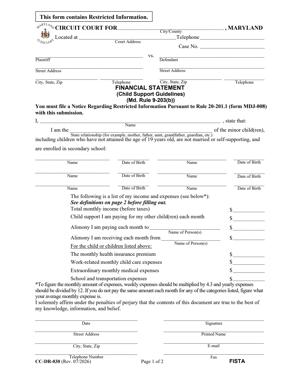
For child support, the Judiciary explains that CC-DR-030 applies when the parents’ combined gross monthly income is $30,000 or less. Above that amount, use CC-DR-031. Gross means before deductions, rather than take-home pay. The general statement also applies to alimony or property distribution requests under the divorce instructions.
Review the Maryland child support financial statement to understand the shorter statement’s role. Check whether your other claims require the general statement. Do not choose solely by income while ignoring an alimony request.
For filing for divorce in Maryland, build figures from records rather than memory. Gather pay information, bills, and account records that help explain your statement. Record the period each number covers. Follow any document request or court order about what must be produced.
A practical mistake is entering a two-week paycheck as monthly income. Another is counting an expense twice. Keep your calculations and mark any estimate so you can explain it later.
Organize income records without creating extra court filings
Useful working records may include filed tax returns, received W-2s, contract-income statements, and business records. These help you check income figures. The exact documents required depend on the claim, instructions, discovery requests, and orders.
The related tax forms below identify record types. They do not mean everyone filing for divorce in Maryland must submit six federal tax forms. Use actual filed or received records when needed. Completing a new blank tax form does not prove past income.
Create an income folder, an expense folder, and an asset-and-debt folder. Keep a short index with dates. This makes a later document request easier to answer and helps prevent unrelated records from entering the filing packet.
Prepare a workable parenting plan
Maryland requires a parenting plan in cases involving custody of a minor child. It addresses decision-making and parenting time. If the parties cannot reach a complete plan, they must submit CC-DR-110, the joint statement of agreed and disputed issues.
When filing for divorce in Maryland with custody issues, think beyond a weekly schedule. Write down school pickup, holidays, health decisions, transportation, and how parents will exchange information. Use the current official tool and instructions to check the details.
Separate points you agree on from points you dispute. That gives the court and any adviser a clearer picture. Follow the instructions for restricted information that accompany parenting documents.
Keep support worksheets separate from financial statements
A financial statement supplies information. A child support worksheet applies the support calculation. They serve different jobs.
The official directory identifies CC-DR-034 as Worksheet A for primary physical custody and CC-DR-035 as Worksheet B for shared physical custody. Use the correct worksheet and current instructions for your circumstances.
You can review Worksheet B for Maryland child support. Do not select it just because parents share some time. Check the legal criteria rather than relying on a casual label.
File the papers and keep a usable record
Before filing for divorce in Maryland, confirm the clerk’s current filing requirements, payment methods, and handling of attachments. Sign required papers and make the copies needed for your records and service.
Ask about the fee rather than relying on a statewide amount copied from an old guide. If you cannot afford upfront costs, the court offers a waiver request, CC-DC-089. Follow its instructions and the court’s decision.
Choose paper filing or electronic filing
Self-represented people are not required to e-file. Paper filing remains available if you have not elected electronic filing. If you register and e-file in a case, you generally must continue electronically in that case.
Filing for divorce in Maryland electronically calls for the same attention to contents and attachments as paper filing. Confirm the submission status. Save the accepted copies and notices. A file stored on your computer is not proof the court accepted it.
Use the case number assigned by the clerk on later filings. Keep a calendar for court notices and deadlines. Check the contact details the court has for you, subject to any safety or confidentiality arrangements.
Check privacy instructions before submission
Some forms contain restricted information, meaning information protected by a rule, statute, or order. The general financial statement requires the notice form MDJ-008. Parenting documents also have notice instructions. Follow the current form’s directions.
If disclosure of your address creates a safety concern, ask about the proper protection procedure before filing. The divorce instructions discuss keeping contact information off the complaint for safety concerns and requesting limits on access.
When filing for divorce in Maryland, label original records and permitted filing copies clearly. Do not assume that every attachment is public or that every document is automatically sealed. Resolve the treatment of sensitive material before uploading it.
Service steps for filing for divorce in Maryland
Service of process is formal delivery of the starting papers to your spouse. The clerk issues a writ of summons after the case is opened. Filing and service are separate steps.
For filing for divorce in Maryland, plan service before the summons arrives. Confirm where your spouse can be reached and who will handle delivery. Check the issued summons for its date and instructions.
Choose a person who can serve
You cannot serve the initial papers yourself, including by certified mail. You may arrange service through the sheriff, a private process server, or an adult who is not a party to the case.
Give the server the summons and the complete set of papers that must be served. Check for exceptions: the July 2026 general instructions say not to serve the fee-waiver request on the other party.
When filing for divorce in Maryland, keep an index of the service packet. Record the version of each paper. That helps you answer what was delivered if a page or attachment is later disputed.
Hand delivery and delivery at the home
Personal service can involve handing papers to your spouse. At the spouse’s home, the rules also permit delivery to a suitable adult who lives there. A person who merely visits the home is different from a resident.
Let the server handle delivery and record what happened. Provide accurate address information. Do not fill out the server’s affidavit yourself or ask them to describe an event they did not witness.
Filing for divorce in Maryland requires a service record that reflects the actual event. If delivery was made to a co-resident, the proof should identify that person and the relevant relationship accurately.

Certified mail requires more than sending an envelope
For initial service by mail, have another eligible person send the packet by certified mail, restricted delivery, with a return receipt. Your spouse must personally sign the receipt for this method.
Filing for divorce in Maryland can stall if you treat tracking marked “delivered” as enough. Review the signature and the required return receipt. Save copies of both sides of the card and follow the affidavit instructions.
If the mail is refused, unclaimed, or signed by someone else, do not claim this method was completed. Ask about another permitted method or the appropriate court procedure.
File the right proof of service
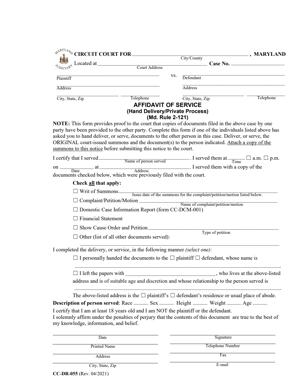
The server completes proof of service. CC-DR-055 is used for private process; CC-DR-056 is used for certified mail with the required receipt. When the sheriff serves, the sheriff files the return.
Review the Maryland private-process affidavit of service to understand the document’s role. Follow the current official form’s signature directions.
For filing for divorce in Maryland, save the proof submitted to the court. Check that it identifies the case, documents, method, and service date. Correct a gap through the proper process rather than quietly altering signed proof.
Track the summons and response deadlines separately
The divorce instructions require service within 60 days of the date on the writ of summons. If service is not completed in time, ask the clerk about renewing or reissuing the summons. Do not keep using an expired summons.
The spouse’s ordinary answer deadline is measured from service. It depends on where service occurred. The following periods are the basic guidance for divorce complaints.
| Where the spouse was served | Ordinary response period after service |
| Maryland | 30 days |
| Another U.S. state | 60 days |
| Outside the United States | 90 days |
Table alt text: Filing for divorce in Maryland response deadlines by place of service, separate from the summons service window.
Filing for divorce in Maryland requires tracking both clocks. Record the summons date and service date in separate fields. Confirm time-calculation rules and any relevant court order before deciding the exact final day.
If you cannot complete service
Keep a dated log of attempts. Note the address, method, result, and supporting record. Save returned mail and reports from the server.
The court provides CC-DR-070, Motion for Alternate Service and Affidavit, for asking permission to use another method. Explain reasonable efforts and attach supporting proof. A judge decides whether another method is allowed.
When filing for divorce in Maryland, failed attempts do not authorize you to substitute a text message or online post on your own. Follow the order if alternate service is granted. International service can require added legal guidance.
Understand what happens after service
Your spouse may answer, contest issues, or file a counterclaim. An answer responds to the complaint. A counterclaim can request relief beyond what the complaint asks for. The official forms are CC-DR-050 and CC-DR-094.
If no timely response is filed, you may request an order of default. A default request is not an automatic divorce judgment. Follow the required process and address military-service protections where relevant.
After filing for divorce in Maryland, continue reading every court notice. A case may involve a scheduling conference, settlement work, a hearing, or a trial. The court’s instructions and orders guide the next steps.
There is no useful universal completion date for every case. Disputed issues, service problems, missing records, and court scheduling can change the time needed. Plan around actual notices rather than a promised “quick divorce” timeline.
Review the packet before you send it
A final filing for divorce in Maryland checklist
- Is the court and case heading correct?
- Do residency facts and the chosen ground match my situation?
- Have I included the case information report and required attachments?
- Does my complaint clearly request the decisions I want?
- Have I checked financial, parenting, and settlement papers that apply?
- Are signatures, dates, and names consistent?
- Have I followed restricted-information and safety instructions?
- Is there a complete service packet and an eligible server?
- Are the summons date and service date tracked separately?
- Will I retain proof of filing and proof of service?
For example, an agreed couple may have a complete signed settlement but omit the case information report. Another filer may prepare the right complaint but forget to arrange service. A task-based review catches both gaps.
For general discussion of resolving disputes, see RunSensible’s divorce mediation guide. Apply Maryland’s official requirements to your filing and agreement. Rules discussed for another state do not replace Maryland procedures.
Conclusion
Filing for divorce in Maryland works best when you connect the ground, the requested relief, and the required documents. Confirm where to file, prepare a consistent packet, and arrange valid service.
Then file accurate proof, track response dates, and follow later notices. Keep questions specific so a court-help attorney can address them. A clear plan helps you move through the process without confusing filing, service, and the final divorce judgment.
Frequently Asked Questions
Do we have to live in separate houses for six months?
Not necessarily. For the six-month separation ground, spouses pursuing separate lives may qualify while living under the same roof. The facts and the full required period still matter.
Must every couple wait six months before filing?
No. The six-month period belongs to the separation ground. Irreconcilable differences and mutual consent have their own requirements. Check residency separately; grounds arising outside Maryland trigger a six-month residency rule.
Is agreeing to divorce enough for mutual consent?
No. The signed written settlement must resolve the required issues. Follow the current settlement form’s attachment instructions, including child-related documents when applicable. The court must review terms involving children.
Can I hand the complaint to my spouse myself?
You cannot personally serve the initial case papers. Arrange a permitted method using an eligible third party. This restriction also applies to initial service by certified mail.
How long does my spouse have to answer?
The ordinary periods are 30 days after service in Maryland, 60 days after service in another state, and 90 days after service outside the United States. Confirm the applicable rules and orders.
Does signing a settlement finish the divorce?
No. A settlement can support the case, but a court judgment ends the marriage. Complete filing, service, and the court process. Do not treat a signed agreement as a divorce decree.
Where can I get help with the forms?
The Maryland Court Help Center offers help from lawyers by phone and chat. Local family law help centers also offer assistance or referrals. These services help you represent yourself; they do not provide courtroom representation.
Resources
Resource numbers in the article connect procedural statements to official sources. Sources and related-form pages were checked on October 8, 2026. Consult the current official index when downloading forms; an older saved or cached PDF may still show superseded grounds.
- Maryland Family Law § 7-103 — current grounds for absolute divorce
https://mgaleg.maryland.gov/mgawebsite/Laws/StatuteText?article=gfl§ion=7-103 - Maryland Family Law § 7-101 — residency when grounds arose outside Maryland
https://mgaleg.maryland.gov/mgawebsite/Laws/StatuteText?article=gfl§ion=7-101 - Maryland Judiciary — General Instructions, Domestic Relations and Guardianship Forms, CC-DRIN (07/2026)
https://www.courts.state.md.us/sites/default/files/court-forms/ccdrin.pdf - Maryland Judiciary — Instructions for Completing and Filing Divorce Forms, CC-DRIN-A (10/2023)
https://www.courts.state.md.us/sites/default/files/court-forms/ccdrina.pdf - Maryland Judiciary — Family Law Court Forms, current revision index
https://www.courts.state.md.us/family/family-forms - Maryland Judiciary — Divorce, grounds, financial forms, and response periods
https://www.courts.state.md.us/legalhelp/family/divorce
Disclaimer: The content provided on this blog is for informational purposes only and does not constitute legal, financial, or professional advice.
Contents