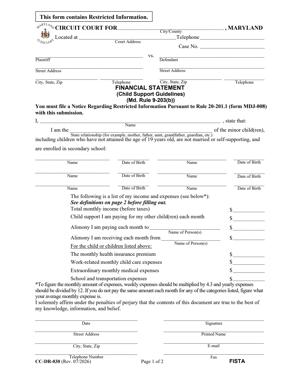
CC-DR-030 – Financial Statement (Child Support Guidelines)
Fill out nowJurisdiction: Country: United States | Province or State: Maryland
If you are involved in a child support case in Maryland, you may be required to complete the CC-DR-030 – Financial Statement (Child Support Guidelines). This form provides the court with a detailed snapshot of your income, expenses, assets, and debts. It is designed to help calculate child support under Maryland’s child support guidelines.
When you are filling out this document, the court is asking for more than rough estimates. You are providing a financial picture under oath. The information you include may directly affect how much child support is ordered, modified, or enforced.
This form is commonly used in divorce, custody, and child support cases in the Maryland Circuit Court. Both parents may be required to complete it. Each person’s financial details are considered separately.
The document can feel overwhelming at first. It asks for specific numbers about income, housing, childcare, health insurance, and other expenses. Breaking it down section by section makes it manageable.
Understanding what the form is asking for—and why—can help you complete it more accurately and confidently.
What is CC-DR-030 – Financial Statement (Child Support Guidelines)?
Clear definition
CC-DR-030 – Financial Statement (Child Support Guidelines) is a court form used in Maryland to report your financial information in cases involving child support. It follows the structure of Maryland’s child support guidelines, which rely heavily on each parent’s income and certain child-related expenses.
The form gathers information about your gross monthly income, adjustments to income, health insurance costs for the child, work-related childcare expenses, and other relevant financial obligations. It also asks about your assets and debts to give the court a broader understanding of your financial condition.
This document is not simply a budget worksheet. It is part of the official court record. The information you provide can influence the court’s calculation of child support and related financial decisions.
Who typically uses this form?
Parents involved in child support cases in the Maryland Circuit Court often complete this form. This includes parents who are divorcing, separating, or were never married but share a child.
You might fill out this document if you are requesting child support, responding to a child support request, or asking the court to modify an existing support order. Both the person seeking support and the person who may be ordered to pay support can be required to complete it.
In some cases, the court directs each parent to file a separate financial statement. Each parent’s income and expenses are reviewed individually before the court applies the child support guidelines.
Attorneys may prepare this form on behalf of their clients, but self-represented individuals commonly complete it on their own. If you are representing yourself, clarity and accuracy become even more important.
Why might you need this form?
The main reason you may need this form is to help the court determine child support under Maryland’s guidelines. Child support is generally calculated using a formula. That formula relies on accurate financial information from both parents.
If you are seeking support, the court needs to understand your financial situation and the child’s needs. If you may be ordered to pay support, the court needs a clear picture of your income and allowable expenses.
You may also need this form if there has been a significant change in circumstances. For example, a job loss, a major increase in income, or changes in childcare costs can affect an existing child support order. The court often requires updated financial statements when reviewing a modification request.
The form may also be used when establishing support for the first time, including in paternity cases or custody disputes where child support has not yet been set.
Typical real-life scenarios
- You and the other parent are going through a divorce. As part of the case, the court must decide custody and child support. Each of you is required to submit a financial statement so the court can calculate support using the guidelines.
- You were never married to the other parent, but you have a child together. One parent files a case asking the court to establish child support. Both parents are asked to complete this form before a hearing.
- You already have a child support order in place. One parent has recently changed jobs and now earns significantly more or less than before. A request to modify child support is filed, and updated financial statements are required.
- You share physical custody of your child on a near-equal basis. Because shared custody arrangements can affect how support is calculated, detailed financial information from both parents is needed to apply the correct formula.
- You are responding to a child support complaint and disagree with the income amount claimed by the other parent. Completing your own financial statement allows you to present your financial details directly to the court.
When would you use CC-DR-030 – Financial Statement (Child Support Guidelines)?
You typically use this form during an active court case involving child support in the Maryland Circuit Court. It is often required early in the process so the court has financial information before making temporary or final decisions.
You may use it when filing for divorce if minor children are involved. Child support is usually addressed as part of the divorce case, and financial disclosures are a routine part of that process.
You may also use it when filing or responding to a petition to establish paternity and child support. In those cases, the court must determine financial responsibility once parentage is legally recognized.
If you are seeking to increase or decrease an existing support order, the court often requires updated financial information. The same form may be used to show how your financial circumstances have changed since the last order.
In some situations, the court may schedule a settlement conference or hearing and direct both parties to file financial statements in advance. This allows the judge or magistrate to review income and expenses before the hearing.
You may also encounter this form if there is a dispute about specific child-related expenses, such as health insurance premiums or work-related childcare. These expenses can directly affect the guideline calculation, and the court relies on accurate figures.
Legal characteristics of CC-DR-030 – Financial Statement (Child Support Guidelines)
This form becomes legally significant once it is filed with the court. You are generally required to sign it under oath or affirmation. By signing, you are confirming that the information is true and accurate to the best of your knowledge.
The effectiveness of the form depends on completeness and accuracy. Leaving sections blank, failing to attach required documentation, or providing inconsistent figures can create problems. The court may question unclear entries or require corrections.
Common issues that lead to delays include math errors, missing income sources, and failing to include documentation such as pay stubs or proof of insurance premiums when required. Even small inaccuracies can affect the guideline calculation.
Maryland’s child support guidelines are formula-based. The court typically uses the financial data from each parent’s statement to complete a child support worksheet. If the information is incomplete, the calculation may not reflect the true financial picture.
This form does not, by itself, establish or modify child support. It is a disclosure tool. The court uses it to make decisions, but a support order only becomes effective when the court issues a written order.
There can be differences in how strictly financial disclosures are reviewed depending on the circumstances of the case. In contested cases, financial statements are often examined more closely. In cases where both parties agree on the numbers, the review may be more streamlined, though accuracy still matters.
The form also does not determine custody or visitation. While financial information may be relevant in some contexts, this document is focused on financial factors used in child support calculations.
Is it legally binding?
The financial statement itself is not a contract between parents. It does not create an agreement. Instead, it is a sworn statement provided to the court.
Because you sign it under oath, the information you include carries legal weight. Providing false or misleading information can lead to serious consequences within the court process. The court relies on honest disclosure to apply the guidelines fairly.
The child support order that results from the case is legally binding once signed by a judge. The financial statement supports that order but does not replace it.
If both parents reach a written agreement about child support, the court may still review financial information to ensure the arrangement aligns with guideline standards. In that context, the form helps the court evaluate whether the proposed amount is consistent with the law.
How to fill out CC-DR-030 – Financial Statement (Child Support Guidelines)
Step 1 – Identify the case information
At the top of the form, enter the court name, case number, and names of the parties exactly as they appear in your court papers. This ensures the document is matched with the correct case file. Double-check spelling and the case number before moving on.
Step 2 – Provide your personal information
Enter your full legal name, address, and contact details as requested. Use current and accurate information. If your mailing address is different from your residence, follow the form’s instructions on how to list it.
Step 3 – Report your gross monthly income
List all sources of income before taxes or deductions. This often includes wages, salaries, overtime, bonuses, commissions, self-employment income, rental income, unemployment benefits, disability payments, and other regular payments. Convert weekly or biweekly pay into a monthly amount if the form requires monthly figures.
If your income changes from month to month, calculate an average based on recent months. Use clear and consistent math so the court can understand how you reached the number.
Step 4 – Document adjustments or allowable deductions
Some sections ask for specific adjustments that may affect guideline calculations. Enter the requested information carefully and only in the sections provided. Follow the form’s structure rather than creating your own categories.
If the form requires documentation for certain deductions, gather those documents before finalizing your numbers. Keeping your figures consistent with your records helps avoid questions later.
Step 5 – List work-related childcare expenses
If you pay for childcare so you can work or attend school, enter the monthly cost. Use the actual amount you pay, not a rough guess. If costs vary during the year, calculate an average monthly amount.
Be clear about which child the expense relates to if you have more than one child involved in different cases.
Step 6 – Enter health insurance costs for the child
If you provide health insurance for the child, identify the portion of the premium that covers the child only. If your plan covers multiple people, calculate the child’s share as directed by the form.
Use documentation from your employer or insurance provider to determine the correct amount. Avoid listing the entire family premium if the form asks only for the child’s portion.
Step 7 – Disclose extraordinary medical or special expenses
If the child has ongoing medical, educational, or special needs expenses not covered by insurance, report them in the appropriate section. Provide monthly figures when possible.
If the form allows space for explanation, briefly describe the nature of the expense so the court understands what it covers.
Step 8 – Detail your monthly living expenses
The form may ask for your regular monthly expenses, such as rent or mortgage, utilities, food, transportation, and other recurring costs. Enter realistic amounts based on your current situation.
Avoid inflating numbers. Use bank statements, bills, or receipts to guide your entries. Consistency between your listed income and expenses helps present a clear financial picture.
Step 9 – List your assets
Include information about bank accounts, vehicles, real estate, retirement accounts, and other significant property if the form requests it. Provide estimated current values when exact figures are not available.
This section helps the court understand your overall financial condition, not just your monthly cash flow.
Step 10 – Identify your debts and financial obligations
Report outstanding debts such as credit cards, loans, and other liabilities in the sections provided. Include the total amount owed and the monthly payment, if requested.
Distinguish clearly between personal debts and child-related expenses. The form is structured to separate different types of financial obligations.
Step 11 – Review your calculations
Before signing, go through each section and verify your math. Confirm that monthly totals are correct and that income and expense figures are consistent throughout the document.
Check that all required sections are complete. If a section does not apply, follow the form’s instructions on how to indicate that, rather than leaving it blank without explanation.
Step 12 – Attach required supporting documents
If the form requires attachments such as recent pay stubs, tax returns, or proof of insurance costs, gather and attach them as directed. Make sure the documents match the figures listed in your financial statement.
Keep copies of everything for your records before submitting the form to the court.
Step 13 – Sign under oath
Read the certification section carefully. When you sign, you are affirming that the information is true and complete to the best of your knowledge.
Sign and date the form in the designated area. If notarization is required, follow the instructions provided on the form.
Step 14 – File and provide copies as required
Submit the completed form to the Maryland Circuit Court in your case according to the filing instructions you have received. Provide copies to the other party if required in your case.
After filing, keep a copy for your records. You may need to refer to the information during hearings or negotiations.
Legal terms you might encounter in CC-DR-030 – Financial Statement (Child Support Guidelines)
- Gross Income: This is your total income before taxes or other deductions. On this form, you must list all sources of income, not just wages. That can include bonuses, commissions, self-employment earnings, rental income, disability benefits, and other recurring payments.
- Adjusted Actual Income: This is your gross income after subtracting certain allowable deductions. The form walks you through which deductions count. The court uses this adjusted figure to apply the child support guidelines.
- Work-Related Child Care Expenses: These are child care costs necessary for you to work or look for work. You must list the monthly amount you actually pay. The court may add these costs to the basic child support obligation.
- Health Insurance Premiums: This refers to the portion of health insurance costs specifically attributable to the child or children in the case. You should separate the child’s portion from your overall premium. Only the amount related to the child is entered in the designated section.
- Extraordinary Medical Expenses: These are uninsured medical costs that exceed ordinary, routine care. Examples include ongoing therapy, specialized treatment, or significant dental work. The form may require you to state monthly averages if the expenses vary.
- Imputed Income: This is income the court may assign to a parent who is unemployed or underemployed without good reason. While you do not “enter” imputed income yourself, your employment information can affect whether it is considered. Your disclosures help the court determine earning capacity.
- Shared Physical Custody: This term applies when each parent keeps the child overnight for a significant number of days per year. The number of overnights can change how support is calculated. You may need to provide details about the custody arrangement elsewhere in your case.
- Voluntary Separation of Income: This refers to situations where a parent voluntarily reduces income, such as quitting a job or cutting work hours. The court reviews this information closely. Be accurate about job changes and explain timing if relevant.
- Financial Affidavit: This document is a sworn statement about your finances. By signing, you confirm that everything is true to the best of your knowledge. False or incomplete information can have legal consequences.
- Arrears: These are unpaid past-due child support amounts. While this form mainly focuses on current finances, existing arrears may appear in your case record. Accurate reporting helps the court address both ongoing and past obligations.
FAQs
Do I have to file CC-DR-030 – Financial Statement (Child Support Guidelines) if my income has not changed?
Yes. If the court requires a current financial statement, you must complete and file it even if your income is the same as before. The court needs up-to-date information in the case record. Make sure the income amounts you enter reflect your current monthly figures, not outdated pay stubs.
What documents should I attach to support the numbers I list?
You should gather recent pay stubs, proof of other income, and documentation of child care and health insurance costs. If you are self-employed, include recent profit and loss statements or similar summaries. Attach copies, not originals, and make sure the totals on your documents match the monthly amounts you enter on this form.
What if I am paid weekly or biweekly instead of monthly?
Convert your income into a monthly amount before entering it. Multiply weekly income by 52 and divide by 12. Multiply biweekly income by 26 and divide by 12. Double-check your math because the court relies on the monthly number you provide in this document.
How do I handle fluctuating income, like commissions or overtime?
Use an average monthly amount based on recent history. Many people look at the last 6 to 12 months and calculate an average. Keep records showing how you reached that figure, because you may need to explain it if the court asks.
Do both parents have to complete this form?
In most child support cases, each parent must provide financial information. The court compares both financial statements to apply the guidelines. Make sure your name and case number match exactly what appears on other court filings so the clerk can associate your document with the correct file.
What happens if I leave a section blank?
Blank sections can delay your case or cause the court to question your credibility. If something does not apply, write “0” or “not applicable” rather than leaving it empty. Review every page of CC-DR-030 – Financial Statement (Child Support Guidelines) to confirm that no required line is skipped.
When does the information on this form take effect?
The financial information reflects your situation as of the date you sign it. The effective date of any support order will be set by the court, not by the date you complete this document. Make sure you sign and date the form accurately because that date shows when you swore the information was true.
Can I update this document after filing it?
Yes, but you cannot simply change the copy already filed. If your income or expenses change significantly before your hearing, you may need to file an updated financial statement. Check that the updated version clearly reflects current numbers and is properly signed so it can be accepted into the court record.
Checklist: Before, During, and After CC-DR-030 – Financial Statement (Child Support Guidelines)
Before
- Gather your three most recent pay stubs.
- Collect proof of any additional income sources.
- Obtain documentation for child care expenses.
- Confirm the monthly cost of the child’s health insurance.
- Review recent bank statements for accurate averages.
- Locate your case number and party names.
- Make a list of your regular monthly living expenses.
During
- Write your full legal name exactly as it appears in the case.
- Double-check that the case number is correct on every page.
- Convert all income to monthly amounts.
- Enter “0” where an item does not apply.
- Use consistent numbers that match your supporting documents.
- Recalculate totals to avoid math errors.
- Review each section before moving to the next page.
- Sign and date the form only after confirming accuracy.
After
- Make at least two copies of the completed form.
- Attach copies of all required supporting documents.
- File the original with the appropriate clerk’s office.
- Provide a copy to the other party as required.
- Keep a stamped copy for your records.
- Calendar your hearing date and bring a copy with you.
- Store digital scans in a secure folder for easy access.
Common mistakes to avoid with CC-DR-030 – Financial Statement (Child Support Guidelines)
- Mistake: Reporting net pay instead of gross income because it feels more accurate to your take-home amount, which leads to an incorrect guideline calculation and may result in a support order that does not reflect your true earnings; do not forget to use pre-tax income figures.
- Mistake: Guessing at child care or medical expenses without checking bills, which happens when you rely on memory and can cause disputes or credibility concerns; do not forget to verify amounts with written statements.
- Mistake: Failing to convert weekly or biweekly income to a monthly figure, which occurs due to confusion about pay cycles and can distort the support calculation; do not forget to use the proper multiplication and division method.
- Mistake: Leaving blanks instead of entering zero, which happens when a section does not apply and may suggest missing information; do not forget to complete every line clearly.
- Mistake: Forgetting to sign and date the form, which is common when you focus on the numbers and overlook the final page, and can result in rejection by the clerk; do not forget that your signature makes it a sworn statement.
- Mistake: Submitting documents that do not match the totals listed, which happens when numbers are updated, but attachments are not, and can undermine trust in your accuracy; do not forget to reconcile every figure before filing.
- Mistake: Underreporting side income because it seems informal or irregular, which can be discovered later and damage your credibility; do not forget that all income sources must be disclosed.
- Mistake: Waiting until the last minute to complete the form, which leads to rushed math and missing attachments and may delay your hearing; do not forget to give yourself enough time to review carefully.
What to do after filling out CC-DR-030 – Financial Statement (Child Support Guidelines)
Once you finish the form, slow down and review it line by line. Check your math. Compare each income and expense figure to the documents you plan to attach. Small errors can affect the child support calculation in a meaningful way.
Make sure your signature and date are on the correct line. Your signature confirms that everything you entered is true to the best of your knowledge. Without it, the form may not be accepted.
- Step 1: Make at least two complete copies of the signed form and all attachments.
- Step 2: Organize the documents in the same order as the sections of the form so they are easy to follow.
- Step 3: File the original with the clerk of the Circuit Court handling your case.
- Step 4: Confirm with the clerk that your filing has been accepted and stamped.
- Step 5: Provide a copy to the other parent or their attorney as required in your case.
- Step 6: Keep a stamped copy for your personal records in a safe place.
- Step 7: Bring a complete copy, including attachments, to any scheduled hearing.
- Step 8: Prepare to explain how you calculated any averages or unusual expenses.
- Step 9: Monitor your income and expenses in case you need to update the court later.
- Step 10: Store digital backups so you can quickly access the information if questions arise.
Stay organized after filing. If your financial situation changes significantly before the court issues a support order, you may need to submit updated information. Keeping careful records now will make any future updates much easier and more accurate.
Disclaimer: This guide is provided for informational purposes only and is not intended as legal advice. You should consult a legal professional.