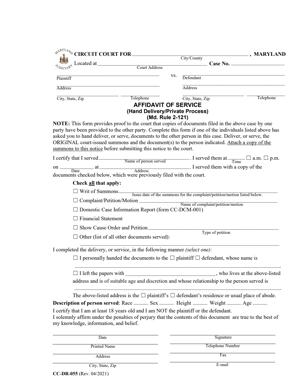
CC-DR-055 – Affidavit of Service (Hand Delivery or Private Process)
Fill out nowJurisdiction: Country: United States | Province or State: Maryland
If you are preparing to prove that court papers were properly delivered, CC-DR-055 – Affidavit of Service (Hand Delivery or Private Process) is the document that records that delivery. It tells the Maryland Circuit Court when, where, and how someone received the papers.
This form is not the document that starts your case. It does not explain your claims or defenses. Instead, it confirms that the other party was officially given notice.
When you represent yourself, service of process can feel confusing. You may know you handed over documents, but the court needs written proof. That proof is what this affidavit provides.
If the service is not documented correctly, your case can be delayed. Hearings may be postponed. Motions may not move forward. This form helps prevent those problems by creating a clear record.
Understanding how this document works will help you complete it accurately and avoid unnecessary setbacks in your case.
What is CC-DR-055 – Affidavit of Service (Hand Delivery or Private Process)?
Clear definition
CC-DR-055 – Affidavit of Service (Hand Delivery or Private Process) is a sworn statement filed in a Maryland Circuit Court case. It confirms that legal documents were delivered by hand to a specific person.
“Affidavit” means the person signing it is making a sworn statement. They are declaring that the information is true. The person who signs is usually the individual who physically delivered the documents.
“Hand delivery or private process” refers to service by someone other than a sheriff. It may involve a private process server or another qualified adult who is not a party to the case.
The form identifies the case, the person served, the documents delivered, and the date, time, and place of delivery. It becomes part of the official court record once filed.
Who typically uses this form?
This form is commonly used in family law cases in the Maryland Circuit Court. These cases may involve divorce, custody, child support, or related matters.
Self-represented plaintiffs often use it when they arrange for a private individual to deliver the initial complaint and summons. Attorneys also use it when they hire private process servers instead of relying on the sheriff.
The person who actually hands the documents to the other party completes and signs the affidavit. The person filing the case does not sign it if they personally served the papers, because service generally must be done by someone who is not a party.
In some cases, a professional process server completes the form after making delivery. In others, a friend or other qualified adult may complete it if allowed under court rules.
Why might you need this form?
Courts require proof that the other side received notice of the case. Without proper notice, a court cannot usually proceed.
This form provides written evidence that the service happened. It allows the judge to confirm that the opposing party had an opportunity to respond.
If you are requesting a default because the other party did not respond, the court will look closely at the proof of service. A properly completed affidavit helps show that deadlines were triggered.
The form also protects the integrity of the case. It reduces disputes about whether documents were actually delivered.
Typical real-life scenarios
- You file for divorce in the Maryland Circuit Court and choose to have a private process server deliver the complaint and summons to your spouse. After delivery, the server completes this affidavit to document what happened.
- You are seeking a modification of custody. A qualified adult, who is not involved in the case, hand-delivers the motion papers to the other parent. That person then fills out the affidavit to confirm the details of service.
- You file a petition related to child support and hire a private process server because the sheriff’s office has a long backlog. The process server uses this form to swear that service was completed.
- You are responding to a reopened family law matter and must serve updated pleadings. The person who hand-delivers the documents completes the affidavit so the court knows the other party received them.
- In each of these situations, the key issue is proof. The court does not rely on verbal statements. It relies on written, sworn documentation filed in the case.
When would you use CC-DR-055 – Affidavit of Service (Hand Delivery or Private Process)?
You use this form after documents have already been delivered by hand. It is not filed before service. It is completed once the service is finished.
It is typically used when the sheriff did not perform service. If a sheriff completes service, a different proof of service document is usually generated by that office. This form applies when service is carried out privately.
You may encounter this form at the beginning of a case, when serving a summons and complaint. It can also be used later in a case when certain motions or petitions require formal service.
The person completing the form is usually the server. The person filing it with the court is often the party who arranged for service. These roles can be different.
If the court has scheduled a hearing and requires proof that the other side was notified, this form becomes part of demonstrating compliance with procedural rules.
It is also relevant when deadlines depend on the date of service. The date listed on the affidavit may determine when the other party’s response is due.
Legal characteristics of CC-DR-055 – Affidavit of Service (Hand Delivery or Private Process)
This form is effective when it clearly identifies the case and accurately describes the service. The case number, court name, and party names must match the official case record.
The affidavit must include specific details. These usually include the full name of the person served, the date of service, the exact location, and a description of the documents delivered. Vague statements can cause problems.
The person signing the affidavit swears that the information is true. Because it is sworn, false statements can have serious consequences. Courts treat affidavits as formal testimony.
Common issues that lead to rejection or delay include missing signatures, incomplete dates, mismatched case numbers, or failure to indicate what documents were served. If required fields are blank, the clerk may not accept the filing.
Another common problem is improper service. Even if the affidavit is completed, if the person served was not the correct individual, or if service was not done in a permitted manner, the court may question its validity.
Rules about who may serve papers can vary depending on the type of document and stage of the case. Some documents must be served in specific ways. The affidavit does not correct improper service. It only records what occurred.
This document does not decide the case. It does not grant relief. It does not prove that the claims in your complaint are true. It simply shows that notice was given.
Is it legally binding?
The affidavit itself does not create rights or obligations between the parties. It is not a contract or settlement agreement.
However, it has legal effect because it is a sworn statement filed with the court. Judges rely on it when determining whether proper notice was given.
If the affidavit shows valid service, procedural timelines may begin. For example, response periods often start running from the date of service listed in the document.
If the affidavit is challenged, the court may examine whether service met legal standards. In some situations, testimony or additional evidence may be considered.
Because it is signed under oath, accuracy is critical. The legal weight of the form comes from the sworn declaration and its role in court procedure.
How to fill out CC-DR-055 – Affidavit of Service (Hand Delivery or Private Process)
Step 1 – Identify the court and case
Enter the full name of the Maryland Circuit Court handling the case. Write the complete case number exactly as it appears on other court documents. List the names of the parties in the same order used in the case caption.
Step 2 – Provide the server’s information
The person who delivered the documents fills in their full legal name and contact information as requested. This identifies who is making the sworn statement and allows the court to know who performed service.
Step 3 – Identify the person served
Write the full name of the individual who received the documents. The name should match the name of the party listed in the case or the authorized person who accepted service on that party’s behalf.
Step 4 – Describe the documents delivered
Clearly list each document that was handed to the person served. Use the exact titles as they appear on the filings, such as complaint, petition, motion, or summons. This ensures there is no confusion about what was delivered.
Step 5 – State the date, time, and place of service
Enter the specific calendar date when the service occurred. Include the time of day and the full address where the documents were handed over. The details should be precise and complete.
Step 6 – Describe the method of hand delivery
Indicate that the documents were personally delivered by hand. If the form asks for additional details about how the service occurred, provide a clear description of what happened during the delivery.
Step 7 – Review for accuracy
Before signing, read the entire form carefully. Confirm that names, dates, and case numbers are correct. Check that all required fields are filled in and legible.
Step 8 – Sign under oath
The server signs the affidavit in the designated signature area. If the form requires notarization or an oath before an authorized official, complete that process as instructed on the document. The signature confirms that the information is true to the best of the server’s knowledge.
Step 9 – File the completed form with the court
Once signed, the completed affidavit is submitted to the clerk of the Maryland Circuit Court for inclusion in the case file. Filing places the proof of service into the official court record so the case can move forward.
Legal terms you might encounter in CC-DR-055 – Affidavit of Service (Hand Delivery or Private Process)
- Affidavit: A written statement made under oath. On this form, the person who delivered the papers swears that the information about the service is true. By signing, the server is subject to penalties for false statements.
- Service of Process: The formal delivery of court documents to a party in a case. This form records how and when that delivery happened. Proper service is required before a court can move forward.
- Private Process Server: A person who is not the sheriff but is authorized to deliver court papers. This individual must meet the court’s eligibility rules. The form identifies who the server is and confirms that they carried out the service.
- Hand Delivery: Also called personal service. It means the documents were physically handed to the person being served. The form asks for details that prove this direct delivery occurred.
- Person Served: The individual who received the documents. The name written on the form must match the name listed in the case caption. Accuracy here prevents delays or challenges.
- Case Caption: The heading at the top of court documents. It lists the court name, case number, and parties involved. You must copy this information exactly as it appears in your case.
- Date and Time of Service: The specific day and hour when delivery occurred. Courts rely on this information to calculate response deadlines. Even small errors can affect the timeline.
- Place of Service: The physical location where the documents were delivered. This could be a residence, workplace, or public place. The form requires enough detail to identify where the service happened.
- Oath or Affirmation: The formal promise that the information provided is true. The server signs under oath, often in front of a notary or authorized official. This gives the document legal weight.
- Proof of Service: Another term for documentation showing that service was completed. This form becomes part of the official court record. Without it, the court may not recognize that service occurred.
FAQs
What exactly does this document prove to the court?
It proves that the other party received the court papers through hand delivery or private process. The court looks at this document to confirm the date, time, place, and method of service. Those details determine when the other party’s response deadline begins.
Who is allowed to complete and sign this form?
The person who actually delivered the documents must complete and sign it. That may be a private process server or another qualified adult who is not a party to the case. You cannot sign it yourself if you are the one who filed the case and also delivered the papers.
Do I have to file CC-DR-055 – Affidavit of Service (Hand Delivery or Private Process) right away?
You should file it as soon as the service is completed. The court cannot move forward until proof of service is in the file. Delaying filing can slow down your case or postpone hearings.
What if the name on the document served is slightly different from the case caption?
The name on this form must match the case caption exactly. If there is a spelling difference or a missing middle initial, the court may question whether the correct person was served. Check the caption and copy it precisely before filing.
What if the person refused to take the papers?
If the server clearly identified the person and left the documents in their presence after they refused to accept them, that may still count as service. The server must describe what happened in detail in this document. The explanation should clearly show that the intended person was identified and given the opportunity to receive the papers.
Do I need to attach anything to this form?
Usually, you do not attach the documents that were served. Instead, you list each document by name so the court knows exactly what was delivered. Make sure the titles match what appears in the case file.
What happens if I make a mistake on CC-DR-055 – Affidavit of Service (Hand Delivery or Private Process)?
If the mistake is minor, you may need to complete a corrected version before filing. If it has already been filed, the court may require an amended affidavit. Inaccurate information can delay your case because the judge must be confident that service was done correctly.
Will this document become part of the public court record?
Yes. Once filed, this form is placed in the case file. Anyone who is allowed to view the case file may see the date, time, and location of service listed on the document.
Checklist: Before, During, and After CC-DR-055 – Affidavit of Service (Hand Delivery or Private Process)
Before
- Confirm that the documents to be served are complete and file-stamped if required.
- Verify the full legal name of the person to be served as it appears in the case caption.
- Check the correct case number and court name.
- Ensure the server meets eligibility requirements and is not a party to the case.
- Provide the server with clear instructions and the correct address.
- Review deadlines so service happens within the required timeframe.
- Prepare a blank copy of the form for the server to complete.
- Double-check that all documents listed for service match the court file.
During
- Confirm the identity of the person being served.
- Hand the documents directly to that person.
- Note the exact date and time of delivery.
- Record the full address or detailed location of service.
- Observe and document any unusual circumstances, such as refusal.
- Keep the documents organized to avoid confusion.
- Avoid discussing the case beyond identifying the documents.
- Ensure the server maintains professional conduct.
After
- Complete all sections of the form clearly and legibly.
- Review the information for accuracy before signing.
- Sign under oath before a notary or authorized official if required.
- Make copies of the signed form for your records.
- File the original with the court promptly.
- Confirm that the court accepted and docketed the filing.
- Calendar the other party’s response deadline based on the service date.
- Store copies with your other case documents.
Common mistakes to avoid with CC-DR-055 – Affidavit of Service (Hand Delivery or Private Process)
- Mistake: Listing the wrong case number because you copied it from memory, which can cause the affidavit to be filed in the wrong case and delay proceedings, so always copy the number directly from an official court document.
- Mistake: Allowing a party to the case to serve the papers, which happens when someone tries to save time or money, but this can invalidate service and require you to start over, so confirm the server is eligible.
- Mistake: Writing an incomplete address for the place of service due to rushing, which may raise questions about where service occurred and weaken proof, so include full street details.
- Mistake: Forgetting to list all documents served because you assumed the court already knows, which can create confusion about what was delivered, so itemize each document exactly as titled.
- Mistake: Signing without an oath or required notarization because you overlooked that section, which can result in rejection by the clerk, so complete the oath properly.
- Mistake: Filing the form late after service was completed, often due to a misunderstanding of deadlines, which can stall your case, so submit it promptly.
- Mistake: Providing an incorrect date or time because you did not record it immediately, which may affect response deadlines and credibility, so write it down at the moment of service.
- Mistake: Failing to review for spelling errors in the person’s name, which can trigger objections about identity, so match the caption exactly before filing.
What to do after filling out CC-DR-055 – Affidavit of Service (Hand Delivery or Private Process)
Once the form is complete and signed under oath, your next focus is proper filing and tracking. The court relies on this document to move your case forward. If it is missing or incorrect, everything can stall.
Start by reviewing the signed form one more time. Check names, dates, and the case number. Make sure the list of documents served matches what is in your case file.
- Step 1: Make at least two copies of the signed affidavit—one for your records and one as a backup.
- Step 2: File the original with the clerk of the circuit court handling your case.
- Step 3: Ask the clerk to confirm the filing was accepted and entered into the docket.
- Step 4: Obtain a file-stamped copy if available for your records.
- Step 5: Mark the date of service on your calendar.
- Step 6: Calculate the other party’s response deadline based on the service date.
- Step 7: Monitor the case docket to confirm the deadline and any response filed.
- Step 8: Organize the affidavit with your other case documents in chronological order.
- Step 9: Prepare for the next procedural step, such as requesting a hearing or waiting for an answer.
- Step 10: Bring a copy of the filed affidavit to any upcoming court appearance in case the judge asks about service.
Stay organized. Courts move on strict timelines. By filing promptly and tracking deadlines, you keep control of your case’s progress.
Disclaimer: This guide is provided for informational purposes only and is not intended as legal advice. You should consult a legal professional.