
When a former tenant owes money, use clear records, proper service, and a realistic recovery plan.
Your tenant has moved out. The keys are back, but rent or other costs remain unpaid. When a former tenant owes money, the next step is to check the claim, gather proof, and choose the right process.
Ontario’s Landlord and Tenant Board, called the LTB, can decide certain claims after move-out. An order does not guarantee payment. Service, evidence, settlement, and enforcement each need separate attention.
This guide covers residential tenancies governed by Ontario’s Residential Tenancies Act. It provides general information, not advice about a particular dispute. Check current official instructions and any directions in your case.
Check your route when a former tenant owes money
Start with possession: has the tenant actually left the unit? A plan to leave is different from giving up possession. Keep messages about move-out, key returns, and the final inspection together.
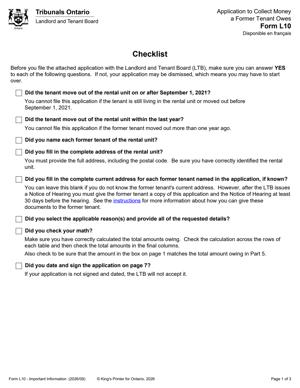
For eligible claims after move-out, the usual LTB application is L10. The official rent-arrears guideline confirms a one-year filing limit after the tenant moves out. It applies to departures on or after September 1, 2021. If the tenant remains in possession, different applications apply.
Confirm who the former tenant owes money to
Check the lease and ownership records before naming the applicant. Use the correct person or company. A property manager’s contact details do not automatically make that manager the landlord entitled to payment.
Match the tenant’s legal name across the lease, payment records, and application. Ask for help if someone signed a guarantee, only occupied the unit, or disputed being a tenant. Do not add a person simply because they lived there.
If a former tenant owes money under an existing order, review that order first. A second application may duplicate a dispute already decided. Seek advice on enforcement, existing applications, or overlapping claims.
Check the forum before filing an unusually large claim. Section 207 ties the LTB’s monetary limit to Small Claims Court jurisdiction. The current limit is $50,000. An LTB order can extinguish the part of a claim above its limit. Get advice before choosing to give up that excess.

Build one accurate statement of account
When a former tenant owes money, start with a clear balance. Create one statement that another person can check without opening every message you exchanged.
Separate the amount charged, payments received, credits, and remaining balance. Record the date and reason for every entry. Link each payment to a bank record or receipt.
Show the rent calculation
Use a separate row for each rental period. Keep rent apart from utility bills and repair costs. Explain any partial payment instead of showing only a running total.
For example, monthly rent is $1,800. A tenant pays $1,200 for one month and $900 for the next. The unpaid amounts are $600 and $900. The rent subtotal is $1,500 before any further credit or adjustment.
That example illustrates arithmetic only. The dates, lawful rent, tenancy end, and credits still need checking. If the former tenant owes money for several periods, make the same calculation for each period.
Check how the last-month rent deposit was applied. Section 106 requires its use toward the last rent period before termination. It is not a general fund for damage charges.
Keep a version date on your statement. If payment arrives after filing, update the balance and preserve the earlier version. This makes the change easy to explain.
Match each claim to proof
Table description: Records to organize when a former tenant owes money in Ontario.
| Claim category | Useful records | Question to answer |
| Unpaid rent | Lease, ledger, receipts, payment records | What was due, paid, and credited? |
| Utilities | Lease terms, bills, billing periods, payments | Why is this tenant responsible for this amount? |
| Property damage | Before-and-after photos, repair records, estimates | What caused the damage and supports the cost? |
| Returned payment charges | Returned-payment notice and bank records | What charge was actually incurred? |
| Other claimed expenses | Event timeline, invoices, payment records | How does the event connect to the claimed loss? |
These are preparation suggestions, not a finding that any charge is recoverable. Each category has legal requirements. A receipt proves a purchase happened; it does not establish the tenant’s liability.
Separate damage from ordinary upkeep
A repair bill needs context. Show the item’s earlier condition, what changed, and when you discovered the problem. The LTB’s maintenance guidance places ordinary repair and wear-related replacement duties on landlords.
If a former tenant owes money for alleged damage, avoid describing every mark or worn surface as misconduct. An old carpet and a broken door raise different questions. Keep the facts specific.
Take wide photos showing the room and close photos showing the problem. Keep original files. Note who took each photo and when. Compare them with earlier inspection records where available.
Explain why the proposed work addresses the damage. If a contractor quotes for a full renovation, ask for a breakdown. Separate the disputed repair from upgrades you chose to make.
For example, a quote may include replacing a damaged cupboard door and installing new cabinets throughout the kitchen. Identify the smaller repair separately. Let the evidence show why the amount requested is reasonable.
When a former tenant owes money for utilities, check the service dates just as carefully. A final bill may cover days after move-out. Highlight the relevant period and explain any allocation.
Keep a usable evidence file
Create a short timeline before assembling a large upload. Include the tenancy start, relevant payment dates, events, move-out, and later payments. Distinguish facts you witnessed from information someone else supplied.
A useful working folder might contain:
- The lease and relevant amendments.
- A dated statement of account.
- Payment records and receipts.
- Condition records and photos.
- Utility bills and repair documents.
- Relevant messages in date order.
- Service records and tribunal notices.
Number the pages in your hearing package. Use short file names that describe the contents. Keep private working notes separate from documents you intend to disclose.
If a former tenant owes money but disputes a payment, preserve the complete transaction record. A cropped screenshot may hide the account, date, or later reversal. Show enough context to make the record understandable.
Save message threads with surrounding replies. A sentence such as “I will pay Friday” may refer to a different bill. A fair record lets both sides see the same exchange.
The LTB decides which submitted items become evidence. Its evidence direction calls for relevant material and warns against repetition. Uploading a large file does not guarantee that every page will be accepted.
Ask for payment without losing track of filing
When a former tenant owes money, a written request may resolve a calculation error or start settlement talks. Keep the request factual. State the rental address, amounts, credits, and how to contact you.
Attach a clear statement rather than a long complaint. Identify any charge still based on an estimate. Invite the former tenant to identify missing payments or specific disputed items.
A useful request explains:
- The balance you are asking them to review.
- The documents supporting it.
- A proposed response date.
- How payment or a written response can be sent.
Choose a response date that leaves time for the next step. Treat negotiations and filing deadlines as separate tasks. Do not assume a conversation, payment promise, or reminder extends a legal deadline.
If a former tenant owes money and proposes instalments, check the total and dates carefully. Record each amount, payment method, and how the remaining dispute will be handled. Get advice before agreeing to release claims or withdraw an application in return for future payments.
Prepare and file the right application
RunSensible’s L10 application page can help you locate and prepare the document. Compare the form with the current official LTB version before submitting it.
When a former tenant owes money, check names, claim categories, totals, and dates together. Your application and supporting statement should tell the same story. Explain differences before filing.
L10 was among the forms updated on September 21, 2026. The LTB states that previous versions will no longer be accepted as of November 30, 2026. Use the current version now and recheck the forms page whenever filing.
The published L10 fee is $186 through the Tribunals Ontario Portal, or $201 through other permitted routes. Confirm the fee and filing method before paying. Fees are non-refundable. A fee waiver may be available under the LTB’s criteria.
Keep the submitted application, payment record, and confirmation. Check later communications for your file number and hearing notice. Filing does not complete the service step.

Ontario Commercial Real Estate Purchase and Representation
Serve the former tenant at the correct address
Service means delivering legal documents using an accepted method. When a former tenant owes money, ordinary payment reminders and formal service serve different purposes.
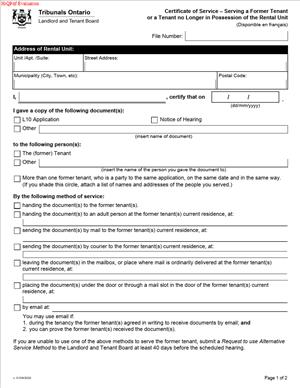
The L10 instructions require service of the application and Notice of Hearing on each former tenant at least 30 days before the hearing. They permit specified methods, including hand delivery, mail, courier, and certain delivery methods at the current residence. Do not leave the package at the former rental unit.
Record how you confirmed the current address. Preserve messages, delivery records, and dated notes. The LTB may ask how you found it.
Check email requirements before sending
Having an email address does not automatically authorize email service. The L10 instructions require written agreement during the tenancy and proof that the former tenant received the emailed documents.
Review any existing consent to service by email against those requirements. Do not assume obtaining a new consent after move-out fixes the issue. Seek directions if the permitted route is unclear.
If a former tenant owes money and stops replying, keep the service question separate from the debt dispute. Silence does not prove that a hearing package reached them.
Request alternative service early
If permitted methods will not work, explain the attempts made and propose a method likely to reach the person. The L10 instructions require an alternative-service request at least 40 days before the hearing. Approval is a decision for the LTB.
RunSensible’s alternative service request supports preparing that request. Follow any directions actually issued. A request by itself does not authorize your proposed method.
File proof of service and plan disclosure
The special former-tenant Certificate of Service records delivery of the hearing package. File it at least 20 days before the hearing. Its official notes warn that failure can lead to cancellation of the hearing and closure of the application.
Use the former-tenant Certificate of Service. Record what actually happened. Do not estimate a delivery date or sign for steps you did not perform.
If a former tenant owes money, proving the debt still depends on evidence disclosure. This is a separate task from serving the application.
Rule 19 generally requires disclosure at least seven days before the hearing, with responding evidence at least five days before it. Case-specific directions can change what is required.
The LTB’s hearing-process webpage currently uses “7 business days” for ordinary documents. Plan to disclose at least seven business days ahead, and earlier where possible. Ask the LTB or your representative to clarify any conflicting directions. Do not rely on the shortest possible reading. [10]
Portal upload also needs care. Unless the other party has agreed in writing to receive materials through the portal, upload alone does not provide them with your evidence. Keep proof of the separate disclosure.
Prepare to explain the claim at the hearing
When a former tenant owes money, prepare a short explanation that follows your records. Start with the amount requested and then show the calculation. Have the lease, account, and key supporting pages ready.
Practise explaining one disputed item without reading every message aloud. For example: identify the damaged item, the earlier condition, the later condition, and the cost evidence. Note any gap honestly.
Write down questions raised by the tenant’s response. They may say a payment was missed, a bill covers the wrong period, or damage existed earlier. Prepare the relevant record rather than a general denial.
Make a hearing checklist:
- Confirm the attendance method and joining instructions.
- Test your phone, connection, and document access.
- Keep the latest balance and service proof nearby.
- Identify the pages supporting each disputed amount.
- Arrange any necessary witness participation early.
- Record directions given during the hearing.
If a former tenant owes money but you cannot explain part of the claim, review that part before the hearing. A smaller supported request may be clearer than a larger total built on assumptions.

RunSensible’s broader Ontario and BC tenancy dispute guide offers background. Use Ontario-specific official sources for this claim’s deadlines and procedure.
Separate an order from actual recovery
Read the written decision carefully. Check the amount, parties, payment date, and any conditions. Record later payments against the ordered balance.
If a former tenant owes money under an unpaid LTB order, Ontario permits qualifying tribunal orders to be filed and enforced in Small Claims Court. Once filed, the order is treated as a court order for enforcement purposes.
This is different from starting a new lawsuit to decide the same tenancy claim again. Confirm the filing requirements, any stay, and the correct court office before taking enforcement steps.
Possible collection processes include an examination hearing, garnishment, or enforcement against eligible property. Exemptions, ownership, costs, and available assets affect the choice. Review Ontario’s official enforcement guide before spending money.
If a former tenant owes money but has no reachable income or assets, an order may remain unpaid. Compare the likely recovery with the next step’s cost. Keep a current ledger and stop pursuing amounts already paid.
Conclusion
When a former tenant owes money, begin with an accurate account and a clear filing plan. Match each amount to evidence. Check the current application, serve the right documents, and keep proof.
Prepare for settlement and the hearing while tracking each deadline separately. If you obtain an order, assess recovery as its own step. Clear records make each decision easier to review.
RunSensible Forms helps users find, complete, validate, and download legal forms. It is not a law firm, tribunal, government agency, or official filing service. A lawyer or licensed paralegal can advise on disputed liability, deadlines, and enforcement.
Frequently Asked Questions
How long do I have to file after the tenant moves out?
The official LTB rent-arrears guideline states that an L10 application cannot be filed more than one year after move-out. Check the actual departure date and applicable claim requirements early.
Can I claim repairs as well as unpaid rent?
L10 provides categories for eligible damage costs and other amounts. Each needs its own explanation and proof. A contractor’s invoice alone does not establish responsibility.
What if I cannot find the former tenant’s new address?
Review the service options and seek directions promptly. Alternative service requires LTB approval. Keep records of attempts and why your proposed method should reach the former tenant.
Does uploading evidence to the portal notify the former tenant?
Not automatically. Written consent is required for portal disclosure to replace separate delivery to the other party. Check the consent, current rules, and hearing directions.
What if a payment arrives after I file?
Record it and update your balance. Keep the original application and the revised account. Explain the credit at the hearing and follow directions about updated materials.
Does winning mean the LTB will collect the money?
An order and collection are separate. You may need to file the order with Small Claims Court and use a permitted enforcement process. Recovery is not guaranteed.
Do I need every form listed below?
No. L10 and its special service certificate are central to this route. Other forms address particular needs, such as service problems, accessibility, or settlement. Select only those that fit your case.
Resources
Official sources checked on November 9, 2026. Bracketed numbers in the article refer to the sources below.
- LTB Rent Arrears Interpretation Guideline 11. https://tribunalsontario.ca/documents/ltb/Interpretation%20Guidelines/11%20-%20Rent%20Arrears.html
- Ontario Residential Tenancies Act 2006, especially sections 106 and 207. https://www.ontario.ca/laws/statute/06r17
- LTB Maintenance and Repairs brochure. https://tribunalsontario.ca/documents/ltb/Brochures/Maintenance%20and%20Repairs%20%28EN%29.pdf
- LTB Practice Direction on Evidence. https://tribunalsontario.ca/documents/ltb/Practice%20Directions/Practice%20Direction%20on%20Evidence.html
- LTB Operational Update effective September 21, 2026. https://tribunalsontario.ca/2026/09/21/ltb-operational-update-legislative-changes-at-the-landlord-and-tenant-board-effective-september-21-2026/
- LTB Forms Filing and Fees. https://tribunalsontario.ca/ltb/forms-filing-and-fees/
- LTB Official L10 Instructions. https://tribunalsontario.ca/documents/ltb/Landlord%20Applications%20%26%20Instructions/L10_Instructions.html
- LTB Certificate of Service for a Former Tenant. https://tribunalsontario.ca/documents/ltb/Other%20Forms/Certificate%20Of%20Service%20-%20L10.pdf
- LTB Rules of Procedure, especially Rules 3 and 19. https://tribunalsontario.ca/documents/ltb/Rules/LTB-Rules_of_Procedure.html
- LTB Application and Hearing Process. https://tribunalsontario.ca/ltb/application-and-hearing-process/
- Ontario Guide to Procedures in Small Claims Court, After Judgment. https://www.ontario.ca/document/guide-procedures-small-claims-court/after-judgment
- Current official Form L10, Important Information marked 2026/09. https://tribunalsontario.ca/documents/ltb/Landlord%20Applications%20%26%20Instructions/L10.pdf
Disclaimer: The content provided on this blog is for informational purposes only and does not constitute legal, financial, or professional advice.
Contents