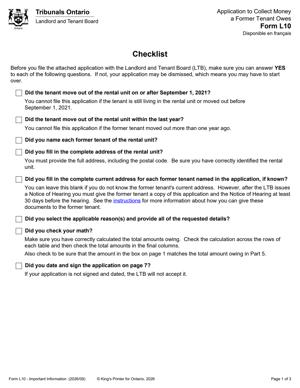
FORM L10 – Application to Collect Money a Former Tenant Owes
Fill out nowJurisdiction: Country: Canada | Province or State: Ontario
Updated October 2026 – FORM L10 – Application to Collect Money a Former Tenant Owes lets a landlord ask Ontario’s Landlord and Tenant Board (LTB) to decide whether a former tenant owes certain unpaid amounts. The LTB is Ontario’s residential tenancy tribunal, not a court.
This application may address unpaid rent, utilities, damage costs, and certain other eligible expenses after a tenant moves out. Each category has its own requirements: an unpaid bill alone does not establish that the former tenant must pay it.
Form L10 is not an eviction application. It concerns a former tenant who has already left. The appropriate process depends on the tenancy, the tenant’s possession of the unit, the amounts claimed, and applicable deadlines.
Preparing the application requires accurate party information, clear dates, itemized calculations, and supporting facts. Filing starts a decision-making process; it does not establish the debt. The former tenant may dispute responsibility, the amount, or your evidence.
What is FORM L10 – Application to Collect Money a Former Tenant Owes?
Clear definition
Form L10 is a formal request for a monetary order against a former residential tenant. It identifies the rental unit, the parties, the amounts claimed, and the reasons the landlord believes payment is owed.
Available categories can include unpaid rent, compensation for certain occupancy periods, qualifying payment-related charges, utilities, damage, and specified expenses arising from conduct during the tenancy.
These categories are not interchangeable. An electricity bill is different from rent arrears, and repairing a damaged fixture is different from replacing an item worn through ordinary use. Explain the underlying obligation rather than presenting one unexplained balance.
Unlike a collection letter or repayment agreement, the application asks a tribunal to decide a claim.
Who typically uses this form?
Landlords use Form L10 when an eligible financial claim remains after a residential tenant leaves. A property manager or authorized representative may assist, but the representative is not automatically the claimant.
Identify the actual landlord and former tenant. Ownership changes, corporate names, and tenancy amendments may require closer review. A roommate, guest, guarantor, or person who paid rent for someone else is not necessarily a tenant.
For former tenants, the application states the landlord’s allegations—not proven facts. Receipts, messages, photographs, and other records may support a different account.
Why might you need this form?
A formal decision may be needed when discussions do not resolve an eligible dispute. The former tenant might deny responsibility, challenge the calculation, or acknowledge an amount without paying.
Some expenses become clear only after departure, such as a final utility bill or a repair assessment. Preparing the application helps distinguish a general complaint from a specific, supported financial claim.
Review earlier settlements, orders, and repayments before applying. They may affect what remains outstanding and whether a further claim is appropriate.
Typical real-life scenarios
- Unpaid rent: Several payments were missed, but the tenant made a partial payment before leaving. Claim the remaining balance, supported by a reconciled ledger.
- Utilities: A final bill includes usage before and after departure. Explain the tenant’s responsibility and allocate the relevant portion.
- Damage: Move-out photographs show a broken door, while earlier photographs show it intact. An invoice supports the repair cost, but responsibility still needs evidence.
- Replacement: Old flooring has ordinary wear and a distinct burn. The replacement invoice does not automatically establish entitlement to the entire cost; age, condition, cause, and improvements matter.
When would you use FORM L10 – Application to Collect Money a Former Tenant Owes?
Use this application when a tenant has moved out and an eligible monetary claim remains. Physical departure, returning keys, ending the tenancy, and settling the account may occur on different dates. Record each event accurately.
Form L10 generally has a one-year filing limit measured from when the former tenant moved out. Check the current instructions and applicable rules before relying on a deadline. Receiving an invoice later does not necessarily change the event that starts the filing period.
You may include several eligible categories from the same tenancy, such as rent arrears and damage. Each category still needs its own explanation, calculation, and supporting records.
An offer to repay does not necessarily resolve the dispute. A completed settlement or existing order raises different issues. Do not use a second application to seek the same amount already awarded merely because the earlier order remains unpaid.
Confirm that the residential tenancy arrangement falls within the LTB’s authority. Some accommodations and relationships are excluded; calling an agreement a “lease” does not establish jurisdiction.
Also distinguish eligibility from collectability. A valid claim does not establish that the former tenant has funds available. Current contact information may help with service, but an eventual payment order may still require separate enforcement.
Legal characteristics of FORM L10 – Application to Collect Money a Former Tenant Owes
Form L10 is a procedural document that places an eligible claim before the LTB. Correct parties, jurisdiction, timing, required information, and service all matter.
Use accurate legal names and a complete rental-unit address. A building name may not identify the landlord, and a contact person may not be a tenant. Missing unit numbers can make supporting records difficult to connect to the dispute.
A claim must explain both responsibility and amount. An invoice may establish an expense without showing who caused it. Photographs may establish a condition without proving the repair cost.
Acceptance for processing is not approval of the claim. Missing information or an incomplete declaration can cause processing problems, while objections about jurisdiction or timing may arise later.
The available relief is limited. Frustration, time spent arguing, and ordinary business expenses do not automatically become recoverable losses. Check each amount against an available claim category and the applicable monetary limit.
For damage, distinguish undue damage from ordinary wear and tear. Separate repair costs from maintenance, renovations, and improvements. An item’s age, prior condition, useful life, and reasonable repair alternatives may affect the amount recoverable.
Payments, credits, reimbursements, and other recoveries may reduce the balance. Apply deposits according to their legal purpose; a rent deposit is not an unrestricted damage fund. Do not count one loss under several categories.
Service is a legal requirement, not simply a courtesy. An email address in your records does not establish that email is an accepted method in your circumstances. Follow the current rules and any case-specific directions.
Is it legally binding?
Submitting Form L10 does not itself require the former tenant to pay the amount requested. Your signature confirms the application’s declaration, but it does not turn allegations into an order.
A resulting LTB order may create an enforceable payment obligation. The award may differ from your request. A lack of response from the former tenant does not necessarily prove every allegation; the decision-maker still needs a sufficient basis for relief.
Settlement obligations depend on the agreement and how it is recorded. Even an enforceable order does not guarantee immediate payment. The application does not authorize seizure of belongings, access to accounts, or deductions from wages.
How to fill out FORM L10 – Application to Collect Money a Former Tenant Owes
Step 1 – Identify the scope of your application
Write a brief description of the former tenancy, claim categories, and outstanding balance. Exclude unrelated personal debts or requests for eviction. Use the current form and instructions to confirm that each proposed claim belongs in this application.
Step 2 – Establish the tenancy timeline
Gather the tenancy start date, payment periods, and move-out evidence. Keep notice dates separate from the date possession ended. If messages, inspection notes, or key-return records conflict, document the uncertainty rather than selecting the most convenient date.
Step 3 – Identify the landlord accurately
Enter the landlord’s correct name and contact details. Distinguish an individual from a corporation, trading name, or management company. Review ownership or management changes where necessary to establish who held the relevant landlord role.
Step 4 – Identify each former tenant
Compare the agreement, amendments, and correspondence. Do not assume everyone who occupied the unit was a tenant. Identify the people against whom you seek payment and the basis for their alleged responsibility without duplicating the overall loss.
Step 5 – Describe the rental unit
Provide the full address, unit number, and requested location details. Keep the rental address separate from the landlord’s mailing address and the former tenant’s current address. Ensure that photographs, invoices, and tenancy records identify the same premises.
Step 6 – Record contact and representative details
Enter requested contact information and distinguish the representative from the applicant. Identify uncertain addresses as uncertain. Providing contact details on the form does not itself satisfy service requirements or establish that a particular delivery method is permitted.
Step 7 – Select the relevant claim reasons
Match each reason to the underlying facts and obligation. Having a contractor’s invoice does not automatically make a damage claim eligible. Each selected category needs a factual explanation and a calculation that can be checked.
Step 8 – Build the rent calculation
Organize rent by rental period, showing charges, payments, and balances. Reflect any applicable rent changes. Separate late payments from unpaid amounts, and ensure the claimed total follows from the entries rather than appearing as an unsupported figure.
Step 9 – Reconcile deposits and credits
Compare the rent account with deposits, adjustments, and payments recorded elsewhere. Explain each credit and whether it has already reduced the balance. Apply deposits consistently with their legal purpose, rather than assuming they can cover any expense.
Step 10 – Separate occupancy compensation and other charges
Calculate occupancy compensation and qualifying payment-related charges separately. Identify relevant dates and supporting figures. Avoid overlapping rent and compensation for the same period or adding unsupported charges merely because a payment was late or inconvenient.
Step 11 – Allocate utility amounts
Identify the utility, billing period, and agreement establishing responsibility. Check whether the statement includes earlier arrears, later usage, or unrelated charges. Explain any allocation and why the amount claimed differs from the full invoice.
Step 12 – Describe each damaged item
State the item, location, observed condition, and relevant dates. Explain the facts supporting responsibility and distinguish personal observations from information supplied by others. Describe what photographs and inspection records show rather than relying on accusations.
Step 13 – Calculate repair or replacement costs
Connect each amount to an invoice, estimate, or other record. State whether work is completed or proposed. Separate repairs from upgrades and maintenance, and explain replacement where relevant, including the item’s age and previous condition.
Step 14 – Explain other eligible expenses
Describe the conduct, resulting expense, and connection between them. Identify who incurred the cost and what it covered. If an invoice includes several services, isolate the eligible portion instead of claiming unrelated work.
Step 15 – Write a clear factual explanation
Use chronological order and supported dates. Explain what happened, why responsibility is alleged, and how the amount arose. Keep speculation out of the narrative and acknowledge uncertainty where records do not establish a fact.
Step 16 – Match evidence to the amounts
Connect each amount to supporting records: for example, rent to a ledger and payment history, or repairs to photographs and invoices. Distinguish required application attachments from evidence subject to separate disclosure requirements.
Step 17 – Review earlier proceedings and payments
Check earlier applications, orders, settlements, and repayment records. Identify amounts already decided or paid. Explain how payments allocated across categories affect the balance, and avoid seeking the same loss twice.
Step 18 – Check the totals and filing fee
Recalculate category totals and the overall request. Look for duplicate invoices, transposed numbers, and rounding differences. Keep the filing fee separate where required; claiming it does not make all preparation or administrative expenses recoverable.
Step 19 – Complete the declaration
Read the declaration, confirm the signer’s identity and capacity, and sign and date as required. Resolve blank mandatory fields and contradictions between the narrative, calculations, and attachments before submission.
Step 20 – Finalize your submission record
Save the exact application, attachments, and confirmation. Track filing, service, and participation requirements separately. Record later payments or corrections without overwriting the original submission, so changes remain traceable.
Legal terms you might encounter in FORM L10 – Application to Collect Money a Former Tenant Owes
- Former tenant: Someone who previously rented the unit and has moved out. Distinguish a tenant from a guest, occupant, guarantor, or emergency contact before alleging responsibility.
- Rent arrears: Rent that became due and remains unpaid. Calculate the balance after relevant payments and credits, rather than treating every charge in a property ledger as rent.
- Compensation for use and occupation: Compensation sought for use of the unit during a qualifying period. Identify the dates and basis of calculation without also claiming rent for the same days.
- Substantial interference: Conduct seriously interfering with reasonable enjoyment or another lawful right, privilege, or interest. An expense claim needs specific qualifying conduct and a supported connection to the resulting cost.
- Undue damage: Damage beyond ordinary wear from normal residential use. Responsibility, cause, prior condition, and reasonable repair or replacement costs remain relevant.
- Reasonable out-of-pocket expenses: Actual expenses within an available category that reasonably connect to the conduct alleged. Distinguish them from estimates, unsupported administrative charges, and lost opportunities.
- Service: Delivery of required documents through an accepted method. Filing with the LTB and serving the former tenant are separate steps.
- Certificate of service: A record describing how documents were served. It must reflect actual delivery; completing it does not correct an invalid service method.
- Order: The tribunal’s decision directing an outcome, potentially including payment. The application requests an order but does not create one.
- Monetary jurisdiction: The limit on the amount the tribunal can award. If your claim exceeds it, obtain guidance rather than assuming you can divide the dispute into multiple applications.
FAQs
What date should I enter if the former tenant moved out gradually?
Use evidence showing when possession was actually given up, interpreted against the date requested by the form. Key-return messages, departure confirmations, and inspection records may help.
The notice termination date, last paid rental period, and date you discovered the unit empty may differ. Keep a short timeline if records conflict. Do not invent precision: the move-out date may affect the filing deadline and claimed periods.
Which name should I use if the lease and payment records do not match?
Start with the tenancy agreement and documents showing changes to the parties. A payment from a relative or employer does not make that payer a tenant.
Use accurate names and preserve records connecting relevant variations, such as a former surname. For the applicant, distinguish the landlord’s legal name from a trading name or property manager. Consistent identification matters for service, the hearing, and enforcement.
Can a property manager or someone else sign this form for me?
Check the current signature instructions and confirm the person’s authority. Permission to arrange repairs or collect rent does not necessarily authorize conducting a tribunal proceeding.
Keep the landlord’s identity separate from the signer’s representative details. Signing and appearing at a hearing are distinct questions; someone assisting with paperwork may not be permitted to represent you in every circumstance. Retain relevant authorization.
What attachments should go with FORM L10 – Application to Collect Money a Former Tenant Owes?
Follow the current instructions for required attachments. Distinguish the filing package from evidence that must be disclosed later; uploading an invoice during filing may not satisfy later requirements.
For each amount, identify records supporting both responsibility and cost. Label continuation pages by the section they support, use readable copies, and remove unnecessary sensitive information only as permitted without obscuring relevant evidence.
What if you receive a payment after submitting this form?
Record the date, amount, payer, and any stated allocation. Preserve the filed application and prepare a reconciliation showing the reduced balance.
Follow the process for notifying the LTB and the other party. A private ledger update does not update the proceeding. If payment appears to settle everything, confirm whether costs or other terms remain unresolved and address withdrawal or closure through the appropriate procedure.
Does a filing confirmation mean the claim has been approved?
No. A receipt or submission message may confirm payment or transmission, not acceptance, valid service, or liability.
Read the response for an application number, missing information, and required action. Compare any hearing notice with your saved application and report discrepancies through the appropriate process. Monitor the contact channels you supplied because correction requests may arrive separately from a payment receipt.
How do you serve this document if you do not know the former tenant’s new address?
Review contact information held lawfully and distinguish current details from historical ones. Do not assume the former rental address remains suitable.
Check accepted service methods and case-specific directions. Ordinary email, text, or social media contact may not qualify. If ordinary service is unavailable, investigate requesting an alternative method. Keep dated records of attempts and do not certify delivery that did not occur.
Does filing this form change a credit report or other public record?
Filing creates a tribunal case record, not an automatic payment order, lien, or credit-report change. Describe the amount as a claim while it remains unresolved.
Access rules may permit disclosure of filed documents or publication of decisions. Review sensitive attachments and follow the proper process for restricted-access requests. Writing “confidential” does not itself restrict disclosure. Enforcement and credit reporting involve separate rules.
Checklist: Before, During, and After FORM L10 – Application to Collect Money a Former Tenant Owes
Before
- Obtain the current form and instructions.
- Confirm the tenancy falls within the LTB’s authority.
- Check the filing deadline, monetary limit, and available claim categories.
- Gather move-out evidence and identify conflicting dates.
- Verify party names and distinguish tenants from other occupants or payers.
- Review previous orders, settlements, and recoveries for overlap.
- Locate current contact information and assess service requirements.
- Preserve original evidence and confirm the signer’s authority.
During
- Use consistent names, addresses, and dates throughout.
- Connect each amount to an eligible claim category.
- Distinguish paid, estimated, invoiced, credited, and outstanding amounts.
- Explain missing records honestly without substituting unsupported assertions.
- Label continuation pages and supporting documents clearly.
- Confirm electronic files are complete, readable, and accessible.
- Review unnecessary sensitive information under the applicable rules.
- Reconcile totals and read the declaration before signing.
After
- Save the exact submitted package and payment confirmation.
- Record the application number and any correction requests.
- Track service obligations and retain delivery records.
- Calendar hearing dates, disclosure deadlines, and required responses.
- Update the balance for new payments, credits, and recoveries.
- Follow the prescribed process for amendments or corrections.
- Prepare organized hearing copies with consistent references.
- Distinguish a pending claim from a settlement, order, or paid balance.
Common mistakes to avoid with FORM L10 – Application to Collect Money a Former Tenant Owes
- Treating the entire ledger balance as recoverable. Accounting software may combine rent, repairs, and administrative charges. Test each item against the available categories and explain it separately.
- Using the planned termination date as the move-out date. Compare notices with messages, possession records, and key-return information. The error can affect both timeliness and the periods claimed.
- Claiming full replacement cost without context. A new-item invoice does not establish the appropriate recovery. Address age, wear, repair alternatives, and any improvement resulting from replacement.
- Using an unsupported total against several people. Explain why each named former tenant is allegedly responsible. Do not assume everyone who lived in the unit had identical obligations.
- Assuming filing completes service. Check who must deliver each document, by what method, and by when. Retain evidence of valid delivery.
- Submitting an unsorted evidence bundle. More documents do not replace a clear explanation. Organize records around amounts and issues, with useful labels and references.
- Ignoring later payments or other recoveries. Reconcile repayments, insurance proceeds, and settlement credits to avoid duplicate compensation. Explain amounts covering different expenses.
- Treating negotiations as a completed settlement. Record agreed amounts, deadlines, covered claims, and procedural consequences. A proposal or promise is not payment received.
What to do after filling out FORM L10 – Application to Collect Money a Former Tenant Owes
Manage the application as an active file. “Submitted,” “accepted,” “served,” and “decided” describe different stages. Track them separately so unfinished work is not mistaken for completion.
Step 1: Create a fixed copy of your completed package.
Save the signed application and all attachments in their submitted arrangement. Keep editable drafts separately. Include continuation pages and signature pages so you can establish exactly what was filed.
Step 2: Check the submission method and technical requirements.
Confirm accepted filing methods, file formats, size limits, and payment arrangements. Avoid duplicate submissions merely because a response is delayed. Use the current instructions rather than relying on a previous application’s procedure.
Step 3: Capture the submission and payment records.
Save confirmation messages, submission dates, transaction references, and fee receipts. Preserve failure messages if an upload or payment does not work. Payment evidence establishes a transaction, not the success of the claim.
Step 4: Verify the application’s status.
Read responses for acceptance, missing information, or correction directions. Record the application number and use it in inquiries. Do not assume silence confirms acceptance or approval of requested hearing arrangements.
Step 5: Plan and document required delivery.
Identify documents, recipients, accepted methods, deadlines, and the person responsible for service. Keep records as delivery occurs. Complete any required certificate from those records, not from an uncertain recollection later.
Step 6: Build a deadline calendar and communication log.
Record hearing details and evidence deadlines in one place. Log correspondence and required action. If several people assist, assign responsibility for monitoring messages so requests do not go unanswered.
Step 7: Prepare evidence for use, not just storage.
Organize documents around the amounts claimed and use consistent references. Preserve originals. Be ready to explain photographs, including when they were taken, what they show, and how they connect to the alleged loss.
Step 8: Maintain a current balance and change history.
Enter payments and credits as new transactions. Reconcile the filed amount with the current request. Follow amendment or notification requirements; changing a private spreadsheet does not change the official record.
Step 9: Record settlement terms and procedural consequences.
Document amounts, due dates, covered claims, and what happens to the proceeding. Keep payment evidence and address any withdrawal or other procedural step properly. Do not record promised payments as received funds.
Step 10: Update your records to reflect the actual outcome.
Save the final decision or agreement and read its operative terms. Distinguish amounts requested from amounts awarded or agreed. Track payments against the correct balance and assess separate enforcement procedures if necessary.
Maintain one authoritative file, store it securely, and limit access appropriately. It should show what was claimed, delivered, changed, decided, and paid.
Disclaimer: This guide is provided for informational purposes only and is not intended as legal advice. You should consult a legal professional.